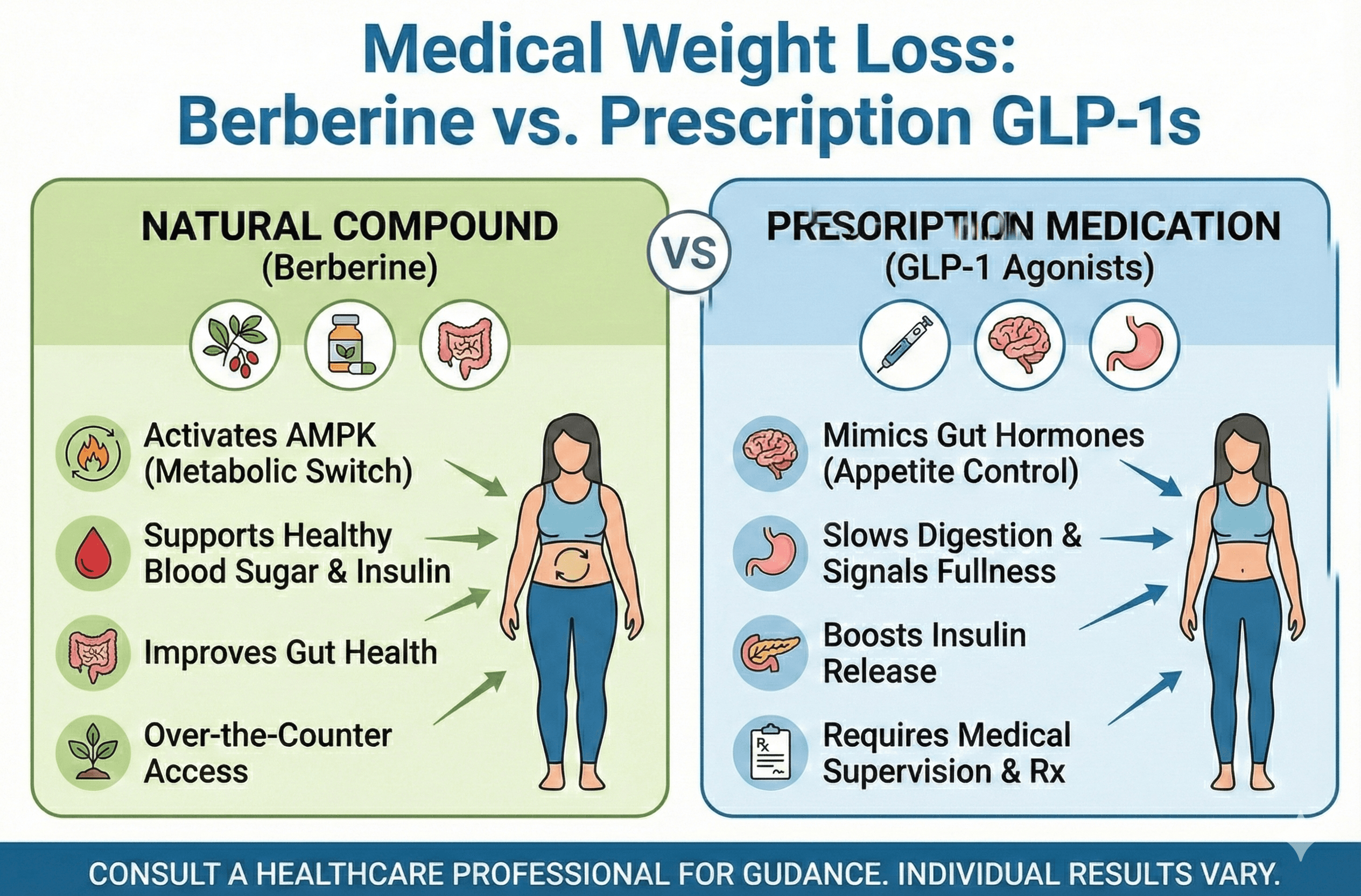
Medical Weight Loss: Berberine vs. Prescription GLP-1s

Should you try berberine or go straight to GLP-1 drugs? Doctors weigh in on one of the most pressing questions in modern weight management.
The explosion of interest in both "nature's Ozempic" (berberine) and actual GLP-1 medications has left patients navigating a highly confusing landscape of treatment options. With social media influencers touting berberine as a cheaper, natural alternative, and physicians increasingly prescribing powerful medications like semaglutide and tirzepatide, the central question remains: which pathway is actually right for your biology?
This evidence-based comparison cuts through the marketing noise to examine the hard science, the financial costs, and the clinical considerations that should guide your weight management decision.
Understanding the Mechanisms: How Each Treatment Works
To make an informed choice, you first need to understand that these two interventions operate through completely different biological pathways.
Berberine's Metabolic Pathways
Berberine is a plant alkaloid extracted from various herbs, including goldenseal and barberry. It operates through multiple, systemic metabolic mechanisms. The compound primarily activates AMP-activated protein kinase (AMPK), an enzyme often referred to as the body's "metabolic master switch."
This activation triggers several downstream health effects:
- Glucose metabolism improvements: Berberine enhances insulin sensitivity at the cellular level, actively reducing insulin resistance—a primary driver of stubborn weight gain and metabolic syndrome. Studies show it can decrease hepatic (liver) glucose production while increasing how efficiently muscle cells pull sugar from the blood.
- Lipid regulation: The supplement modulates lipid metabolism by inhibiting fatty acid synthesis and promoting fat oxidation. Clinical research indicates berberine can reduce LDL ("bad") cholesterol by 20-25% and triglycerides by up to 35% in some populations.
- Gut microbiome modulation: Emerging evidence suggests berberine positively alters gut bacteria composition, potentially increasing beneficial bacterial species that heavily influence weight regulation and systemic inflammation.
The Reality Check: Berberine's weight loss effects are indirect. It does not aggressively suppress your appetite or physically slow down your digestion. It primarily addresses the underlying metabolic dysfunctions (like insulin resistance) that make losing weight difficult in the first place.
GLP-1 Receptor Agonists: Targeted Pharmacology
GLP-1 (glucagon-like peptide-1) medications like semaglutide (Ozempic, Wegovy) and tirzepatide (Mounjaro, Zepbound) work through much more direct, aggressive, and highly targeted mechanisms:
- Appetite suppression: These drugs actively bind to GLP-1 receptors in the brain's appetite centers, significantly and forcefully reducing hunger signals and "food noise." Patients commonly report feeling completely satisfied with much smaller portions.
- Delayed gastric emptying: GLP-1 agonists physically slow the rate at which food leaves your stomach, heavily prolonging satiety and reducing the frequency of hunger between meals.
- Improved insulin secretion: Like berberine, these medications enhance insulin release in response to glucose, but they do so through a different, more potent pathway, by directly stimulating the pancreatic beta cells.
- Reduced glucagon: By suppressing glucagon secretion, GLP-1 drugs prevent the liver from dumping excess glucose into the bloodstream.
The Reality Check: The pharmacological precision of GLP-1 medications produces dramatic, highly predictable weight loss compared to berberine's broader, gentler metabolic effects.
Cost-Benefit Analysis: Weighing Your Options
Efficacy: What the Clinical Data Shows
Berberine Outcomes: Meta-analyses of clinical trials show that berberine produces modest weight loss, averaging 2 to 5 pounds over a 12-week period when strictly combined with lifestyle modifications. One comprehensive review found mean BMI reductions of just 1.5 to 2.0 points over three months. The effects appear most pronounced specifically in patients dealing with metabolic syndrome or clinical prediabetes. (Note: Berberine studies often involve much smaller sample sizes and shorter durations than pharmaceutical trials, limiting perfect direct comparisons).
GLP-1 Medication Results: The data here is incredibly robust and heavily monitored by the U.S. Food and Drug Administration (FDA). Clinical trials demonstrate:
- Semaglutide 2.4mg (Wegovy): Average weight loss of 15-17% of total body weight over 68 weeks.
- Tirzepatide 15mg (Zepbound): Average weight loss of 20-22% of total body weight over 72 weeks.
The Verdict on Efficacy: The magnitude of difference is undeniable. GLP-1 drugs routinely produce 3 to 4 times greater weight loss than berberine in head-to-head efficacy comparisons.
Side Effect Profiles
Both interventions carry risks that must be managed.
Berberine Tolerability & Risks: * The most common side effects are strictly gastrointestinal: diarrhea, constipation, or abdominal cramping (affecting 10-15% of users).
- These are generally mild and transient as the body adjusts.
- Red Flag: Berberine's "natural" status does not guarantee complete safety. It can interact heavily with prescription diabetes medications, blood thinners, and certain antibiotics (particularly those metabolized by CYP3A4 liver enzymes).
GLP-1 Medication Risks: More extensive safety data exists for these drugs due to rigorous, massive FDA trials:
- Nausea (affecting 40-50% of patients initially, though usually decreasing over several weeks).
- Vomiting and diarrhea (affecting 20-30% of users).
- Potential risk of pancreatitis (rare but highly serious).
- Possible thyroid C-cell tumor risk (seen in rodent studies; the human significance is still being heavily monitored).
- Concerns regarding gastroparesis (stomach paralysis) with long-term use.
- Muscle loss (if the patient is not consuming adequate protein and resistance training).
Medical supervision is absolutely mandatory for GLP-1 drugs to monitor for these potentially serious complications.
Financial Considerations
The financial gap between these two options is massive.
Berberine Costs:
- $15 to $40 per month for high-quality, third-party tested supplements.
- Not covered by any health insurance.
- No prescription or doctor's visit required.
- Total annual cost: Roughly $180 to $480.
GLP-1 Medication Expenses:
- List price: $900 to $1,350 per month out-of-pocket.
- With comprehensive insurance coverage (requiring an official obesity diagnosis): $25 to $250 per month copay.
- Without insurance (using manufacturer savings programs): $500 to $700 per month.
- Total annual cost: $300 to $16,000+, heavily depending on your specific insurance coverage.
When to Escalate: A Clinical Decision Framework
The choice between a supplement and a prescription isn't a simple binary, it should be a staged approach based entirely on your individual medical circumstances.
Berberine May Be Appropriate When:
- Your BMI is 25-30 (categorized as overweight, but not obese).
- You have prediabetes or markers of metabolic syndrome, and you desire to address cholesterol and blood sugar alongside very modest weight goals.
- You prefer conservative interventions before escalating to pharmaceuticals.
- You have limited financial resources or your insurance explicitly denies GLP-1 coverage.
- Your expectations are realistic. You understand that a 3 to 5-pound weight loss over 3 to 6 months is the typical outcome, not a dramatic 30-pound transformation. Berberine works best as a metabolic adjunct to strict diet and exercise, not a replacement for them.
GLP-1 Medications Should Be Considered When:
- Your clinical situation demands it: You have a BMI ≥30, or a BMI ≥27 accompanied by weight-related comorbidities (like type 2 diabetes, severe hypertension, sleep apnea, or fatty liver disease).
- You have a history of unsuccessful attempts at lifestyle modification alone.
- You face significant health risks from continued, severe obesity.
- You have access to ongoing medical supervision and the financial means (or insurance) to sustain the treatment.
- You are prepared for a long-term commitment. Current medical evidence strongly suggests that weight regain is highly likely after stopping GLP-1 drugs, meaning patients must consider this a potentially indefinite, chronic treatment.
The Hybrid Approach
Some progressive clinicians advocate for a structured, staged escalation:
Stage 1 (3-6 months): Intensive, coached lifestyle modification combined with berberine for baseline metabolic support.
Stage 2 (If insufficient progress): Transition to a prescription GLP-1 medication while rigorously maintaining the lifestyle changes established in Stage 1.
Stage 3 (Maintenance): A long-term strategy involving the gradual tapering of medication dosages, the possible re-introduction of berberine for continued metabolic benefits, and sustained behavioral modifications.
This hybrid approach respects a patient's preference for trying conservative options first, while establishing clear, data-driven criteria for medical escalation based on measurable outcomes.
Red Flags: When Neither Is Appropriate
Certain situations require entirely different medical interventions:
- A BMI >40 with multiple severe comorbidities may warrant an immediate bariatric surgery evaluation.
- Underlying, active eating disorders require dedicated psychological treatment before focusing on weight loss.
- Medication-induced weight gain (e.g., from certain antidepressants) may require a prescription adjustment from your psychiatrist rather than adding weight loss drugs.
- Pregnancy, or planned pregnancy, strictly contraindicates the use of both berberine and GLP-1 medications.
Maryland Trim Clinic (MTC) in Laurel, MD
Deciding between natural supplements and prescription medications is a complex medical choice that shouldn't be made based on internet trends. You need a comprehensive evaluation of your metabolic health to determine the safest, most effective path forward. At Maryland Trim Clinic (MTC) in Laurel, MD, we specialize in cutting through the confusion to provide personalized, physician-led weight management.
Whether you are a candidate for GLP-1 weight loss injections to aggressively treat obesity, or you need a structured medical weight loss program to guide your nutrition and lifestyle changes, our clinic is equipped to support your journey. We utilize advanced metabolic testing and analysis to understand exactly how your unique body processes energy, allowing us to recommend the right intervention at the right time. If you are ready to stop guessing and start a scientifically sound weight loss journey, visit the Maryland Trim Clinic online to learn how our medical experts can help you achieve sustainable results.
The Personalized Decision
The berberine versus prescription debate ultimately depends entirely on your individual health status, your metabolic goals, your financial resources, and your personal values.
The clinical evidence clearly demonstrates that GLP-1 medications produce vastly superior weight loss outcomes. However, "superior efficacy" does not automatically mean it is the "right choice" for your specific body or situation.
Consider these final decision points:
- If your priority is maximizing total weight loss: GLP-1 medications are unmatched in current pharmacological options.
- If you are seeking metabolic improvement with modest weight reduction: Berberine offers a reasonable, low-cost intervention.
- If you are averse to injections or intensive medical oversight: Berberine's over-the-counter accessibility may align better with your preferences—though this preference should never override sheer medical necessity if your health is failing.
The most important factor is securing a proper physician consultation. A qualified obesity medicine specialist can assess your complete health picture, carefully review your laboratory markers, discuss dangerous medication interactions, and create a truly personalized treatment plan. Self-directed supplement use, or pursuing prescription medications through shady telemedicine platforms without comprehensive evaluation, carries immense risks.
Whether you start with berberine's gentle metabolic nudge or pursue a GLP-1 medication's powerful appetite suppression, lifelong success requires treating weight management as a chronic condition that requires ongoing, daily intervention—not a short-term fix.
Disclaimer: The information provided in this article is for educational purposes only and is not intended as a substitute for professional medical advice, diagnosis, or treatment. Always seek the advice of your physician or other qualified health provider before starting any new supplement or medication, especially if you have pre-existing health conditions.
Frequently Asked Questions
Q: Can I safely take berberine and GLP-1 medications together? A: There are no widely known direct drug interactions between berberine and GLP-1 agonists, and some specialized physicians do prescribe them together (berberine for insulin support and GLP-1s for appetite control). However, because both substances actively lower blood sugar, combining them requires strict medical supervision and frequent glucose monitoring to prevent dangerous hypoglycemia (low blood sugar). Always consult your prescribing physician before combining any over-the-counter supplements with your prescription medications.
Q: How long does it take to see results with berberine versus GLP-1 drugs? A: Berberine typically shows very modest effects on weight and metabolic markers within 8 to 12 weeks of highly consistent use at therapeutic doses (usually 1500mg daily, divided into three doses). GLP-1 medications work vastly faster—many patients notice profound appetite reduction within days of their first injection, and measurable weight loss within 4 to 8 weeks, with peak weight loss effects occurring at 6 to 12 months of treatment.
Q: Will I regain the weight after stopping berberine or GLP-1 medications? A: Weight regain patterns differ substantially. Stopping berberine typically results in a gradual return of your metabolic markers to their baseline, with modest weight regain occurring if your healthy lifestyle changes aren't maintained. GLP-1 medication cessation, however, often leads to rapid and significant weight regain. Clinical studies show patients often regain approximately two-thirds of their lost weight within one year of stopping the injections. This biological reality suggests that GLP-1 drugs may require long-term or indefinite use for sustained benefits.
Q: Are compounded GLP-1 medications a safe alternative to expensive brand-name prescriptions? A: Compounded semaglutide and tirzepatide have proliferated rapidly due to brand-name shortages and high retail costs, but they carry substantial additional risks. The FDA has issued severe warnings about compounded versions, explicitly noting they have not undergone the same safety, purity, and efficacy testing as FDA-approved, brand-name medications. Quality control varies wildly among compounding pharmacies. If you are considering compounded GLP-1 drugs, you must ensure you are using an FDA-registered 503B or 503A facility, verify your physician's direct oversight, and understand you are accepting greater uncertainty regarding the drug's purity.
Q: What specific blood tests should I get before starting berberine or GLP-1 medications? A: * For berberine: Baseline testing should absolutely include fasting glucose, HbA1c, a comprehensive lipid panel, and liver function tests, as berberine directly affects all these markers.
- For GLP-1 medications: A much more comprehensive medical evaluation is standard. This includes fasting glucose, HbA1c, a comprehensive metabolic panel (CMP), a lipid panel, thyroid function tests, and sometimes lipase to establish a baseline for your pancreatic function. Patients with a personal or family history of thyroid issues may need additional screening. Your physician will determine the exact testing protocol based on your unique medical history.
Ready to Find the Right Weight Loss Solution for Your Body?
Stop guessing whether supplements or prescriptions are right for you. Schedule a consultation with the medical weight loss experts at Maryland Trim Clinic today. Let us review your metabolic health, discuss your options safely, and build a personalized plan that delivers sustainable results.