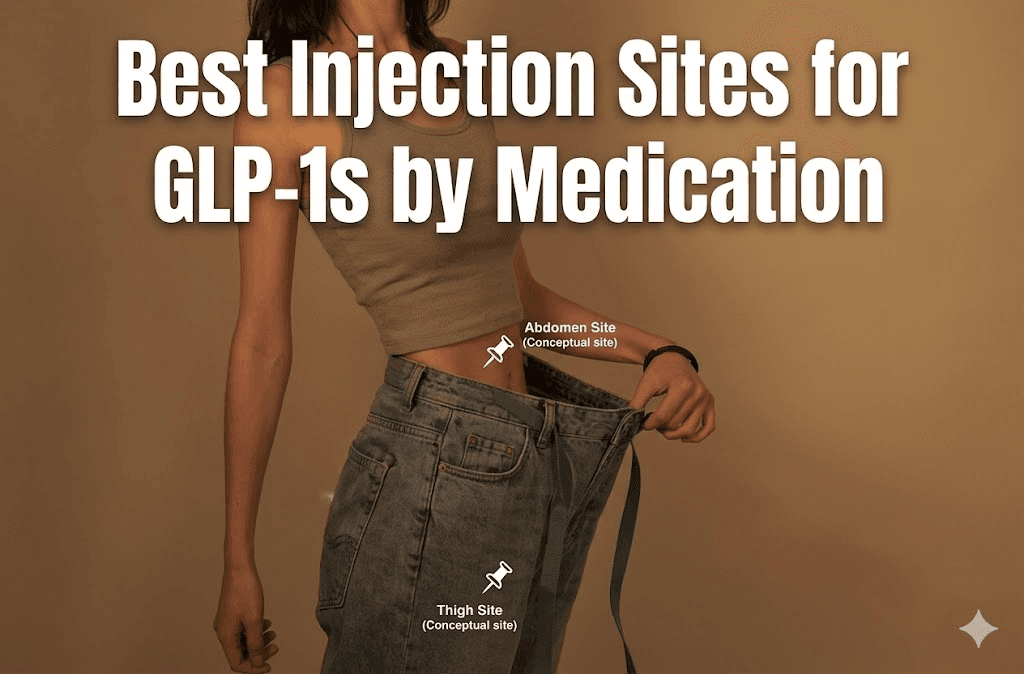
Best GLP-1 Injection Sites: Ozempic, Mounjaro & More

The stomach vs. thigh debate is everywhere — but the right answer actually depends on which GLP-1 medication you're taking.
If you're currently utilizing GLP-1 weight loss injections like Ozempic, Wegovy, Mounjaro, or Zepbound, and you've been injecting based on general advice found on social media, there's a real chance you might not be optimizing your medication's absorption. Injection site selection isn't just a matter of comfort. It directly influences how quickly your medication is absorbed into the subcutaneous fat, how consistently it reaches therapeutic levels in your bloodstream, and whether you develop underlying scar tissue that could blunt the drug's effectiveness over time.
This guide breaks down the nuances by medication, so you know exactly where to inject, why it matters, and how to rotate your sites correctly for long-term safety and success.
ACT 1: Semaglutide (Ozempic & Wegovy) — Why the Abdomen Wins
Semaglutide is a once-weekly GLP-1 receptor agonist. Because it only enters your system once every seven days, the absorption rate at the injection site has an outsized effect on your overall weekly drug exposure. A slower or incomplete absorption event doesn't just mean a slightly lower peak — it means your entire week of appetite suppression and blood sugar regulation could run below optimal levels.
What the Research Shows
Clinical pharmacokinetic observations for semaglutide consistently indicate that abdominal injections produce the most reliable and complete absorption compared to other sites. According to medical guidelines on subcutaneous administration detailed by the National Center for Biotechnology Information (NCBI), the subcutaneous fat layer in the abdomen is highly vascularized, allowing molecular structures like semaglutide to move efficiently into systemic circulation.
The thigh is the second most commonly recommended site. It is perfectly safe and effective, but absorption tends to be slightly slower due to differences in subcutaneous tissue density and blood flow patterns in the upper leg. The upper arm (posterior tricep area) is the third approved site, but it generally shows the most variability, particularly in individuals with lower body fat percentages.
Practical Guidance for Semaglutide Users
To ensure you are administering your medication correctly, follow this site-selection hierarchy:
- Primary site: The abdomen. Stay at least 2 inches away from the navel. Avoid the navel itself, the belt line, and any visible veins, stretch marks, or scar tissue.
- Secondary site: The front or outer thigh, positioned midway between the knee and the hip.
- Tertiary site: The back of the upper arm. This is best utilized when a caregiver or partner is administering the injection for you, as it can be difficult to pinch the skin and inject simultaneously on your own arm.
- Injection angle: Aim for a 90-degree angle for most adults with adequate subcutaneous tissue. A 45-degree angle may be more appropriate for very lean individuals to avoid hitting muscle.
- Needle depth awareness: Semaglutide pens come pre-set, but ensure you're gently pinching the skin to isolate the subcutaneous fat away from the underlying muscle.
The Wegovy vs. Ozempic Distinction
Both drugs utilize the active ingredient semaglutide, but their dosing schedules differ significantly. Wegovy titrates up to 2.4 mg weekly, while Ozempic is approved for up to 2.0 mg.
At higher doses, absorption consistency becomes critical. Because the satiety-signaling mechanism is highly dose-dependent at the upper end of the titration schedule, Wegovy users should especially prioritize the abdomen as their default site to ensure they are getting the full benefit of their prescribed dose.
ACT 2: Tirzepatide (Mounjaro & Zepbound) — More Flexibility, Same Discipline
Tirzepatide is a dual GIP/GLP-1 receptor agonist, making it pharmacologically distinct from semaglutide. Its dual-action mechanism operates on two separate receptor pathways simultaneously, which has practical implications for how injection site selection impacts your results.
Why Tirzepatide Tolerates More Site Variability
Because tirzepatide activates both GIP and GLP-1 receptors, its therapeutic effect is quite robust, even if absorption varies slightly between injection sites. Clinical trial data from the SURMOUNT and SURPASS programs did not show dramatic differences in efficacy between abdominal, thigh, and upper arm injections for the majority of participants.
However, "more flexibility" does not mean "it doesn't matter." Absorption still varies slightly by site, and at higher dose tiers (10 mg, 12.5 mg, and 15 mg), you want to ensure the medication is being absorbed efficiently.
Optimal Sites for Tirzepatide Users: A Quick Guide
- If you are in early dose titration (2.5 mg or 5 mg) → Try the Abdomen. It remains the most consistent performer while your body calibrates to the medication. Keep the 2-inch distance from the navel.
- If you experience injection site irritation on your stomach → Try the Thigh. The outer thigh is fully viable and often preferred by users who find the tirzepatide formulation causes minor skin sensitivity on the abdomen.
- If you have someone to assist you → Try the Upper Arm. The arm is more usable for tirzepatide than semaglutide, though self-injecting requires stabilizing your arm against a wall or firm surface to ensure a proper angle.
Mounjaro vs. Zepbound: Does the Label Change Anything?
Mounjaro and Zepbound contain the exact same active ingredient—tirzepatide—at the exact same dosages. The only difference is the FDA-approved indication (type 2 diabetes versus chronic weight management). Therefore, injection site guidance is identical for both. If your provider switches your prescription from one to the other, your injection protocol does not need to change.
ACT 3: The Rotation Strategy — Protecting Your Sites for the Long Haul
Getting the right site is step one. Rotating correctly is the crucial habit that keeps that tissue healthy and functional for months or years of ongoing therapy.
What Is Lipohypertrophy and Why Should You Care?
Lipohypertrophy is the development of fatty, fibrous lumps under the skin caused by repeated injections into the same small area. You may have felt these—small, slightly firm bumps that usually don't hurt to touch.
While they may feel harmless, they severely disrupt your treatment. Medication injected into lipohypertrophic tissue is absorbed erratically and incompletely. Users who unknowingly inject into these fibrous areas frequently report unexplained weight loss plateaus, inconsistent appetite suppression, and variable side effects week to week. Fortunately, lipohypertrophy is highly preventable.
The Zone-Based Rotation System
Instead of randomly picking a spot each week, think in organized "zones." Each approved body region contains multiple micro-zones that you can cycle through systematically.
- Abdomen Zones: Imagine four quadrants around your navel (upper left, upper right, lower left, lower right). Each quadrant contains several viable injection points spaced at least one inch apart.
- Thigh Zones: Each thigh is its own zone. Alternate between the left and right thigh, moving slightly up, down, left, or right within the safe outer-thigh area to ensure you aren't hitting the exact same tissue.
- Upper Arm Zones: Alternate between the left arm one week and the right arm the next, staying strictly in the soft, fatty tissue behind the bone.
A Weekly Rotation Example for Abdomen/Thigh Users
To give tissue enough time to heal, avoid injecting into the exact same point for at least four to six weeks. Here is a simple rotation schedule:
Week 1: Abdomen, upper right quadrant
Week 2: Abdomen, upper left quadrant
Week 3: Abdomen, lower right quadrant
Week 4: Abdomen, lower left quadrant
Week 5: Right outer thigh
Week 6: Left outer thigh
Week 7: Return to Abdomen, upper right quadrant (but space it an inch away from Week 1's exact spot)
Additional Site Care Tips for Better Injections
- Let it warm up: Cold medication increases site discomfort and may slightly slow absorption. Let your pen sit at room temperature for 15–30 minutes before injecting.
- Let the alcohol dry: Follow the Centers for Disease Control and Prevention (CDC) injection safety guidelines: always clean the site with an alcohol swab, but let the skin air dry completely before injecting. Wet alcohol pushed into the skin causes stinging.
- Do not rub the site: After injecting, apply light pressure with a dry cotton pad or tissue if needed, but do not massage or rub the area. Rubbing can accelerate the medication's dispersion in unpredictable ways.
- Monitor your skin: Periodically run your fingers over your injection zones. If you feel any firm, raised areas, retire that spot from your rotation for at least two to three months to let it heal.
Maryland Trim Clinic (MTC) in Laurel, MD
Managing a weight loss medication involves much more than just picking a spot on your abdomen. For the medication to work optimally, you need comprehensive oversight of your body's metabolic response. Located in Laurel, MD, the Maryland Trim Clinic (MTC) provides a supportive, medically supervised environment for patients navigating these highly effective treatments.
When you enroll in a medical weight loss program at MTC, the focus shifts from simply taking a weekly shot to holistically improving your health. Our clinical team helps you manage side effects, provides clear guidance on injection protocols to ensure you are maximizing absorption, and tracks your progress safely. By combining prescribed medications with lifestyle guidance, we ensure that your weight management journey is as comfortable, effective, and sustainable as possible.
The Bottom Line
For semaglutide users on Ozempic or Wegovy, the abdomen is your primary site — prioritize it, especially at higher doses to ensure consistent satiety signaling. For tirzepatide users on Mounjaro or Zepbound, you have slightly more flexibility between the stomach and thigh, but the abdomen generally delivers the most consistent results during early dose escalations.
For everyone, a strict site rotation strategy isn't optional; it's the required mechanism that keeps your subcutaneous tissue healthy and ensures your expensive, carefully calibrated medication can actually do its job.
Medical Disclaimer: The information provided in this article is for educational purposes only and is not intended as a substitute for professional medical advice, diagnosis, or treatment. Always seek the advice of your physician or other qualified healthcare provider regarding your specific medical condition, injection techniques, or before altering your prescribed treatment plan.
Frequently Asked Questions
Q: Does it matter which site I inject Ozempic into? A: Yes, it matters significantly. Semaglutide (Ozempic) shows the fastest and most complete absorption when injected into the abdomen. Since it is a once-weekly injection, any reduction in absorption efficiency affects your medication levels for the entire week. The abdomen is the recommended primary site, with the thigh and upper arm acting as acceptable secondary options.
Q: Can I inject Mounjaro in my thigh instead of my stomach? A: Yes. Tirzepatide (Mounjaro/Zepbound) has more site flexibility than semaglutide. The outer thigh is a fully approved and viable injection site, and many users prefer it to avoid stomach irritation. The abdomen is still considered the most consistent option during early titration phases, but the thigh performs very well across the full dose range.
Q: What is lipohypertrophy and how do I know if I have it? A: Lipohypertrophy is the formation of fatty, fibrous lumps under the skin resulting from repeated injections in the same location. You can detect it by gently pressing on your injection zones—if you feel small, firm, rubbery bumps under the skin, that is likely lipohypertrophy. Prevent it by rotating injection sites systematically and never revisiting the exact same spot within four to six weeks.
Q: Should I inject Wegovy in a different spot than Ozempic since the dose is higher? A: Both utilize semaglutide and follow the same site guidance. However, because Wegovy reaches higher doses (up to 2.4 mg), absorption consistency becomes even more critical for managing appetite. Prioritizing the abdomen and rotating meticulously is especially important for Wegovy users.
Q: How long should I wait before injecting in the same spot again? A: You should wait at least four to six weeks before returning to the exact same injection point. Using a zone-based rotation system makes it easy to space out revisits, giving the tissue sufficient time to heal and preventing fibrous buildup.
Q: Does injecting into muscle instead of fat affect GLP-1 medication? A: Yes. GLP-1 medications are formulated strictly for subcutaneous (under-the-skin fat layer) injection. Injecting into muscle alters the absorption rate and can increase pain and bruising. To ensure you hit subcutaneous tissue, lightly pinch a fold of skin before injecting and use the correct angle (usually 90 degrees).
Q: Why does my GLP-1 medication seem less effective some weeks than others? A: Inconsistent weekly results are frequently tied to injection site issues—specifically, injecting into areas with lipohypertrophy, failing to rotate sites properly, or utilizing a less absorptive site. Standardizing your rotation schedule and injection technique can significantly reduce week-to-week variability in how you feel.
Ready to Optimize Your Weight Loss Journey?
Navigating GLP-1 medications, injection sites, and side effects can be overwhelming to manage alone. Visit the Maryland Trim Clinic homepage today to schedule a consultation, and let our dedicated team help you build a safe, personalized, and effective medical weight loss plan.