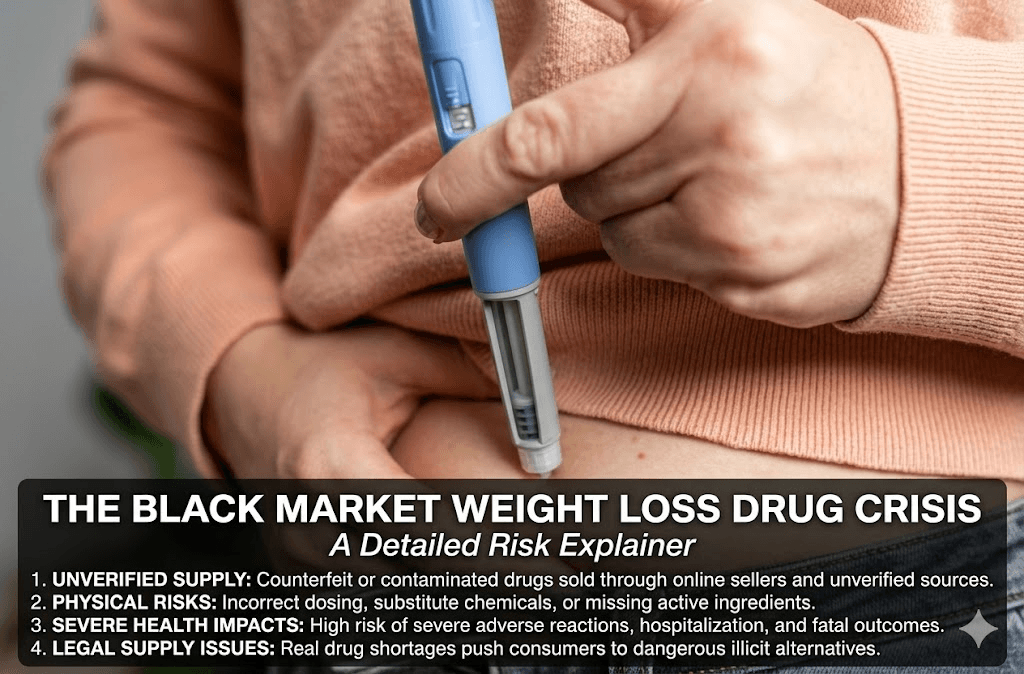
The Black Market Weight Loss Drug Crisis: What You Need to Know

The real reason people are buying fake Ozempic — and who's profiting from it.
When a drug works well enough to change the cultural conversation around obesity, diabetes, and metabolic health, you can almost predict what happens next. Demand explodes. Supply strains. Prices climb. And somewhere in the gap between what a life-changing medication costs and what ordinary people can actually afford, a shadow market takes root.
That is precisely where we find ourselves today with GLP-1 receptor agonists — the class of medications that includes semaglutide (brand names Ozempic and Wegovy) and tirzepatide (Mounjaro, Zepbound). The black market for counterfeit versions of these drugs is not a fringe phenomenon. It is a direct, measurable consequence of an affordability crisis that the healthcare system has so far failed to solve.
The Price Gap That Created a Black Market
To understand why people are turning to unregulated, potentially dangerous counterfeit drugs, you have to start with the numbers. In the United States, a monthly supply of Wegovy — the FDA-approved semaglutide formulation specifically indicated for weight loss — carries a list price of approximately $1,350 per month, or more than $16,000 per year. Ozempic, its diabetes-indicated sibling, runs around **$900 to $1,000 monthly** at list price. Eli Lilly's tirzepatide products sit in a similar range.
For the uninsured or underinsured patient, these are not medications — they are aspirational purchases.
Insurance coverage makes a critical difference, but it is inconsistently available:
- Medicare Restrictions: Until very recently, Medicare was legally prohibited from covering weight-loss drugs under most circumstances.
- Private Insurance Hurdles: Many private insurers categorize obesity treatment as an "elective" condition. They either exclude GLP-1s for weight loss entirely or impose such stringent prior authorization requirements that approval becomes a months-long bureaucratic ordeal.
- Employer Plan Limitations: Employer-sponsored health plans are increasingly dropping or limiting coverage due to the aggregate cost burden on their formularies.
The result is a large and growing population of people who have watched these medications transform the health trajectories of others — who have seen the clinical evidence, the before-and-after stories, the dramatic HbA1c improvements — and who simply cannot access them through legitimate channels.
This is the fertile ground in which the counterfeit market grows. When someone has tried every diet, carries real metabolic risk, and watches a medication that genuinely works remain financially out of reach, the psychological calculus shifts. A vial sold online for $100, shipped from overseas, with a label that says "semaglutide" starts to feel like a reasonable gamble.
Sellers in these markets are sophisticated enough to exploit that desperation. They operate through encrypted messaging apps, social media communities, overseas pharmacy websites, and even personal trainer networks. They understand their customer: someone motivated, frustrated, and willing to accept risks they would otherwise avoid.
What Authorities Are Finding — And What's Really in the Vials
The U.S. Food and Drug Administration (FDA), Interpol, and national law enforcement agencies in Europe, Latin America, and Asia have all issued urgent warnings and conducted seizures related to counterfeit GLP-1 products. What investigators are finding is alarming on multiple levels.
Contamination and Incorrect Dosing These are the most immediate dangers. In late 2023 and throughout 2024, the FDA issued multiple alerts about counterfeit semaglutide products seized within the U.S. supply chain. Laboratory analysis of seized products revealed critical, life-threatening problems:
- "Dummy" Vials: Some vials contained little to no active semaglutide at all, making them effectively placebos with a dangerous price tag.
- Severe Over-Concentration: Others contained the correct active ingredient but at wildly incorrect concentrations — sometimes ten times the intended dose. Semaglutide at excessive doses can cause severe gastrointestinal injury, pancreatitis, dangerous drops in blood sugar, and acute kidney injury from dehydration caused by persistent vomiting.
Unidentified Foreign Substances Beyond dosing errors, investigators have found dangerous adulterants in counterfeit vials. This includes insulin, which is particularly lethal because it can cause fatal hypoglycemia in non-diabetic users who have no idea they are injecting it. Some products have also shown bacterial contamination consistent with non-sterile manufacturing environments, raising the risk of serious injection-site infections and systemic sepsis.
Who is Profiting? The counterfeit GLP-1 market is not primarily the domain of small-time opportunists. Investigators have traced sophisticated manufacturing and distribution operations to organized networks operating out of China, Eastern Europe, and parts of Southeast Asia. These operations invest in highly convincing packaging — holographic seals, lot number formats that mimic legitimate pharmaceutical labeling, and even QR codes that link to fake verification pages.
The profit margins are extraordinary. A vial that costs pennies to produce in an unregulated facility can be sold for $80 to $200 to a buyer who believes they are getting a pharmaceutical-grade product.
The Role of Social Media Platforms like TikTok, Instagram, and Telegram host communities where buyers share sourcing tips, "reviews" of vendors, and dosing protocols. The language used in these communities often mimics harm reduction — people advise each other on what to watch for, how to test products, and how to titrate slowly. This creates an illusion of managed risk around what is fundamentally an unmanaged and dangerous supply chain.
Safety Checklist: Spotting Red Flags
- If you see: Semaglutide sold in a vial with separate syringes.
- Avoid: Purchasing or using the product. Authentic, FDA-approved brand-name Ozempic or Wegovy comes only in pre-filled auto-injector pens.
- If you see: Websites offering prescription medications without requiring a consultation or a valid prescription.
- Avoid: Giving them your personal or financial information. Legitimate pharmacies always require a prescription from a licensed healthcare provider.
- If you feel: Overwhelmed by the high cost of legitimate medications.
- Try: Discussing Patient Assistance Programs or FDA-regulated alternatives with a licensed medical professional instead of turning to unverified online vendors.
Safer Paths — What Actually Exists for Cost-Conscious Patients
The counterfeit crisis is a symptom of a structural failure, but that does not mean patients are entirely without options. Several legitimate pathways to affordable or reduced-cost GLP-1 access exist, and understanding them is essential for prioritizing your safety.
According to the National Institutes of Health (NIH), GLP-1 receptor agonists are highly effective at mimicking endogenous hormones to regulate glucose and appetite, but because of their potent effects on the body's endocrine system, they must be prescribed and monitored carefully by licensed professionals.
Manufacturer Patient Assistance Programs (PAPs) This is the most direct route for qualifying patients. Novo Nordisk operates a Patient Assistance Program that can provide free or deeply discounted medication to uninsured or underinsured patients who meet specific income thresholds. Eli Lilly operates a similar program for its tirzepatide products. While these programs require documentation and a prescriber's involvement, they represent access to genuine, FDA-approved medication at little or no cost. Additionally, savings cards can reduce out-of-pocket costs to as little as $25 per month for eligible commercially insured patients (though they are not available to Medicare or Medicaid enrollees).
FDA-Authorized Compounding Pharmacies During periods when semaglutide and tirzepatide were officially listed on the FDA's drug shortage list, state-licensed compounding pharmacies and 503B outsourcing facilities were legally permitted to prepare compounded versions of these medications. These were typically available at lower prices (often $150 to $300 per month).
- Important Note: As manufacturers resolve supply constraints, the legal window for compounded GLP-1 products is narrowing. The key distinction between compounded products from legitimate pharmacies and black market products is the prescription requirement and state pharmacy board oversight. Legitimate compounders require a valid prescription and are heavily regulated for sterility and safety.
Biosimilar Development This represents a promising medium-term structural solution. While semaglutide's core patents are complex, the biosimilar pipeline is active. Analysts project that generic competition could bring prices down substantially within the next three to five years, potentially mirroring the much lower costs seen in other developed nations.
Advocacy and Policy Levers The Inflation Reduction Act's drug price negotiation provisions, the ongoing push to expand Medicare coverage for anti-obesity medications, and state-level Medicaid coverage expansions all represent meaningful policy pathways to making these drugs accessible.
Maryland Trim Clinic (MTC) in Laurel, MD
For individuals looking for legitimate, medically supervised weight management options without navigating the dangers of the black market, localized clinics provide a safe, supportive alternative. The Maryland Trim Clinic (MTC) located in Laurel, MD, focuses on evidence-based strategies tailored to your metabolic health and lifestyle.
Working with a dedicated provider means you are never left guessing about the safety, dosing, or origin of your treatment. MTC offers comprehensive evaluations through a structured medical weight loss program, ensuring that any prescribed treatments are appropriate for your unique health profile. For those who are clinical candidates, the clinic provides legitimate, pharmacy-sourced GLP-1 weight loss injections administered under strict medical supervision. Having a trusted, local partner like the Maryland Trim Clinic eliminates the intense risks associated with unverified online vendors and ensures your long-term health remains the top priority.
The Bottom Line
The black market for counterfeit GLP-1 drugs is not a story about irresponsible consumers making foolish choices. It is a story about what happens when a healthcare system prices life-improving medication beyond the reach of the people who need it most, and then is surprised when those people find other ways to get it.
The danger is very real — contaminated products, insulin adulterants, and wildly miscalibrated doses have already sent patients to emergency rooms. But the solution is not simply law enforcement. Enforcement without affordability reform is a holding action that leaves the underlying desperation fully intact.
For public health advocates, the immediate priority is ensuring that patients know legitimate low-cost pathways exist before they turn to unregulated sources. For policymakers, the data is unambiguous: the black market expands in direct proportion to the affordability gap. Closing that gap is not just a cost question. It is a patient safety emergency.
Disclaimer: The information in this article is for educational purposes only and should not replace professional medical advice. Always consult a licensed healthcare provider before starting any weight loss program or taking new medications. Never use prescription medications obtained without a prescription from an unregulated source.
FAQs
1. Why are GLP-1 drugs like Ozempic so expensive in the United States? GLP-1 drugs are expensive in the U.S. primarily because of how the American pharmaceutical pricing system works. Manufacturers set list prices without direct government negotiation, patent protections limit generic or biosimilar competition, and pharmacy benefit manager contracts add layers of cost. Until biosimilar competition enters the market, structural reform or patient assistance programs remain the main tools for reducing out-of-pocket costs.
2. How can I tell if a semaglutide product I purchased is counterfeit? The FDA has provided clear guidance: legitimate semaglutide products approved for use in the U.S. come in pre-filled auto-injector pens or pen devices — not in vials with separate syringes. Any injectable semaglutide sold in a vial format outside of a licensed, prescription-requiring pharmacy should be considered a major red flag.
3. Is compounded semaglutide the same as black market semaglutide? No — these are fundamentally different. Compounded semaglutide from an FDA-registered 503B outsourcing facility or a state-licensed compounding pharmacy requires a valid prescription, is subject to regulatory oversight, and must meet quality and sterility standards. Black market semaglutide is produced in unregulated environments with no oversight or safety checks.
4. What patient assistance programs exist for Ozempic and Wegovy? Novo Nordisk operates a Patient Assistance Program that provides free medication to qualifying uninsured or underinsured patients based on income criteria. For commercially insured patients, they offer savings cards that can significantly reduce monthly costs. Eli Lilly provides similar assistance programs for Mounjaro and Zepbound.
5. What are the real medical risks of using counterfeit GLP-1 drugs? The risks are severe and heavily documented. Counterfeit products have been found to contain no active ingredient (acting as placebos), overdose-level concentrations of semaglutide (causing pancreatitis and kidney injury), insulin as an adulterant (causing life-threatening hypoglycemia), and bacterial contamination (causing systemic sepsis).
6. Will GLP-1 drugs become more affordable in the future? The outlook is cautiously optimistic over a three-to-five year horizon. Biosimilar versions of semaglutide are in development, and market competition historically drives significant price reductions. Legislative efforts aim to expand Medicare coverage for anti-obesity medications, which could eventually prompt broader insurance coverage nationwide.
Take Control of Your Health Safely
Ready to explore medically sound, supervised weight management options without the risk? Don't gamble your health on unverified medications. Reach out to a qualified healthcare provider today to discuss a personalized, legitimate care plan that fits your metabolic needs, your goals, and your budget.