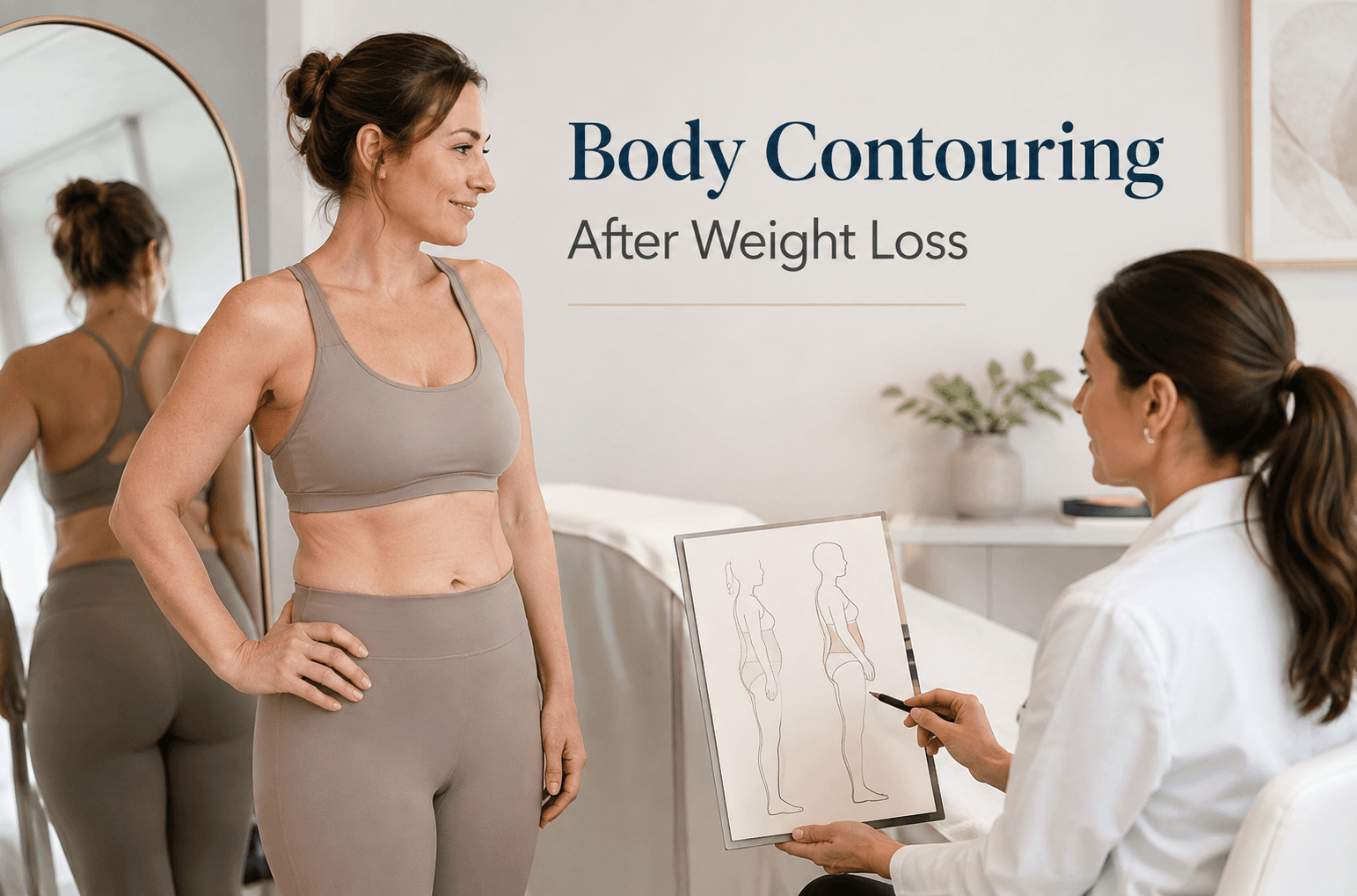
Body Contouring After Weight Loss: Timing Guide


Losing weight can change your health, confidence, clothing fit, and daily comfort. But after the scale moves, some people notice a different concern: loose skin, uneven contours, stubborn fat pockets, or areas that no longer match the progress they have made.
That is where body contouring after weight loss comes into the conversation. The right timing matters. If you move too early, continued weight loss may change the result. If you wait too long without a plan, frustration can grow. The goal is to understand whether your concern is loose skin, remaining fat, reduced muscle tone, or a combination, then decide whether medical weight-loss support, non-invasive body contouring, skin tightening, or surgical consultation is the better next step.
Body Contouring After Weight Loss: The Quick Answer
Body contouring after weight loss is usually best considered when your weight is close to stable, your nutrition and health are in a good place, and your main concern is shape refinement rather than major weight loss. Non-invasive treatments may help mild laxity or stubborn fat, while significant loose skin may require surgical consultation.
Medical Disclaimer: Educational information only. Results and suitability vary. A clinician should review your history, contraindications, and goals before recommending any medical/aesthetic treatment or prescription.
First, Know Which “Body Contouring” You Mean
Body contouring can mean different things depending on the clinic, technology, and patient goal.
The FDA explains that non-invasive body contouring refers to procedures performed on the skin surface without incisions. These treatments do not remove tissue from the body and are different from surgery such as tummy tuck surgery, which removes excess skin, or liposuction, which removes fat through a small incision. The FDA also states that non-invasive body contouring does not treat obesity, does not improve health, and does not result in weight loss.
Surgical body contouring is different. The American Society of Plastic Surgeons describes surgical body contouring after major weight loss as a way to remove excess sagging skin and fat while improving the shape of the underlying support tissue.
That distinction matters because Maryland Trim Clinic offers non-invasive body contouring, 3D body scanning, medical weight loss, GLP-1 support when appropriate, nutrition coaching, metabolic testing, and weight maintenance services. MTC’s services page describes non-invasive body contouring as outpatient body-shaping care that may use cryolipolysis, HIFEM, laser lipolysis, and radiofrequency for targeted fat reduction, muscle definition, and skin tightening.
In simple terms:
Concern
Better starting point
Still actively losing weight
Medical weight loss, nutrition support, maintenance planning
Small stubborn fat pocket
Non-invasive body contouring evaluation
Mild skin laxity
Skin-tightening or contouring consultation
Major loose hanging skin
Plastic surgery consultation may be more appropriate
Unsure what changed
3D body scanning, measurements, and clinical evaluation
When Body Contouring May Make Sense
Body contouring may be worth discussing when your weight-loss phase has slowed, your weight is more predictable, and your concern is no longer “I need to lose a lot more weight” but “I want to refine this area.”
Good timing may include:
- Your weight has been stable or nearly stable for a few months.
- You are close to your realistic goal range.
- You have stubborn fat in a specific area.
- You have mild skin laxity that may respond to non-invasive tightening.
- You understand that results vary and may be gradual.
- You can maintain nutrition, hydration, protein, and activity.
- You do not expect body contouring to replace weight loss.
- You are ready to discuss safety, contraindications, and realistic limits.
Mayo Clinic notes that after weight loss, skin may not shrink along with the body, creating loose folds. It also states that weight usually needs to be stable for at least three months before certain body-shaping surgery, and that a clinician may advise against surgery if a person plans to lose a lot of weight, smokes, has serious conditions such as heart disease or diabetes, or has an unstable mental health condition.
For non-invasive contouring, the timing may be more flexible than surgery, but the principle is similar: the more stable your weight and habits are, the easier it is to judge whether contouring is likely to fit your goal.
When Not to Do Body Contouring Yet
Sometimes the most helpful answer is “not yet.”
You may need to delay body contouring if:
- You are still losing weight quickly.
- You are far from your target range.
- Your weight is fluctuating significantly.
- You are not eating enough protein or calories to support recovery and maintenance.
- You have unmanaged medical conditions.
- You have active skin infection, rash, or wound issues in the treatment area.
- You expect body contouring to produce major weight loss.
- You have significant loose skin that non-invasive treatment is unlikely to correct.
- You are not ready to maintain results with nutrition and activity.
- You have not discussed medication, implants, scars, skin conditions, or contraindications with a provider.
The FDA advises patients considering non-invasive body contouring to discuss personal risk factors, device limitations, likely effects, and risks with a healthcare provider. It also lists factors a provider should know about, including blood thinners, immune suppression, clotting or bleeding disorders, uncontrolled diabetes, active skin infection, autoimmune skin conditions, keloids, tattoos, scars, implants, prior surgery in the treatment area, and certain medications.
If the issue is heavy, hanging, or folded skin after major weight loss, a non-invasive treatment may not be enough. Surgery may be the more appropriate discussion, especially if the skin causes rashes, chafing, hygiene problems, mobility issues, or discomfort.
What If You Are Still Losing Weight?
If you are still actively losing weight, the better strategy is usually to keep focusing on weight loss, muscle preservation, nutrition, and tracking. Contouring too early may lead to disappointment because the body is still changing.
During this phase, consider:
- Continue your medical weight-loss plan.
- Prioritize protein to support lean mass.
- Strength train when medically appropriate.
- Track measurements, not just scale weight.
- Use 3D body scanning to understand shape and circumference changes.
- Build a weight maintenance plan before starting aesthetic treatments.
- Reassess body contouring once weight is more stable.
Maryland Trim Clinic’s medical weight loss program may be a better first step for patients who are still focused on weight reduction. MTC describes its program as physician-led care with health assessments, personalized nutrition and exercise planning, behavioral support, medications when appropriate, and ongoing monitoring.
Patients using GLP-1 treatment may also need to wait until appetite, weight trend, nutrition, and maintenance goals are clearer. MTC offers GLP-1 weight-loss injections when clinically appropriate, but body contouring should still be viewed as shape refinement, not a substitute for medical weight management.
Which Treatments Help Loose Skin?
Loose skin exists on a spectrum.
Mild laxity may look like softness, crepey texture, or a small amount of looseness. More significant laxity may look like hanging folds, apron-like skin, or skin that remains loose even when the underlying fat has decreased.
Non-invasive skin tightening may help some patients with mild laxity, especially when the skin still has enough elasticity. MTC’s services page describes radiofrequency and other non-invasive technologies as part of its body contouring offerings for tightening skin and improving body shape.
However, non-invasive treatments do not cut away extra skin. The FDA specifically states that non-invasive body contouring does not remove tissue, and that surgical procedures such as tummy tuck surgery remove excess skin. The American Society of Plastic Surgeons describes post-weight-loss body contouring surgery as removing excess sagging skin and fat.
A useful way to think about it:
Loose skin type
Likely discussion
Mild looseness with good skin quality
Non-invasive skin tightening may be discussed
Mild laxity plus small fat pocket
Combination non-invasive contouring may be discussed
Moderate laxity after weight loss
Evaluation needed, results may be limited
Hanging folds or apron-like skin
Surgical consultation may be more appropriate
Skin causing rashes or hygiene problems
Medical evaluation and possible surgical referral
How Post Weight Loss Body Sculpting Fits Into a Maintenance Plan
Post weight loss body sculpting works best when it supports a broader maintenance plan. If weight is still rising and falling, or if eating and activity routines are unstable, aesthetic treatment may not give a lasting or satisfying result.
A maintenance-focused plan may include:
- A stable weight range
- Protein-forward meals
- Strength training or muscle-preserving activity
- Hydration and fiber
- Adequate sleep
- Consistent follow-up
- Tracking body measurements
- Early action if weight regain begins
Maryland Trim Clinic’s weight loss maintenance program may be relevant for patients who have completed active weight loss and want ongoing monitoring, nutrition support, activity guidance, behavioral coaching, and plan adjustments as metabolism and lifestyle change.
This matters because body contouring can refine shape, but it cannot maintain your result for you. If weight increases significantly after treatment, remaining fat cells can enlarge and body shape may change again.
The Sequencing Strategy: What to Do First, Second, and Third
A sequencing strategy helps you avoid doing the right treatment at the wrong time.
Step 1: Stabilize the weight trend
Before contouring, review your weight trend over the last 8 to 12 weeks. If the number is still dropping quickly, wait. If it is stable or moving slowly within a predictable range, you may be closer to a contouring conversation.
Step 2: Identify the main concern
Ask: is this fat, skin, muscle tone, or a combination?
- Pinchable fat may respond differently from loose skin.
- Loose skin may need tightening or surgical evaluation.
- Low muscle tone may respond better to strength training or muscle-focused technologies.
- Uneven contours may need measurement and clinical assessment.
Step 3: Measure before treating
Photos, measurements, and 3D body scanning can help create a baseline. MTC’s services page says 3D body scanning captures circumference and cross-sectional data, body fat percentage, muscle mass, posture, and segmental analysis, and that repeat scans every 2 to 3 months can help visualize fat loss and muscle gain over time.
Step 4: Choose the least aggressive option that fits the goal
If the concern is mild, non-invasive treatment may be reasonable. If the concern is significant hanging skin, a surgical consultation may be more realistic.
Step 5: Reassess before adding more
Non-invasive fat removal results are gradual. The American Academy of Dermatology notes that device-based non-invasive fat removal may show some changes as early as 3 weeks, but many people see fuller effects between 3 and 6 months after the last treatment. It also notes that most people need more than one treatment session.
Do not judge too early or stack treatments without waiting long enough to see response.
Body Contouring Options by Goal
The best option depends on the tissue problem.
Goal
Possible option
Timing note
Stubborn fat pocket
Cryolipolysis, laser lipolysis, ultrasound, RF-based fat reduction
Best when weight is stable and area is specific
Mild skin laxity
RF or ultrasound-based tightening
Better for mild looseness than hanging folds
Muscle definition
HIFEM or muscle-focused contouring
Works best with nutrition and activity support
Large loose skin folds
Surgical body contouring consultation
Usually considered after stable weight
Tracking progress
3D body scan and measurements
Useful before and after treatment planning
The FDA notes that non-invasive body contouring technologies may use cooling, heating, ultrasound, radiofrequency, or other energy types, and that each has its own benefits, limits, risks, and safety considerations.
What Results Should You Expect?
Expect gradual, modest, and individualized results from non-invasive treatments. Non-invasive contouring is not meant to transform the body like major weight loss or surgery.
The AAD states that non-invasive fat removal results appear gradually and are usually subtler than liposuction, with most people returning to normal activities right away, though swelling, bruising, or discomfort may occur. The FDA also cautions that body contouring may not produce the desired effect, results may be temporary, and more than one treatment may be needed.
For surgical body contouring after significant weight loss, ASPS states that results are visible almost immediately, but final results can take two years or more, visible scars must be accepted, and results are generally long-lasting when stable weight and general fitness are maintained.
That means expectations should be different for each path:
- Non-invasive body contouring: gradual refinement
- Skin tightening: mild to moderate firmness improvement in selected patients
- Muscle toning: definition support, not a replacement for exercise
- Surgery: more dramatic skin removal, but with scars, recovery, and surgical risk
How Maryland Trim Clinic Supports Timing Decisions in Laurel, MD
Maryland Trim Clinic in Laurel, MD can help patients decide whether they are ready for non-invasive body contouring or whether another step should come first.
Relevant services may include:
- Non-invasive body contouring and sculpting
- Ultimate Contour Body Sculpting
- 3D body scanning
- Medical weight loss
- GLP-1 weight-loss support
- Nutritional counseling and coaching
- Weight loss maintenance planning
A consultation may review:
- Whether your weight is stable enough
- Whether your concern is fat, loose skin, or muscle tone
- Whether non-invasive treatment is realistic
- Whether body scanning should be used for tracking
- Whether medical weight loss or maintenance should come first
- Whether loose skin is significant enough for plastic surgery referral
- Whether any medical or skin factors affect treatment suitability
This kind of review can help patients avoid spending time and money on a treatment that does not match the real issue.
The Bottom Line
Body contouring after weight loss is best timed after your weight is stable, your health and nutrition are in a good place, and your goal is shape refinement rather than major weight loss. Non-invasive treatments may help with stubborn fat, mild skin laxity, or muscle definition in the right candidate, but they do not remove large amounts of loose skin.
If you are still losing weight, focus first on medical weight management, protein, activity, and maintenance planning. If your weight is stable but loose skin or body shape concerns remain, the next step is a clinical evaluation that distinguishes fat, skin, muscle tone, and expectations.
The right timing protects your result, your safety, and your investment.
Frequently Asked Questions
Should you wait until goal weight?
Yes, in most cases it is better to wait until you are close to your goal weight or within a stable maintenance range before body contouring. Mayo Clinic notes that weight usually needs to be stable for at least three months before certain body-shaping surgery. Non-invasive treatments may also be easier to plan when weight is stable.
What if you’re still losing weight?
If you are still losing weight, it may be better to delay body contouring and focus on medical weight loss, nutrition, strength training, protein, and tracking. Continued weight loss can change the treated area and create new looseness. A clinician can help decide whether contouring is premature or whether tracking with 3D body scanning makes more sense first.
Which treatments help loose skin?
Mild loose skin may be discussed with non-invasive skin-tightening options such as radiofrequency or ultrasound-based treatments, depending on candidacy. Significant hanging skin usually requires a surgical consultation because non-invasive body contouring does not remove tissue. The FDA distinguishes non-invasive body contouring from tummy tuck surgery, which removes excess skin.
How do you plan a sequencing strategy?
A sequencing strategy starts with weight stabilization, then identifying whether the concern is fat, skin, muscle tone, or a combination. Next, measure with photos, circumference tracking, or 3D body scanning. Then choose the least aggressive realistic option, allow time to see results, and reassess before adding more treatments.
Can body contouring replace weight loss?
No. Body contouring should not be used as a replacement for weight loss. The FDA states that non-invasive body contouring does not treat obesity, does not improve health, and does not result in weight loss. It is better understood as shape refinement for selected patients.
What is the best treatment for post weight loss body sculpting?
The best treatment depends on the main concern. Stubborn fat may be approached differently from loose skin or reduced muscle tone. Mild laxity may respond to non-invasive tightening in selected patients, while significant loose skin may need surgical consultation. A clinical evaluation is needed before choosing a technology.
How long should results take to show?
Non-invasive fat removal results usually develop gradually. The American Academy of Dermatology says some changes may appear as early as 3 weeks, but many people see fuller effects between 3 and 6 months after the last treatment. Surgical body contouring results are more immediate, but final results may take much longer.
How do you maintain results after contouring?
Maintain results with stable weight, protein-forward nutrition, regular physical activity, strength training, hydration, sleep, and follow-up when needed. ASPS states that surgical body contouring results are generally long-lasting when stable weight and general fitness are maintained.
Plan Body Contouring Around Your Real Weight-Loss Timeline
If you have lost weight and are wondering whether it is time for body contouring, Maryland Trim Clinic can help you evaluate your next step. A consultation may review your weight stability, loose skin, stubborn fat, body-composition changes, maintenance plan, and whether non-invasive contouring or another path fits your goals safely and realistically.
Plan Body Contouring Around Your Real Weight-Loss Timeline
If you have lost weight and are wondering whether it is time for body contouring, Maryland Trim Clinic can help you evaluate your next step. A consultation may review your weight stability, loose skin, stubborn fat, body-composition changes, maintenance plan, and whether non-invasive contouring or another path fits your goals safely and realistically.