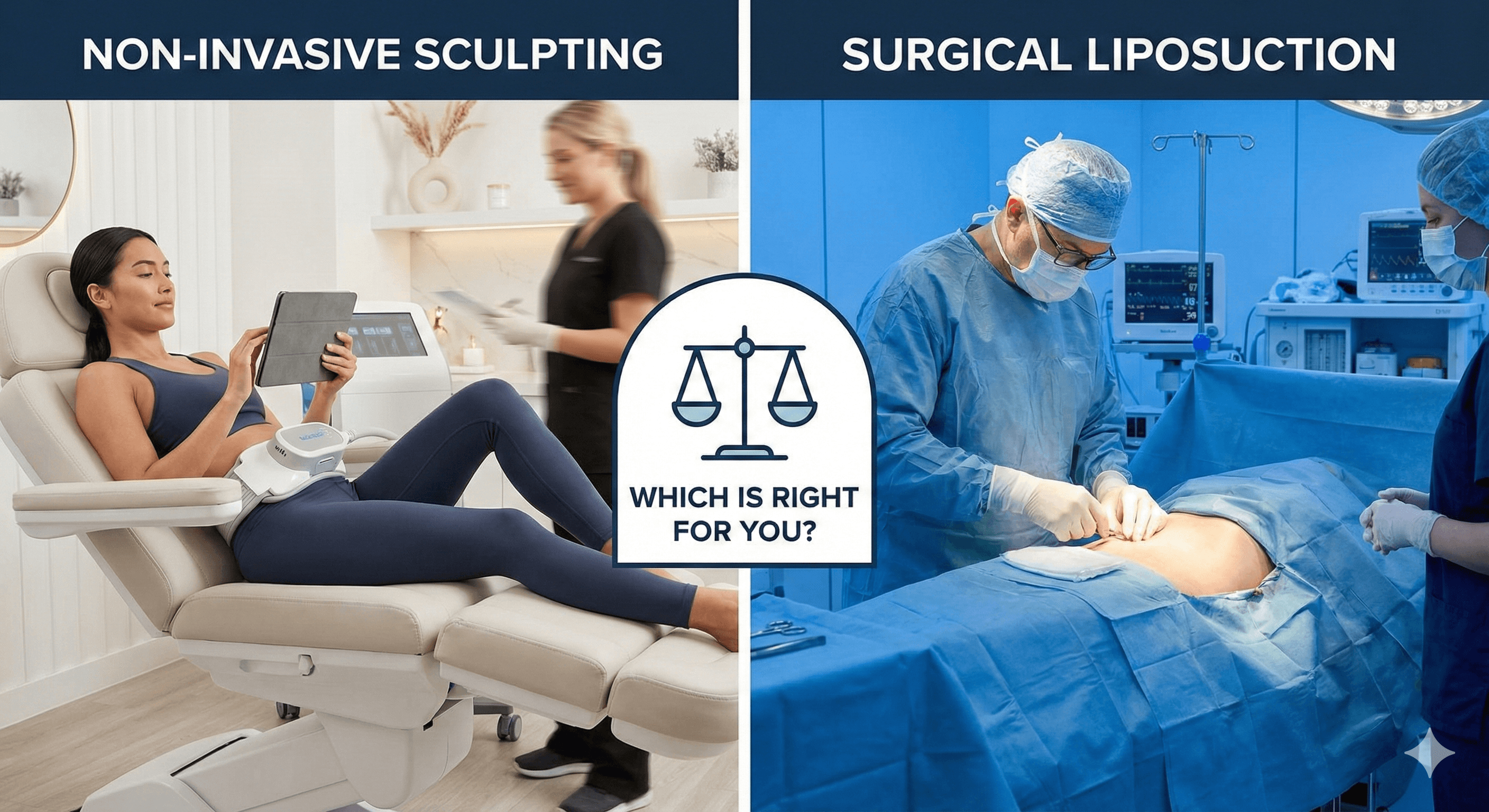
Body Sculpting vs Liposuction: Which Is Right for You

Non-invasive or surgical? Here's how to choose the right body contouring method for your goals.
The choice between non-invasive body sculpting and surgical contouring often leaves patients caught in a state of "analysis paralysis." You’ve likely scrolled through endless before-and-after galleries, ranging from the subtle refinements of CoolSculpting to the dramatic overhauls of traditional liposuction, yet determining which path aligns with your unique anatomy and lifestyle remains a challenge. To find your ideal solution, you must cut through the glossy marketing and understand the biological reality of how these treatments work.
The body contouring landscape has shifted beneath our feet over the last decade. What was once a binary choice—surgery or nothing, is now a spectrum of sophisticated technologies. While some procedures can literally be performed during a lunch break with zero downtime, others remain the "gold standard" for a reason. This guide bridges the gap between clinical jargon and your aesthetic goals, offering a comprehensive deep dive into candidacy, expectations, and the practicalities of each approach.
When Non-Invasive Body Sculpting Is Sufficient
Non-invasive body sculpting is a broad category of "energy-based" treatments designed to eliminate fat, build muscle fibers, or contract skin tissues without a single incision. These modalities are high-tech, low-risk, and increasingly popular—but they are not "liposuction lite." They serve a very specific purpose for a specific type of patient.
Ideal Candidates for Non-Invasive Treatments
Non-invasive sculpting is most effective for individuals who are already living a healthy lifestyle but are frustrated by "genetic holdouts"—those stubborn pockets of fat that refuse to budge despite a disciplined caloric deficit and consistent exercise. If you can "pinch an inch" on your flanks or abdomen but are otherwise satisfied with your silhouette, you are likely in the sweet spot for these technologies.
The best candidates typically exhibit these traits:
- Near Maintenance Weight: You are within 10–15 pounds of your goal weight.
- Targeted Concerns: Your goals are localized (e.g., a persistent "pouch" after pregnancy or stubborn "love handles").
- Risk Aversion: You have a medical or personal preference to avoid general anesthesia and surgical scars.
- Busy Lifestyles: You cannot afford the 1–2 weeks of downtime required for surgical recovery.
- Skin Integrity: You possess good "snap-back" quality (elasticity), meaning your skin is firm enough to conform to a slightly smaller volume once the fat is gone.
Technology Options and How They Work
- Cryolipolysis (Fat Freezing): Best known by the brand name CoolSculpting, this process uses "Apoptosis"—programmed cell death. By chilling fat cells to a precise temperature, the device triggers them to crystallize and die without damaging the surrounding skin or nerves. Over the next 12 weeks, your lymphatic system flushes these cells out.
- Ultrasound Cavitation: This uses focused sonic waves to create "micro-bubbles" within the fat tissue. These bubbles eventually implode, breaking down the fat cell membranes and turning the fat into a liquid state that the body then metabolizes.
- Radiofrequency (RF) Treatments: Devices like Vanquish or truSculpt use deep-tissue heating. This thermal energy not only destroys fat cells but also stimulates the production of new collagen and elastin fibers, providing a secondary benefit of mild skin tightening.
- Electromagnetic Muscle Building: EMSCULT and similar technologies represent a shift in the industry. Instead of focusing only on fat, they use High-Intensity Focused Electromagnetic (HIFEM) energy to trigger "supramaximal" contractions. This builds the underlying muscle architecture while simultaneously inducing a high-intensity fat burn.
- Injection Lipolysis: Kybella utilizes a synthetic version of deoxycholic acid—a naturally occurring molecule in the body that aids in the breakdown and absorption of dietary fat. It is the go-to for precise "submental" (under-the-chin) sculpting.
Limitations of Non-Invasive Approaches
It is vital to manage expectations. While these tools are powerful, they are tools of refinement, not transformation.
- Volume Thresholds: You can expect roughly a 20–25% reduction in the treated fat layer per session. It will not "flatten" a significant protrusion.
- The Patience Factor: Results are a slow burn. Because the body must naturally process the destroyed cells, you won't see your final look for 3 to 4 months.
- The "Cost Trap": While a single session is cheaper than surgery, achieving a "wow" result often requires 3 to 5 sessions. When you tally the total, the price tag can quickly approach the cost of a single, definitive surgical procedure.
When Surgical Intervention Is Necessary
Liposuction remains the undisputed champion of body contouring when the goal is a significant, structural change. It is no longer just about "sucking out fat"; modern surgery is about liposculpting, the art of removing fat strategically to reveal the beautiful anatomy beneath.
Situations Requiring Liposuction
Liposuction is likely your best path when:
- High-Volume Removal: If you have more than 3 inches of pinchable fat or desire a dramatic "before and after" that changes your clothing size, surgery is the only way to physically remove that much volume in one day.
- Comprehensive Contouring: If you want to address your abdomen, waist, and back simultaneously (360-degree contouring), surgery allows the doctor to treat all these areas in one theater session.
- Athletic Definition: For those seeking the "etched" look of abdominal muscles or a highly defined "V-taper" in the back, a surgeon can use specialized cannulas to sculpt around muscle groups with a level of detail no machine can replicate.
- Correcting "Fibrous" Fat: In areas like the male chest (gynecomastia) or the upper back, fat can be dense and fibrous. Non-invasive tools often struggle to penetrate this tissue, whereas surgical tools can physically break it down.
Advanced Surgical Techniques
The "dark ages" of aggressive, bloody liposuction are over. Today’s techniques are gentler and more precise:
- Tumescent Liposuction: The modern baseline. A specialized fluid is injected to numb the area and shrink blood vessels, making the fat easier to remove and drastically reducing bruising.
- Power-Assisted (PAL): Uses a vibrating cannula that moves back and forth at high speeds, allowing the surgeon to navigate through fat with less manual force and higher precision.
- Ultrasound/Laser-Assisted (VASER/SmartLipo): These "melt" the fat before it is suctioned out. This is particularly useful for skin tightening and treating "tough" areas like the chin or male breast.
Understanding Surgical Risks
Liposuction is a medical procedure. While safety rates are incredibly high with board-certified surgeons, patients must respect the process. Potential risks include temporary contour irregularities, fluid accumulation (seromas), or prolonged numbness. Choosing a surgeon who prioritizes safety over "sales" is your most important step in mitigating these risks.
Recovery Time, Cost, and Result Longevity Comparison
Recovery and Downtime
- Non-Invasive: This is the "no-excuses" category. You can literally head to the gym or a dinner party immediately following most sessions. You might feel a bit sore—akin to a tough workout—but your life continues uninterrupted.
- Liposuction: Expect a "hibernation" period. You will need 3–5 days of dedicated rest, followed by a few weeks of wearing a medical-grade compression garment. This garment is crucial—it helps the skin adhere to the new, smaller frame and minimizes swelling.
Cost Comparison
At first glance, body sculpting seems more affordable ($750–$1,500 per applicator). However, because most people need multiple "rounds" and multiple "areas," a full transformation often lands between $4,000 and $8,000.
Liposuction usually starts higher ($5,000–$12,000+), but it is a "one-and-done" investment. In the long run, surgery is often more cost-effective for those seeking a total body overhaul.
Result Longevity and Maintenance
In both cases, the fat cells are gone forever. However, the remaining fat cells in your body are like balloons—they can still expand if you gain weight.
- Liposuction offers a more "permanent" change to your proportions because the surgeon removes a higher percentage of cells in the target area.
- Non-invasive muscle treatments (like EMSCULPT) require "maintenance" sessions every 6 months to keep the muscle tone at its peak.
Making Your Decision
The "right" choice is rarely about the machine; it’s about the gap between your current state and your desired state.
Choose non-invasive body sculpting if:
- You are "fit but frustrated."
- You have a phobia of needles or anesthesia.
- You prefer a subtle change that looks like you just had a very successful month at the gym.
Choose liposuction if:
- You want a "total transformation" that people will notice immediately.
- You have significant localized fat deposits that haven't moved in years.
- You want a permanent, one-time solution and are willing to trade two weeks of recovery for a lifetime of results.
The Hybrid Approach
The future of aesthetics is "Combination Therapy." It is common for a patient to undergo liposuction to remove the bulk of the fat, followed by a series of RF treatments months later to "shrink-wrap" the skin. Alternatively, some use EMSCULPT after liposuction to "pop" the muscle definition they just uncovered.
Conclusion
Ultimately, neither body sculpting nor liposuction is a "magic wand" for weight loss. They are tools of artistry designed to help your body reflect the hard work you put into your health. By understanding the biological mechanics of each—and being honest about your own lifestyle—you can choose the path that leads to the most confident version of yourself.
Frequently Asked Questions
Q: Can I combine non-invasive body sculpting with liposuction? Absolutely. Think of liposuction as the "heavy lifting" and non-invasive treatments as the "fine-tuning." Using RF or ultrasound after surgery can help smooth out minor irregularities and tighten the skin for a "Photoshopped" finish.
Q: How do I know if I have enough fat for liposuction but not too much? The "pinch test" is a good start. If you can firmly grasp a handful of fat that is separate from the muscle, you are a candidate. If your BMI is over 35, your surgeon may recommend losing a few pounds first to ensure the safest surgical outcome and the best aesthetic result.
Q: Will non-invasive treatments work if liposuction didn't give me the results I wanted? It depends. If the "missed" result is a small pocket of fat, yes. If the result is "lumpy" or involves loose skin, non-invasive treatments may not be powerful enough to fix it; a surgical revision would be the better route.
Q: Which option is better for loose skin after weight loss? Neither is a "skin" procedure, but RF-based non-invasive treatments offer mild tightening. For significant "apron" skin or "bat wings," surgical excision (like a tummy tuck) is the only effective solution.
Q: How long do I need to wait between non-invasive treatments and liposuction? Generally, you should wait 3–6 months. You want the internal inflammation from one treatment to completely subside so the surgeon (or technician) can see the true "baseline" of your body before starting the next phase.
Your Ideal Fit Is Just a Conversation Away
Stop letting confusion hold you back from the body you’ve worked so hard for. Contact us today for a personalized body contouring assessment, and let's turn your aesthetic goals into reality