Calorie Control vs. Fasting: Which Wins for 100+ Lb Weight Loss?

Two people. Both lost 100+ lbs without surgery. They used completely different methods.
If you are 50 to 200 lbs overweight and ready to make a serious change—without going under the knife—you have likely heard two very different schools of thought: count every single calorie or stop eating for stretches of time.
The problem? Most people try to do both badly at the exact same time, burn out in three weeks, and wonder why the scale refuses to move.
This is a direct, no-fluff comparison of both strategies using real-world mechanics and physiological outcomes. Not theory. Not influencer trends. Just results.
Strategy 1: What Is Calorie Control, Really?
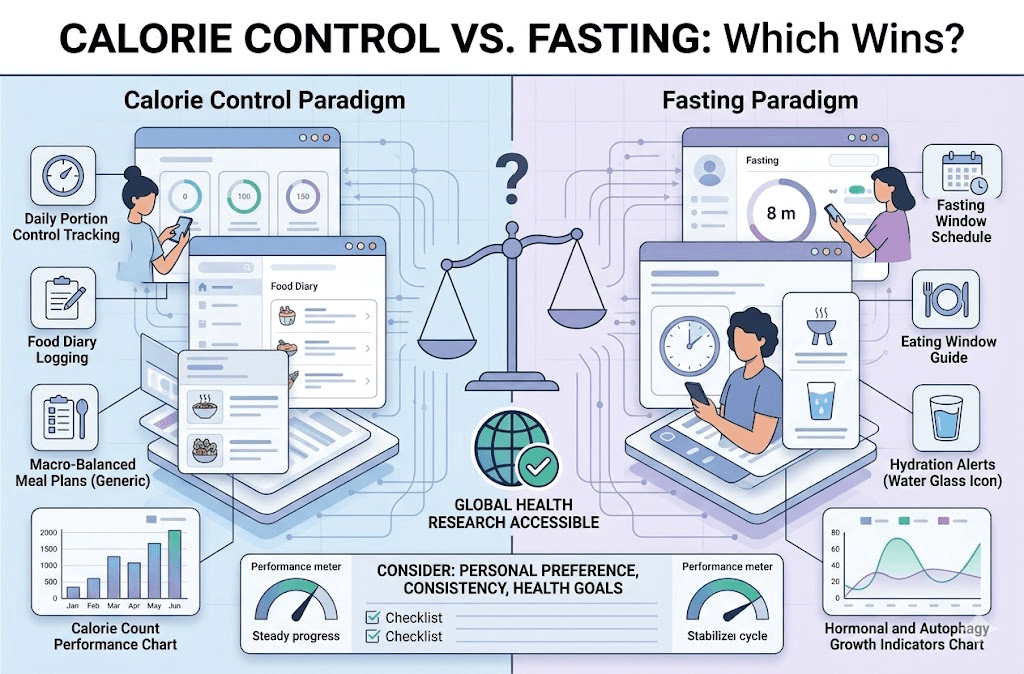
Calorie control is the science of thermodynamics applied to your plate. It means tracking everything you eat and staying within a calculated daily energy deficit. In practice, this typically means consuming 500–1,000 fewer calories than your body burns each day, creating a predictable, math-backed loss of 1 to 2 lbs per week.
For people carrying significant excess weight, the math becomes especially powerful. A person weighing 350 lbs has a dramatically higher Total Daily Energy Expenditure (TDEE) than someone at 180 lbs. That means a much larger natural deficit is already built in, and faster early results are genuinely achievable.
Why Calorie Control Works:
- Zero Ambiguity: You know exactly what you consumed and exactly what you burned. The math doesn't negotiate.
- Flexibility: You can technically eat whatever you want, provided it fits within your daily calorie budget.
- Measurable Adjustments: If weight loss stalls, you have hard data to review and adjust.
The Accountability Factor: This method requires structured meal logging using tools like MyFitnessPal or Cronometer. Because tracking can induce "diet fatigue," having an accountability partner, dietitian, or clinical coach is often the difference between long-term success and a quick rebound.
The 100 Lbs in 4 Months Outcome
This isn't a marketing claim—it's documented in clinical settings. Individuals starting at 350–400 lbs have lost 100 lbs in approximately 16 weeks through aggressive but medically supervised calorie restriction paired with consistent daily movement.
The Mechanism: At extreme starting weights, a supervised deficit of 1,200–1,500 calories per day can generate 3–5 lb weekly losses in the early months. Add a structured workout routine (even low-impact walking for 45 minutes daily), and the deficit widens meaningfully.
The Honest Tradeoff: This rapid pace cannot last forever. The body adapts, metabolism recalibrates downward, and without a deliberate transition strategy, plateaus and rebound weight gain become serious risks. Rapid loss demands a long-term maintenance plan.
Strategy 2: What Is Fasting, Really?
Fasting is not just skipping meals and suffering through hunger. It is a deliberate, time-based eating structure that exploits your body's hormonal response to the absence of food.
When you fast, your insulin levels drop sharply. When insulin drops, your body pivots from burning dietary glucose (from your last meal) to burning stored body fat for energy. For people with substantial fat reserves, this is one of the most powerful metabolic levers available—and it costs nothing to activate.
The Most Common Fasting Approaches:
- 16:8 Protocol: Eat all your meals within an 8-hour window; fast for the remaining 16 hours.
- OMAD (One Meal a Day): A 23-hour fast followed by one large, satisfying meal.
- Extended Fasting: Periodic 24–72 hour fasts, typically done under medical supervision.
Fasting doesn't inherently require calorie counting (though combining both methods can be highly effective). The restriction comes from time, not meticulous gram-by-gram logging.
The 200+ Lbs Total Outcome
People who lose 200+ lbs through fasting-focused lifestyles typically do it over 18 to 36 months. It is slower than aggressive calorie restriction, but here is what makes it remarkable: the lifestyle itself becomes the maintenance plan.
When someone adopts fasting as a permanent eating rhythm rather than a temporary diet phase, they aren't perpetually white-knuckling a calorie ceiling. They are living inside a structure that naturally governs their intake.
What the Research Supports:
- According to the National Institute on Aging (NIA), intermittent fasting has been shown to improve insulin sensitivity and reduce inflammation, which are frequently impaired in people with obesity.
- Fasting helps regulate ghrelin (the primary hunger hormone) over time, making adherence progressively easier.
- It adapts naturally to social situations: skip breakfast, fast through lunch, and eat a normal, satisfying dinner with your family.
Head-to-Head: The Key Differences
To figure out which path is best for you, you need to understand the practical differences in execution.
If you choose Calorie Control:
- Speed of initial loss: Faster (especially at high starting weights).
- Daily structure required: High. Requires consistent logging, measuring, and tracking.
- Long-term sustainability: Moderate. Tracking fatigue is a very real phenomenon.
- Risk of rebound: Higher, unless you have a strict transition plan for maintenance.
If you choose Intermittent Fasting:
- Speed of initial loss: Slower, but highly consistent.
- Daily structure required: Moderate. You only manage your time window.
- Long-term sustainability: High. It easily transitions into a permanent lifestyle.
- Risk of rebound: Lower, provided fasting becomes a habitual daily rhythm.
Maryland Trim Clinic (MTC) in Laurel, MD
Deciding between calorie control and fasting—or figuring out how to safely combine them—should not be a guessing game, especially if you have significant weight to lose. Trying to orchestrate a massive physical transformation without clinical support often leads to metabolic burnout, muscle loss, and rapid weight regain.
If you want to achieve lasting results safely, the Maryland Trim Clinic (MTC) in Laurel, MD, provides the medical oversight necessary for massive weight loss. The clinic offers a highly structured, supervised medical weight loss program tailored to your specific metabolic needs. Whether you need the metabolic assistance of GLP-1 weight loss injections to help regulate your appetite while you establish a fasting routine, or you need expert nutritional counseling and coaching to ensure your calorie deficit isn't destroying your muscle mass, MTC has the resources to support you.
By partnering with the team at the Maryland Trim Clinic, you stop relying on internet trends and start relying on evidence-based medicine, ensuring that the weight you lose is gone for good.
The Verdict: Which One Is Right for YOU?
If you are 50–100 lbs overweight: Calorie control with a structured deficit, daily movement, and a real accountability system can generate fast, motivating early results. The quick wins build the psychological momentum that keeps you moving. Engage a dietitian or certified clinic—the investment pays off heavily in compliance.
If you are 100–200+ lbs overweight: Fasting—particularly a 16:8 or OMAD protocol—is likely more sustainable for the long haul. The hormonal benefits of fasting (like lowered insulin) are most pronounced at higher body fat percentages, and the lifestyle is far more adaptable to real life without requiring a food scale at every single meal.
The hybrid approach: Many of the most successful non-surgical weight loss journeys use both strategically. They use medically supervised calorie control during the early phase to generate rapid momentum, followed by a deliberate transition to a fasting-based lifestyle for long-term maintenance.
The Takeaway
Stop trying both methods halfway. The messy middle ground between calorie counting and fasting is where most people stall and quit.
Pick a lane. Commit fully. Build your medical and social support system before you start.
Either path has taken real people to 100 lbs lost, 150 lbs lost, and 200 lbs lost without surgery. The difference is the pace, the process, and the commitment of the person doing it. The method doesn't win. The person who stays consistent does.
Frequently Asked Questions
Q: Can I combine calorie counting and fasting at the same time? A: Yes, and for many people, combining both is the most effective approach. Fasting naturally reduces your eating window, which often produces a calorie deficit without obsessive logging. However, deliberately tracking calories within your eating window ensures you are hitting your protein targets and avoiding unintentional binge eating. Start with one method to build the habit, then layer in the second once the first feels automatic.
Q: Is intermittent fasting safe if I'm significantly overweight or have health conditions? A: For most overweight individuals, fasting is metabolically beneficial. However, according to guidelines from the Centers for Disease Control and Prevention (CDC) regarding meal planning for chronic conditions, if you have Type 1 or Type 2 diabetes, take blood pressure medications, or have a history of disordered eating, you must consult a physician before starting any fasting protocol. Medical supervision turns a good plan into a safe one.
Q: How quickly can I realistically expect to lose weight with calorie control? A: At higher starting weights (300+ lbs), early losses of 3–5 lbs per week in the first 4–8 weeks are achievable with a proper deficit and daily movement. This rate will naturally slow down as your body weight decreases. A realistic, safe long-term average for sustained weight loss is 1–2 lbs per week.
Q: Do I need to exercise for either method to work? A: Neither calorie control nor fasting strictly requires exercise to produce weight loss—the dietary deficit or hormonal shift does the primary work. However, exercise dramatically improves outcomes. It preserves vital lean muscle during rapid loss, improves your metabolic rate, and provides mental health benefits. Even 30–45 minutes of daily walking can meaningfully accelerate results and prevent plateaus.
Q: What happens after I reach my goal weight — how do I keep it off? A: This is where most diets fail. For calorie counters, the transition to maintenance requires recalculating your TDEE at your new weight and eating at (rather than below) that number. For fasting practitioners, the method often simply becomes the maintenance plan, as the eating window naturally limits excess intake. Research shows that people who maintain significant weight loss do so by treating the behavioral change as a permanent identity shift, not a temporary fix.
Ready to Start Your Transformation?
Would you like me to help you draft a list of questions to ask your doctor or a medical weight loss clinic during your first consultation to ensure you choose the safest path for your biology?