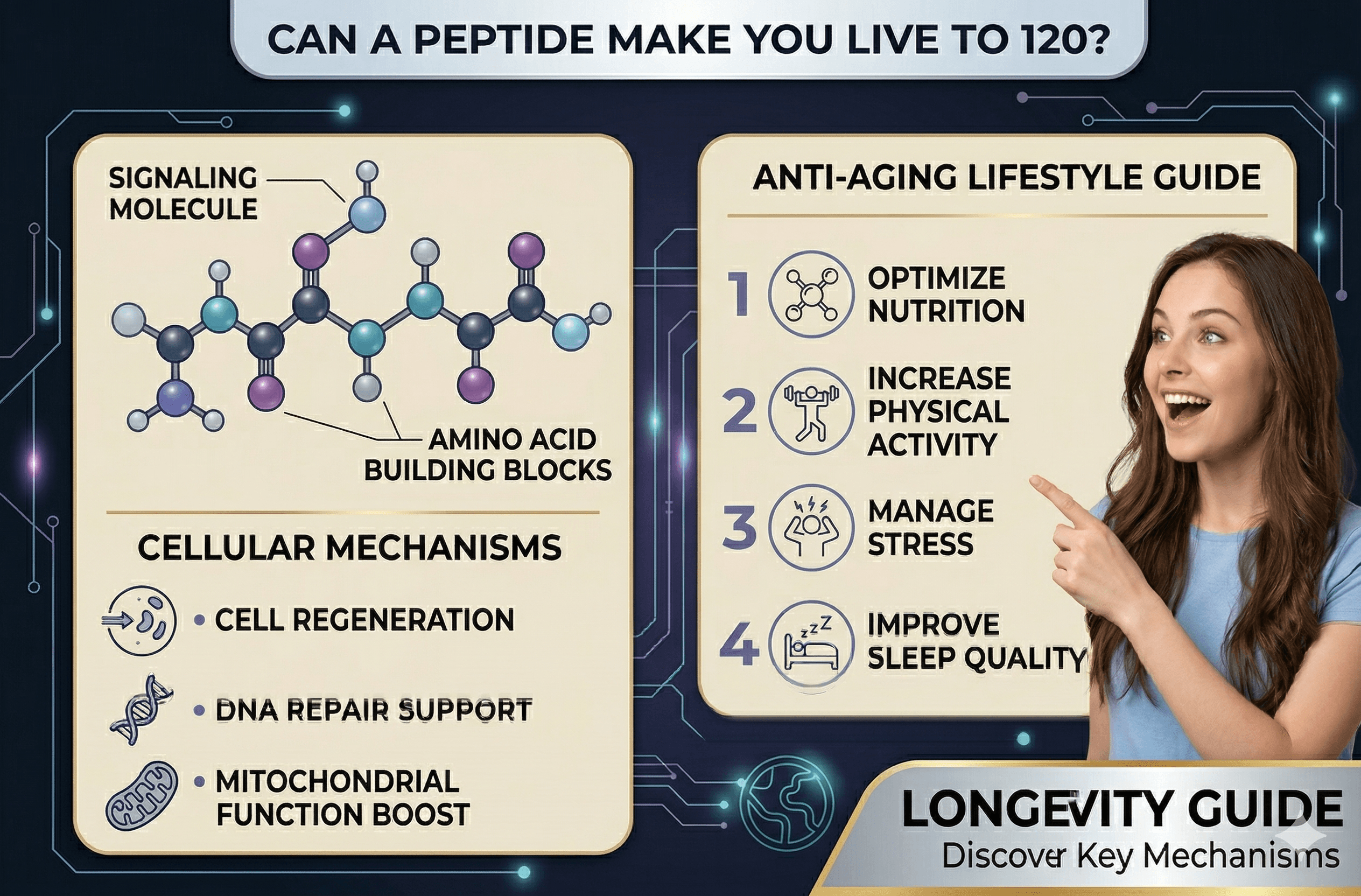
Can Peptides Make You Live to 120? The Science of Anti-Aging

They say this one peptide could let you live to 120. Here's the problem with that claim.
It spreads like wildfire. A viral podcast clip, a wellness influencer's daily "stack" reveal, a massive Reddit thread in a biohacking community—and suddenly, a tiny molecule is being positioned as the master key to radical human longevity. If you spend any time in health and wellness circles, you have almost certainly encountered a version of this claim.
The specific peptide changes depending on the current trend cycle—Epitalon, BPC-157, MOTS-c, or Humanin—but the promise is always some variation of the same breathless headline: This compound could let you live decades longer than nature intended.
The problem isn't that the underlying science is pure fiction. Some of the cellular biology is genuinely fascinating. The problem is what happens between a published study in a foreign biochemistry journal and a $200 vial being shipped to your door with a "live to 120" tagline.
That gap—between what science actually shows and what the unregulated market sells—is where the real danger lives. For longevity enthusiasts and anti-aging hopefuls alike, learning to navigate that gap isn't optional. It is essential.
ACT 1: What These Peptides Actually Do at a Cellular Level
Let's use Epitalon as our primary case study. It is the peptide most commonly paired with extreme longevity claims and possesses one of the longest research trails in the biohacking space.
Epitalon is a synthetic tetrapeptide (composed of just four amino acids: alanine, glutamic acid, aspartic acid, and glycine). It was developed by Russian gerontologist Vladimir Khavinson, derived from a natural polypeptide extracted from bovine pineal glands.
This pineal gland connection is important: the pineal gland regulates melatonin and plays a vital role in circadian rhythms and neuroendocrine signaling, both of which are deeply implicated in the biology of aging.
The Telomere Connection At the cellular level, the most heavily cited mechanism for Epitalon is its apparent ability to activate telomerase—the enzyme responsible for maintaining telomere length.
- Think of telomeres like the plastic tips on shoelaces: They sit at the ends of your chromosomes.
- Every time a cell divides, these telomeres shorten.
- When they become critically short, cells enter a state called senescence—they stop dividing, become metabolically dysfunctional, and begin secreting inflammatory signals.
In laboratory settings (Petri dishes), Epitalon has demonstrated the ability to stimulate telomerase activity in human fetal cells, effectively elongating telomeres and allowing cells to exceed their normal replicative limit.
The Animal Data Animal studies, many conducted by Khavinson's own group, have reported lifespan extensions in fruit flies, mice, and rats. Some studies in mice showed:
- Increased median and maximum lifespan.
- Reduced tumor incidence.
- Improved markers of immune function.
- Normalized circadian melatonin secretion.
So far, this sounds incredibly compelling. And it is—at a cellular and animal level. The problem begins the exact moment anyone tries to draw a straight, factual line from these microscopic findings to a human being celebrating their 120th birthday.
ACT 2: The Enormous Gap Between Research and Reality
Here is where intellectual honesty demands we slow down considerably. Taking an animal study and extrapolating it to human life expectancy ignores several massive biological hurdles.
The Study Quality Problem The bulk of Epitalon's research comes from a single research group operating predominantly within a post-Soviet scientific tradition. This work was largely isolated from the peer-review norms of Western biomedical research. While this doesn't automatically invalidate the findings, it means the work has not been independently replicated at scale by external laboratories using blinded, controlled methodologies. In longevity science, independent replication is the difference between a promising signal and background noise.
The Lack of Human Clinical Trials Human clinical trials for extreme lifespan extension are nearly nonexistent. The studies that do involve human subjects are small, often uncontrolled, and measure surrogate endpoints (biomarkers like melatonin levels or immune cell counts) rather than actual lifespan outcomes. No large-scale, double-blind, placebo-controlled randomized trial has demonstrated that Epitalon, or any currently marketed longevity peptide, extends human lifespan. When marketers cite "decades of research," they are almost always referring to isolated cell studies and mice experiments.
The Mouse-to-Human Translation Failure This is one of the most frustrating realities of biomedical science: interventions that dramatically extend lifespan in mice routinely fail in humans. Resveratrol is the most famous example—a media darling that ultimately collapsed under clinical scrutiny. A compound that buys a mouse 20% more lifespan (a matter of months) may do absolutely nothing for a species that already lives eight to nine decades.
The Bioavailability Hurdle Most peptides, when taken orally, are destroyed by digestive enzymes in your gut long before they reach your bloodstream. The peptide you swallow is rarely the peptide that arrives at your cells. Subcutaneous injections bypass this, but the gray-market industry selling these compounds rarely addresses tissue distribution or receptor targeting in living humans.
The Regulatory Landscape Epitalon and its category-siblings are not approved by the FDA as drugs for anti-aging. They exist in a precarious regulatory gray zone. According to warnings regarding compounded peptide products, many of these molecules are sold as "research chemicals" and have not been evaluated for safety, purity, or efficacy. The gap between "not yet studied enough" and "proven to work" cannot be filled by an influencer's online testimonial.
ACT 3: Why Lifespan Claims Require Extreme Scrutiny — And How to Spot Bad Science
Understanding what real longevity science looks like makes the marketing claims far easier to identify and dismiss.
Legitimate aging research is painfully incremental. The scientists doing credible work on longevity are highly cautious about extrapolating their findings. Caution at the medical frontier is a feature, not a limitation. When you encounter a longevity claim that isn't hedged with scientific nuance, that is your first red flag.
The 5 Red Flags of Bad Longevity Science:
- Red Flag 1: A single "miracle" solution. Aging involves at least twelve recognized biological hallmarks (mitochondrial dysfunction, cellular senescence, epigenetic alterations, etc.). Any claim that a single peptide addresses the full complexity of human aging is a marketing argument, not a scientific one.
- Red Flag 2: "Decades of research" with no human citations. Ask for peer-reviewed publications in indexed journals. If the only research comes from the inventor's own lab, or if the studies were only done on fruit flies, be highly skeptical.
- Red Flag 3: Anecdote disguised as evidence. Before-and-after testimonials and n=1 self-experiments are not substitutes for controlled data. The human body is extraordinarily susceptible to the placebo effect, especially for subjective outcomes like energy and mood.
- Red Flag 4: Conflating Lifespan with Healthspan. Healthspan is the number of years spent in good health; lifespan is absolute maximum years alive. Many compounds improve healthspan markers in animals without extending maximum lifespan. Be precise about which claim is actually being made.
- Red Flag 5: The absence of risk discussion. Telomerase activation—the very mechanism touted for Epitalon—is a double-edged biological sword. Cancer cells are defined in part by their ability to activate telomerase to become effectively immortal. Any intervention that increases telomerase activity carries a theoretical oncogenic (cancer-causing) risk. Marketing that never mentions risk is lying by omission.
Maryland Trim Clinic (MTC) in Laurel, MD
While ordering unregulated "research chemicals" online is a dangerous gamble, taking a proactive, medically supervised approach to your aging process is incredibly smart. If your goal is to optimize your healthspan, improve your energy, and protect your body against the chronic metabolic diseases that accelerate aging, you need clinical guidance, not internet biohacking.
For patients looking for evidence-based care, the Maryland Trim Clinic (MTC) in Laurel, MD, offers comprehensive wellness and anti-aging solutions built on real science. Because aging is deeply intertwined with metabolic decline, MTC provides advanced metabolic testing and analysis to uncover exactly how your body is functioning at a cellular level.
Furthermore, instead of chasing unproven peptide fads, you can address one of the most well-documented drivers of age-related decline: hormonal imbalance. Through expertly managed hormone replacement therapy, the medical team can help restore your body's natural baseline, protecting your muscle mass, bone density, and cognitive focus. By partnering with Maryland Trim Clinic, you gain access to safe, regulated, and personalized medical care designed to help you age with strength and vitality.
Frequently Asked Questions
Q: What is Epitalon and why is it associated with extreme longevity claims? A: Epitalon is a synthetic tetrapeptide developed by a Russian gerontologist, derived from a pineal gland extract. It has been studied for its ability to activate telomerase (the enzyme that maintains telomere length) in cell cultures and animal models. Because telomere shortening is a hallmark of aging, marketers have extrapolated these findings into claims about radical human lifespan extension, despite a total lack of large-scale clinical trials proving this in humans.
Q: Do any peptides have legitimate scientific backing for anti-aging effects? A: Some peptides show promising signals in preliminary research. GHK-Cu has been studied for topical tissue repair, while MOTS-c and Humanin show interesting metabolic profiles in animal models. However, "promising signals" is very different from a "proven anti-aging therapy." None of these compounds have cleared the rigorous bar of large, randomized controlled trials in humans required to justify claims of adding decades to your life.
Q: Why can't we just trust animal study results for human longevity research? A: Animal models—particularly mice—have a long history of generating exciting longevity findings that completely fail to replicate in humans. Short-lived species age under different evolutionary constraints, have different metabolic rates, and respond differently to pharmacology. What cures a mouse often does nothing for a human.
Q: Is it safe to use longevity peptides available online as 'research chemicals'? A: This is an area of genuine, significant risk. Peptides sold as "research chemicals" have not been evaluated for safety, purity, or efficacy by the FDA. Beyond the lack of safety data, contamination and inaccurate dosing are massive risks outside of pharmaceutical-grade manufacturing. Furthermore, manipulating mechanisms like telomerase carries theoretical risks, including promoting the viability of undiscovered cancer cells.
Q: What is the difference between lifespan and healthspan, and why does it matter? A: Lifespan refers to the total duration of life (how long you live). Healthspan refers to the portion of life spent in vibrant, functional health. Most credible longevity interventions aim to extend healthspan so that disease and physical decline are compressed into a much shorter period at the very end of life. Many online claims purposefully confuse the two to sell products.
Q: How can I evaluate whether a longevity research claim is credible? A: Start by asking these questions:
Was the study conducted in humans, or just mice/cells?
Was it independently replicated by multiple, unaffiliated research groups?
Was it a randomized controlled trial with a placebo arm?
Did it measure real health outcomes, or just surrogate biomarkers? If a longevity claim cannot pass these basic scientific filters, hold it with extreme skepticism.
Ready to Optimize Your Healthspan Safely?
Stop guessing with unregulated online trends. Contact the medical team at Maryland Trim Clinic today to schedule a comprehensive consultation, and discover how evidence-based medicine can help you protect your vitality and age on your own terms.