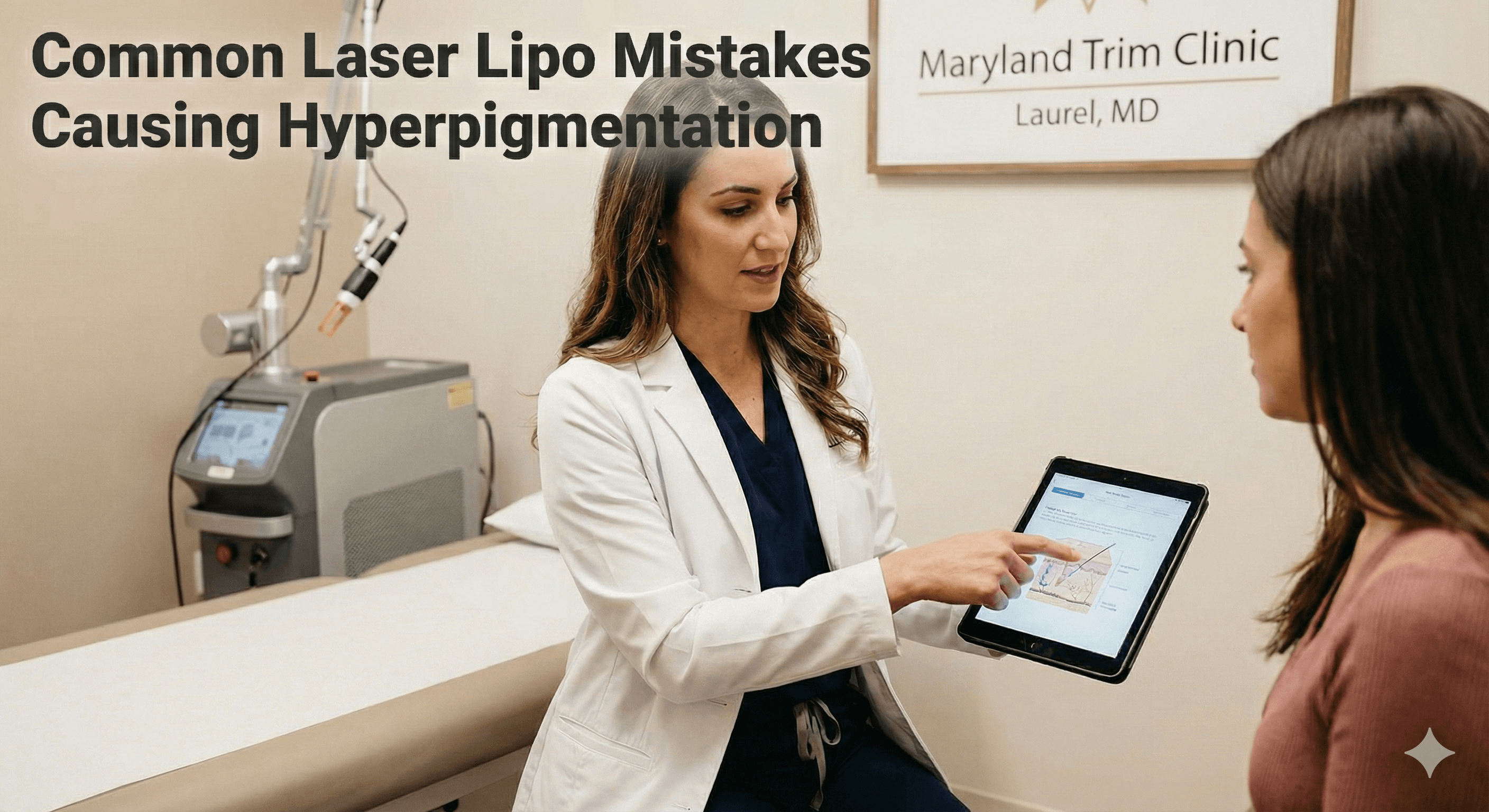
Common Laser Lipo Mistakes Causing Hyperpigmentation

Your laser lipo settings might be causing permanent skin damage. Here is the science behind why it happens—and how to fix it.
Hyperpigmentation remains one of the most common, yet highly preventable, complications in laser lipolysis procedures. Whether you are a professional operating a clinical-grade non-invasive body contouring system or an advanced home user, understanding the physics of light-tissue interaction is absolutely non-negotiable.
The difference between smooth, even results and patchy, darkened skin rarely comes down to luck. It almost always comes down to three critical factors: frequency selection, coupling medium choice, and power density management.
This technical breakdown will walk you through the science of how laser energy moves through your skin and fat, why common habits like applying massage oil are actively sabotaging your results, and exactly which settings can help minimize your risk of skin discoloration.
Act 1: How Frequency Therapies Move Through Tissue Layers
The Physics of Tissue Penetration
Laser lipolysis works by delivering concentrated light energy to adipose (fat) tissue beneath the skin. However, not all wavelengths penetrate the body equally. The electromagnetic spectrum offers different frequencies, and each has distinct absorption and scattering properties when it encounters biological tissue.
Wavelength directly determines penetration depth. Here is a quick guide to how light travels through tissue:
- 635–680nm (Red visible light): Penetrates 5–10mm. This primarily affects the superficial dermis and the subcutaneous junction.
- 808–980nm (Near-infrared): Penetrates 10–30mm. This successfully reaches deeper adipose layers.
- 1064nm (Nd:YAG): Penetrates 30–50mm. This is ideal for targeting deeper tissue and visceral fat.
- 1320–1440nm (Mid-infrared): Limited penetration of just 2–3mm. This is primarily used for dermal heating.
A critical mistake many practitioners make is using shorter wavelengths (635–680nm) at inappropriately high power densities. While red-spectrum lasers are effective at disrupting fat cell membranes, they also deposit a significant amount of energy into the melanin-rich epidermis. This is the exact tissue layer responsible for pigmentation changes.
Chromophore Competition
Every layer of your tissue contains chromophores—molecules that absorb specific wavelengths of light. The three primary chromophores you must account for in laser lipo are:
Melanin (located in the epidermis): Absorbs strongly across 400–1000nm, peaking in the visible spectrum.
Hemoglobin (located in the dermis): Absorbs 400–600nm, which is relevant during vascular heating.
Water and Lipids (located in adipose tissue): Absorb variably, with water showing strong absorption above 1400nm.
When you select a wavelength that melanin absorbs efficiently (anything below 900nm), you are forcing the light to compete with your target tissue. In darker skin types, melanin acts like a massive heat sink, converting laser energy into thermal damage long before it ever reaches the fat cells. This localized trauma is a leading trigger for post-inflammatory hyperpigmentation (PIH).
The Fitzpatrick Paradox
Here is the clinical paradox: the wavelengths most effective at fat cell disruption (635–850nm) are also the most likely to cause PIH in Fitzpatrick skin types IV and above. Conversely, longer wavelengths (1064nm+) penetrate safely past melanin, but they require higher total energy to achieve the same lipolytic effects, which increases treatment time and risks thermal buildup.
The solution is not to abandon effective wavelengths entirely. Instead, practitioners must understand how light distributes across tissue layers and adjust power density accordingly.
Act 2: Why Oil Application Blocks Light Transmission Effectiveness
The Coupling Medium Misconception
Many practitioners apply oil, thick lotions, or heavy gels to the treatment area before applying the laser, believing it improves device gliding and "conducts" energy. This is one of the most damaging myths in the body contouring industry.
Laser light travels most efficiently through materials that share a similar refractive index. Human skin has a refractive index of approximately 1.4 to 1.5. Water-based gels (refractive index ~1.33) create a modest mismatch but maintain highly effective light transmission. Oils, however, range from 1.45 to 1.52. While oil might seem like a mathematical match, the physical reality is much more volatile due to boundary scattering.
Scattering, Reflection, and Thermal Trapping
When laser light encounters a layer of oil on the skin, a chain reaction of interference occurs:
- Surface reflection spikes: Reflection at the air-oil and oil-skin boundaries scatters 8–15% of the light before it even enters the tissue.
- Beam divergence occurs: Oil layers create a "microlensing" effect, spreading the focused beam and drastically reducing power density at the target depth.
- Uneven distribution: Oil does not spread uniformly. Thicker pools of oil block more light, creating patchy energy delivery.
- Thermal trapping: Oils act as insulators. They trap heat in the superficial tissue rather than allowing it to dissipate, increasing the inflammatory cascade that causes hyperpigmentation.
Some areas receive insufficient energy for fat reduction, while adjacent regions suffer from excessive heating—the exact recipe for melanocyte hyperactivity and PIH.
Quick Swaps for Coupling Mediums:
- If you currently use: Massage oils, baby oil, or coconut oil.
- Swap it for: Clear, water-based ultrasound gel applied in a paper-thin layer (1–2mm max).
- If your device has a cooled sapphire window: Consider safe, direct skin contact with no medium at all (follow manufacturer guidelines).
- Strictly Avoid: Colored gels, petroleum-based products, and thick lotions.
Act 3: Proper Device Settings to Minimize Hyperpigmentation Risk
Wavelength Selection by Skin Type
Customizing settings based on the Fitzpatrick scale is crucial for safe targeted fat reduction.
For Fitzpatrick I–III (Light to medium skin):
- Primary wavelength: 635–850nm is highly effective and generally safe with proper fluence.
- Power density: 0.5–1.5 W/cm².
- Pulse duration: Continuous wave or 200–500ms pulses.
For Fitzpatrick IV–VI (Olive to dark skin):
- Primary wavelength: 980–1064nm is mandatory to bypass the melanin-rich epidermis safely.
- Power density: 0.8–2.0 W/cm² (higher energy compensates for lower melanin absorption).
- Pulse duration: 100–300ms pulses are highly preferred over a continuous wave.
- Safety tip: Always conduct a test patch 48–72 hours before a full treatment.
Power Density: The Goldilocks Zone
Power density (irradiance) measures the energy delivered per unit area, per unit time. If it is too low, you see no results. If it is too high, you cause irreversible thermal damage. To ensure safe practices, the FDA provides medical laser safety guidelines that underscore the importance of proper calibration.
Safe Power Ranges by Wavelength:
- 635–680nm: 0.3–1.0 W/cm² maximum (stay at the lower end for darker skin).
- 808–850nm: 0.5–1.5 W/cm².
- 980–1064nm: 0.8–2.5 W/cm².
Note: These values assume you are using proper water-based coupling or direct skin contact. If you use oil, these numbers become entirely unpredictable.
Treatment Duration and Motion Technique
Hyperpigmentation risk increases exponentially with time. Even at safe power densities, prolonged exposure allows thermal accumulation that damages melanocytes.
Time Management Checklist (per 100cm² zone):
- Keep single passes to a maximum of 8–12 minutes.
- For multi-pass protocols, use 4–6 minutes per pass with a 3–5 minute cooling interval in between.
- Limit total session time to 30–45 minutes across multiple zones.
Furthermore, static (stationary) laser application creates dangerous localized hotspots. Always use continuous motion. Rely on overlapping circular patterns or linear passes with a 50% overlap, maintaining a steady movement speed of 2–3 cm per second. Never pause the laser in one location.
Maryland Trim Clinic (MTC) in Laurel, MD
Navigating the complexities of safe, effective body contouring can be overwhelming, particularly when trying to balance aesthetic goals with skin safety. This is where professional clinical oversight makes a massive difference. Located in Laurel, MD, the Maryland Trim Clinic offers specialized, medical-grade weight management and aesthetic services tailored to your unique biology and skin type.
Instead of guessing with at-home devices, patients can consult with professionals who understand tissue physics and proper device calibration. Beyond fat reduction, MTC provides comprehensive support ranging from skin tightening procedures to enhance your contouring results, to holistic lifestyle interventions. By partnering with a comprehensive medical weight loss clinic, you ensure your wellness journey is supervised, evidence-based, and designed to prioritize your long-term health and safety above all else.
The Bottom Line
Hyperpigmentation from laser lipolysis is almost entirely preventable when you respect tissue physics. The three critical rules to remember are:
Choose wavelengths above 900nm for darker skin types, as melanin absorption drops dramatically in the near-infrared spectrum.
Never use oil as a coupling medium. It scatters light, creates uneven hotspots, and traps thermal energy.
Stay strictly within safe power density limits (0.5–2.0 W/cm² depending on the wavelength) and keep the device in continuous motion.
Professional-grade devices should display real-time power density and total fluence; if your device lacks these readouts, you are operating blind. Home devices rarely provide this data, making conservative protocols essential—lower power, shorter duration, and longer intervals between sessions.
When in doubt, always do a test patch. Treat a small 5×5cm area and wait 72 hours. If you observe persistent redness or darkening, reduce power density by 25–30%. By understanding exactly how laser energy interacts with tissue, you can achieve your fat reduction goals without collateral skin damage.
Medical Disclaimer: The information provided in this article is for educational purposes only and does not constitute medical advice. Body contouring results vary by individual, and all aesthetic procedures carry inherent risks. Always consult with a licensed, qualified healthcare provider or certified laser technician before beginning any new treatment.
Frequently Asked Questions
Q: What wavelength is safest for laser lipo on dark skin? A: Wavelengths of 980–1064nm are the safest choice for Fitzpatrick IV–VI skin types. These near-infrared frequencies penetrate past the melanin-rich epidermis with minimal absorption, which can reduce the risk of hyperpigmentation significantly compared to shorter wavelengths (635–850nm).
Q: Can I use coconut oil with my laser lipo device? A: No. Coconut oil—and all oil-based products—scatter laser light at the skin boundary, reducing light transmission by 8–15% and creating uneven, dangerous heating patterns. Stick to clear, water-based ultrasound gel applied in very thin layers (1–2mm).
Q: How long should I wait between laser lipo sessions? A: You should wait at least 7–14 days between treatments on the same physical area. This interval allows any deep tissue inflammation to resolve and prevents cumulative damage to your melanocytes. Individuals with skin types IV–VI should strictly adhere to the 14-day minimum interval.
Q: What power density should I use for home laser lipo devices? A: For maximum safety, home devices should operate at 0.3–0.8 W/cm². Stay at the lower end (0.3–0.5 W/cm²) if you have a darker complexion or if your device does not clearly specify its wavelength. Professional devices can utilize higher densities but require clinical training to use safely.
Q: How do I know if I'm causing thermal damage during treatment? A: Immediate warning signs include skin reddening (erythema) that lasts beyond 10 minutes post-treatment, a sharp burning sensation during application, or any signs of blistering. If you experience these, immediately reduce your power density by 30–40% and cut your treatment duration short.
Ready for Safe, Professional Body Contouring?
Reach out to our Laurel, MD office today to schedule a personalized consultation. Together, we can build a safe, evidence-based treatment plan that helps you achieve your aesthetic goals without ever compromising your skin's health.