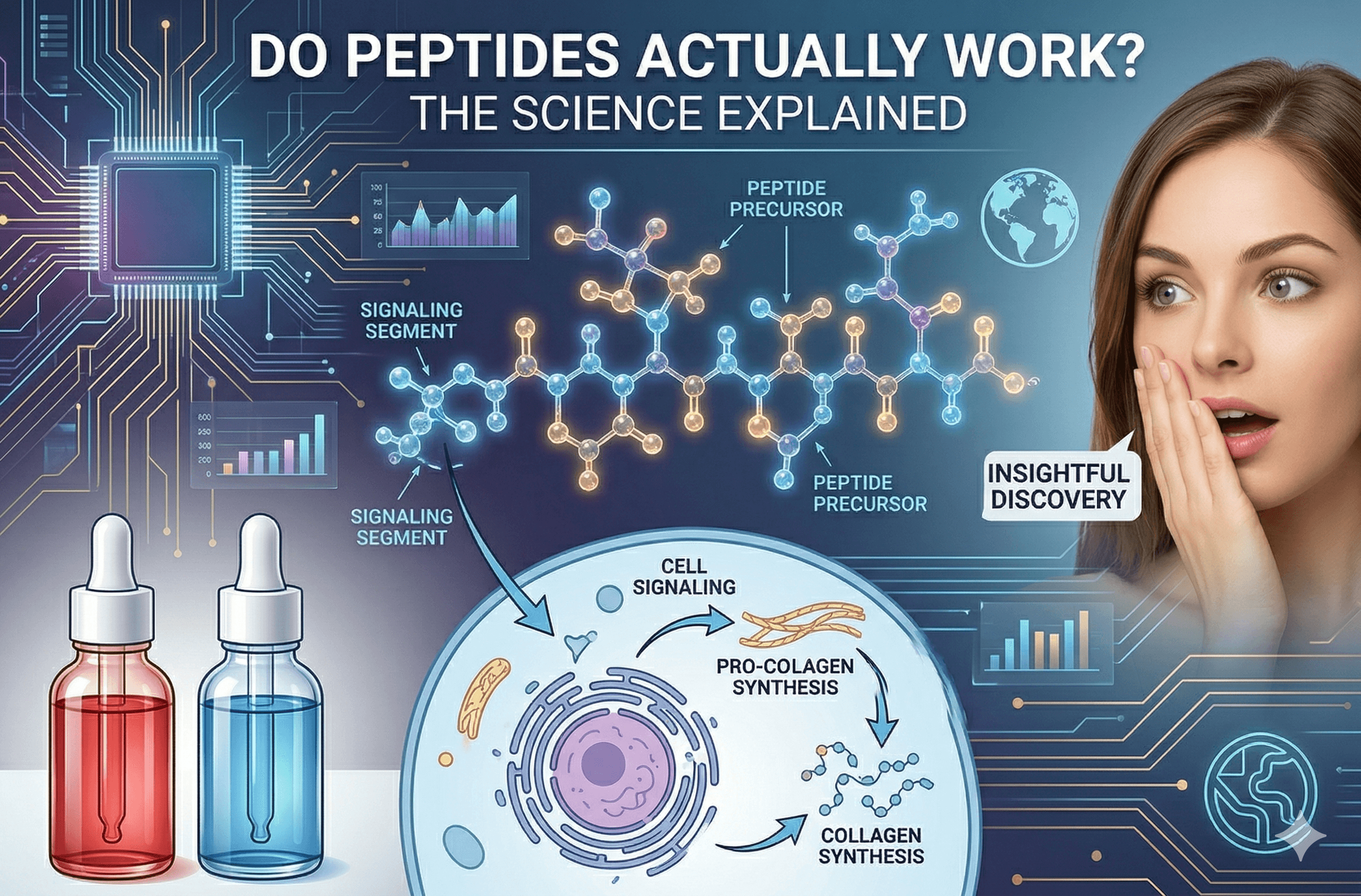
Do Peptides Actually Work? The Science Explained

Medical Disclaimer: The information provided in this article is strictly for educational and informational purposes and does not constitute medical advice. Many peptides are considered experimental and are not FDA-approved for human therapeutic use. Always consult a licensed healthcare provider before beginning any peptide, hormone, or weight-loss protocol.
Wellness clinics say peptides can do everything. Here's what the actual science says.
From viral social media reels to boutique longevity clinics, peptides have become one of the most aggressively marketed categories in modern health optimization. The promises are sweeping: shred fat, build muscle, reverse aging, repair tissues, and recalibrate your hormonal axis—all using "targeted" compounds that your body supposedly already understands.
The problem? When you actually follow the citations, many of those claims dissolve faster than a peptide bond in a digestive tract.
This is not an argument that peptides are useless. It is an argument for reading the fine print—carefully. Below, we walk through what the peer-reviewed literature actually says about three of the most widely used peptides in the wellness and biohacking space: CJC-1295, Ipamorelin, and GHK-Cu. Then, we will build a reusable, science-backed framework for evaluating any peptide claim before you spend money on a protocol.
ACT 1: What the Peer-Reviewed Research Actually Shows
CJC-1295: The Growth Hormone Amplifier
CJC-1295 is a synthetic analog of growth hormone-releasing hormone (GHRH). Its mechanism is straightforward: it stimulates the anterior pituitary gland to release more growth hormone (GH), which in turn elevates insulin-like growth factor 1 (IGF-1). For most people purchasing a peptide protocol, IGF-1 is the downstream anabolic signal they are actually chasing for muscle growth and fat loss.
Here is where the story becomes genuinely interesting. There are human studies. A notable Phase 2 clinical trial published in the Journal of Clinical Endocrinology & Metabolism examined CJC-1295 in healthy adult volunteers. The results demonstrated dose-dependent increases in serum GH levels—up to 10-fold over baseline—and sustained IGF-1 elevation lasting up to 14 days following a single injection. On paper, that sounds extraordinary.
Here is what that study did not show: * Improved body composition
- Increased lean muscle mass
- Reduced body fat percentage
- Enhanced physical performance
Those clinical endpoints were never measured. The trial was designed to establish safety and pharmacokinetics (how the drug behaves in the body)—not to validate the dramatic physical outcomes that wellness clinics are actively marketing to consumers. The inferential leap from "this compound demonstrably raises GH levels" to "this compound will help you lose fat and gain muscle" is enormous, and it is not a leap the published data supports.
The version most commonly sold today is CJC-1295 with DAC (Drug Affinity Complex), a modification that extends the peptide's half-life by allowing it to bind to albumin in the bloodstream. This produces a sustained, low-level "GH bleed" rather than the sharp, pulsatile release pattern that characterizes natural GH secretion. Whether that sustained elevation is physiologically superior, equivalent, or potentially inferior to natural pulsatile release for healthy humans remains an open, untested scientific question.
Ipamorelin: The "Clean" Growth Hormone Secretagogue
Ipamorelin is a growth hormone secretagogue (GHS) and ghrelin receptor agonist. It is routinely marketed as a "cleaner" and more refined alternative to older compounds like GHRP-6, primarily because it selectively stimulates GH release while producing minimal downstream spikes in cortisol and prolactin.
This selectivity claim does carry mechanistic support—but almost exclusively from animal research. Preclinical data on ipamorelin is reasonably substantive. Rodent studies have shown increased GH secretion, improvements in bone mineral density, and favorable shifts in body composition under controlled laboratory conditions.
Human data is an entirely different landscape. As of this writing, there are no published, peer-reviewed randomized controlled trials (RCTs) in healthy adult humans demonstrating that ipamorelin produces meaningful improvements in muscle mass, fat reduction, or any longevity-associated endpoint. The compound has been studied in early-phase clinical settings for indications like postoperative ileus (gastrointestinal motility)—notably not for body composition.
The biohacking community's marketed uses are operating years, possibly decades, ahead of the evidence base. Ipamorelin almost certainly produces a pharmacological effect (elevated GH secretion). However, the unresolved question is whether that biomarker shift translates into the specific physical transformations being promoted. For healthy adults, the current answer is: we simply do not know.
GHK-Cu: The Longevity Copper Peptide
GHK-Cu—the tripeptide glycine-histidine-lysine bound to a copper ion—occupies a different and arguably more scientifically grounded corner of the peptide market. It is a naturally occurring molecule found in human plasma, saliva, and urine.
Plasma concentrations of GHK-Cu decline measurably with age, leading researchers to hypothesize that exogenous supplementation might counteract some aspects of biological aging.
The in vitro (petri dish) and preclinical data are genuinely compelling:
- Cell culture studies show GHK-Cu stimulates collagen synthesis.
- It promotes wound contraction and activates antioxidant enzymes.
- It modulates the expression of genes involved in DNA repair and inflammatory signaling.
The catch? It happens in a Petri dish. For topical applications, the evidence base is the strongest of any GHK-Cu use case. Multiple small human trials have shown statistically significant improvements in skin firmness, reduction in fine lines, and accelerated wound healing with GHK-Cu-containing serums. If your interest is evidence-backed skincare, topical GHK-Cu has a credible argument.
The systemic longevity narrative—injecting or ingesting GHK-Cu to repair internal organs, extend lifespan, or enhance cognition—is a different claim entirely. That story is being written in cell cultures and extrapolated into human biology without the intermediate step of rigorous clinical validation.
ACT 2: Why Most Peptide Studies Are in Animals — and Why That Gap Is Bigger Than You Think
Understanding why robust human clinical data is scarce is essential context for correctly interpreting any peptide claim you encounter.
- Peptides are metabolically fragile: The vast majority of peptides are rapidly cleaved by proteases (enzymes that break apart proteins) in the gastrointestinal tract. This is why virtually all clinically studied peptides are administered via subcutaneous injection to bypass gut degradation. Oral peptide supplements face a near-insurmountable bioavailability problem; they are usually digested into basic amino acids before they can exert any targeted effect.
- Rodent models do not reliably translate to humans: Mice and rats have metabolic rates, GH secretion architectures, and hormonal feedback systems that are fundamentally different from ours. A compound that produces dramatic body composition changes in a rodent may produce marginal or undetectable effects in a human.
- Clinical trials are economically broken: A properly designed Phase 3 RCT costs tens of millions of dollars. Most naturally occurring peptide molecules are not patentable. That removes the financial incentive for pharmaceutical companies to fund large trials, leaving the market flooded with mechanism-hypotheses rather than proven human outcomes.
- Surrogate biomarkers are not clinical outcomes: This is the most important conceptual distinction in the peptide debate. Raising IGF-1 levels is measuring a surrogate biomarker. The assumption is that higher IGF-1 automatically equals more muscle and less fat. However, chronically elevated IGF-1 carries a documented association with increased proliferative risk in certain tissues—a fact wellness marketing rarely mentions.
- Publication bias distorts the landscape: Studies reporting positive or mechanistically interesting results get published. Studies showing a compound produced zero detectable effects tend to quietly disappear into file drawers.
ACT 3: How to Evaluate Peptide Claims Before Spending Money
Skepticism without a framework is just cynicism. Here is a practical, 6-point checklist you can apply to any peptide claim before committing to a protocol:
Is there a human RCT—and did it measure the outcome you actually care about? Do not accept "studies show it works" without interrogating the specifics. A pharmacokinetic safety trial in 20 people is not evidence of efficacy for fat loss.
What is the sample size and study duration? A 12-person study over four weeks is hypothesis-generating at best. Meaningful body composition changes require larger groups and minimum 12-week durations.
Do the measured endpoints match the marketed claims? "Raised GH levels by 300%" is not equivalent to "improved lean body mass." Demand that the claim and the evidence share the same vocabulary.
Is there bioavailability data for the delivery route? If a clinic is selling an oral peptide capsule, demand specific evidence that the active molecule survives digestion and reaches target tissues. "Bioavailability" should be demonstrated, not assumed.
What are the known and plausible risks? Every compound that modulates a major hormonal axis carries risk. Chronic GH and IGF-1 elevation raises legitimate questions about cellular proliferation.
Is the price proportionate to the evidence? A $500 monthly protocol backed primarily by rodent studies is a terrible value proposition compared to interventions with robust human clinical data.
Maryland Trim Clinic (MTC) in Laurel, MD
Navigating the landscape of peptides, longevity, and metabolic health can be overwhelming and, if done without medical supervision, potentially unsafe. Many peptides exist in a regulatory gray zone, meaning purity and safety are not guaranteed when purchased through unauthorized online vendors.
If you are looking for evidence-based interventions to improve your body composition and metabolic health, clinical supervision is non-negotiable. At the Maryland Trim Clinic (MTC) located in Laurel, MD, patients receive comprehensive, medically supervised care tailored to their unique biology.
Instead of guessing with unregulated research chemicals, MTC offers a highly structured medical weight loss program designed to safely and sustainably address metabolic dysfunction. For patients whose biological barriers require advanced intervention, the clinic provides hormone replacement therapy to help restore balance to foundational endocrine systems. By partnering with the professionals at Maryland Trim Clinic, you gain the accountability, precise lab monitoring, and FDA-regulated medical support necessary to achieve real, lasting transformations.
The Honest Bottom Line
Peptides are not snake oil. The mechanistic biology is real, and the pharmacological effects on biomarkers like GH and IGF-1 are demonstrable. Some specific applications—like topical GHK-Cu for skincare—have a credible evidence base that extends into human populations.
But the gap between what the current science demonstrates and what wellness clinics are actively selling is wide. That gap is currently being bridged by financial incentive, selective citation, and the human appetite for cutting-edge solutions.
"Promising" and "proven" are not the same word. Until there are large, independent human trials measuring the clinical outcomes that actually matter, anyone using systemic peptides is participating in an experiment with an incompletely characterized outcome. If you choose to take that risk, do so with your eyes wide open, under the care of a licensed physician.
Frequently Asked Questions
Q: Are CJC-1295 and Ipamorelin legal to use? A: The legal status of these peptides varies significantly. In the United States, they are not FDA-approved for anti-aging or body composition, and they exist in a regulatory gray zone. They are explicitly banned by organizations like WADA for competitive athletes. Always consult a licensed physician and verify the regulatory status in your jurisdiction before use.
Q: Can you take peptides orally, or do they have to be injected? A: Most peptides studied for systemic effects are administered via subcutaneous injection because they are highly susceptible to degradation in the GI tract. Stomach acid and digestive enzymes break the peptide bonds before they can exert a targeted biological effect. Oral peptide supplements are commercially available but generally lack rigorous bioavailability data.
Q: What is the difference between CJC-1295 and Ipamorelin, and why are they often stacked together? A: CJC-1295 is a GHRH analog that mimics the signal telling the pituitary to produce GH. Ipamorelin is a ghrelin receptor agonist that acts on a different pathway to also stimulate GH release. The rationale for combining them is that they trigger GH secretion through complementary mechanisms, theoretically producing a synergistic pulse. However, this synergistic clinical benefit for body composition has not been rigorously proven in human RCTs.
Q: Is GHK-Cu safe for topical use, and is it worth the cost? A: GHK-Cu has a well-established safety profile for topical application. Small human trials support its efficacy for improving skin firmness and reducing fine lines, making it one of the more evidence-backed applications in the peptide category. However, for systemic use (injection or ingestion), the human evidence base is far thinner and should be approached with extreme caution.
Q: How do I know if a peptide supplement I'm reading about is supported by real evidence? A: Apply a structured filter: Identify whether the supporting studies are in humans or animals. Determine whether the measured endpoints match the claimed benefit (e.g., raising IGF-1 is not the same as fat loss). Assess the sample size, check for independent replication, and verify the delivery route. If it fails these criteria, the marketing is running ahead of the science.
Ready to Explore Evidence-Based Care?
Stop guessing with your health and metabolism. Contact Maryland Trim Clinic today to schedule a comprehensive medical consultation and discover safe, medically supervised protocols that actually deliver results.