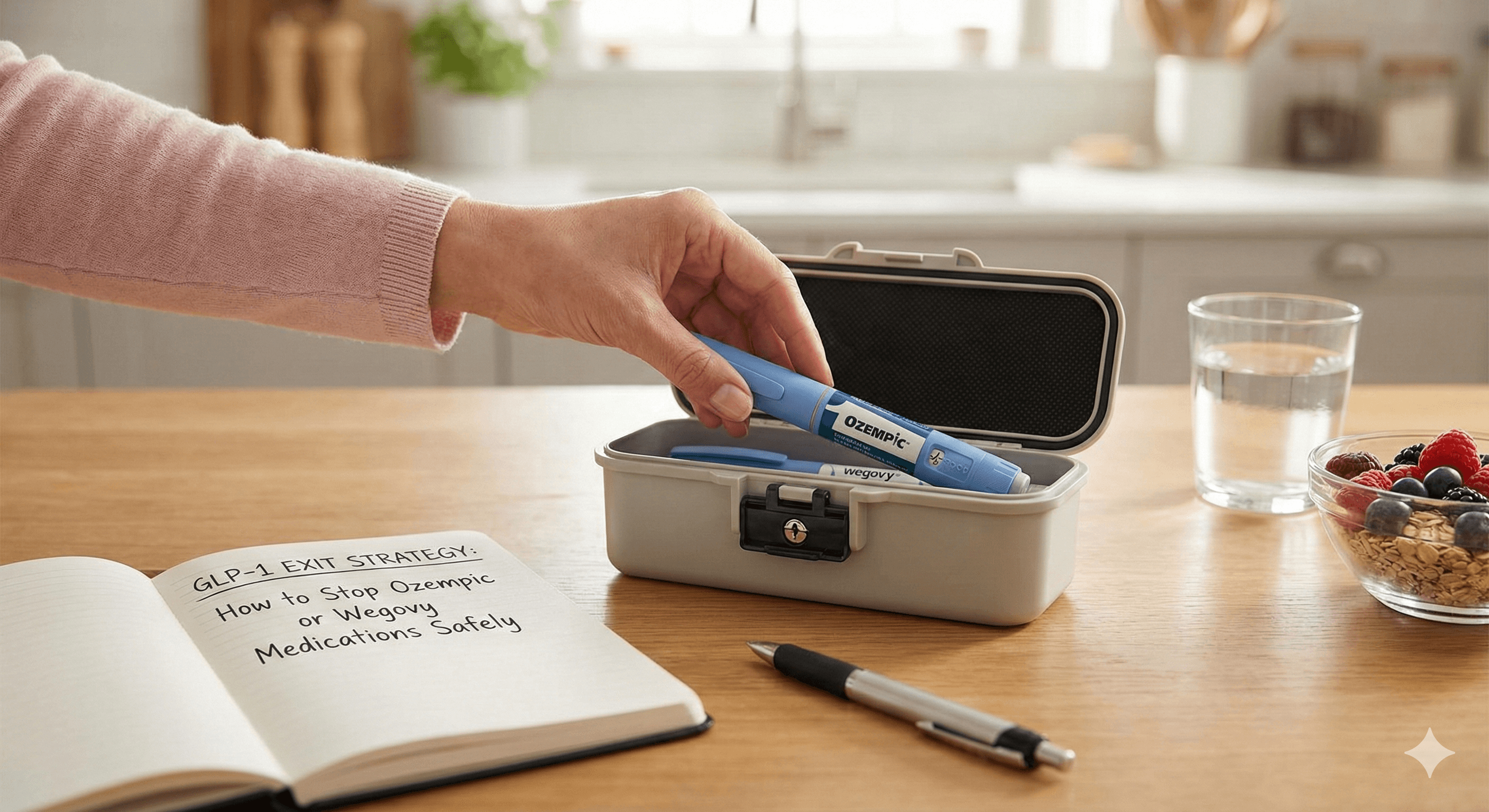
GLP-1 Exit Strategy: How to Stop Ozempic or Wegovy Medications Safely

Thinking about stopping a medication like Ozempic or Wegovy? If so, your primary concern is likely how to avoid gaining the weight back.
The statistics can feel sobering: research indicates that within 12 months of stopping GLP-1 weight loss injections, many patients regain a significant portion of their lost weight, with some studies showing regain rates approaching two-thirds or more. For people who have invested months of injections, deep dietary changes, and substantial financial resources into improving their health, this represents a frustrating setback.
However, weight regain after discontinuation is not an absolute certainty. With a strategic tapering protocol, professional guidance from a weight management clinic, and evidence-based lifestyle strategies, you can give your body the best chance to preserve your results. Here is a medically responsible playbook for transitioning off GLP-1 medications safely.
How GLP-1 Medications Actually Work in the Body
The Triple Mechanism
To understand why stopping abruptly is so difficult, you first need to understand the profound ways these medications alter your physiology. GLP-1 receptor agonists operate through three primary mechanisms:
- Appetite Suppression: These drugs activate GLP-1 receptors in the brain's appetite control centers, particularly the hypothalamus. This creates strong satiety signals that dramatically reduce hunger. Most patients report feeling full after eating small portions and experiencing very little "food noise" between meals.
- Delayed Gastric Emptying: GLP-1 medications physically slow the rate at which food leaves your stomach. This mechanical effect prolongs the feeling of physical fullness after eating and blunts the rapid blood sugar spikes that often trigger subsequent cravings.
- Metabolic Regulation: According to resources from the National Institute of Diabetes and Digestive and Kidney Diseases (NIDDK), these medications help regulate insulin and glucagon. This dual action stabilizes blood sugar levels, reducing the metabolic swings that drive intense sugar cravings and energy crashes.
The Rebound Effect Explained
When you stop GLP-1 medication cold turkey, your body doesn't simply return to its original baseline. Instead, you face a perfect storm of metabolic compensation:
- Homeostatic Hunger Surge: Your body naturally interprets significant weight loss as a threat to survival. Removing the medication that artificially suppressed your appetite unleashes a flood of hunger hormones—particularly ghrelin—which can spike to levels even higher than before your treatment began.
- Metabolic Adaptation: As you lose weight, your metabolic rate naturally decreases because a smaller body requires less energy. This adaptation persists even after stopping the medication. You may now be burning 200 to 400 fewer calories daily than someone of the same weight who never had to lose it, creating an immediate caloric surplus if your eating returns to previous patterns.
- Loss of Pharmacological Support: The medication's effects wash out of your system within days to weeks, depending on the specific drug's half-life. Suddenly, you are managing intense rebound hunger with willpower alone.
This metabolic backlash explains why abrupt discontinuation reliably produces weight regain. Fortunately, a structured tapering approach can help mitigate this shock to the system.
Evidence-Based Tapering Schedule to Minimize Rebound
Why Gradual Tapering Works
The fundamental key to successful GLP-1 discontinuation is giving your body time to adapt. A gradual taper provides several crucial benefits:
- Allows appetite hormones to recalibrate slowly rather than surging all at once.
- Provides a window to practice behavioral eating patterns while still having a safety net of pharmaceutical support.
- Gives your metabolism time to adjust to maintaining a newly lowered body weight.
- Helps you identify your personal hunger triggers before the medication is completely out of your system.
The 5-Step Tapering Protocol
Note: Never adjust your medication dosage without direct supervision from your prescribing healthcare provider.
Step 1: Extend Your Dosing Intervals (Weeks 1-4)
Instead of stopping completely, your provider may suggest extending the time between injections. If you take weekly injections, you might move to every 10 days, then every 14 days. This allows medication levels in your bloodstream to gradually decline while maintaining some baseline appetite control. (Best suited for longer-acting formulations like semaglutide).
Step 2: Reduce Your Dose by 25-30% (Weeks 5-8)
After establishing longer intervals, the next step is often reducing the actual dose. For example, dropping from 1mg to 0.5mg or 0.75mg. You should maintain this reduced dose for at least one full month while carefully monitoring your hunger levels and checking for weight stability. You will likely notice an increase in appetite, but it should feel manageable.
Step 3: Actively Monitor Hunger and Satiety Signals (Ongoing)
During the taper, keep a daily journal to track:
- Hunger levels on a scale of 1-10 before meals.
- Feelings of fullness 20 minutes after eating.
- Cravings, "food noise," or urges to snack between meals.
- Emotional eating triggers.
- Weekly (not daily) weight measurements to track overall trends.
Step 4: Continue Gradual Dose Reductions (Weeks 9-24)
Every 4 to 6 weeks, your provider may reduce your dose by another 25-30% or extend the intervals further. A complete, medically supervised taper typically takes 3 to 6 months. While this feels slow, clinical experience suggests that slower tapers significantly improve long-term weight maintenance.
Step 5: Final Discontinuation with Close Monitoring (Weeks 25-36)
After your final dose, you enter the highest-risk period for weight regain (the first 12 weeks post-discontinuation). Increase your monitoring frequency. If you notice a rapid regain of more than 5-7 pounds or experience uncontrollable binge-eating urges, contact your physician to discuss whether resuming a low maintenance dose is necessary.
Behavioral and Metabolic Strategies to Maintain Results
Nutritional Interventions
- Protein Prioritization: Aim for a high-protein intake daily. Protein provides superior satiety compared to carbohydrates or fats and is essential for preserving metabolically active lean muscle mass during the vulnerable post-medication period.
- Meal Timing Structure: While on GLP-1s, you may have naturally skipped meals due to a lack of appetite. Post-medication, establishing a structured eating schedule prevents extreme hunger build-ups that lead to overeating.
- Volume Eating Strategies: Focus on constructing high-volume, low-calorie-density meals. Fill half your plate with fibrous vegetables and lean proteins to physically stretch the stomach, recreating the mechanical fullness previously provided by the medication. Partnering with a professional for nutritional counseling and coaching can make this transition significantly easier.
Metabolic Preservation Strategies
- Resistance Training Priority: The single most important metabolic intervention you can make is preserving your muscle tissue. Aim for 3 to 4 strength training sessions weekly. If you are struggling to build muscle, specialized muscle building and toning therapies can provide targeted support to help counteract the metabolic adaptation of weight loss.
- NEAT Optimization: Non-exercise activity thermogenesis (NEAT)—the calories you burn doing daily tasks—often plummets during weight loss. The Centers for Disease Control and Prevention (CDC) recommends moving more and sitting less throughout the day. Take the stairs, stand during calls, and aim for a high daily step count.
- Sleep and Stress Management: Poor sleep and chronic stress elevate cortisol and ghrelin (the hunger hormone) while suppressing leptin (the fullness hormone). Prioritize 7 to 9 hours of quality sleep nightly to keep your hormones balanced.
Hunger Management Without Medication
- The Volumetrics Approach: Always start your meals with a high-volume, low-calorie appetizer, such as a broth-based soup or a large green salad.
- Appetite-Supporting Nutrients: While they cannot replicate the power of a GLP-1, certain dietary additions can offer modest support, such as soluble fiber supplements (like psyllium husk) taken before meals to promote physical fullness. Always clear supplements with your doctor first.
When to Consider Staying On Long-Term
For many patients, discontinuing GLP-1 medications completely may not be the optimal medical strategy. Long-term maintenance therapy is worth discussing with your doctor if:
- You have obesity-related health conditions (like type 2 diabetes or sleep apnea) that have drastically improved on the medication.
- You have attempted a slow taper previously but experienced rapid, uncontrollable weight regain.
- The medication has profoundly improved your quality of life, and you tolerate it well with minimal side effects.
Red Flags Requiring Medical Intervention
Reach out to your healthcare provider immediately if you experience:
- Rapid weight regain (more than 2-3 pounds per week consistently).
- The return of weight-related health issues, such as spiking blood pressure or blood sugar.
- Binge eating episodes or a complete loss of control around food.
- Severe emotional distress or depressive symptoms related to body changes.
Maryland Trim Clinic (MTC) in Laurel, MD
Transitioning off weight loss medication shouldn't be a journey you take alone. At the Maryland Trim Clinic (MTC) in Laurel, MD, patients receive compassionate, medically supervised support tailored to their unique biology. MTC understands that weight management is a chronic, evolving process. Through their comprehensive medical weight loss program, their team can help you design a safe tapering protocol, monitor your metabolic markers, and provide the behavioral and nutritional frameworks necessary to protect your progress. Whether you need ongoing maintenance care or a strategic exit plan, having a dedicated medical team in your corner makes all the difference. Visit the Maryland Trim Clinic homepage to learn more about their holistic approach to lasting wellness.
Frequently Asked Questions
Q: How long does it take to safely stop taking Ozempic or other GLP-1 medications?
A: A medically safe tapering schedule typically spans 3 to 6 months. This slow runway allows your appetite hormones and metabolism to adjust gently, drastically reducing the risk of a severe rebound. Tapering too quickly almost always results in overwhelming hunger surges.
Q: Will I definitely gain weight back after stopping GLP-1 medications?
A: It is not an absolute certainty, but it is highly common. Studies show up to 80% of patients regain significant weight within a year. However, patients who utilize a gradual taper, implement high-protein diets, maintain consistent strength training, and work closely with a medical provider have much higher success rates in keeping the weight off.
Q: Can I just cut my dose in half and stop, or do I need a specific tapering schedule?
A: Simply cutting your dose in half and stopping creates an abrupt transition that your body will likely fight against. A structured, multi-step taper—involving gradual dose reductions or extended injection intervals over several months—is strongly recommended to give your brain and gut time to adapt.
Q: What is the most important thing to focus on when stopping GLP-1 medications?
A: Protecting your muscle mass is paramount. Focus on hitting a high daily protein target and engaging in resistance training 3 to 4 times a week. Muscle is highly metabolic; preserving it helps counteract the natural metabolic slowdown that occurs after significant weight loss.
Q: Is it okay to stay on GLP-1 medications long-term instead of stopping?
A: Yes. Major medical organizations recognize obesity as a chronic, relapsing disease. Just as a patient with hypertension takes blood pressure medication long-term, utilizing GLP-1s for long-term weight maintenance is a clinically valid and often necessary approach. Discuss the risks and benefits of ongoing maintenance doses with your provider.
Medical Disclaimer: The information provided in this article is for educational purposes only and does not substitute for professional medical advice, diagnosis, or treatment. Always consult with your physician or a qualified healthcare provider before stopping, starting, or adjusting the dosage of any prescription medication, including GLP-1 receptor agonists.
Ready to Create Your Personalized Tapering Plan?
If you are considering stepping down your medication, don't leave your hard-earned results to chance. Schedule a consultation with a medical professional to design a step-by-step tapering and maintenance strategy that fits your body's unique needs.