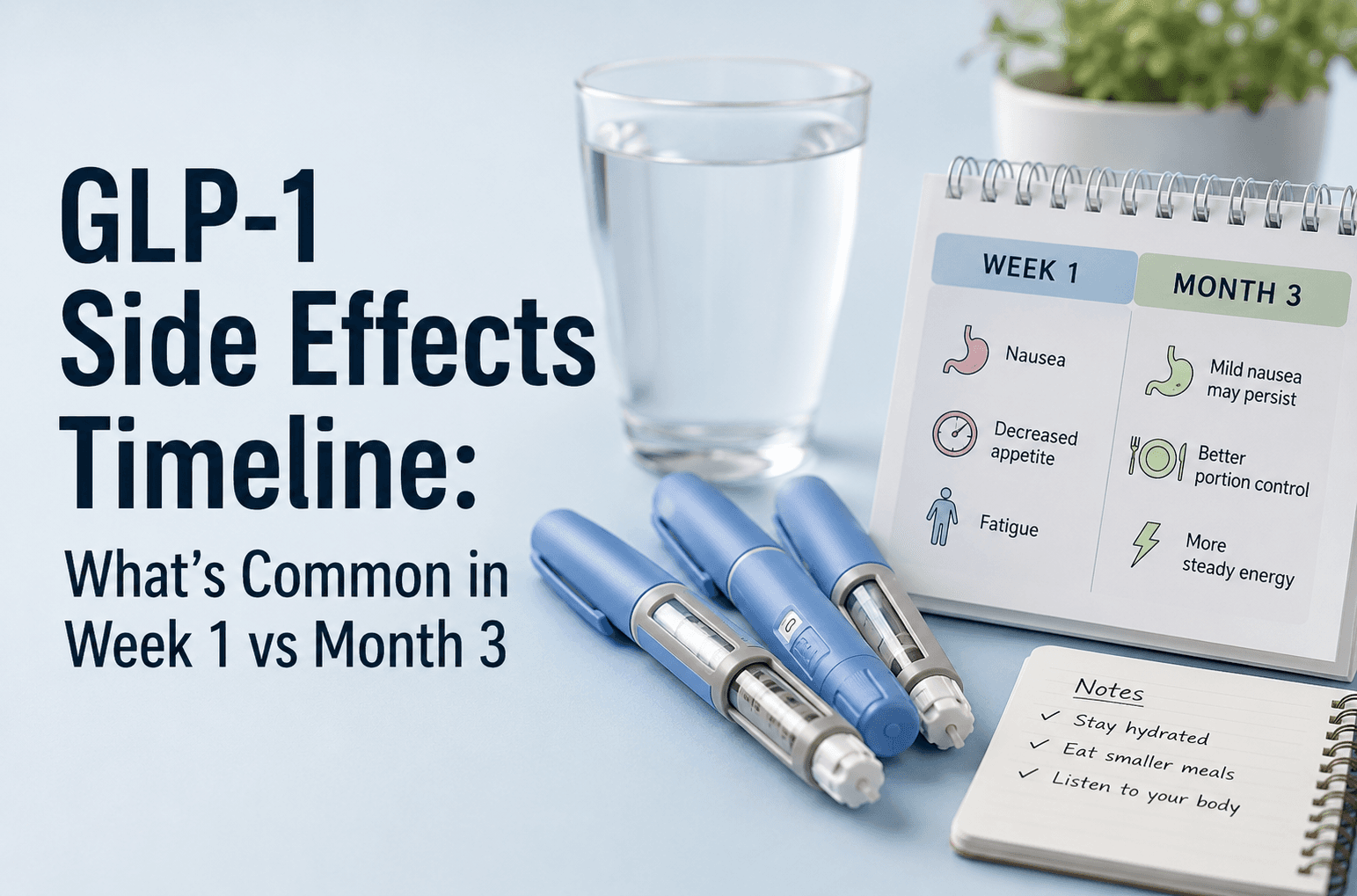
GLP-1 Side Effects Timeline: Week 1 to Month 3


Starting a GLP-1 medication can make every new stomach sensation feel significant. Is nausea expected in week 1? Should constipation still be happening in month 3? Does a return of symptoms after a dose change mean something is wrong?
A useful GLP-1 side effects timeline is less predictable than many online charts suggest. Gastrointestinal symptoms such as nausea, diarrhea, vomiting, constipation, abdominal discomfort, and indigestion are common with semaglutide and tirzepatide. They are often more noticeable during treatment initiation and dose escalation, then may decrease as treatment continues. Still, there is no universal day when side effects begin or a guarantee that they disappear by month 3. Current prescribing information emphasizes individual tolerability and symptom monitoring rather than a fixed week-by-week pattern.
GLP-1 Side Effects Timeline: The Quick Answer
Week 1 may bring nausea, reduced appetite, fullness, bloating, diarrhea, or constipation, although some people notice few symptoms. By month 3, early digestive effects may be less intense if treatment is tolerated, but a dose increase can trigger another flare. Persistent, severe, or worsening symptoms need medical review.
Medical Disclaimer: Educational information only. Do not start, stop, or change any medication without speaking to your healthcare provider. If you have severe symptoms or think you’re having an emergency, call 911 or seek emergency care.
What the GLP-1 Side Effects Timeline Actually Looks Like
A timeline can help set expectations, but it should not be treated like a countdown clock. Semaglutide and tirzepatide are usually introduced with gradual dose escalation because gastrointestinal tolerability matters. Current Wegovy and Zepbound labeling specifically connects escalation schedules with reducing or managing gastrointestinal adverse reactions.
Treatment stage
What may be common
What deserves attention
Week 1
Nausea, fullness, reduced appetite, bloating, indigestion, diarrhea, constipation, fatigue
Repeated vomiting, severe pain, inability to stay hydrated
Weeks 2 to 4
Early symptoms may settle, persist, or fluctuate
Symptoms interfering with eating, drinking, or daily function
Weeks 5 to 8
Symptoms may reappear after clinician-directed dose escalation
A significant return or worsening of gastrointestinal symptoms
Months 2 to 3
Some patients tolerate treatment more comfortably; constipation, reflux, or intermittent nausea may continue
Persistent or progressive symptoms rather than gradual improvement
After month 3
Symptoms may remain mild or infrequent at a tolerated regimen
New severe symptoms should not automatically be blamed on the medication
The most important pattern is not simply "week 1 is bad and month 3 is good." A more accurate pattern is initiation, adaptation, possible symptom flare during dose escalation, and reassessment based on tolerability. Zepbound's prescribing information reports that the majority of nausea, vomiting, and diarrhea events occurred during dose escalation and decreased over time. Wegovy labeling similarly reports that gastrointestinal reactions were most frequently reported during dosage escalation.
Week 1: Early Semaglutide and Tirzepatide Side Effects
During the first week, some patients notice a clear change in appetite or how quickly they feel full. Others feel relatively normal. The absence of early side effects does not by itself mean a medication is failing, and noticeable nausea is not proof that a medication is "working better."
What may feel different during the first week?
Common early complaints can include:
- Nausea or a mildly unsettled stomach
- Feeling full after smaller meals
- Reduced interest in food
- Bloating or belching
- Indigestion or heartburn
- Diarrhea
- Constipation
- Abdominal discomfort
- Fatigue
These symptoms overlap with adverse reactions listed in current prescribing information for Wegovy and Zepbound.
The widely repeated claim that GLP-1 symptoms always begin within 24 to 72 hours is too precise. The official prescribing information does not assign nausea or constipation a universal 24-to-72-hour onset window. Symptom timing can vary according to the medication, formulation, treatment stage, individual response, food intake, other medicines, and gastrointestinal history. That is an inference from the variability recognized in current labeling, not a fixed rule.
Patients beginning GLP-1 weight-loss injections with medical supervision may benefit from tracking what they feel, when it occurs, and whether symptoms affect hydration or normal food intake. Maryland Trim Clinic describes regular follow-up and side-effect monitoring as part of its GLP-1 service.
Weeks 2 to 4: Is Your Body Adjusting or Are Symptoms Persisting?
The first month is often an adjustment period, but "adjusting" should not become a reason to dismiss significant symptoms.
A person who experienced mild nausea in week 1 may notice it becomes less frequent. Diarrhea may settle. Appetite effects may become easier to predict. Another patient may continue dealing with constipation or reflux.
What matters is the direction and severity of symptoms.
Mild symptoms that gradually become easier to manage are different from repeated vomiting, progressive abdominal pain, or gastrointestinal problems that make it difficult to drink enough fluid. Current Wegovy and Zepbound medication information advises patients to report gastrointestinal symptoms that are severe, persistent, or do not go away.
This is also a period when food quality can become more important. A sharp drop in appetite may unintentionally reduce protein, fiber, and overall nutrient intake. Patients who are struggling to build meals around a smaller appetite may benefit from nutritional counseling and coaching rather than relying on a generic list of "GLP-1 foods." MTC's nutrition service focuses on personalized eating guidance and health goals.
Weeks 5 to 8: Why Side Effects Can Come Back
One of the most confusing parts of the GLP-1 nausea timeline is that feeling better does not always mean nausea is gone permanently.
A patient may tolerate treatment for several weeks and then experience nausea, diarrhea, fullness, or reflux again after a clinician-directed dose increase. That pattern is consistent with prescribing information describing gastrointestinal adverse reactions during escalation.
This does not mean everyone will develop symptoms after every dosage change. It also does not mean patients should alter their own medication schedule.
For Wegovy, current prescribing information states that escalation is designed to reduce gastrointestinal adverse reactions and allows clinicians to consider delaying escalation when a dose is not tolerated. Zepbound labeling also directs clinicians to consider treatment response and tolerability when choosing a maintenance dose. These are prescribing decisions for healthcare professionals, not instructions for patients to independently delay, increase, or decrease medication.
A physician-led medical weight loss program may help patients discuss symptom changes in the context of their broader health and treatment progress instead of treating every side effect as an isolated problem. MTC describes monitoring and prescription treatment when medically appropriate as part of this program.
Month 3: Should GLP-1 Side Effects Be Gone by Now?
No. GLP-1 side effects do not have to be completely gone by month 3, although nausea, vomiting, or diarrhea may decrease over time in patients who tolerate treatment. Dose escalation can affect the timeline, and constipation, indigestion, reflux, or intermittent gastrointestinal symptoms may continue in some patients.
The idea that month 3 is automatically a "stabilization phase" oversimplifies treatment.
For example, current Wegovy injection labeling uses a staged escalation schedule that extends beyond 12 weeks before the standard maintenance stage. Zepbound labeling also uses gradual increases separated by at least four weeks. A patient may therefore still be in an escalation period around month 3, depending on the prescription and tolerability.
That distinction matters. Nausea returning in month 3 may have a different context if it appeared shortly after a medication change. Conversely, new severe abdominal pain after months of treatment should not be automatically described as "normal adjustment."
What about hair shedding around month 3?
Hair loss appears among the reported common side effects in current Wegovy and Zepbound medication information. However, a rigid claim that hair shedding always starts in weeks 6 to 8 is not supported by the prescribing information.
Changes in weight, nutritional intake, and other medical factors can also be relevant when evaluating hair loss. A clinician may need to consider the wider health picture instead of assuming the medication is the sole cause.
Tracking changes beyond body weight can be useful during longer-term treatment. MTC offers high-precision 3D body scanning for body-composition and progress tracking. The clinic's service information describes repeat scanning as one option for following fat and muscle trends over time.
The GLP-1 Nausea Timeline: Why Nausea Often Fluctuates
Nausea is one of the most recognizable GLP-1 side effects.
In adult weight-reduction trials summarized in current Wegovy labeling, nausea was reported in 44% of patients receiving Wegovy 2.4 mg injection compared with 16% receiving placebo. In pooled Zepbound weight-reduction trials, nausea was reported in 25% to 29% of treatment groups across labeled doses compared with 8% receiving placebo. These numbers come from separate clinical trial programs and should not be used as a direct head-to-head comparison. Wegovy's prescribing information specifically cautions that adverse-reaction rates from different drug trials cannot simply be compared.
A practical nausea timeline may look like this:
After starting treatment: nausea may occur, but some patients have little or none.
During early adjustment: mild symptoms may become less frequent as treatment continues.
After a dosage increase: nausea can appear or become more noticeable again.
At a tolerated treatment stage: nausea may decrease, although persistent symptoms require review.
For mild nausea, smaller meals and stopping before uncomfortable fullness may be easier to tolerate than large meals. High-fat meals may worsen gastrointestinal discomfort for some patients. Hydration is also important because prolonged nausea accompanied by vomiting or diarrhea can contribute to volume depletion. Expert consensus on managing GLP-1 gastrointestinal adverse effects supports smaller portions, avoiding overly fatty foods, and maintaining adequate fluid intake.
Do not independently use a dose change as a nausea-management strategy. A healthcare professional should evaluate persistent or significant symptoms.
The GLP-1 Constipation Timeline: Why It May Last Longer
Constipation can be less dramatic than vomiting, but it can become an ongoing quality-of-life problem.
Current Wegovy labeling reports constipation among common adverse reactions, with 24% of adults receiving Wegovy 2.4 mg injection reporting it in the weight-reduction trials summarized in the label. Zepbound trial data in its prescribing information reported constipation in 11% to 17% of treatment groups across labeled doses. Again, these were separate studies and the percentages should not be interpreted as proof that one medication is more constipating than another.
Unlike nausea, the Zepbound label's statement that events decreased over time specifically refers to the majority of nausea, vomiting, and diarrhea events. It does not make the same timeline claim for constipation.
That is one reason a GLP-1 constipation timeline can be harder to predict.
A patient may first notice fewer bowel movements in the early weeks. Lower food intake may also mean less dietary volume. Changes in fluid intake, fiber, activity, other medications, and pre-existing bowel patterns can affect symptoms.
For mild constipation, a clinician may ask about hydration, dietary fiber, physical activity, and other medications. Fiber should be considered in the context of the individual's symptoms. Someone with severe abdominal swelling, significant pain, or repeated vomiting should seek medical guidance rather than simply adding more fiber and assuming the problem is routine constipation.
Patients trying to understand how energy needs and nutrition change during weight loss may also discuss metabolic testing and analysis as part of a broader plan. MTC describes its metabolic testing service as measuring resting metabolic rate to help inform personalized calorie and macronutrient goals.
How to Manage Common GLP-1 Side Effects More Safely
The goal is not to "push through" every symptom. It is to recognize mild effects, reduce avoidable triggers, and know when medical review is appropriate.
For mild nausea
Try smaller portions and eat slowly. Stop eating when comfortably full rather than continuing until the plate is empty. Heavy or high-fat foods may be harder to tolerate for some people.
For constipation
Pay attention to fluid intake, fiber, physical movement, and changes in your usual bowel pattern. Ask your healthcare provider before adding a laxative or other medication if constipation is persistent or you have other medical conditions.
For diarrhea
Replace fluids and monitor how often diarrhea is occurring. Persistent diarrhea matters because fluid loss can contribute to dehydration and kidney problems. Both Wegovy and Zepbound medication information warn about dehydration related to nausea, vomiting, or diarrhea.
For fatigue
Reduced appetite can sometimes make it harder to consume enough food and nutrients. Fatigue can also have many causes unrelated to GLP-1 therapy. Persistent or substantial fatigue deserves individual assessment rather than an automatic assumption that electrolytes or a single supplement will solve the problem.
Keep a symptom log
Record the symptom, its severity, when it occurred relative to medication administration or a clinician-directed medication change, foods eaten, bowel changes, and whether you could drink normally.
A symptom log gives a clinician more useful information than simply saying, "The medication makes me sick."
What GLP-1 Symptoms Require Urgent Medical Attention?
Most common adverse effects are gastrointestinal, but some symptoms can overlap with serious medication warnings.
Seek prompt medical guidance or urgent care when medically appropriate for symptoms such as:
- Severe or persistent abdominal pain, especially pain that does not go away and may radiate to the back. This can be a warning symptom of pancreatitis.
- Persistent vomiting, nausea, or diarrhea that does not go away, particularly if you cannot maintain fluid intake. Dehydration can contribute to acute kidney injury.
- Upper abdominal pain, fever, jaundice, or clay-colored stools, which are listed as warning symptoms of gallbladder problems in Zepbound's medication guide.
- Swelling of the face, lips, tongue, or throat, trouble breathing or swallowing, severe rash, fainting, or a very rapid heartbeat, which may indicate a serious allergic reaction.
- Significant vision changes in a patient with type 2 diabetes, which should be reported to a healthcare professional.
- Severe symptoms of low blood sugar, particularly in people using insulin or a sulfonylurea with GLP-1-related treatment.
The current Wegovy prescribing information and current Zepbound prescribing information provide detailed warnings and patient counseling information.
Patients should also tell surgical and anesthesia teams about GLP-1 or tirzepatide treatment before procedures involving general anesthesia or deep sedation because current labeling includes warnings related to delayed gastric emptying and pulmonary aspiration. Do not independently decide when to stop or restart medication around a procedure.
How Clinicians Monitor Side Effects Over Time
Side-effect monitoring should answer more than one question.
A clinician may consider:
- Is the symptom mild, moderate, or severe?
- Is it improving, stable, or becoming worse?
- Did it appear during initiation or after a prescription change?
- Is the patient able to eat and drink adequately?
- Are bowel habits changing significantly?
- Are other medications contributing?
- Does the patient have diabetes, kidney disease, gallbladder history, gastrointestinal disease, or another relevant condition?
- Are symptoms affecting the patient's ability to continue treatment?
Kidney function may require attention when gastrointestinal symptoms create a risk of significant fluid loss. Blood glucose may need closer monitoring in patients with diabetes, particularly those using insulin or insulin secretagogues. Current labels also include specific monitoring considerations for diabetic retinopathy.
As weight changes, progress may also need to be viewed beyond the bathroom scale. MTC's weight loss maintenance program emphasizes follow-up, accountability, and adjustment as health and lifestyle needs change.
Managing GLP-1 Side Effects With Maryland Trim Clinic in Laurel, MD
A timeline is helpful, but medical supervision matters because the same symptom can mean different things in different patients.
At Maryland Trim Clinic, GLP-1 services are positioned within a broader medical weight-management approach that includes assessment, follow-up, nutrition guidance, and progress monitoring. The clinic is located in Laurel, Maryland.
For a patient dealing with early nausea, persistent constipation, or symptoms that return after a treatment change, an individualized review may consider medical history, current medications, symptom severity, hydration, food intake, previous gastrointestinal concerns, and overall treatment goals.
Not every side effect means treatment must be stopped. Likewise, not every uncomfortable symptom should be dismissed as a normal part of taking a GLP-1 medication.
Patients in Laurel and surrounding Maryland communities can contact Maryland Trim Clinic to discuss medical weight-loss evaluation, treatment monitoring, and current GLP-1 options. Eligibility and treatment decisions depend on individual clinical assessment.
The Bottom Line
The most accurate GLP-1 side effects timeline is not a straight line from "sick in week 1" to "fully adjusted by month 3."
Digestive symptoms are common early and during dose escalation. Nausea, vomiting, and diarrhea may decrease over time, but treatment changes can bring symptoms back. Constipation may follow a less predictable pattern, and month 3 is not a guaranteed side-effect finish line.
Track the pattern, pay attention to severity, and discuss persistent or worsening symptoms with a healthcare professional. The goal of medically supervised weight management is not simply to tolerate a prescription at any cost. It is to find an appropriate treatment plan while continuing to monitor your health.
Frequently Asked Questions
What side effects are most common early on?
Nausea, diarrhea, vomiting, constipation, abdominal discomfort, indigestion, bloating, and changes in appetite are among the most common early concerns. Some patients may also notice fatigue, belching, or heartburn. Symptoms vary considerably, and some people have few noticeable side effects during the first weeks. Gastrointestinal reactions are especially associated with treatment initiation and dose escalation.
When do GLP-1 side effects usually improve?
Many gastrointestinal side effects may decrease as treatment continues, but there is no guaranteed week when they disappear. Current Zepbound labeling says the majority of nausea, vomiting, and diarrhea events occurred during dose escalation and decreased over time. Wegovy gastrointestinal reactions were also most frequently reported during escalation. A later dosage change can therefore affect an individual's side-effect timeline.
What GLP-1 symptoms require urgent care?
Severe persistent abdominal pain, repeated vomiting with inability to maintain fluids, symptoms of serious dehydration, or signs of a severe allergic reaction require prompt medical attention. Upper abdominal pain with fever or jaundice may signal a gallbladder problem. The appropriate level of care depends on symptom severity, but serious or rapidly worsening symptoms should not be managed by simply waiting for them to pass.
How can dosing changes affect GLP-1 side effects?
Dose escalation can make gastrointestinal symptoms more noticeable or cause symptoms to return after a quieter period. Both Wegovy and Zepbound use gradual escalation approaches partly because tolerability matters. Medication changes should be clinician-directed. Patients should not independently increase, reduce, delay, stop, or restart prescription treatment to manage side effects.
How long does GLP-1 nausea last?
There is no fixed nausea duration for every patient. Nausea may occur early, improve with continued treatment, and sometimes become noticeable again after a clinician-directed dose increase. Persistent nausea that interferes with hydration, nutrition, or daily function should be discussed with a healthcare professional rather than assumed to be a normal adjustment symptom.
Is constipation normal after three months on a GLP-1 medication?
Constipation can still occur after three months, and its timeline is not as clearly described as the pattern for nausea, vomiting, and diarrhea. Food intake, hydration, fiber, activity, other medications, and baseline bowel habits may all be relevant. Persistent constipation, significant abdominal swelling, severe pain, or vomiting should be evaluated rather than treated as routine constipation.
Are tirzepatide side effects worse than semaglutide side effects?
Not necessarily. Both have substantial gastrointestinal side-effect profiles, but percentages from separate Wegovy and Zepbound clinical trial programs cannot be treated as a direct comparison. Individual tolerance varies. A medication that causes fewer symptoms for one patient may be difficult for another, so side-effect severity and treatment decisions need individualized clinical review.
Does having no side effects mean my GLP-1 medication is not working?
No. The absence of nausea, constipation, or other side effects does not prove that a GLP-1-related medication is ineffective. Side effects and therapeutic response are not the same measurement. Treatment progress should be assessed according to the medication's purpose, health goals, clinical response, and the monitoring plan established with the prescribing healthcare professional.
Get Help Understanding Your GLP-1 Side Effects
GLP-1 symptoms can change from the first week through later treatment, especially around medication adjustments. Maryland Trim Clinic offers medically supervised weight-management services in Laurel, MD for patients who need individualized evaluation, monitoring, and support. A consultation can help put your symptoms, health history, nutrition, and treatment goals into context without assuming that every patient should follow the same timeline or use the same medication.
Get Help Understanding Your GLP-1 Side Effects
GLP-1 symptoms can change from the first week through later treatment, especially around medication adjustments. Maryland Trim Clinic offers medically supervised weight-management services in Laurel, MD for patients who need individualized evaluation, monitoring, and support. A consultation can help put your symptoms, health history, nutrition, and treatment goals into context without assuming that every patient should follow the same timeline or use the same medication.