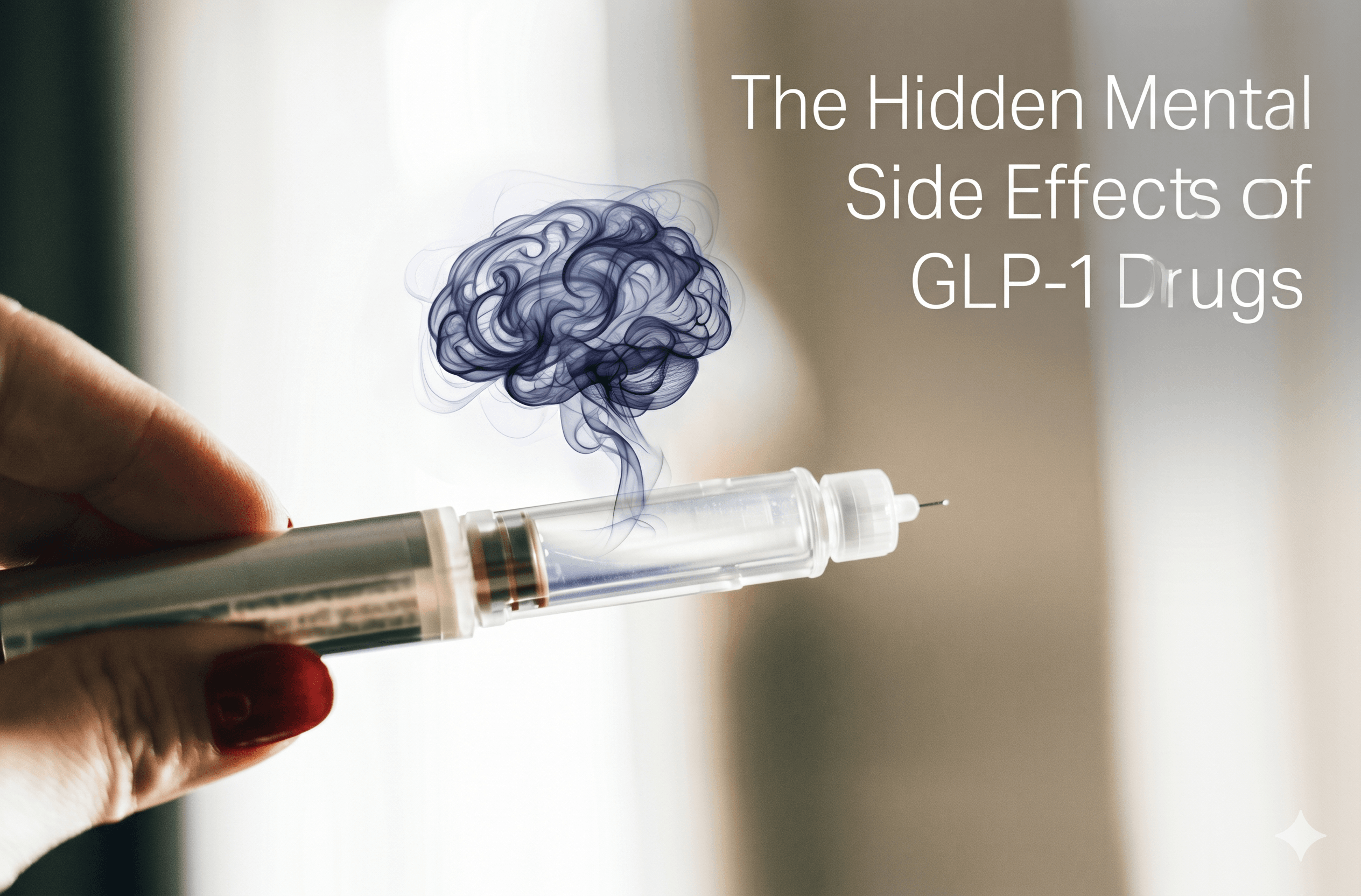
The Hidden Mental Side Effects of GLP-1 Drugs

You're losing weight but feeling nothing. Is your weight loss drug making you emotionally numb?
For millions of people taking GLP-1 receptor agonists like semaglutide (Ozempic, Wegovy) and tirzepatide (Mounjaro, Zepbound), the physical results can feel like a miracle. Clothes fit differently. The number on the scale moves in the right direction. Friends notice. But beneath that visible physical transformation, a quieter and more troubling story is emerging—one that doctors rarely warn patients about before they fill their first prescription.
A growing number of GLP-1 users are reporting something that doesn't show up on a weight chart: a persistent emotional flatness, a loss of motivation, and a blunted capacity for joy that shadows their physical progress. They are thinner, but they are not happier. In some cases, they feel actively worse—not in a way that's easy to name or explain to a physician, but in a way that quietly hollows out daily life.
This phenomenon is increasingly being called GLP-1 blunting, and understanding it may be one of the most important conversations in weight loss medicine right now.
ACT 1: What 'GLP-1 Blunting' Actually Feels Like
Scroll through any GLP-1 community forum or patient group, and a pattern emerges that isn't about the standard physical side effects like nausea or fatigue. It is something harder to articulate:
- "I should be happy. I've lost 40 pounds. But I feel like I'm watching my life through a window."
- "Food noise is gone, which is great. But so is music. And laughter. And wanting to do anything."
- "I cried at my daughter's recital before I started the medication. Now I sit there and I feel... present but not there. Like the volume got turned down on everything."
These aren't isolated complaints. They represent a pattern that researchers, psychiatrists, and endocrinologists are beginning to take very seriously. The technical term some clinicians use is anhedonia—a reduced ability to feel pleasure or reward—and it appears to be an underreported side effect, particularly at higher doses of GLP-1 weight loss injections.
What makes this particularly confusing for patients is the mismatch. Objectively, their lives are improving. They are healthier, more mobile, and receiving positive reinforcement. Yet internally, the emotional reward system isn't keeping pace. The wins don't feel like wins.
Signs You Might Be Experiencing GLP-1 Blunting:
- Motivational flatness: Difficulty initiating tasks, not from sadness or physical exhaustion, but from a profound lack of internal drive.
- Social withdrawal: Less interest in conversation, socializing, or activities that used to feel engaging.
- Reduced libido: A distinct dampening of physical and emotional desire that extends far beyond food.
- Creative blunting: Writers, musicians, and professionals describing a loss of inspiration or imaginative engagement.
- Emotional distance in relationships: Partners and family members noticing a withdrawal that you may not fully perceive yourself.
Critically, many users report these symptoms emerging or worsening at higher dose escalations—particularly when moving from a lower maintenance dose to a higher therapeutic dose. This dose-dependency is an important clue to what may be happening neurologically.
ACT 2: Why High Doses May Suppress Mood-Related Brain Signals
To understand why GLP-1 drugs might affect your emotional experience, you have to understand what GLP-1 receptors actually do in the brain—because their role extends far beyond appetite regulation.
GLP-1 (glucagon-like peptide-1) is not just a gut hormone. Receptors for GLP-1 are distributed throughout the central nervous system, including in regions deeply involved in emotional processing and reward. These include the hypothalamus, the nucleus accumbens, the prefrontal cortex, and the ventral tegmental area (VTA)—a core node in the brain's dopamine reward circuit.
The Dopamine Connection
The dopamine reward system is essentially the brain's motivation and pleasure engine. It fires when you anticipate or experience something rewarding: food, sex, social connection, achievement, or creative expression. It is what makes effort feel worthwhile.
According to peer-reviewed pharmacological research published by the National Institutes of Health (NIH), GLP-1 receptors in the mesolimbic system actively modulate and reduce reward-driven behaviors. At therapeutic doses, this interaction successfully reduces "food noise"—the obsessive preoccupation with eating. For people whose relationship with food has been driven by compulsive reward-seeking, quieting that circuit can feel like freedom.
But the brain does not have a dial labeled "food reward" that operates independently from everything else. The same dopaminergic pathways that generate compulsive food cravings also generate motivation, creative desire, social bonding, and the capacity to feel joy.
When GLP-1 agonists at higher doses suppress dopamine signaling more broadly, the result may be a system-wide blunting of reward sensitivity. The medication that silences the craving for a second slice of cake may also inadvertently silence the anticipation of seeing a friend or the warmth of a laugh with a partner.
Distinguishing Blunting from Depression
It is vital to draw a clinical distinction between anhedonia and severe clinical depression. Recently, the U.S. Food and Drug Administration (FDA) requested the removal of suicidal ideation warnings from GLP-1 medications after comprehensive reviews found no increased risk of suicidal behavior. However, experiencing a gray, flattened emotional landscape (dysthymia or blunting) is a distinct, nuanced neurological side effect that still requires careful medical attention.
ACT 3: When to Talk to Your Doctor — and What to Say
The challenge with GLP-1-related emotional side effects is that they are easy to misattribute. Patients and physicians alike may assume that low mood is a pre-existing mental health issue, a reaction to life stress, or simply the psychological complexity of a major body change.
Here is how to identify whether your emotional experience may be dose-related and what to do about it.
Recognize the Timeline
One of the strongest signals that emotional blunting is medication-related is timing. Did your mood shift around the time you increased your dose? If you can identify a direct correlation between dose escalation and emotional change, that is medically significant information. Keep a simple log detailing the date, your current dose, and a brief note on your emotional state.
Understand That This Is a Legitimate Medical Concern
Many patients hesitate to raise emotional side effects because they feel ungrateful—they are losing weight, after all—and worry a doctor will dismiss the complaint as trivial. Emotional wellbeing is a core component of health. A medication that improves metabolic outcomes while degrading your quality of life is not a net win. You are entitled to raise this concern without apology.
Specific Questions to Ask Your Doctor
Come to your appointment prepared with direct, actionable questions:
- "Could my current dose be contributing to the emotional flatness and apathy I'm experiencing?"
- "Is there evidence that a lower maintenance dose might preserve my metabolic benefits with fewer neurological side effects?"
- "Should I be screened for depression or anhedonia to establish a baseline?"
- "What would a supervised dose reduction trial look like, and how will we monitor it?"
Consider a Dose Reduction Trial
For some patients, the highest approved dose is not necessary to maintain meaningful weight loss or glycemic benefits. Many individuals find that a lower dose produces significantly less emotional blunting. This is a clinically reasonable approach, and progressive endocrinologists are already recommending it proactively.
Don't Discontinue Without Medical Guidance
Do not abruptly stop a GLP-1 medication without speaking to your doctor. Discontinuation can have rapid metabolic consequences, including severe blood sugar spikes and immediate weight regain. There are often better solutions—such as dose adjustments or spacing out injections—that preserve the benefits while addressing the emotional side effects.
Build a Support Structure
If emotional blunting is affecting your relationships or your sense of self, consider working with a therapist. Having professional support to navigate the emotional terrain of major body changes alongside medication effects is genuinely valuable.
Maryland Trim Clinic (MTC) in Laurel, MD
Navigating the complex physical and emotional changes of medical weight loss is not something you should ever have to do alone. Located in Laurel, MD, the Maryland Trim Clinic (MTC) provides the comprehensive, compassionate clinical oversight needed to ensure your treatment improves your whole life—not just your waistline.
If you are experiencing emotional flatness, apathy, or a loss of motivation, our expert medical team can help. When you enroll in our holistic medical weight loss program, we don't just blindly increase your dosage; we closely monitor your metabolic and psychological response to the medication. We may incorporate nutritional counseling and coaching to support brain health naturally, or explore whether hormone replacement therapy is needed to address underlying endocrine imbalances that frequently mimic depression. At MTC, your mental wellbeing is treated with the exact same priority as your physical health.
The Broader Conversation We Need to Have
GLP-1 drugs represent a genuine medical advance. For many people, they have transformed not just physical health but provided freedom from an exhausting, lifelong struggle. That is real and worth honoring.
But medicine's obligation doesn't end at the scale. The goal of treatment is a better life—not just a lighter body. As these medications become more widely prescribed and doses escalate in pursuit of greater weight loss targets, the medical community must develop better frameworks for monitoring their neurological and psychological effects.
Patients deserve to be warned that their emotional experience may shift. They deserve to be screened, not just weighed. And they deserve the assurance that if they are losing weight but feeling nothing, that is a medical problem—not a personal failing—and it is worth solving.
You came to these medications to feel better. All of you. Hold that standard.
Medical Disclaimer: The information provided in this article is for educational purposes only and is not intended as a substitute for professional medical or psychiatric advice. Always seek the advice of your physician or mental health provider regarding any questions or symptoms related to your physical or mental health.
Frequently Asked Questions
Q: What is GLP-1 blunting and is it a recognized medical condition?
A: GLP-1 blunting is a term used by patients and clinicians to describe emotional flatness, reduced motivation, and anhedonia (diminished capacity for pleasure) experienced by some users of GLP-1 medications. While not yet a formally codified standalone diagnosis, the underlying mechanism—GLP-1 receptors interacting with dopamine reward pathways—is heavily supported by neurological research.
Q: Are emotional side effects more common at higher GLP-1 doses?
A: Yes. Based on patient-reported experiences and pharmacology, emotional blunting appears more prevalent at higher dose levels. This dose-dependency suggests that neurological effects on reward pathways scale with the extent of GLP-1 receptor activation in the brain.
Q: Could my low mood on a GLP-1 drug just be pre-existing depression?
A: It's possible, but the key diagnostic clue is timing. If your emotional flatness began or significantly worsened right after starting or increasing your GLP-1 medication, that correlation is clinically significant. Discuss the exact timeline carefully with your doctor.
Q: Will reducing my GLP-1 dose bring back my emotional responsiveness?
A: For many patients, yes. Those who reduce to a lower maintenance dose often report a rapid recovery of emotional tone, motivation, and capacity for pleasure. Importantly, many also find that their metabolic benefits are preserved at these lower doses.
Q: Can GLP-1 drugs also have positive effects on mental health?
A: Yes, which makes the picture beautifully complex. Some research suggests GLP-1 agonists have neuroprotective properties and may reduce neuroinflammation associated with depression. The relationship between these drugs and brain chemistry is highly individualized.
Q: Is it safe to stop taking my GLP-1 medication if I'm experiencing emotional side effects?
A: You should never discontinue a GLP-1 medication abruptly without medical guidance. Stopping suddenly can trigger a rapid return of appetite dysregulation, weight regain, and blood sugar spikes. Speak with your doctor about a gradual, supervised dose reduction instead.
Ready to Reclaim Your Mental and Physical Health?
Don't let the hidden side effects of weight loss medications compromise your joy and quality of life. Visit the Maryland Trim Clinic homepage today to schedule a comprehensive consultation. Our dedicated team in Laurel, MD, will help you find the perfect balance, optimizing your metabolic health while fiercely protecting your emotional wellbeing.