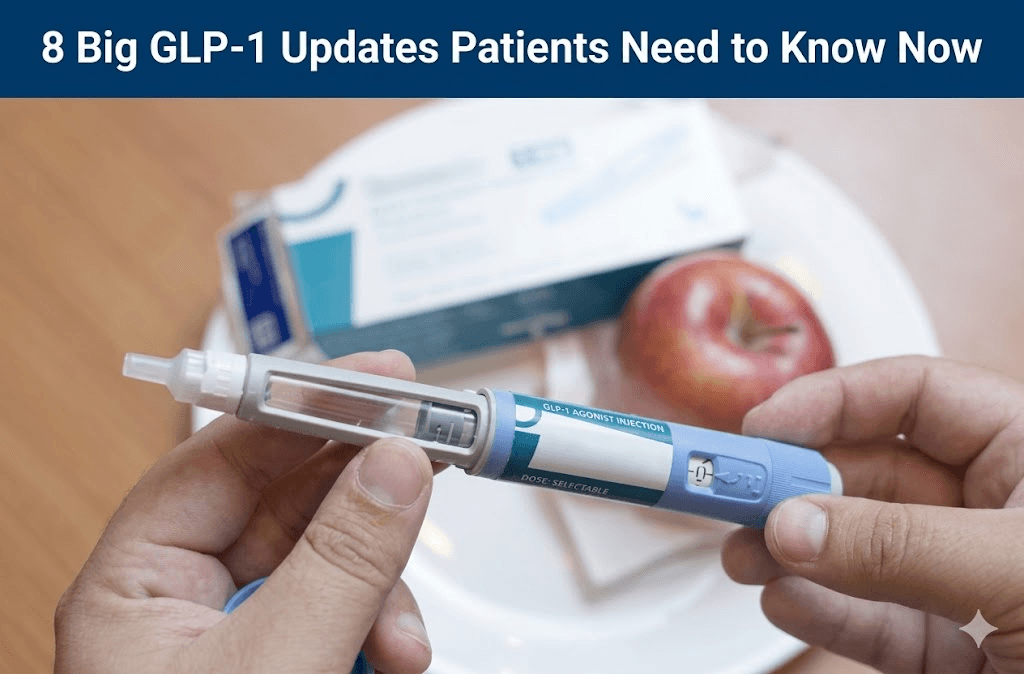
8 Major GLP-1 Updates: Foundayo, FDA Shortages & Zepbound

In one week, eight major GLP-1 announcements dropped—here is what actually matters for your treatment.
If you have been utilizing medications like Zepbound, Wegovy, or Ozempic for any length of time, you already know the drill: a headline hits, your phone buzzes with notifications, and suddenly everyone in your online support group is asking whether they need to call their doctor.
Most of the time, the news sounds bigger than it is. But occasionally, a week comes along where the announcements are dense, layered, and genuinely consequential. This past week was one of those weeks. Eight significant updates landed in a short span, touching everything from FDA supply designations to Medicare reimbursement policies and the arrival of a brand-new oral option.
The challenge isn't finding the news; it's figuring out which pieces of it actually change something for you. That is what this breakdown is for.
ACT 1: FDA AND PHARMA ANNOUNCEMENTS AFFECTING SUPPLY AND PRICING
1. The FDA Officially Removed Tirzepatide from Its Drug Shortage List
This is the announcement that generated the most immediate noise—and for good reason. The U.S. Food and Drug Administration (FDA) decision to remove tirzepatide (the active ingredient in Zepbound and Mounjaro) from its official drug shortage list has direct, immediate downstream effects.
The most important consequence is that large-scale compounding pharmacies are no longer legally permitted to produce copies of tirzepatide for most patients under the previous shortage exemptions. With the designation lifted, that regulatory window has effectively closed.
What you should do practically:
- Do not panic, but act promptly: If you have been utilizing a compounded tirzepatide product through a telehealth platform or pharmacy, your supply situation is likely changing fast.
- Contact your prescriber: Ask what their specific transition plan is for your next fill date. Some patients will need to transition to brand-name Zepbound, while others may pivot to alternative medications still on the shortage list.
2. Eli Lilly Expanded the Zepbound Savings Card Program
Perhaps partly in anticipation of patients transitioning away from compounded versions, Eli Lilly quietly expanded the income eligibility thresholds for its Zepbound savings card program. Previously, the card offered reduced out-of-pocket costs primarily to commercially insured patients who met very specific criteria.
Simultaneously, Lilly confirmed the continuation of its self-pay vial option through LillyDirect—the direct-to-patient pharmacy channel it launched to bypass traditional retail pharmacy markups. If you are currently paying full retail or navigating insurance denials, this program is worth a serious look. At roughly $550/month for the lower doses, it undercuts what many patients have been paying for third-party compounders once shipping and consultation fees are factored in.
3. Novo Nordisk Announced a Wegovy Supply Expansion — With a Catch
Novo Nordisk confirmed that all doses of semaglutide injectable (Wegovy) are now considered fully available in the U.S. market. This is a highly meaningful milestone, as dose titration has been a practical nightmare for patients who couldn't reliably access intermediate dose pens for months.
The Catch: "Available" does not mean "affordable" or "covered." Insurance coverage for Wegovy remains inconsistent, and the full retail price continues to hover near $1,350/month without coverage. While the supply stress is easing, the financial friction remains a major hurdle for patients on employer-sponsored plans that explicitly exclude obesity drugs.
4. CMS Issued Clarifying Guidance on Medicare GLP-1 Coverage for Cardiovascular Indications
Following semaglutide's SELECT trial results—which demonstrated cardiovascular risk reduction in non-diabetic patients with obesity—the Centers for Medicare & Medicaid Services (CMS) issued updated guidance. This clarifies how Medicare Part D plans should handle coverage requests for Wegovy when prescribed specifically for cardiovascular risk reduction, rather than weight loss alone.
While the guidance doesn't mandate blanket coverage, it provides a much clearer regulatory pathway for prior authorization appeals. If you or a family member on Medicare has been denied Wegovy coverage, citing the cardiovascular indication explicitly in your appeal (supported by your doctor's documentation) now carries formal regulatory backing.
ACT 2: PATIENT ACCESS PROGRAMS AND TELEHEALTH COVERAGE CHANGES
5. Major Telehealth Platforms Updated Their GLP-1 Prescribing Policies
In the wake of the FDA's compounding crackdown, several major telehealth platforms that built portions of their business model around compounded GLP-1 prescriptions announced immediate policy pivots. Many are now actively steering patients toward brand-name medications and partnering directly with manufacturer patient assistance programs.
Questions to Ask Your Telehealth Provider Today:
- What is the clinical plan to maintain my current dose?
- Will there be changes to my monthly consultation or membership fees?
- Can your platform help me navigate my insurance prior authorization for the brand-name equivalent?
6. Hims & Hers and the Compounded Semaglutide Exemption
Unlike tirzepatide, semaglutide remains on the FDA's shortage list for certain formulations, meaning the compounding exemption window has not fully closed for Wegovy's active ingredient. Telehealth providers like Hims & Hers publicly announced they will continue offering compounded semaglutide while that designation holds.
This is good news for patients currently on compounded semaglutide programs who do not want to transition right now. However, given the trajectory of FDA decisions, the most medically responsible posture is to treat this as a temporary status, not a permanent safe harbor. Start thinking now about what your transition plan looks like if semaglutide is removed from the list next.
ACT 3: WHAT THE FOUNDAYO ORAL GLP-1 APPROVAL MEANS FOR INJECTABLE USERS
7. The FDA Approved Foundayo (and Clarifying the Oral GLP-1 Landscape)
The most forward-looking announcement of the week involves the FDA approval of Foundayo. While early reports occasionally confused the pipeline, it is important to understand the science: Foundayo is Eli Lilly’s orforglipron. (Novo Nordisk has its own oral semaglutide, known as the Wegovy pill).
This is a crucial distinction. Foundayo is a small-molecule oral GLP-1 receptor agonist approved specifically for weight management—a genuinely historic regulatory milestone.
- For existing injectable users: The convenience factor here is massive. Unlike older peptide-based pills that require strict fasting windows and tiny sips of water, Foundayo's small-molecule design allows for much more flexible daily dosing without complex food or water restrictions.
- Efficacy: While oral medications show highly meaningful, clinically significant weight reduction, they generally trail the peak percentages seen in high-dose injectable trials. However, a daily pill is a spectacular, legitimate option for patients who experience severe needle fatigue, injection site reactions, or lifestyle barriers to weekly shots.
8. Pricing and Insurance Coverage for Oral GLP-1s
Here is the tempering note: Foundayo's list price and exact insurance coverage tiers are still shaking out. Given the historical pattern with obesity drug rollouts, patients should expect a slow and uneven coverage expansion. If you are eager to try a new oral GLP-1, the most practical path right now is to ask your prescriber to document your medical necessity clearly and flag it for a coverage review with your insurer as formularies update.
Maryland Trim Clinic (MTC) in Laurel, MD
Navigating the rapid updates in the medical weight loss landscape—from shifting FDA supply guidelines to the introduction of groundbreaking oral medications—can feel overwhelming to manage alone. Located in Laurel, MD, the Maryland Trim Clinic (MTC) provides a supportive, medically supervised framework to help you make sense of these changes and optimize your health.
Whether you are seeking stability with traditional GLP-1 weight loss injections amid supply fluctuations or want to explore newly approved therapies, MTC’s clinical team is here to guide you. By enrolling in a personalized medical weight loss program, you ensure that you aren't just reacting to the news cycle. Instead, you are proactively building a sustainable, evidence-based treatment plan tailored directly to your unique metabolic needs.
The Bottom Line
Eight announcements in one week sounds overwhelming, but the through-line is actually fairly clear. The regulatory environment is tightening around compounded products, which means patients who have relied on compounding pathways need to take action now.
At the same time, the commercial landscape is genuinely expanding, with new access programs, clearer Medicare guidance, and the arrival of breakthrough oral options like Foundayo. The noise is real, but so is the signal. Talk to your prescriber this week to ensure your treatment plan remains secure and optimized.
Medical Disclaimer: The information provided in this article is for educational purposes only and is not intended as a substitute for professional medical advice, diagnosis, or treatment. Always seek the advice of your physician regarding a medical condition, treatment options, or before altering your prescribed medication routine.
Frequently Asked Questions
Q: Is my compounded tirzepatide (Zepbound) still legal to use?
A: Since the FDA removed tirzepatide from its official drug shortage list, large-scale compounding pharmacies are no longer legally permitted to mass-produce copies of tirzepatide under previous shortage exemptions. If you are currently using a compounded product, contact your prescriber immediately to discuss transition options before your next refill.
Q: What is the cheapest legitimate way to get Zepbound right now?
A: Eli Lilly's LillyDirect self-pay vial program offers Zepbound starting at approximately $550/month for lower doses, bypassing traditional retail pharmacy pricing. Lilly also recently expanded its savings card program eligibility. These are currently the most accessible options for patients without comprehensive insurance coverage.
Q: Can Medicare now cover Wegovy?
A: CMS issued clarifying guidance that strengthens the pathway for prior authorization appeals when Wegovy is prescribed for cardiovascular risk reduction (not just weight loss). Medicare doesn't mandate blanket coverage, but if you've been denied, working with your prescriber to explicitly cite the cardiovascular indication in your appeal now carries stronger regulatory backing.
Q: What is Foundayo and is it better than injectable Wegovy?
A: Foundayo (orforglipron) is an FDA-approved, small-molecule oral GLP-1 medication. It provides a highly convenient, daily pill alternative to weekly injectables without strict fasting requirements. While high-dose injectables may show slightly higher peak weight loss percentages in trials, Foundayo offers highly meaningful, robust clinical results, making it an excellent choice for patients who prefer to avoid needles.
Q: Should existing Zepbound users switch to Foundayo?
A: Not automatically. Zepbound's dual GIP/GLP-1 mechanism has consistently shown incredibly strong weight loss outcomes in comparative data. However, for patients maintaining well on lower doses who want to explore the convenience of an oral option, Foundayo is absolutely a conversation worth having with your prescriber.
Q: Is compounded semaglutide (Wegovy) still available?
A: As of this reporting, yes—but conditionally. Semaglutide currently remains on the FDA shortage list for certain formulations, meaning the compounding exemption hasn't fully closed. However, given the FDA's trajectory on tirzepatide, patients should actively plan for a potential transition rather than assuming this compounded option is permanent.
Q: What should I do right now if I'm on any GLP-1 medication?
A: Contact your prescriber this week. Key questions to ask: Is my current medication source still valid? Do I qualify for any updated savings programs? Should I explore the new CMS guidance or an oral GLP-1 alternative? Proactive communication now will prevent gaps in your treatment down the line.
Ready to Secure Your Medical Weight Loss Strategy?
Don't let changing regulations and shifting supply chains derail your progress. Visit the Maryland Trim Clinic homepage today to schedule a consultation. Our expert medical team in Laurel, MD, will help you navigate these updates safely and ensure you have continuous access to the best therapies for your health goals.