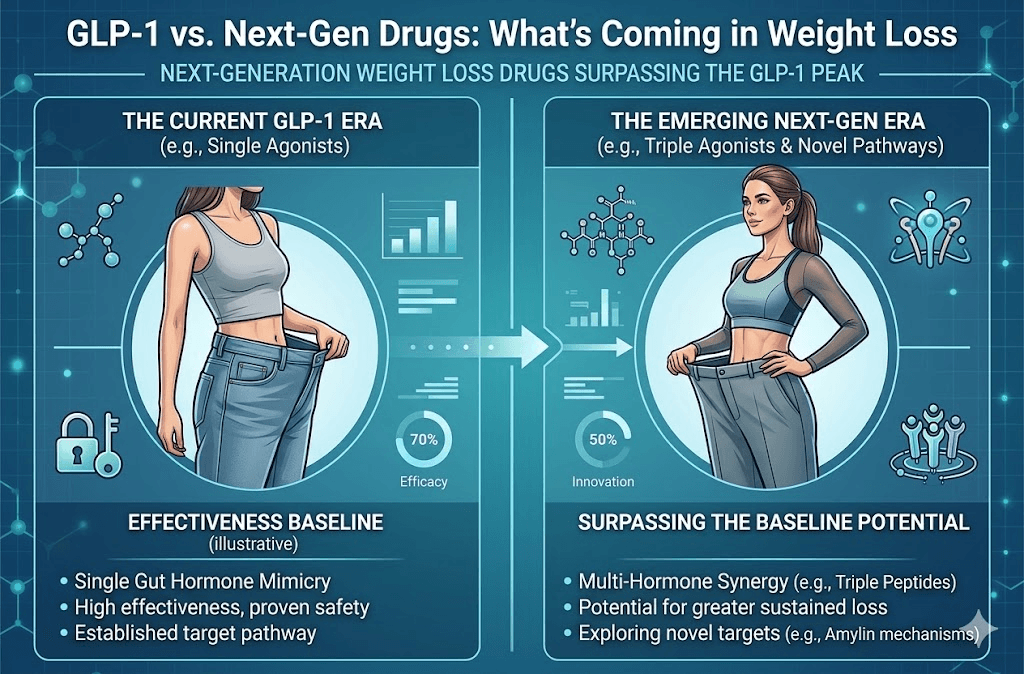
GLP-1 vs. Next-Gen Drugs: The Future of Weight Loss

Ozempic felt revolutionary — but it might already be getting replaced by something far more powerful.
That sentence alone is enough to send anyone currently managing their weight with semaglutide into a spiral of second-guessing. Should you wait? Switch? Ask your doctor about something new? The weight loss drug landscape is evolving at a pace most patients — and even many clinicians — are struggling to keep up with. New receptor targets, multi-hormone combinations, and drugs engineered at a molecular level to hit the metabolic system from multiple angles simultaneously are moving through the pipeline faster than public conversation can catch them.
This article is your roadmap. Not a hype cycle. Not a breathless announcement that "everything is about to change." Here is a clear-eyed look at what the science actually shows, where the regulatory timeline stands, and what a rational, medically responsible treatment strategy looks like in an era of rapidly advancing options.
ACT 1: Beyond GLP-1 — Why Triple Agonists Are Rewriting the Weight Loss Ceiling
To understand why newer drugs like Retatrutide are generating so much excitement in obesity medicine, you first need to understand what current medications actually do — and where their limitations lie.
The Mechanism of First-Generation GLP-1s
GLP-1 (glucagon-like peptide-1) is a hormone naturally released in the gut after eating. According to physiological research documented by the National Center for Biotechnology Information (NCBI), it signals to the brain that you're full, slows gastric emptying, and stimulates insulin secretion in a glucose-dependent manner.
GLP-1 receptor agonists (like semaglutide and liraglutide) mimic this signal pharmacologically. In the landmark STEP trials, semaglutide produced average weight loss of approximately 15% of body weight over 68 weeks.
The Ceiling Problem: GLP-1 works primarily through appetite suppression and satiety. It doesn't meaningfully engage the body's energy expenditure side of the equation.
- Some patients hit a plateau early.
- Some lose significantly less than the trial averages.
- For severe obesity, a 15% weight loss, while clinically significant, may still leave substantial cardiometabolic risk behind.
Enter the Dual and Triple Agonists
To break through this ceiling, scientists began combining hormone targets:
- Dual Agonists (GLP-1 + GIP): Tirzepatide (Mounjaro, Zepbound) was the first commercially approved dual agonist. It targets both GLP-1 and GIP (glucose-dependent insulinotropic polypeptide). In trials, patients on the highest dose lost an average of 22.5% of body weight. GIP enhances the satiety effects of GLP-1 and may influence fat tissue directly.
- Triple Agonists (GLP-1 + GIP + Glucagon): Retatrutide, developed by Eli Lilly, takes the logic a step further by adding a glucagon receptor target. While glucagon typically raises blood sugar, at the right dose, it significantly increases energy expenditure — essentially telling the liver and fat tissue to burn more fuel.
In Phase 2 trials, Retatrutide produced weight loss of up to 24.2% of body weight over 48 weeks. The mechanistic insight here is crucial: single-target drugs suppress appetite; triple agonists suppress appetite and actively increase energy expenditure.
ACT 2: The Regulatory Pipeline — What's Actually Close to Approval
Excitement about clinical trial data needs to be tempered by one practical reality: a Phase 2 result is not a prescription you can fill at a pharmacy today. The gap between trial data and FDA approval involves massive Phase 3 trials, years of safety monitoring, and a rigorous, cautious regulatory review.
Here is a quick breakdown of where the key next-generation candidates currently stand:
- Retatrutide (Eli Lilly): Phase 3 trials are actively studying cardiovascular outcomes alongside weight loss. Analysts estimate a potential FDA submission in the 2026–2027 window, pending clean Phase 3 data.
- Cagrilintide + Semaglutide / CagriSema (Novo Nordisk): This combination blends semaglutide with cagrilintide (an amylin analogue that affects satiety). Early Phase 3 data showed approximately 22.7% weight loss at 68 weeks. This could be among the first next-generation approvals, potentially in 2025–2026.
- Orforglipron (Eli Lilly): A small-molecule oral GLP-1 receptor agonist. Unlike current oral semaglutide (which has absorption limits), Orforglipron has better bioavailability and showed roughly 14–15% weight loss in Phase 2 trials. It could be transformative for patients who avoid injections, with possible approval around 2025–2026.
- Bimagrumab (Novartis/Versanis): Mechanistically distinct, this is an antibody that blocks a pathway limiting muscle growth. It has shown the unique ability to preferentially reduce fat mass while preserving (or increasing) lean muscle mass — addressing a major limitation of current GLP-1s. Phase 3 enrollment is currently in progress.
- Pemvidutide (Altimmune): A GLP-1/glucagon dual agonist showing strong fat loss with notably lower muscle mass reduction. Phase 3 has not yet been announced.
The Pipeline Takeaway: The next 24–36 months will likely introduce two to three new approvals offering superior efficacy, oral delivery options, or much better body composition outcomes.
ACT 3: The Strategic Verdict — Stop Chasing, Start Planning
The availability of increasingly effective treatments on the horizon often produces a specific kind of decision paralysis in health-savvy patients: the perpetual wait.
Why start Wegovy now if Retatrutide might be available in two years? Why accept 15% weight loss when 25% might eventually be on offer? This reasoning is understandable, but medically risky. Two years of untreated or under-treated obesity carries compounding costs to your joints, cardiovascular system, and metabolic health that no future drug can fully reverse.
Here is an evidence-based strategic framework to navigate this landscape:
Treat the disease you have today with the best available tool. If you are a candidate for a structured medical weight loss program, starting now manages your current risks. Obesity does not pause while you wait for new drugs. Starting today does not lock you out of future treatments; it simply protects your health in the present.
Treat switching as an upgrade, not a rescue. When next-generation drugs become available, transitioning from one agent to another is usually straightforward. Patients who have already built healthy habits and lost weight are generally better candidates for next-generation drugs.
Prioritize muscle preservation now. Up to 25–40% of total weight lost on current GLP-1s can be lean muscle mass. You can counteract this today through resistance training, adequate protein, and utilizing tools like metabolic testing and analysis to ensure your body is burning fat, not muscle.
Understand that averages mask individual variation. A drug that boasts 24% average weight loss in a trial might cause intolerable side effects for you, while an older drug might work perfectly. The best medication is the one your body tolerates well over the long term.
Work with a forward-looking prescriber. You need a clinician who tracks the regulatory timeline, monitors muscle mass, and builds longitudinal strategies rather than just writing a prescription and walking away.
Maryland Trim Clinic (MTC) in Laurel, MD
Navigating the transition from first-generation treatments to next-generation therapies requires close, personalized medical supervision. Located in Laurel, MD, Maryland Trim Clinic (MTC) provides the comprehensive framework necessary to manage weight safely and effectively in this rapidly changing landscape.
A modern obesity treatment plan isn't just about the medication; it’s about how your body responds to it. For patients utilizing GLP-1 weight loss injections, MTC’s approach emphasizes holistic monitoring. Rather than leaving patients to manage side effects or muscle loss alone, specialized clinics like MTC focus on optimizing body composition, preserving metabolic health, and ensuring that any weight lost is sustainable. By treating weight management as a collaborative, medically guided journey, patients are better prepared to adapt their treatment plans as new scientific advancements become available.
The Bottom Line
Semaglutide was not the finish line. Neither is tirzepatide. Retatrutide, CagriSema, and the drugs that will follow represent a sustained scientific expansion of what's pharmacologically achievable in obesity management.
But progress in the pipeline is not a reason to defer your health. It is simply context for understanding that the medical community now treats obesity as a complex, chronic disease—a classification strongly supported by the Centers for Disease Control and Prevention (CDC). It deserves the same long-term, evidence-updated treatment thinking we apply to hypertension or diabetes. Build a durable treatment strategy today, so you are in the best possible position to incorporate tomorrow’s advancements when they arrive.
Disclaimer: The information provided in this article is for educational purposes only and is not intended as a substitute for professional medical advice, diagnosis, or treatment. Always seek the advice of your physician or other qualified health provider regarding a medical condition, treatment options, or before starting any new weight loss program or medication.
Frequently Asked Questions
Q: What is the difference between a GLP-1 agonist and a triple agonist like Retatrutide? A: A GLP-1 agonist like semaglutide targets only the GLP-1 receptor, primarily suppressing appetite and slowing digestion. Retatrutide is a triple agonist targeting GLP-1, GIP, and glucagon receptors simultaneously. This multi-receptor approach not only suppresses appetite but also increases energy expenditure (fuel burning), leading to significantly greater weight loss in trials.
Q: When will next-generation weight loss drugs like Retatrutide be available? A: Retatrutide is estimated to potentially reach FDA approval in the 2026–2027 window, depending on Phase 3 trial results. CagriSema and oral Orforglipron may be closer, potentially seeing FDA submissions in the 2025–2026 range.
Q: Should I wait for a better weight loss drug before starting treatment? A: Most obesity medicine specialists advise against waiting. Untreated obesity carries compounding risks that accumulate in real-time. Treating with the best currently available option manages your health today and does not prevent you from transitioning to a newer drug later.
Q: What is the concern about muscle mass loss with GLP-1 drugs? A: Studies show that up to 25–40% of total weight lost on current GLP-1 medications can come from lean muscle mass. Muscle is critical for maintaining a healthy metabolic rate and physical function. Resistance training and adequate protein intake are essential, and several upcoming pipeline drugs aim specifically to protect muscle during fat loss.
Q: Is oral semaglutide (Rybelsus) as effective as injectable versions? A: Current oral semaglutide has significant absorption limitations, reducing its weight loss efficacy compared to injectables. However, a newer oral agent in development called Orforglipron has shown much better bioavailability and produced around 14–15% weight loss in Phase 2 trials, making it nearly comparable to current injectables.
Q: What is tirzepatide and how does it compare to semaglutide? A: Tirzepatide (Mounjaro, Zepbound) is a dual GLP-1/GIP receptor agonist. By targeting two receptors, it produced an average weight loss of approximately 22.5% in clinical trials, which is significantly greater than the roughly 15% typically seen with semaglutide.
Ready to Build a Sustainable Weight Loss Strategy?
Don't wait to prioritize your health. If you are exploring your medication options or need expert guidance on managing your metabolic health, visit the Maryland Trim Clinic homepage to learn how our evidence-based, medically supervised programs can help you achieve your goals safely today.