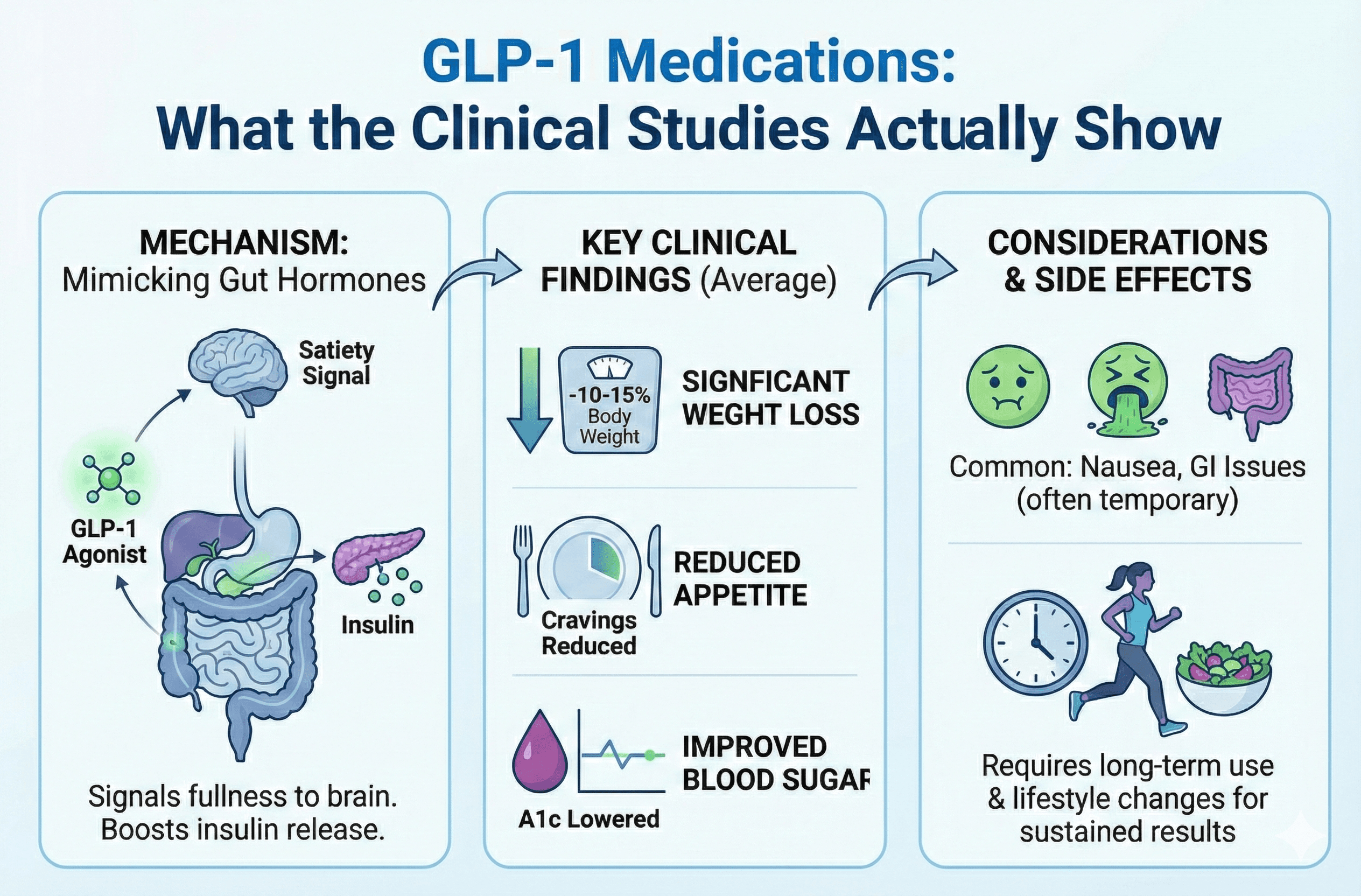
GLP-1 Medications: What the Clinical Studies Actually Show

GLP-1 Medications: What Medical Studies Actually Show
Considering Ozempic or Wegovy? Here's what the actual medical studies reveal.
As a physician who has spent considerable time reviewing the clinical literature on GLP-1 receptor agonists, I can tell you there is an enormous gap between what social media promises and what peer-reviewed research actually demonstrates.
The confusion isn't entirely your fault. These medications have been hyped as miracle cures, vilified as "cheating," and misrepresented by everyone from wellness influencers to tabloid headlines. Let's cut through the noise and examine what the clinical trials actually show about efficacy, patient selection, and long-term outcomes.
Act 1: What the Clinical Trials Actually Demonstrate
The evidence base for GLP-1 medications is substantial and highly encouraging, but understanding the numbers requires proper clinical context.
The STEP Trials: Semaglutide for Weight Management
The STEP (Semaglutide Treatment Effect in People with Obesity) program represents the gold standard for understanding Wegovy's efficacy. STEP 1, published in the New England Journal of Medicine in 2021, enrolled 1,961 adults with obesity (BMI ≥30) or overweight (BMI ≥27) with at least one weight-related comorbidity.
The results at 68 weeks:
- 14.9% average body weight loss in the semaglutide 2.4mg group.
- 2.4% average loss in the placebo group (who only used lifestyle interventions).
- 86.4% of participants lost at least 5% of their body weight.
- 50.5% lost at least 15% of their body weight.
These are impressive numbers, but notice what they don't say: nobody lost 100% of their excess weight, and individual variation was enormous. Some participants lost over 20% of their body weight, while others saw minimal response despite perfect adherence.
STEP 2 focused specifically on people with type 2 diabetes. Here, the weight loss was more modest, 9.6% at 68 weeks, but it came with significant metabolic benefits, including A1C reductions averaging 1.6 percentage points.
The SUSTAIN Trials: Semaglutide for Diabetes
The SUSTAIN program examined lower doses of semaglutide (the formulation marketed as Ozempic) primarily for glycemic control. SUSTAIN 6, a cardiovascular outcomes trial, demonstrated:
- A 26% reduction in major adverse cardiovascular events (like heart attacks and strokes).
- A1C reductions of 1.0–1.4%, depending on the dose.
- Weight loss of roughly 10–14 lbs as a secondary outcome.
This is crucial context: the life-saving cardiovascular benefits emerged even at lower doses than those used purely for weight loss.
Tirzepatide: The Dual Agonist Data
The SURMOUNT trials examining tirzepatide (marketed as Mounjaro for diabetes and Zepbound for weight loss) showed even more dramatic results. SURMOUNT-1 demonstrated:
- 20.9% weight loss at the 15mg dose.
- 15.0% weight loss at the 10mg dose.
- Only 3.1% weight loss in the placebo group.
These numbers represent the upper end of what medication-assisted weight loss can currently achieve, approaching the efficacy of some bariatric surgical procedures.
What the Numbers Mean in Practice
A 15% weight loss for a 200-pound person equals 30 pounds. For a 300-pound person, it's 45 pounds. These are clinically meaningful reductions associated with improved insulin sensitivity, reduced blood pressure, and decreased joint stress.
But they do not typically result in a "normal" BMI for people starting with severe obesity. A person beginning at a BMI of 40 who loses 15% of their body weight will still have a BMI around 34. They will still be in the obese category, though with substantially improved internal metabolic health.
Act 2: Who Actually Benefits Most?
The clinical trials reveal that GLP-1 medications don't work equally well for everyone. Patient selection matters enormously.
Baseline BMI and Response
Post-hoc analyses of the STEP trials show that a higher baseline BMI correlates with greater absolute weight loss, but similar percentage reductions. Someone starting at 250 pounds typically loses more total pounds than someone at 180 pounds, even though both might lose 15% of their total body weight.
The medications appear less effective in people with a BMI under 27. This makes biological sense, these individuals typically have less severe metabolic dysfunction and may not have the same degree of leptin resistance and appetite dysregulation that GLP-1 agonists are specifically designed to target.
Diabetes Status Makes a Difference
People with type 2 diabetes tend to see slightly less weight loss than those without diabetes (9-10% vs. 12-15%), but they gain substantial glycemic benefits:
- Many patients are able to reduce or eliminate other diabetes medications.
- A1C improvements often exceed what is achievable with older drug classes.
- Cardiovascular risk reduction appears most pronounced in this specific population.
For someone with diabetes and obesity, the medication addresses two serious conditions simultaneously, making the benefit-to-risk calculation quite different than for someone using it purely for cosmetic reasons.
Metabolic Syndrome Indicators
Subgroup analyses consistently show that people with metabolic syndrome components respond particularly well.
- Elevated triglycerides: Often normalize or substantially improve.
- High blood pressure: Reductions of 5-10 mmHg are common.
- Fatty liver disease: Multiple studies show rapid improvement in hepatic steatosis.
- Sleep apnea: Weight loss correlates strongly with a reduced apnea-hypopnea index.
The "Non-Responder" Population
Across all trials, 5-15% of participants lose less than 5% of their body weight despite appropriate dosing and strict adherence. We don't fully understand why, but emerging research points to several factors:
- Genetic variations in GLP-1 receptor expression.
- Differences in gut microbiome composition.
- Underlying hormonal issues, such as undiagnosed hypothyroidism or severe PCOS.
- Interference from other medications, like certain antidepressants or antipsychotics.
Act 3: What Happens When You Stop
This is where the clinical data becomes uncomfortable, because it directly challenges the popular idea of GLP-1 medications as a temporary, "quick-fix" intervention.
The STEP 4 Withdrawal Study
STEP 4 was specifically designed to answer the discontinuation question. Participants first lost weight on semaglutide for 20 weeks. Then, they were randomized: half continued the medication, and half were secretly switched to a placebo.
The 48-week results after randomization:
- Continuation group: Lost an additional 7.9% of body weight.
- Withdrawal group: Regained 6.9% of body weight almost immediately.
Within one year of stopping the medication, participants regained roughly two-thirds of their lost weight. Crucially, their metabolic improvements, blood pressure, lipids, and glucose, similarly regressed back toward their original baseline.
The Biological Reality
This rapid regain isn't a character flaw or a lack of willpower. It is pure physiology. When you lose weight through any method, your body responds defensively by:
- Increasing hunger hormones (ghrelin).
- Decreasing satiety hormones (leptin, PYY).
- Reducing your metabolic rate.
- Enhancing food reward signaling in the brain (making junk food look irresistible).
GLP-1 medications artificially counteract these adaptations while you are taking them. When you stop, the biological adaptations return, often with a vengeance.
The Chronic Treatment Model
The data increasingly supports treating obesity like we treat hypertension or asthma—as a chronic condition requiring ongoing pharmacotherapy for many patients. This is difficult to accept in a culture that moralizes weight and views medication dependence as a personal failure, but it is exactly what the clinical evidence shows.
Does this mean you will be on semaglutide forever? Not necessarily. But it likely means some form of ongoing intervention, whether continued medication at a lower maintenance dose, or incredibly intensive lifestyle modification, will be necessary to maintain your results.
Maryland Trim Clinic (MTC) in Laurel, MD
If you are considering medication to assist with your weight loss, it is vital to work with a clinical team that understands the nuances of the data. The Maryland Trim Clinic (MTC) in Laurel, MD, provides evidence-based, medically supervised care for patients struggling with metabolic dysfunction.
Rather than just writing a prescription and sending you on your way, MTC offers comprehensive support. They evaluate your unique biology to determine if you are a proper candidate for GLP-1 weight loss injections. Because medication works best when paired with lifestyle changes, they also offer targeted nutritional counseling and coaching to help you build sustainable habits. If you have been struggling to lose weight despite your best efforts, enrolling in a structured medical weight loss program at MTC ensures you are using these powerful tools safely and effectively.
The Bottom Line: Setting Realistic Expectations
The clinical research on GLP-1 medications shows they are incredibly effective tools for weight loss and metabolic improvement in the appropriate patient populations. But "effective" needs proper context.
They work best for:
- People with a BMI ≥30 (or ≥27 with metabolic complications like high blood pressure).
- Those with type 2 diabetes and weight concerns.
- Individuals who have struggled with severe appetite dysregulation despite genuine lifestyle efforts.
- People willing to commit to long-term medical treatment.
Realistic expectations include:
- 10-20% body weight loss over 1 to 2 years (which may not mean reaching a societal "ideal" weight).
- Significant internal metabolic improvements, even if scale goals aren't fully met.
- Gastrointestinal side effects (nausea, constipation) affecting 40-70% of users as their bodies adjust.
- The likely need for ongoing treatment to maintain the results.
The research is clear: GLP-1 medications represent a massive advance in obesity medicine, but they are not magic bullets. They are powerful clinical tools that work best as part of comprehensive care. Understanding what the studies actually show, rather than what marketing promises, is essential for making an informed decision about your health.
Medical Disclaimer: The information provided in this article is for educational purposes only and does not constitute medical advice. Always consult with a qualified healthcare provider before starting or stopping any medication, or beginning a new weight loss regimen.
Frequently Asked Questions
Q: How much weight can I realistically expect to lose on semaglutide or tirzepatide? A: Clinical trials show an average weight loss of 12-15% with semaglutide (Wegovy) and 15-21% with tirzepatide (Zepbound) over 16 to 18 months. However, individual results vary widely. Your baseline weight, metabolic health, and lifestyle factors all influence your specific outcomes.
Q: Will I regain the weight if I stop taking GLP-1 medication? A: Most likely, yes. The STEP 4 trial showed that participants regained about two-thirds of their lost weight within one year of discontinuing semaglutide. This is a biological response, not a lack of willpower. Current medical evidence supports viewing GLP-1 therapy as long-term management, similar to taking medication for high blood pressure.
Q: Do GLP-1 medications work better for people with diabetes versus those without? A: People without diabetes typically see slightly more absolute weight loss on the scale. However, diabetic patients gain massive additional benefits, including deep A1C reductions and a 26% reduction in major cardiovascular events. The overall metabolic benefit for diabetics is substantial.
Q: What percentage of people don't respond to GLP-1 medications? A: About 5-15% of people lose less than 5% of their body weight despite appropriate dosing, these are considered non-responders. If you haven't lost at least 5% of your body weight after 3 to 4 months at therapeutic doses, you should consult your doctor, as the medication may not be biologically effective for you.
Q: Are GLP-1 medications safe for long-term use? A: Current safety data extends to 2-3 years in clinical trials, showing acceptable safety profiles for most patients. Common side effects like nausea typically improve over time. The FDA has approved these medications for chronic use, but ongoing monitoring by a healthcare provider is essential to manage any potential long-term risks.
Ready to Explore Medically Supervised Weight Loss?
Schedule a Consultation with Maryland Trim Clinic If you want to know if GLP-1 medications are right for your specific biology, don't rely on internet rumors. Partner with the medical experts at MTC to review your health history and build a safe, effective, and personalized plan. Visit Maryland Trim Clinic to Get Started