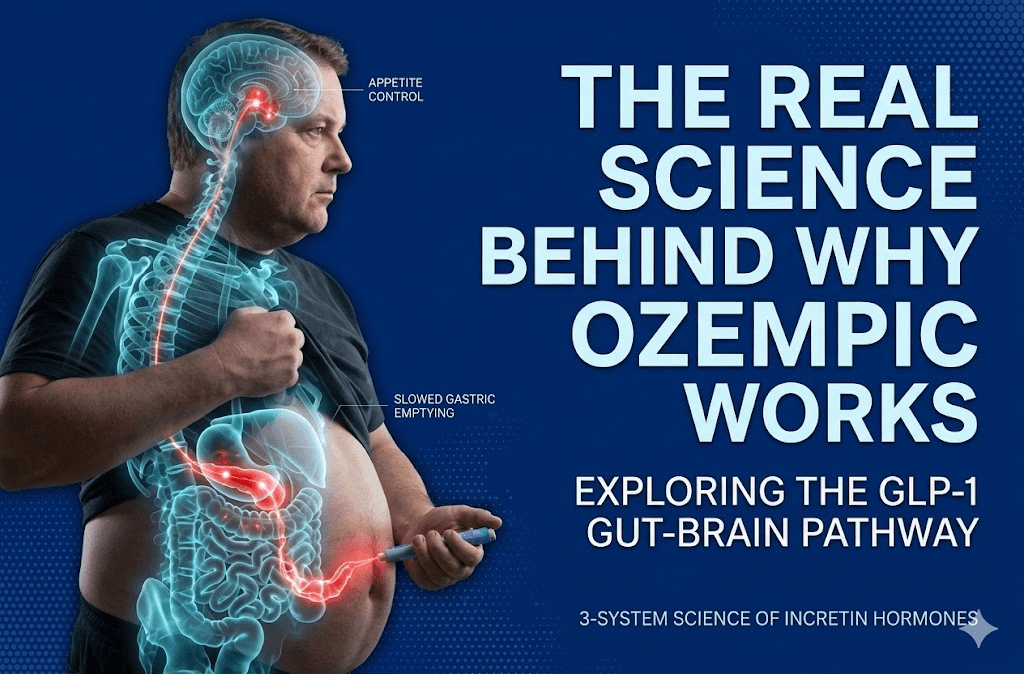
The Real Science Behind Why Ozempic Works

Everyone's talking about Ozempic. Almost no one understands what it actually does to your body.
That knowledge gap matters more than most people realize. Patients are starting the drug without understanding why they feel nauseated. Critics are dismissing it as a "shortcut" without grasping its neurological depth. Enthusiasts are treating it like a permanent solution when the biology tells a far more complicated story.
Obesity is a complex, chronic condition that impacts millions. To understand the scale of this public health issue, it helps to look at the concrete data. According to the Centers for Disease Control and Prevention (CDC), obesity affects demographic groups differently in the United States, with prevalence rates at 49.9% among non-Hispanic Black adults, 45.6% among Hispanic adults, 41.4% among non-Hispanic White adults, and 16.1% among non-Hispanic Asian adults. Against this backdrop of widespread and complex metabolic challenges, the debate around semaglutide—the active molecule in Ozempic and its weight-loss cousin Wegovy—has become almost entirely cultural, divorced from the science that makes it genuinely remarkable.
Let's fix that. Here is what Ozempic actually does, organ by organ, signal by signal, from the moment it enters your bloodstream to the long-term hormonal changes researchers are only beginning to map.
ACT 1: Your Brain on GLP-1 — Rewriting the Hunger Signal
To understand Ozempic, you first need to understand a hormone your body already produces: glucagon-like peptide-1, or GLP-1.
This peptide is naturally secreted by specialized cells in your small intestine (called L-cells) in direct response to eating. Its evolutionary job is elegant and ancient: tell the brain that food has arrived, tell the pancreas to release insulin, and begin the coordinated shutdown of appetite.
The Problem with Natural GLP-1: Your natural GLP-1 is extraordinarily short-lived. Enzymes in your bloodstream (specifically DPP-4) degrade it within one to two minutes of release. The signal fires, does its job briefly, and disappears. For most healthy people in an ancestral environment of food scarcity, this was perfectly adequate.
The Semaglutide Solution: Semaglutide is a synthetic analog of GLP-1, engineered with a crucial structural modification. A fatty acid chain attached to its backbone allows it to bind to albumin (a protein in the blood), dramatically slowing its degradation.
The result? A molecule that mimics GLP-1 but with a half-life of approximately one week rather than two minutes. That is not a minor pharmacological tweak. That is a fundamental transformation of a fleeting whisper into a sustained, week-long broadcast.
How the Brain Hears the Signal
The hypothalamus, a small but extraordinarily powerful region at the base of your brain, is the master regulator of hunger and energy balance. It is studded with GLP-1 receptors. When semaglutide binds to these receptors, it triggers a dual-action response:
- Activates POMC neurons: These are the neurons responsible for generating satiety (fullness) signals.
- Suppresses NPY and AgRP neurons: These are the neurons that drive hunger and food-seeking behavior.
In plain language, these appetite suppressant medications tip the neurological scales decisively toward "I am full" and away from "I need to eat."
But the hypothalamus is not acting alone. Researchers have observed that semaglutide also dampens the dopaminergic reward signal associated with food in the brain's reward circuitry. Patients frequently report that ultra-processed snacks and fast food simply lose their pull. The drug doesn't just make you feel full; it quiets the neurological voice that says eating those foods will feel good.
ACT 2: The Gut Connection — Why You Feel Full (and Why You Feel Sick)
The brain is only half the story. GLP-1 receptors also line the gastrointestinal tract, and semaglutide activates all of them.
The Mechanics of Gastric Emptying
The most significant gut effect is a dramatic slowing of gastric emptying—the rate at which your stomach pushes food into the small intestine.
- Normal digestion: A meal might clear the stomach within 2 to 4 hours.
- On semaglutide: This process is substantially prolonged.
Food sits in the stomach longer, maintaining stretch receptor activation that sends continuous fullness signals to the brain via the vagus nerve. You eat less at a meal because you feel full faster, and you feel hungry again much later because the stomach is still processing what you ate hours ago.
The Trade-off: Gastrointestinal Side Effects
Here is the unavoidable pharmacological trade-off: the exact same mechanism responsible for Ozempic's effectiveness is responsible for its most common side effects.
When gastric emptying slows too aggressively, partially digested food accumulates, gastric pressure builds, and the body's response is often to trigger nausea. This is why the standard prescribing approach involves gradual dose escalation. The goal is to give your enteric nervous system time to adapt, reducing the severity of side effects.
Quick Tips for Managing Early GI Symptoms:
- Eat smaller, more frequent meals.
- Avoid highly fatty or overly greasy foods, which naturally digest slower.
- Stay consistently hydrated throughout the day.
The Hidden Risk: Muscle Loss
Slowed gastric emptying and reduced appetite mean significantly reduced caloric intake. Without adequate protein intake and resistance exercise, a large portion of the weight lost on GLP-1 agonists comes from lean muscle tissue rather than fat. To prevent this, patients must be highly intentional about muscle building and toning in a way that the drug itself does not mandate.
ACT 3: The Hormonal Aftermath — What Changes After You Stop
The most underappreciated aspect of GLP-1 pharmacology is what happens to the broader hormonal environment—not just during treatment, but potentially after it ends. According to the National Institute of Diabetes and Digestive and Kidney Diseases (NIDDK), understanding how medications interact with your body's chronic metabolic pathways is vital for long-term planning.
The Tale of Two Hormones: Ghrelin and Leptin
Ghrelin (The Hunger Hormone): Produced in the stomach, ghrelin spikes before meals and drives appetite. In people with obesity, the normal post-meal suppression of ghrelin is blunted. Semaglutide suppresses ghrelin release, contributing to overall appetite reduction.
Leptin (The Satiety Hormone): Produced by fat cells, leptin tells the brain how much fat is stored. In obesity, "leptin resistance" is common; fat cells produce enormous amounts of leptin, but the brain stops listening.
As patients lose significant body fat on semaglutide, circulating leptin levels fall. Normally, this triggers the brain to ratchet up appetite to prevent "starvation." Semaglutide essentially argues back against the brain's hunger-amplifying response, recalibrating the hypothalamic setpoint during treatment.
What Happens When You Stop?
The word "during" carries enormous clinical weight. The landmark STEP 1 trial extension study found that one year after stopping semaglutide, participants had regained approximately two-thirds of their lost weight on average.
Why? Because ghrelin rebounded, hunger increased, and the hormonal environment that predisposed them to obesity reasserted itself. This is not a moral failing of patients; it is a biological consequence. Using tools like metabolic testing and analysis can help patients and clinicians understand these shifting metabolic baselines, but the reality is that for the majority of people, current evidence suggests this may be a long-term or indefinite treatment.
Maryland Trim Clinic (MTC) in Laurel, MD
Understanding the science of GLP-1 medications is empowering, but managing the biological complexities of these drugs requires comprehensive, personalized medical support. Located in Laurel, MD, the Maryland Trim Clinic (MTC) provides evidence-based, medically supervised care tailored to your unique physiology.
Rather than simply prescribing a medication and leaving you to navigate the side effects alone, MTC offers holistic, structured medical weight loss programs. Our team helps you manage dose escalations safely, guides you on nutritional strategies to prevent muscle loss, and tracks your metabolic health over time. At MTC, we believe that powerful pharmacological tools like GLP-1s work best when paired with expert clinical oversight, ensuring your weight loss journey is both safe and sustainable.
The Bottom Line
Ozempic works. The clinical evidence is overwhelming, and the biology is well understood. It works because it mimics a natural satiety hormone with a prolonged half-life, activates GLP-1 receptors in the brain's hunger and reward circuits, slows the physical processing of food, and reshapes the hormonal environment governing appetite.
It is not magic, and it is not a shortcut. It is targeted pharmacology acting on a profoundly dysregulated system.
Understanding the mechanism does not automatically tell you whether to take it—that is a conversation for you and your physician. But understanding the mechanism does tell you what you are dealing with: a genuinely novel drug that uses pathways evolution built for exactly this purpose, and that deserves to be evaluated on its actual biology rather than the cultural noise surrounding it.
Disclaimer: The information provided in this article is for educational purposes only and is not intended as a substitute for professional medical advice, diagnosis, or treatment. Always seek the advice of your physician or other qualified health provider regarding a medical condition, treatment options, or before starting any new weight loss program or medication.
Frequently Asked Questions
Q: What exactly is semaglutide, and how is it different from natural GLP-1? A: Semaglutide is a synthetic analog of glucagon-like peptide-1, a hormone naturally produced after eating. While natural GLP-1 is degraded by the body in minutes, semaglutide has been chemically modified to last roughly a week. This sustained presence produces powerful, continuous effects on hunger and digestion.
Q: Why does Ozempic cause nausea and digestive side effects? A: Nausea, bloating, and other GI symptoms are a direct consequence of Ozempic's core mechanism: slowing gastric emptying. When the stomach empties slowly, food accumulates and gastric pressure builds, triggering the brain's nausea centers. These effects are usually most severe early on and diminish as the body adapts to the medication.
Q: Will I regain weight if I stop taking Ozempic? A: Clinical evidence suggests that most people do regain a significant portion of lost weight after discontinuing semaglutide. This happens because the hormonal drivers of obesity (like elevated ghrelin) return once the sustained GLP-1 signal is removed. This reflects the biology of obesity as a chronic condition, not a failure of willpower.
Q: Does Ozempic affect more than just hunger — does it change cravings? A: Yes. GLP-1 receptors are expressed in the brain's reward circuitry. Semaglutide appears to dampen the dopamine reward signal associated with eating ultra-processed or highly palatable foods. Many patients report that foods they once craved intensely simply lose their appeal.
Q: Is Ozempic safe to take long-term? A: Based on current clinical trial data, semaglutide has a well-characterized safety profile supporting long-term use for most patients. The most common ongoing concerns are GI tolerability and potential muscle loss if diet and exercise are neglected. Long-term safety monitoring is ongoing, and risk-benefit calculations should always be individualized with a doctor.
Q: How is Ozempic different from older weight-loss drugs? A: Older weight-loss medications (like amphetamine-derived compounds) worked by broadly stimulating the central nervous system to suppress appetite, often carrying significant cardiovascular risks. Semaglutide is fundamentally different: it mimics a hormone the body naturally uses to regulate energy balance, speaking the brain's own hormonal language safely and effectively.
Ready to Explore Your Medical Weight Loss Options?
If you're ready to cut through the cultural noise and take a science-backed approach to your metabolic health, we are here to help. Visit the Maryland Trim Clinic homepage today to schedule a consultation with our expert team, and discover a sustainable path to weight management.