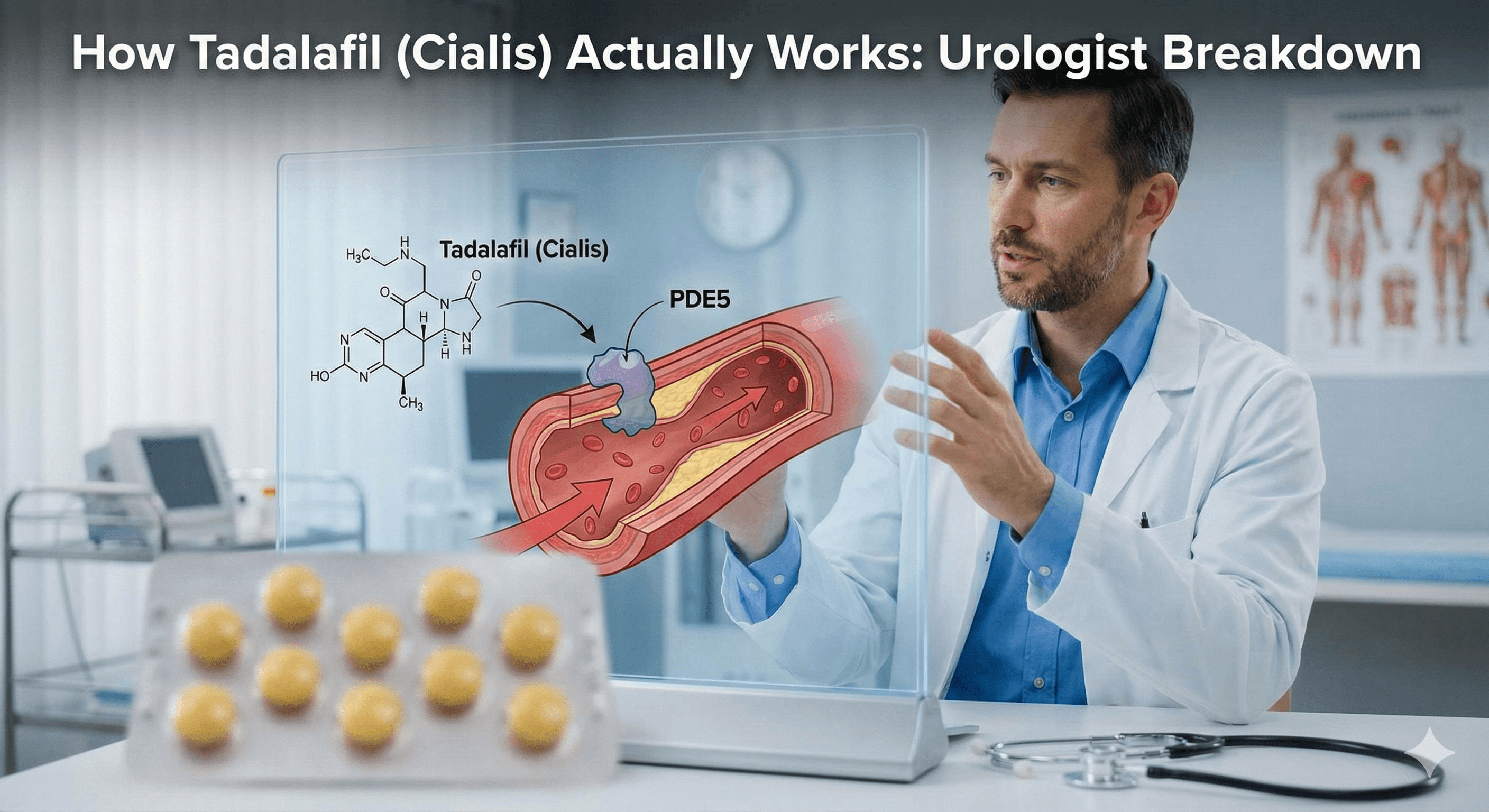
How Tadalafil (Cialis) Actually Works: Urologist Breakdown

What actually happens in your body when you take Cialis?
If you're like most men taking tadalafil (the generic name for Cialis), you probably know it helps with erectile dysfunction (ED)—but you might not understand exactly how. You take the medication, wait an hour or so, and it "works." But what is actually happening at the cellular level? Why does it require physical or mental arousal to kick in? And why does Cialis last so much longer than Viagra?
Understanding the underlying mechanism of tadalafil isn't just a matter of intellectual curiosity. Knowing how this medication functions in your body helps you use it more effectively, set realistic expectations, and communicate more confidently with your healthcare provider.
Let's break down the science of tadalafil into plain, actionable language.
The Core Misunderstanding: It's Not Viagra for Your Brain
The single most common misconception about PDE5 inhibitors—the class of drugs that includes tadalafil and sildenafil—is that they act as aphrodisiacs or "automatic erection" pills. Men sometimes expect to take Cialis, sit back on the couch, and spontaneously develop an erection without any sexual stimulus.
That is simply not how this medication works, and understanding why requires a quick dive into your body's vascular plumbing.
Erections are fundamentally a hydraulic event. Your penis contains two cylinder-shaped chambers called the corpora cavernosa, which are filled with spongy tissue and blood vessels. When you become aroused, these chambers fill with blood, expand, and naturally compress the veins that would normally drain that blood away. This traps the blood inside, creating rigidity.
Tadalafil doesn't create this hydraulic process out of thin air. It simply enhances it. To understand this enhancement, we need to talk about enzymes.
PDE5 Inhibition and Blood Flow Enhancement Explained
The Enzyme You Never Knew You Had
PDE5 stands for phosphodiesterase type 5. It is an enzyme found in high concentrations in the smooth muscle tissue of your penis. (It is also found in your lungs, which is why these types of medications are occasionally prescribed for pulmonary hypertension).
To understand what PDE5 does, we need to introduce a second microscopic player: cGMP (cyclic guanosine monophosphate).
- Think of cGMP as the "relax" signal for your smooth muscles.
- When cGMP levels are high in the cells lining your penile blood vessels, those muscles relax.
- Relaxed smooth muscle means dilated, widened blood vessels.
- Widened blood vessels allow for a rapid inflow of blood, resulting in an erection.
PDE5 is essentially the cleanup crew. Its primary job is to break down cGMP. After a sexual encounter passes, PDE5 metabolizes the cGMP, the smooth muscles contract, the blood vessels narrow, the blood drains out, and the erection subsides.
In a man experiencing erectile dysfunction, this system is out of balance. Due to factors like age, poor cardiovascular health, diabetes, or psychological stress, the body either doesn't produce enough cGMP to begin with, or the PDE5 "cleanup crew" breaks it down much too quickly.
What Tadalafil Actually Does
Tadalafil is what urologists call a "competitive inhibitor" of PDE5. According to StatPearls research on tadalafil from the National Institutes of Health (NIH), the drug binds to the exact same site on the PDE5 enzyme where cGMP would normally attach. By occupying that parking spot, tadalafil actively prevents PDE5 from breaking down your cGMP.
Because the cleanup crew is blocked, cGMP accumulates and stays in your smooth muscle tissue much longer. This prolonged presence results in:
- Enhanced muscle relaxation in the arterial walls of the penis.
- Increased arterial dilation, allowing a much larger volume of blood to flow in.
- Sustained vessel expansion, keeping the exit veins compressed to maintain rigidity.
Essentially, tadalafil removes a "brake" that your body has been applying too aggressively.
The Selectivity Factor
You might wonder: if PDE5 is just one of many phosphodiesterase enzymes in the body, why doesn't this drug relax blood vessels everywhere, causing chaos?
Tadalafil is highly selective for PDE5. It has a slight affinity for PDE11 (which accounts for the mild back pain some men experience) but leaves most other enzymes alone. This precision is why healthcare providers can prescribe these medications safely—they target the right tissue with minimal off-target effects.
Why It Doesn't Work Without Arousal
Here is where the mechanism gets incredibly interesting, and where patients often get confused.
Tadalafil does not create cGMP; it only preserves it. So, where does the cGMP come from in the first place?
The Nitric Oxide Trigger
Sexual arousal—whether triggered by physical touch, visual cues, or fantasy—starts in the brain. The brain sends nerve signals down the spinal cord to the pelvic region. These nerve endings release a vital neurotransmitter called nitric oxide (NO) directly into the blood vessels of the penis.
Nitric oxide is the spark that lights the fire. It activates an enzyme that manufactures cGMP. This is the starting gun for the entire erection cascade.
The Step-by-Step Erection Pathway:
Arousal: Psychological or physical stimulation occurs.
Signal: Nitric oxide is released from local nerve endings.
Activation: Guanylate cyclase (an enzyme) is activated.
Production: cGMP is successfully produced.
Relaxation: Smooth muscles relax.
Dilation: Blood vessels open wide.
Result: An erection occurs.
If you skip Step 1 (Arousal) and Step 2 (Nitric Oxide), there is absolutely no cGMP for the tadalafil to protect. You can block PDE5 all day long, but without arousal, the pill does nothing.
What This Means for Your Routine
Understanding this pathway explains several practical, real-world observations:
- No Spontaneity Without Stimulus: You need foreplay or mental arousal for the pill to work.
- The Mental Barrier: If severe stress, relationship issues, or performance anxiety are blocking your brain from sending the initial arousal signals, tadalafil cannot override that psychological block.
- Not a Cure-All: Severe vascular disease or uncontrolled diabetes can damage blood vessels so badly that nitric oxide isn't released effectively. In these cases, even preserved cGMP might not be enough.
How Dosage Affects Duration and Effectiveness
The 36-Hour Window: Why Tadalafil Lasts So Long
One of tadalafil's most famous distinguishing features is its duration. It can remain active in the body for up to 36 hours, famously earning it the nickname "the weekend pill." Compare this to sildenafil (Viagra), which typically lasts only 4 to 6 hours.
This difference comes down to the drug's half-life (how long it takes for your liver to clear half the dose from your bloodstream). Tadalafil's half-life is a lengthy 17.5 hours. Even after 35 hours, there is still enough of the medication circulating to meaningfully inhibit PDE5 and support an erection.
On-Demand vs. Daily Dosing
Because of its long, slow-release nature, tadalafil is prescribed in two entirely different ways based on your lifestyle:
- On-Demand Dosing (10 mg or 20 mg): You take this dose 30 to 60 minutes before you anticipate having sex. The higher dose provides a strong, immediate PDE5 blockade. This is ideal for men who don't mind planning ahead or those who need a stronger dose to overcome more stubborn ED.
- Daily Dosing (2.5 mg or 5 mg): You take a micro-dose every single day at the same time, regardless of whether you plan to have sex. This builds a continuous "steady state" of the medication in your system, allowing for complete spontaneity. Men who have sex frequently, or who hate the anxiety of timing a pill, usually prefer this route.
Does a Higher Dose Mean a Better Erection?
Not necessarily. Tadalafil's effects plateau. If a 10 mg pill successfully blocks all your available PDE5 enzymes, taking 20 mg will not give you an erection that is "twice as good." It will only increase your risk of side effects like flushing, headaches, or nasal congestion. The golden rule of ED medication is to find the lowest effective dose.
Key Factors That Affect Your Response
- Food: Unlike Viagra, which can be blunted by a heavy, fatty meal, tadalafil's absorption is not impacted by food.
- Alcohol: A glass of wine is fine, but moderate-to-heavy drinking acts as a central nervous system depressant, actively fighting against the arousal signals tadalafil relies on.
- Underlying Health: Your baseline metabolic health matters heavily. Conditions like obesity or low testosterone can severely blunt your response to tadalafil.
The Bigger Picture: Empowerment Through Understanding
Knowing exactly how tadalafil works—by inhibiting PDE5, preserving cGMP, and leaning on your natural arousal pathway—gives you a massive advantage in managing your sexual health.
It highlights a crucial truth: ED is rarely just a "plumbing" issue. The National Institute of Diabetes and Digestive and Kidney Diseases (NIDDK) notes that ED is deeply tied to underlying health conditions. In the medical community, erectile dysfunction is often considered the "check engine light" for the male body. Because the blood vessels in the penis are so small, they are often the first to show signs of cardiovascular disease, insulin resistance, or hormonal imbalances.
Tadalafil is a fantastic tool for managing the symptom, but it is not a cure. To truly reclaim your vitality, you have to look at the whole picture—your weight, your hormones, your heart, and your lifestyle.
Maryland Trim Clinic (MTC) in Laurel, MD
At Maryland Trim Clinic (MTC) in Laurel, MD, we understand that sexual health is intimately connected to your overall physical well-being. Treating erectile dysfunction with medication is often just the first step. When medications like tadalafil aren't providing the robust response you want, or if you simply want to address the root causes of your symptoms, a comprehensive approach is required.
As a dedicated Maryland Trim Clinic, we look beyond the surface. Because ED is so frequently linked to metabolic and hormonal imbalances, we offer specialized services to get your body back to peak performance. For instance, optimizing your testosterone levels through customized hormone replacement therapy can reignite the libido and energy required for tadalafil to work effectively.
Similarly, excess weight can cause systemic inflammation and vascular damage that blunts the efficacy of ED medications. By utilizing an integrated medical weight loss program, supported by precise metabolic testing and analysis, you can improve your cardiovascular health, lower your blood pressure naturally, and ensure that your body’s natural nitric oxide pathways are firing on all cylinders. When you treat the whole patient at a modern wellness center, the results speak for themselves.
Frequently Asked Questions
Q: How long does it take for tadalafil to start working? A: Tadalafil typically begins working within 30 to 60 minutes after taking the pill, though some men report feeling the effects in as little as 16 minutes. Peak concentration in your blood is reached around the 2-hour mark. Because food does not slow its absorption, you can take it with or without a meal.
Q: Can I take tadalafil every day? A: Yes. Tadalafil is explicitly approved for daily use in lower doses (2.5 mg and 5 mg). Taking it daily maintains a steady, continuous PDE5 inhibition in your bloodstream. This completely removes the need to "time" your medication, allowing for spontaneous intimacy.
Q: Will tadalafil give me an erection without sexual stimulation? A: No. Tadalafil is a facilitator, not an initiator. It only works when you are physically or mentally aroused. Without arousal, your body does not release nitric oxide, which means no cGMP is produced for the tadalafil to protect. This is a built-in safety feature of your physiology.
Q: Why does tadalafil last so much longer than Viagra? A: It comes down to how the body metabolizes the drug. Tadalafil has a very long half-life of 17.5 hours, compared to sildenafil's 4 hours. It is broken down by the liver much more slowly and distributes into your body tissues differently, resulting in an effective window of up to 36 hours.
Q: What are the most common side effects of tadalafil? A: The most common side effects are mild and include headaches, facial flushing, nasal congestion, indigestion, and muscle or back aches. These occur because PDE5 is slightly inhibited in other parts of the body (like the smooth muscle of the digestive tract or nasal passages). Symptoms usually pass as the medication leaves your system.
Q: Can I drink alcohol while taking tadalafil? A: Light consumption (one or two drinks) is generally fine. However, alcohol is a central nervous system depressant that dulls the nerve signaling required for arousal. Heavy drinking will actively counteract tadalafil’s benefits and can also increase the risk of dizziness and a sudden drop in blood pressure.
Disclaimer: The information provided in this article is for educational purposes only and is not intended as a substitute for professional medical advice, diagnosis, or treatment. Always seek the advice of your physician or other qualified healthcare provider with any questions you may have regarding a medical condition, erectile dysfunction, or before starting any new medication.
Take a Comprehensive Approach to Your Sexual Health?
If you are experiencing erectile dysfunction, understanding how medications like tadalafil work is an excellent first step—but it is often only one piece of the puzzle. At Maryland Trim Clinic in Laurel, MD, we look beyond the symptoms to address the underlying metabolic and hormonal factors that impact your sexual health and overall vitality.