How to Protect Muscle While on Ozempic | Healthy Weight Loss

How to Protect Muscle While on Ozempic
Medical Disclaimer: The information provided in this article is for educational purposes only and is not intended as medical advice. Always consult with your prescribing physician or a qualified healthcare provider before altering your diet, starting a new exercise routine, or making changes to your medication.
Losing weight on Ozempic can feel like a revelation. Keeping your muscle, however, is the hard part that often goes undiscussed in the doctor's office.
For the millions of people now using semaglutide — the active ingredient in Ozempic and Wegovy — the dramatic drop in appetite feels like a long-awaited solution. The scale finally moves. Clothes fit differently. People notice your progress.
What often goes unnoticed is what's happening beneath the surface: along with stubborn fat, the body may be quietly dismantling lean muscle tissue. This isn't a rare side effect or a worst-case scenario. It is a predictable physiological consequence of rapid weight loss in a deep caloric deficit. It is happening to GLP-1 users at scale, while many receive zero guidance on how to prevent it.
This article is the protocol nobody handed you when you picked up your prescription.
The Hidden Cost — Why Ozempic Users Lose Muscle
To understand the problem, you need to understand what Ozempic actually does. Semaglutide mimics a hormone called GLP-1 (glucagon-like peptide-1), which regulates insulin secretion and — critically — your appetite. Users frequently report feeling full after just a few bites. Persistent cravings diminish, and the overall desire to eat simply drops. For someone who has struggled with caloric overconsumption for years, this feels nothing short of miraculous.
However, the body doesn't distinguish between a virtuous, medically guided caloric deficit and a physiological emergency. When your daily calories drop sharply and stay low, the body enters a catabolic state — meaning it begins breaking down its own tissue for energy. While fat is the preferred target, muscle is always on the chopping block.
According to guidance and research compiled by the National Institute of Diabetes and Digestive and Kidney Diseases (NIDDK), rapid and aggressive weight loss can lead to significant reductions in lean muscle mass. In fact, research consistently shows that anywhere from 25% to 40% of the weight lost during severe calorie restriction can come from lean mass rather than fat. Studies tracking GLP-1 users specifically have found similar figures, particularly among those who remain sedentary and under-eat protein.
This matters enormously. Muscle tissue isn't just about aesthetics; it is your body's metabolic engine. It governs insulin sensitivity, supports physical function, protects bone density, and is crucial for long-term weight maintenance. Losing muscle while losing fat means you're shrinking in ways that will make it harder to keep the weight off if you eventually taper off the medication.
The Protein Solution: 1 Gram Per Pound of Bodyweight
The most powerful nutritional lever you can pull to protect your metabolism is your daily protein intake. The research is consistent and compelling: consuming higher amounts of protein during a caloric deficit significantly reduces the loss of lean mass.
The target that has emerged from both sports science and clinical nutrition research is 1 gram of protein per pound of bodyweight per day. For a 180-pound person, that means aiming for 180 grams of protein daily. For a 150-pound person, 150 grams. This is an aggressive target, and that's exactly the point—you are in an aggressive physiological situation.
If navigating these nutritional shifts feels overwhelming, seeking professional nutritional counseling and coaching can help you build a personalized, sustainable eating plan that prioritizes muscle preservation.
Here is where Ozempic creates a unique challenge: the drug suppresses your appetite so effectively that many users naturally default to eating only 800 to 1,200 calories per day. Hitting 150 to 180 grams of protein within that small caloric window requires strategy.
Actionable Strategies for a Suppressed Appetite:
- If you feel full after a few bites → Try prioritizing protein first. Eat your chicken, fish, Greek yogurt, or eggs before touching side dishes. If you fill your small appetite window with carbohydrates or fats first, your protein intake will suffer.
- If you struggle with large meals → Try high-protein, low-volume foods. Cottage cheese, egg whites, canned tuna, and nonfat Greek yogurt deliver massive protein doses in small volumes, which is ideal when you feel full quickly.
- If the thought of eating makes you nauseous → Try strategic liquid protein. A high-quality whey or casein protein shake containing 40–50 grams of protein takes minutes to consume and doesn't require feeling "hungry."
- If you can't hit your goal in two meals → Try spreading it out. Muscle protein synthesis responds best to repeated protein spikes throughout the day. Aim for 4 to 5 smaller protein-forward eating occasions.
Note for higher body weights: If you are significantly overweight, calculating 1 gram per pound of your current weight might result in an impossibly high number. In this case, use your target goal weight or an estimate of your lean body mass to set a more realistic, yet still robust, daily protein goal.
The Resistance Training Imperative
Protein provides the raw material. Resistance training provides the signal.
This distinction is crucial. Eating protein does not, by itself, preserve muscle. The body must receive a mechanical stimulus — the stress of lifting heavy things — before it decides to prioritize muscle retention and repair. In the absence of that signal, your body will simply use dietary protein for other metabolic functions rather than protecting your biceps or quadriceps.
For Ozempic users in a caloric deficit, resistance training at least 3 times per week is the non-negotiable minimum. This is about sending a biological message to your body that your muscle tissue is functionally necessary and should not be cannibalized for fuel.
What Counts as Resistance Training
You don't need to become a competitive powerlifter, but you do need to challenge your muscles with progressive overload. This means the work you do must be difficult enough to constitute a meaningful stimulus. Light resistance band circuits watched on YouTube while sitting on the couch generally do not provide enough tension.
Effective resistance training for muscle preservation includes:
- Compound Free Weights: Barbell or dumbbell movements like squats, deadlifts, bench presses, rows, and overhead presses. These engage the largest muscle groups and produce the strongest anabolic signal.
- Machine-Based Training: Leg presses, seated machine rows, and cable exercises. These are entirely valid and highly effective, particularly for beginners or those managing joint issues.
- High-Intensity Bodyweight Training: Push-ups, pull-ups, Bulgarian split squats, and tricep dips. These count provided the difficulty is high enough that you are approaching muscular failure by the end of your set.
The Golden Rule of Effort: Sets should feel challenging. The last 2 to 3 reps of each set should require genuine, focused effort. If you are completing your sets easily and could easily hold a conversation while doing them, the stimulus is likely insufficient.
A Realistic 3-Day Weekly Template
Rest days between training sessions are ideal but not mandatory. A structure of 3 non-consecutive days per week (e.g., Monday, Wednesday, Friday) is a classic, highly effective routine.
Here is a straightforward template you can adapt to your fitness level:
- Day 1 (Push - Chest, Shoulders, Triceps): * Dumbbell bench press or push-ups
- Seated overhead press
- Lateral raises
- Tricep pushdowns or dips
- Day 2 (Pull - Back, Biceps): * Dumbbell or barbell rows
- Lat pulldowns or assisted pull-ups
- Cable face pulls
- Bicep curls
- Day 3 (Legs - Quads, Hamstrings, Glutes): * Goblet squats or machine leg press
- Romanian deadlifts (RDLs)
- Walking lunges or split squats
- Calf raises
Quick Swaps: If barbells feel intimidating, swap them for dumbbells. If free weights aggravate your joints, swap them for selectorized machines. The tool matters less than the effort applied.
A Note on Fatigue and Low Calories
Many Ozempic users report noticeable fatigue, particularly early in their treatment journey. Training while under-fueled and adapting to a new medication is genuinely harder. Acknowledge this reality without using it as a permanent reason to skip your workouts.
Even abbreviated, lower-intensity sessions preserve significantly more lean mass than doing nothing at all. A focused 30-minute resistance session at 70% of your usual effort is vastly superior to resting on the couch. Protect the habit of showing up, even on the days when your energy levels are entirely depleted.
Measuring What Actually Matters
Here is where most people on a weight loss journey go wrong: they celebrate every single pound lost on the bathroom scale as equally good news. It isn't.
A pound of fat lost and a pound of muscle lost look identical on a standard scale, but they are metabolically, functionally, and aesthetically worlds apart. Chasing scale weight without knowing what tissue you are actually losing is like managing your finances by looking only at your checking account balance while ignoring the fact that your savings are being drained.
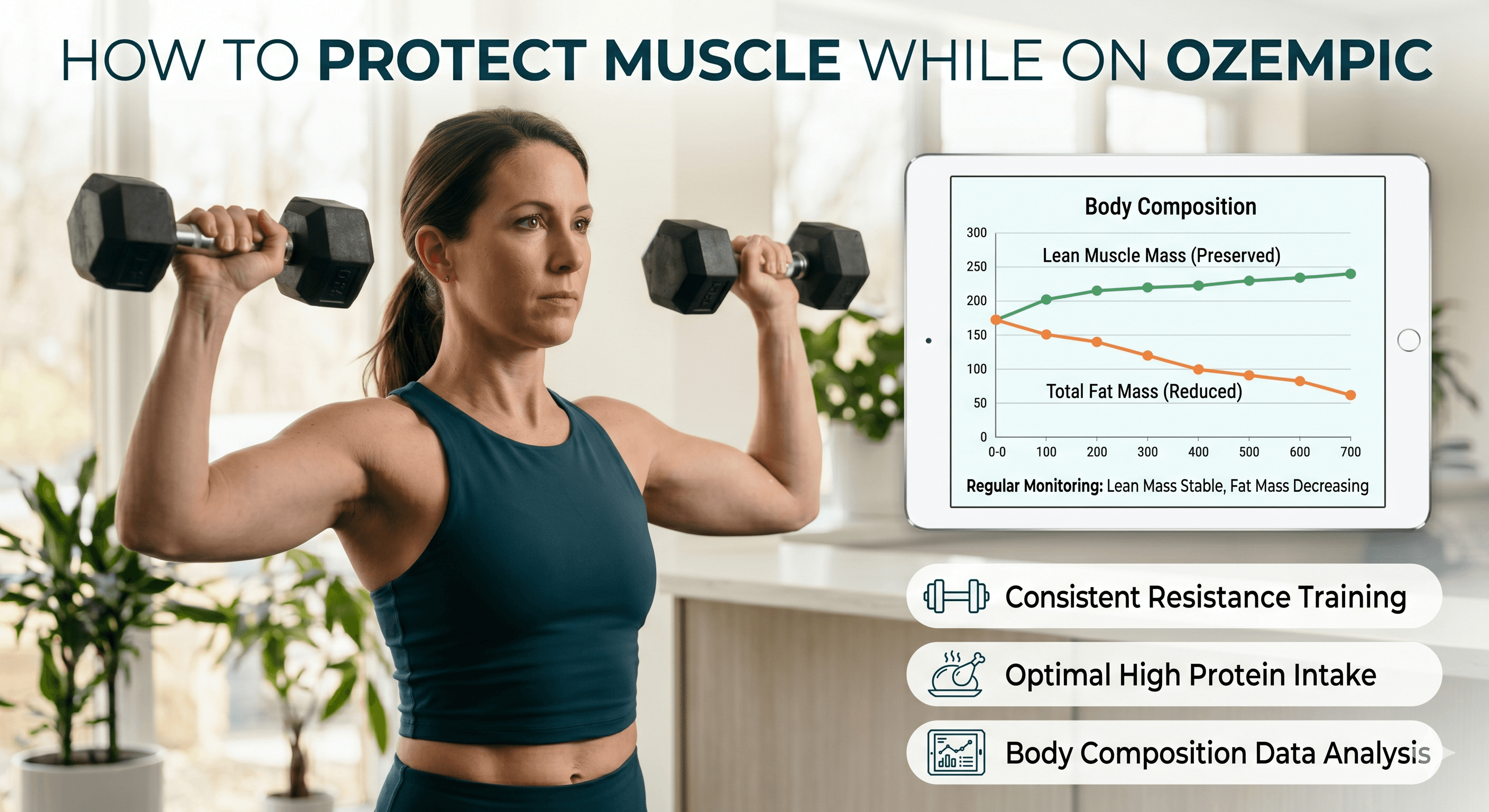
The only way to know if you're losing fat versus muscle is to track your body composition.
Methods for Tracking Body Composition
To get a true picture of your health, consider these tracking methods:
- DEXA Scan (Dual-Energy X-ray Absorptiometry): This is widely considered the gold standard. It provides highly precise measurements of fat mass, lean mass, and bone density broken down by body region.
- Advanced Body Scanning: Utilizing modern 3D body scanning technology allows you to visualize your physical changes over time, offering detailed metrics and circumferences that a standard scale simply cannot detect.
- Bioelectrical Impedance Analysis (BIA): These are the smart scales and handheld devices that estimate your body fat percentage through a mild electrical current. While less accurate than clinical scans, they are useful for tracking general trends if used under consistent daily conditions.
- Progress Photos & Tape Measures: Highly underrated. Taking consistent measurements of your waist, hips, and arms, alongside taking photos in the same lighting and pose every 4 weeks, tells a visual story that numbers alone cannot capture.
What to Do With the Data
If your composition tracking reveals that a significant portion of your weight loss is coming from your lean mass, treat that as a signal to intervene immediately.
Your Action Checklist:
Audit your protein intake: Are you actually hitting your target of 1g per pound, or are you just estimating loosely? Track your food diligently for 3 days to find out.
Assess your training effort: Are you lifting weights with sufficient intensity, or are you doing low-effort cardio and calling it a workout?
Evaluate your caloric deficit: If you are regularly eating under 1,000 calories, the deficit may be too steep. Discuss with your prescribing physician whether your medication dose needs to be adjusted.
Remember, your true goal is fat loss, not just weight loss. Those are different objectives that require entirely different metrics of success.
Maryland Trim Clinic (MTC) in Laurel, MD
Navigating the complexities of GLP-1 medications, nutrition, and body composition doesn't have to be a solo journey. At Maryland Trim Clinic in Laurel, MD, patients receive comprehensive, medically supervised support tailored to their unique physiology. Rather than just focusing on the number on the scale, a dedicated medical weight loss clinic can help you monitor and optimize your overall health. Whether you are exploring GLP-1 weight loss injections to manage your appetite safely or need structured guidance on protecting your lean muscle mass during your physical transformation, professional oversight ensures your weight loss is both sustainable and aligned with your long-term wellness goals.
The Bottom Line
Ozempic is a powerful tool for weight reduction. Left unmanaged, however, it can inadvertently become a tool for body composition degradation — shrinking your body in ways that leave you physically weaker, more metabolically fragile, and less equipped to maintain your results over the long term.
The protective protocol is not complicated:
- Eat 1 gram of protein per pound of your goal bodyweight daily.
- Lift weights challenging enough to stimulate muscle growth three times per week.
- Measure your body composition, not just your scale weight.
These three actions, done consistently, are the difference between merely losing weight and actually getting healthier. The medication handles your appetite. You handle the rest.
Frequently Asked Questions
Q: How much muscle loss is normal on Ozempic?
A: Studies suggest that without deliberate intervention — specifically adequate protein intake and resistance training — anywhere from 25% to 40% of total weight lost on GLP-1 drugs can come from lean mass rather than fat. However, this is not inevitable. With the right protocol, lean mass loss can be minimized significantly.
Q: Can I just eat more protein without exercising and still preserve muscle?
A: Protein alone offers only partial protection. The research is clear that resistance training is required to fully activate muscle protein synthesis. Without the mechanical stimulus of lifting weights, your body lacks the signal to prioritize muscle retention. Protein and resistance training work synergistically.
Q: Is it safe to use GLP-1 medications for weight loss?
A: When prescribed and monitored by a qualified healthcare provider, GLP-1 medications are a recognized treatment path. The U.S. Food and Drug Administration (FDA) has approved specific formulations of semaglutide for chronic weight management in adults with obesity or overweight conditions who have at least one weight-related condition. Always consult your doctor to see if it is the right fit for your health profile.
Q: What if my appetite is so suppressed that I can't hit my protein goals?
A: This is one of the most common challenges for GLP-1 users. Strategies that help include eating your protein first at every meal, utilizing high-protein/low-volume foods (like Greek yogurt and cottage cheese), and incorporating high-quality protein shakes to supplement your intake without requiring a large appetite.
Q: Is cardio completely useless for preserving muscle on Ozempic?
A: Cardio is certainly not useless — it supports cardiovascular health, daily caloric expenditure, and endurance. However, it does not provide the same anabolic signal to your muscle tissue that resistance training does. For the specific goal of preserving lean mass, resistance training must take priority.
Q: Does it matter what type of protein I eat, or is total protein what counts?
A: Total daily protein is the primary variable, but protein quality matters as well. Animal-based proteins (meat, fish, eggs, dairy) are considered complete proteins with high leucine content, the amino acid most responsible for triggering muscle repair. Plant-based proteins can absolutely be part of an effective strategy, but they typically require higher total intake and deliberate food combining to match the response of animal proteins.
Take the Next Step in Your Wellness Journey
If you are ready to approach weight loss with a strategy that protects your strength and metabolism, you don't have to figure it out alone. Reach out and visit Maryland Trim Clinic to schedule a consultation and build a personalized, medically guided plan today.