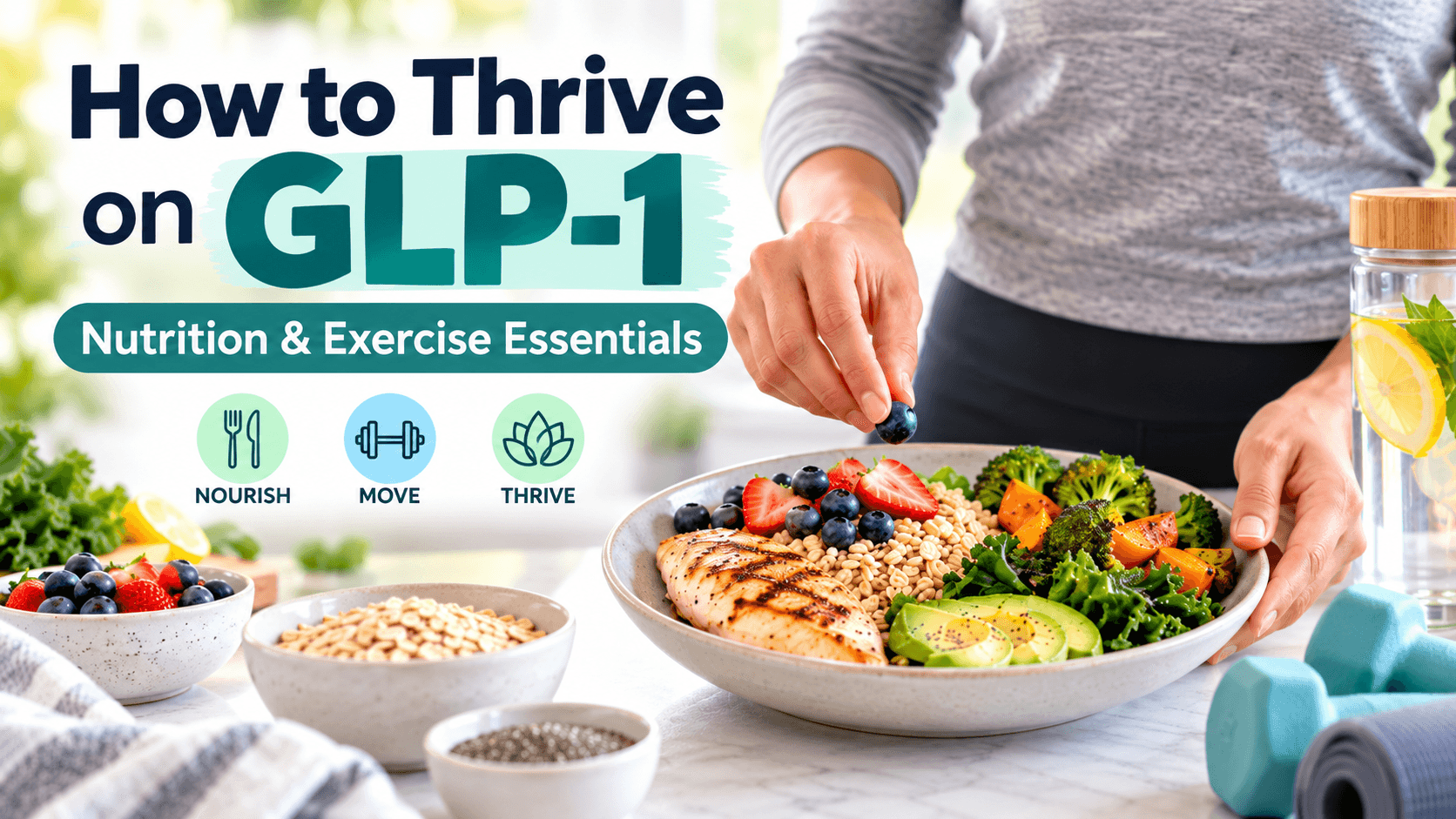
How to Thrive on GLP-1: Nutrition & Exercise Essentials


The medication makes you lose weight, but it won't keep you healthy without this
GLP-1 medications like semaglutide and tirzepatide have changed how millions of people manage weight and blood sugar. They work by suppressing appetite, slowing gastric emptying, and making food feel less appealing. That is the intended effect, and for many people it works well.
But appetite suppression is not the same thing as nourishment. A medication that reduces how much you eat does nothing to guarantee that the food you do eat contains enough protein, fiber, vitamins, or minerals. It also does nothing to protect the muscle mass you had before you started losing weight. Without a deliberate nutrition and exercise plan, GLP-1 users can lose significant lean mass along with fat, end up nutrient-deficient, and feel weaker even as the number on the scale drops.
Maryland Trim Clinic note: At Maryland Trim Clinic in Laurel, MD, GLP-1 treatment can be paired with nutritional counseling, metabolic testing, and progress tracking so reduced appetite does not become an excuse to ignore protein, energy needs, or body composition.
This article is a practical guide for people already using GLP-1 medications who want to protect their muscle, energy, and long-term health while the drug does its job on appetite. None of this replaces medical advice. Always coordinate nutrition and exercise changes with the prescribing clinician, especially if you have existing health conditions.
Why appetite suppression is not the same as being fed well
GLP-1 receptor agonists reduce hunger signals from the gut and brain. For someone who has struggled with overeating, this can feel like relief. But there is a tradeoff that is easy to miss in the first few months.
The core problem
When appetite drops sharply, total daily intake often falls to 1,000 to 1,400 calories or lower, sometimes without the person consciously trying. At that intake level, it becomes very hard to hit protein, fiber, and micronutrient targets unless every meal is deliberately planned. Most people are not used to planning meals with that level of precision, because previously their appetite did the work of prompting them to eat enough.
The result is a pattern seen repeatedly in clinical reports and dietitian case notes:
- Rapid weight loss, partly from fat, partly from lean muscle
- Reduced protein intake because appetite drops before food quality habits adjust
- Lower intake of fiber-rich foods, which can worsen the constipation many GLP-1 users already experience
- Micronutrient gaps, particularly iron, B12, calcium, and magnesium, when food variety shrinks
- Fatigue or irritability that gets misread as a medication side effect when it is actually a fueling problem
Why muscle loss matters specifically
Muscle is metabolically active tissue. It supports strength, balance, glucose regulation, and daily function. Studies on rapid weight loss, including from GLP-1 use, have shown that a meaningful share of total weight lost can come from lean mass rather than fat, especially without resistance training or adequate protein.
Losing muscle while losing fat can leave someone at a lower body weight but with reduced strength, a slower metabolism, and a higher risk of regaining fat later if the medication is paused or stopped. This is the central reason nutrition and exercise strategy matters just as much as the medication itself.
What eating well actually needs to look like
Because appetite is unreliable on GLP-1 medications, eating well shifts from "eat when hungry" to "eat by design." That means:
- Prioritizing protein at every eating occasion, even small ones
- Choosing nutrient-dense foods over low-density filler foods
- Structuring smaller, more frequent meals if large meals feel uncomfortable
- Tracking intake periodically, at least during the first few months, to catch gaps early
This is not about eating more overall. It is about making every bite count when total volume is limited.
Exercise strategies to protect muscle while losing weight rapidly
Exercise on GLP-1 medication has a different purpose than exercise for general weight loss. The goal is not to burn more calories. The goal is to signal the body to preserve muscle while fat is being lost through caloric restriction driven by the medication.
Why resistance training should be the priority
Cardio burns calories in the moment, but resistance training is what tells the body to keep muscle tissue instead of breaking it down for energy. For GLP-1 users, this shifts the exercise hierarchy compared to typical weight loss advice.
A reasonable framing:
Exercise Type
Primary Role on GLP-1
Suggested Frequency
Resistance training
Preserve and build muscle
2 to 4 sessions per week
Walking / low-intensity cardio
Support recovery, mobility, appetite regulation
Most days, 20 to 40 minutes
High-intensity cardio
Optional, add cautiously
0 to 2 sessions per week
Flexibility / mobility work
Reduce injury risk as body composition shifts
1 to 2 sessions per week
Resistance training does not need to mean heavy gym sessions. Bodyweight exercises, resistance bands, and machine-based circuits are all effective, particularly for people who are deconditioned or new to structured exercise.
Practical resistance training approach
For most GLP-1 users starting out, a simple full-body approach two to three times a week works better than complex split routines, because it is easier to sustain on reduced energy intake.
A sample structure:
- Lower body compound movement (squats, leg press, step-ups)
- Upper body push movement (push-ups, chest press)
- Upper body pull movement (rows, resistance band pulls)
- Core stability work (planks, dead bugs)
Two to three sets of 8 to 12 repetitions per movement is a reasonable starting point. Intensity should increase gradually as strength and confidence build, not aggressively, since recovery capacity may be lower on reduced calorie intake.
Managing energy for workouts
Because appetite is suppressed, some GLP-1 users try to exercise on very low fuel, which increases the risk of dizziness, fatigue, or poor workout quality. A few practical adjustments help:
- Have a small protein-containing snack 30 to 60 minutes before training if tolerated
- Time workouts for when nausea or fullness side effects are typically lowest
- Hydrate consistently, since reduced food and fluid intake together increase dehydration risk
- Scale workout intensity down on low-energy days rather than skipping entirely
The cardio tradeoff
Cardio is not the enemy, but overprioritizing it on a reduced-calorie, appetite-suppressed diet can accelerate muscle loss rather than fat loss specifically. Long, frequent, high-intensity cardio sessions combined with very low intake can push the body toward burning muscle for fuel when glycogen and food intake are both low.
Walking is generally the safer default cardio choice for most GLP-1 users, since it supports calorie expenditure and mobility without adding significant recovery burden on top of resistance training.
How to get proper nourishment on minimal food intake

The practical challenge for most GLP-1 users is not motivation. It is fitting enough protein, fiber, and micronutrients into a much smaller amount of total food. This requires a shift in how meals are planned.
Protein first, always
A reasonable target for most adults on GLP-1 medication, discussed with a clinician or dietitian, is roughly 1.2 to 1.6 grams of protein per kilogram of body weight per day, prioritized over other nutrients when appetite is limited.
Practical ways to hit protein targets on low volume:
- Start meals with the protein portion before other foods, since fullness may set in quickly
- Choose higher-protein-density foods over lower-density ones (eggs, Greek yogurt, cottage cheese, lean meat, fish, tofu, protein shakes)
- Use a protein supplement as a backup on days when solid food intake is very low, not as a full replacement for meals
- Split protein across three to five small meals rather than trying to get it all in two large ones
Fiber and digestion
GLP-1 medications slow gastric emptying, which already increases constipation risk. Reduced food intake compounds this by lowering total fiber consumed. Practical steps:
- Include a fiber source at most meals in small amounts (berries, vegetables, chia seeds, oats)
- Increase fluid intake alongside fiber, since fiber without adequate water can worsen constipation
- Introduce fiber gradually if intake has been very low, rather than adding a large amount at once
Micronutrient coverage
With lower food volume, variety becomes the main defense against micronutrient gaps. A simple check:
- Iron and B12: lean meats, fish, fortified foods, or supplementation if intake is very restricted
- Calcium and vitamin D: dairy, fortified alternatives, or supplementation depending on sun exposure and diet
- Magnesium and potassium: leafy greens, nuts, seeds, and legumes in small servings
A basic multivitamin is a reasonable safety net for many GLP-1 users, but it should be discussed with a healthcare provider rather than assumed, since needs vary by individual.
A simple daily framework
For someone eating far less than before, a workable daily structure looks like this:
Small protein-forward breakfast (eggs, yogurt, or a shake)
Mid-morning snack with protein and a small fiber source
Lunch with a clear protein portion plus vegetables
Afternoon snack if tolerated
Dinner with protein prioritized, smaller starch and vegetable portions
The goal is not volume. It is consistency and nutrient density across smaller meals, so that limited intake still covers the body's core needs.
- Medical evaluation and medication monitoring
- Personalized nutritional counseling
- Metabolic testing to estimate resting energy needs
- 3D body scanning and progress tracking
- Long-term weight-maintenance support
For patients concerned about under-eating, low protein intake, or loss of lean mass, those services can be used together: nutrition counseling helps translate reduced appetite into a practical eating plan, metabolic testing can provide a more individualized view of energy needs, and repeat body-composition or 3D body scans can add context beyond scale weight alone.
At Maryland Trim Clinic in Laurel, Maryland, GLP-1 treatment is approached as part of a broader medical weight-loss plan rather than as a medication-only strategy. The clinic's current services include medical weight-loss evaluation, GLP-1 therapy with semaglutide or tirzepatide when appropriate, nutritional counseling, metabolic testing, and ongoing follow-up.
How Maryland Trim Clinic Supports Nutrition and Muscle Preservation
Common mistakes and considerations
A few patterns show up repeatedly among GLP-1 users who struggle with energy, muscle loss, or nutrient gaps:
- Skipping protein at breakfast because appetite is lowest early in the day
- Relying on convenient low-nutrient foods because they are easier to tolerate
- Doing cardio-only routines instead of prioritizing resistance training
- Not adjusting hydration upward as food and fluid intake naturally drops
- Ignoring persistent fatigue instead of checking it against protein and micronutrient intake
- Making major diet or supplement changes without checking with the prescribing clinician
Before assuming any specific meal plan or workout routine is "the right one," it is worth having a short conversation with a registered dietitian or the prescribing provider, since GLP-1 dosing, side effect profile, and existing health conditions all affect what nutrition and exercise plan makes sense.
Conclusion
GLP-1 medications are effective at reducing appetite, but appetite suppression on its own does not guarantee good nutrition or preserved strength. The core theme carries through every section of this guide: the medication removes hunger as a driver of eating, so nutrition and exercise have to be handled deliberately instead of reactively.
Prioritizing protein, maintaining resistance training, managing fiber and hydration, and filling micronutrient gaps are the practical levers that turn medication-driven weight loss into a healthier, more sustainable outcome. The medication can get someone to a lower number on the scale. What happens to muscle, energy, and nutrient status along the way depends on the choices made around it.
Frequently Asked Questions
Why does GLP-1 medication make it harder to eat enough protein?
GLP-1 medications reduce hunger signals and slow gastric emptying, so overall food intake drops sharply. Without deliberate planning, protein intake often falls first because appetite decreases before eating habits adjust to prioritize protein-dense foods.
How much protein should GLP-1 users aim for daily?
A commonly discussed range is roughly 1.2 to 1.6 grams of protein per kilogram of body weight per day, but this should be confirmed with a healthcare provider or dietitian based on individual health status and medication dosage.
Is cardio or resistance training more important on GLP-1?
Resistance training is generally prioritized because it helps preserve muscle mass during rapid weight loss. Cardio, especially walking, still has value for calorie expenditure and mobility, but excessive high-intensity cardio combined with low food intake can increase muscle loss risk.
Why do GLP-1 users often experience constipation?
GLP-1 medications slow gastric emptying, and reduced food volume often means lower fiber intake, both of which contribute to constipation. Gradually increasing fiber alongside adequate fluid intake can help manage this.
Should GLP-1 users take a multivitamin?
Many GLP-1 users benefit from a basic multivitamin as a safety net against micronutrient gaps caused by reduced food intake, but this should be discussed with a healthcare provider rather than assumed as necessary for everyone.
How many meals per day work best on GLP-1 medication?
Smaller, more frequent meals, often three to five per day, tend to work better than two large meals, since GLP-1 medications can cause early fullness and discomfort with larger portions.
Can exercising on GLP-1 medication be unsafe if done on very low food intake?
Exercising on very low fuel can increase risks like dizziness or fatigue. Timing workouts around a small protein-containing snack, staying hydrated, and scaling intensity down on low-energy days can reduce this risk.
Does stopping GLP-1 medication reverse muscle loss?
Muscle regained after stopping medication typically requires deliberate resistance training and adequate protein intake. Muscle lost during treatment does not automatically return just because the medication is discontinued.
What is the biggest mistake GLP-1 users make with nutrition?
The most common mistake is continuing to eat reactively, waiting for hunger cues that no longer function normally, instead of planning protein-forward, nutrient-dense meals proactively despite reduced appetite.
How can Maryland Trim Clinic help me protect nutrition and muscle while using a GLP-1 medication?
Maryland Trim Clinic offers medically supervised weight-loss care in Laurel, MD, including GLP-1 therapy with semaglutide or tirzepatide when appropriate, nutritional counseling, metabolic testing, body-composition tracking, and ongoing follow-up. Your provider can use those tools to build a plan around your health history, appetite changes, and progress.
Make Your GLP-1 Plan Work for More Than the Scale
Maryland Trim Clinic combines medically supervised GLP-1 treatment with nutritional counseling, metabolic testing, and progress tracking to help you protect muscle, maintain energy, and build a more sustainable weight-loss plan. Schedule a consultation to create a plan that fits your body, health goals, and lifestyle.