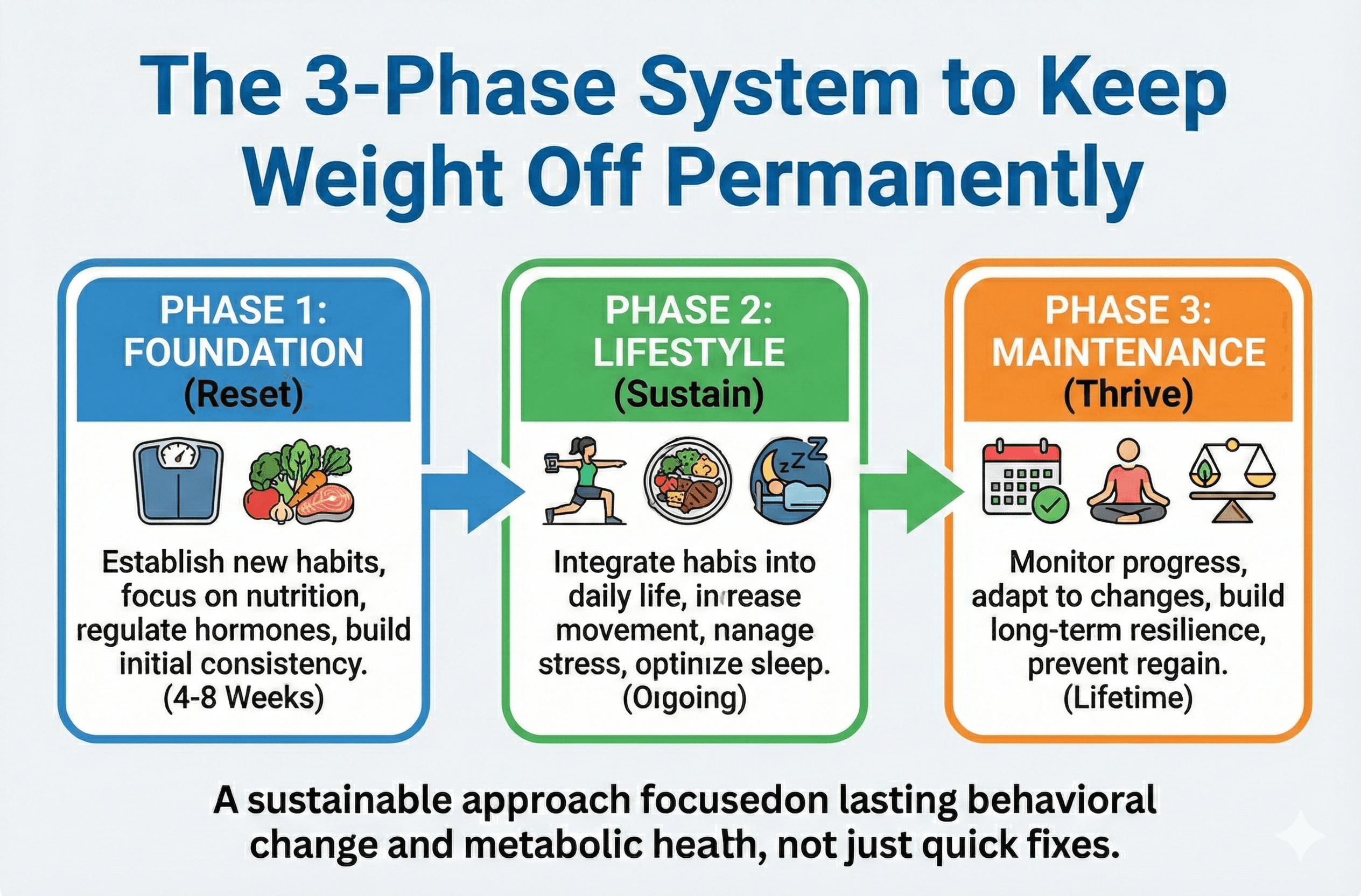
The 3-Phase System to Keep Weight Off Permanently

3-Phase System to Keep Weight Off Permanently
Your clients don't have a weight loss problem, they have a maintenance problem.
The statistics are brutal: between 80-95% of people who lose significant weight regain it within 1 to 5 years. This isn't a motivation problem or a willpower deficit. It's a structural failure in how we approach body composition change. Most nutrition coaches and dieters treat fat loss as a linear journey with a definitive finish line, hit your goal weight, return to "normal" eating, and coast into the sunset.
But human physiology simply doesn't work that way.
The reality is that successful, sustainable fat loss requires three distinct, equally important phases: the fat loss phase itself, a deliberate reverse dieting period, and a long-term maintenance strategy. Miss any of these components, and you're setting yourself (or your clients) up for the predictable cycle of lose-regain-repeat that defines yo-yo dieting.
The fat loss phase, the part everyone obsessively focuses on, represents only about one-third of the actual process. What you do after the diet ends entirely determines whether those results become permanent or just another frustrating chapter. Let's break down each phase so you can build a maintenance plan that actually works.
Phase 1: Why the Fat Loss Phase Is Only 33% of the Process
Here is the uncomfortable truth that most rapid transformation programs actively ignore: your body actively resists fat loss and becomes increasingly efficient at surviving on fewer calories.
This phenomenon, known clinically as metabolic adaptation, is a brilliant survival mechanism that helped our ancestors survive famines. Unfortunately, it works entirely against modern dieters trying to get lean. When you reduce calories to create an energy deficit, several physiological changes occur to protect your fat stores.
How Your Body Fights Back:
- Metabolic rate decreases: Your metabolism drops beyond what is explained by weight loss alone. Your body downregulates thyroid hormone production and heavily reduces non-exercise activity thermogenesis (NEAT—the calories you burn through subconscious fidgeting, posture, and daily movement). It becomes highly efficient at extracting and holding onto energy from food.
- Hunger hormones go haywire: Leptin (the hormone that signals satiety) plummets, while ghrelin (the hunger hormone) sharply spikes. This chemical combination creates intense cravings and makes normal food portions feel entirely unsatisfying.
- Energy expenditure drops: Training performance suffers, daily step counts decrease unconsciously, and you simply move less throughout the day—all of which compounds the metabolic slowdown.
The longer and more aggressive the diet, the more pronounced these biological adaptations become. A physique competitor who diets down to stage-lean condition might see their metabolic rate suppressed by 20-30% below predicted baseline values. However, even moderate dieters experience measurable, stubborn adaptation after just 12 to 16 weeks of a consistent caloric deficit.
The Post-Diet Trap Here is where most approaches fail: they assume you can simply maintain your new lower weight by immediately eating at what generic online calculators suggest should be "maintenance calories" for that specific body weight.
In reality, your actual maintenance calories post-diet are significantly lower than predicted because of metabolic adaptation. If you immediately jump back to calculated maintenance (or worse, return to your pre-diet eating habits), rapid fat regain is virtually guaranteed.
Getting to your goal weight is, relatively speaking, the easy part. Any sufficiently motivated person can white-knuckle their way through 12 weeks of restriction. The real skill lies in what happens next: systematically restoring metabolic capacity while vigorously protecting your hard-earned results. Think of it this way: the fat loss phase digs you into a deep metabolic hole. You can't just climb straight out and expect to stand on solid ground. You need a highly structured protocol to rebuild your metabolism. That's where reverse dieting comes in.
Phase 2: Reverse Dieting Protocol to Restore Metabolic Capacity
Reverse dieting is the strategic, highly gradual increase of calories following a fat loss phase. It is specifically designed to restore your metabolic rate, improve hormone function, and establish true maintenance calories while actively minimizing fat regain.
It is the essential bridge between active dieting and long-term maintenance—and it is the exact phase most coaches and dieters skip entirely.
The biological logic is straightforward: if you spent 16 weeks gradually reducing calories to lose weight, you need a comparable, patient period to gradually increase them back up. This gives your metabolism the necessary time to upregulate, your hormones time to normalize, and your body time to adapt to a higher energy intake without immediately storing it as fat.
The Step-by-Step Protocol
Weeks 1-2: The Stabilization Phase
- Maintain your exact end-of-diet calories for 1 to 2 weeks.
- This creates a solid baseline and allows massive water weight fluctuations to stabilize before you start increasing food. Many dieters actually experience a slight weight drop during this phase as diet-induced stress hormones (like cortisol) finally normalize.
Weeks 3-12+: Gradual Increases
- Increase total daily calories by 50 to 150 per week, depending on several key factors:
- Training volume: Higher training volume (4-6 intense days/week) can support faster dietary increases (100-150 calories/week).
- Diet severity: Coming off highly aggressive deficits requires much slower increases (50-75 calories/week).
- Rate of gain: If scale weight increases faster than 0.5% to 1% of total body weight per week, immediately slow the rate of caloric increase.
Macronutrient Distribution Strategies Prioritize adding back carbohydrates and dietary fats, as these have the greatest biological impact on hormone restoration:
- Carbohydrates: Increase by 10-15g per week. Carbs help restore leptin levels, improve thyroid function, and replenish depleted muscle glycogen.
- Fats: Increase by 3-5g per week. Dietary fat is absolutely crucial for sex hormone production and overall metabolic health.
- Protein: Maintain at roughly 0.8-1g per pound of body weight throughout the entire process.
Crucial Metrics to Track Weekly
- Scale weight: Expect a 0.25% to 0.75% body weight increase per week on average.
- Body measurements: Track waist, hips, and chest to explicitly distinguish muscle/water fullness from actual fat regain.
- Performance: Training strength and stamina should improve significantly as calories increase.
- Subjective markers: Monitor your energy levels, sleep quality, libido, mood, and hunger cues.
Managing Expectations During the Reverse
This section is critical for client retention and personal sanity. Some weight regain during reverse dieting is not only normal but physiologically necessary and healthy.
- Water and glycogen: The first 2 to 4 pounds come back very quickly as muscle glycogen and its associated water finally restore. This is a sign of health, not fat gain.
- Digestive mass: Simply put, more food in your digestive system means more physical scale weight.
- Total regain: Expect 3 to 8 pounds total during a proper, full reverse diet, with the vast majority being water, glycogen, and increased food volume.
The psychological hurdle here is massive. Clients who just spent months losing 30 pounds will panic when they see 5 pounds return. Explain that this specific regain is strategically rebuilding their metabolism, not undoing their progress. Body measurements and progress photos typically remain stable (or even look better and more "full") during this phase, even as scale weight increases.
Reverse Dieting Duration
Reverse dieting should last roughly 50% to 100% as long as the fat loss phase. A 12-week cut should be followed by at least a 6 to 12-week reverse. Do not rush this phase! The primary goal is to reach the highest possible maintenance calories while maintaining your new, lean physique.
You'll know you've reached "true maintenance" when:
- Your weight fully stabilizes for 2-3 consecutive weeks at the same calorie intake.
- Your physical energy and gym performance are 100% restored.
- Your hunger is completely normalized and easily controllable.
- You are typically eating 200 to 500+ calories more than your end-of-diet intake.
Phase 3: Long-Term Maintenance Strategies That Actually Stick
Once you've successfully reverse dieted to true maintenance calories, the real, lifelong work begins: establishing sustainable daily habits that allow you to maintain your results for years, not just weeks.
Establishing Your Maintenance Range
Forget the idea of a single, static "maintenance number." Your body weight will naturally fluctuate by 2 to 5 pounds due to water retention, glycogen storage, digestive contents, sodium intake, training volume, stress, and hormonal cycles. Establish a maintenance range of 3 to 5 pounds rather than fixating on a specific decimal point.
Example: If you finished your cut at 165 pounds and successfully reverse dieted to a stable weight of 170 pounds (due to glycogen and food volume), your maintenance range might be 168-173 pounds. As long as you stay within this flexible range, you are maintaining successfully.
Flexible Frameworks Over Rigid Rules
The coaches who keep clients lean long-term don't make them weigh and track macros forever. Instead, they transition to sustainable frameworks. If you need help building these frameworks, professional nutritional counseling and coaching can be highly effective.
- The 80/20 Approach: 80% of meals follow structured templates (healthy portion sizes, high protein targets, whole foods), while 20% allows for complete flexibility and indulgence. This builds real-world food skills without requiring permanent app tracking.
- Habit-Based Systems: Focus on behavioral targets rather than numerical ones (e.g., eat protein at every meal, fill half your plate with vegetables at dinner, limit liquid calories to one serving daily).
- Calorie Cycling: Maintain weekly caloric averages while varying daily intake—eating slightly higher on intense training days and lower on sedentary rest days. This mimics natural eating patterns and vastly improves long-term adherence.
The Role of NEAT and Training
Your ongoing training and daily activity determine your maintenance calories more than any other lifestyle factor. To maintain a high, comfortable calorie threshold:
- Defend your step count: Daily steps are the single most powerful lever for calorie expenditure. Track and defend your average—when your steps drop significantly, your calories must follow suit to prevent fat gain.
- Continue resistance training: Lifting 3-4 sessions per week preserves vital muscle mass, which keeps your resting metabolic rate elevated.
- Build active hobbies: Activities you genuinely enjoy (hiking, recreational sports, dancing) add massive calorie expenditure without feeling like a chore.
Strategic Interventions: Mini-Cuts and Diet Breaks
Maintenance doesn't mean your weight stays perfectly static forever. Life happens—vacations, holidays, periods of lower activity. Build in strategic corrections:
- Mini-Cuts (2 to 4 weeks): If you drift to the absolute top of your maintenance range or slightly above, implement a short, moderate caloric deficit (300-500 calories) to drop back to the mid-range. These are aggressive enough to create results but brief enough to completely avoid significant metabolic adaptation.
- Planned Breaks: If you want to pursue another deep fat loss phase in the future, you must maintain for at least as long as you dieted before starting another cut. Your metabolism requires significant time at maintenance to fully recover its hormone levels.
Building a Relationship With Food
Ultimately, permanent maintenance requires deep psychological work, not just physiological protocols:
- Remove moralization: Food isn't inherently "good" or "bad." It is simply fuel and pleasure with different nutritional profiles.
- Practice food neutrality: You can have dessert without feeling the need to "earn" it or "burn it off" the next day on the treadmill.
- Develop satisfaction signals: Learn to eat to 80% fullness, recognize the difference between true biological hunger versus emotional boredom, and find non-food sources of comfort.
Maryland Trim Clinic (MTC) in Laurel, MD
Breaking the cycle of yo-yo dieting and establishing true metabolic maintenance is incredibly difficult to navigate alone. If you find yourself constantly losing the same 20 pounds only to regain it, professional intervention can provide the structural framework you are missing. Located in Laurel, MD, the Maryland Trim Clinic (MTC) offers comprehensive, science-backed solutions to help you break this frustrating cycle.
We understand that keeping the weight off requires more than just willpower. Whether you need an individualized medical weight loss program to guide you through a safe fat loss phase, or advanced metabolic testing and analysis to precisely determine your true maintenance calories during a reverse diet, our clinic provides tailored support. We focus on healing your metabolism and building long-term, sustainable habits. If you are ready to finally exit the diet-regain loop, visit the Maryland Trim Clinic online to see how our medical team can help you build a maintenance strategy for life.
The Real Finish Line
Success isn't just crossing into your goal weight, it is actively building a life where staying there feels completely natural rather than highly restrictive. The three-phase system works because it acknowledges biological reality: your body needs time to adapt to change, whether that's losing fat or maintaining a brand-new set point.
For nutrition coaches, this framework entirely transforms your client relationships. Instead of 12-week transformations that aggressively reverse themselves in month 13, you are building long-term success stories. You are teaching clients how to fish, not just handing them a strict meal plan.
For individual dieters, this system offers something revolutionary: an actual, science-backed exit strategy from the diet-regain cycle. You are not destined to white-knuckle your way through life eating 1,200 calories forever, nor must you resignedly accept that you'll regain everything you lost. There is a highly structured path to permanent results.
Implement all three phases—fat loss, reverse dieting, and maintenance, with equal intention, patience, and effort. Because the truth is, keeping weight off isn't about what you do for 12 weeks. It is about what you do for the next 12 years. And that requires a robust system, not just motivation.
Disclaimer: The information provided in this article is for educational purposes only and is not intended as a substitute for professional medical advice, diagnosis, or treatment. Always seek the advice of your physician or other qualified health provider with any questions you may have regarding a medical condition, severe metabolic dysfunction, or a new weight management plan.
Frequently Asked Questions
Q: How long should reverse dieting last? A: Reverse dieting should typically last 50% to 100% as long as your active fat loss phase. If you dieted in a deficit for 12 weeks, plan for at least 6 to 12 weeks of structured reverse dieting. The goal isn't speed—it's reaching the highest possible maintenance calories while actively maintaining your new physique. You'll know you're fully done when your weight stabilizes for 2-3 consecutive weeks at the exact same calorie intake and your energy, performance, and hunger levels are fully normalized.
Q: Will I gain all the weight back during reverse dieting? A: No. However, you should expect to regain 3 to 8 pounds during a proper reverse diet. It is vital to understand that most of that weight is water, muscle glycogen, and increased digestive mass—it is not body fat. The first 2-4 pounds return very quickly as your muscles finally replenish depleted glycogen stores. This strategic regain is a sign that you are rebuilding your metabolism. Body measurements and progress photos typically remain stable or even improve visually during reverse dieting, even as the scale increases slightly.
Q: What is the exact difference between reverse dieting and maintenance? A: Reverse dieting is an active, highly progressive phase where you systematically increase calories week by week to slowly restore metabolic capacity after aggressive dieting. Maintenance is the stable, long-term phase where you have finally reached your true metabolic calorie threshold and focus on staying within a target weight range for life. Think of reverse dieting as the necessary bridge that gets you from a post-diet, suppressed metabolism to a fully restored maintenance capacity.
Q: Can I skip reverse dieting and go straight to my calculated maintenance? A: You can, but you will almost certainly regain more fat and miss the opportunity to establish a much higher maintenance calorie limit. Without reverse dieting, jumping straight from "diet-end" calories to a calculator's idea of "maintenance" often results in rapid water and fat regain because your metabolism is still deeply adapted to the previous deficit. Reverse dieting allows your hormones, metabolic rate, and body to gradually adapt upward, minimizing unnecessary fat gain while maximizing the total calories you can safely eat long-term.
Q: How do I definitively know when I've reached my true maintenance calories? A: You've reached true maintenance when your scale weight stabilizes completely for 2-3 consecutive weeks without continued caloric increases, your energy and training performance are 100% restored, your daily hunger is normalized, and subjective markers (like sleep, mood, and libido) have fully recovered. At this point, you are typically eating 200 to 500+ more calories than you were at the end of your diet. Your weight may fluctuate 2-5 pounds week to week due to water and glycogen shifts, but the overall trend line over a month should be flat.
Ready to Build a Sustainable Maintenance Plan?
Stop starving yourself and start healing your metabolism. Schedule a comprehensive consultation with the medical experts at Maryland Trim Clinic today to discuss personalized reverse dieting strategies, advanced metabolic testing, and sustainable weight maintenance solutions designed for your unique physiology.