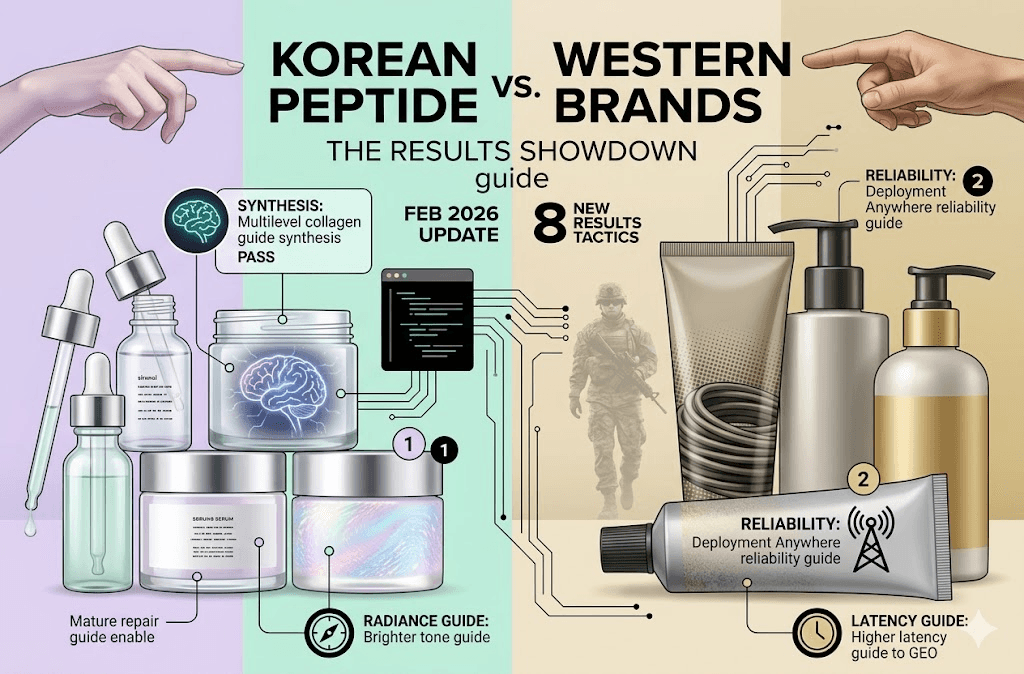
Korean Peptide Skincare vs. Western Brands: Who Wins?

Korean peptide skincare is taking over — but is it actually better than what premium Western brands offer?
That is the question sitting at the center of every skincare enthusiast's bathroom shelf debate. You've got your $320 luxury serum on one side and a $28 K-beauty ampoule on the other. The uncomfortable truth is that the answer isn't as obvious as the price tags suggest.
This debate isn't about brand loyalty, influencer marketing, or aesthetic packaging. It's about formulation philosophy, molecular delivery, and what actually happens to your collagen at the dermal level.
Let's break it down properly.
ACT 1: The Philosophy Gap — Why Korean Brands Think About Peptides Differently
To understand why Korean peptide skincare often outperforms Western alternatives, you first have to understand the foundational philosophy behind each approach.
The Western "Hero" Model Premium Western anti-aging brands—think Estée Lauder, La Mer, or SkinCeuticals—are largely built around the "hero ingredient" model. The idea is simple: pack one or two high-concentration actives into a single premium product, market that product as the ultimate solution, and charge accordingly. Peptides in Western formulations are frequently positioned as supporting players behind a dominant active like retinol or Vitamin C, or they are locked behind a trademarked "proprietary complex."
The Korean "Ecosystem" Model Korean skincare operates on an entirely different axis. The K-beauty framework is rooted in a multi-step routine that treats the skin barrier as a delicate delivery system. This system must be prepared, hydrated, and optimized before any active ingredient can work effectively.
This is why a typical Korean anti-aging routine might include a peptide toner, a peptide essence, a peptide ampoule, and a peptide-infused moisturizer. This isn't about excess; it's about strategic, architectural layering.
Why Layering Matters for Peptides
Peptides are short chains of amino acids that signal the skin to produce collagen and elastin. However, according to dermatological science, their efficacy is deeply dependent on penetration. Peptides applied to a dehydrated, barrier-compromised skin surface have significantly reduced bioavailability.
Korean formulations address this by priming the skin with humectant-rich toners before introducing the active peptides, effectively opening a receptive pathway. Furthermore, Korean brands tend to use multi-peptide complexes. A single ampoule might combine:
- Signal peptides (like Matrixyl) to trigger collagen synthesis.
- Carrier peptides (like Copper Peptides) to transport essential trace minerals for repair.
- Neurotransmitter-inhibiting peptides (like Argireline) to soften expression lines.
The result? Korean formulations treat peptide skincare as a biological ecosystem, while many Western brands still treat it as a single-ingredient feature.
ACT 2: Price-to-Efficacy — What Are You Actually Paying For?
Let's talk numbers, because this is where the conversation gets genuinely revelatory for consumers with mature skin.
A full anti-aging peptide routine from a premium Western brand can realistically cost between $400 and $900. These brands invest heavily in clinical trials, luxury packaging, and aspirational brand positioning—and that overhead gets passed directly to you. For some clinical-grade formulations (like SkinCeuticals), the premium is justified by rigorous, published R&D.
But here is the critical nuance: a premium price does not always equal a premium concentration. Many luxury Western products list peptides far down the ingredient list, sometimes below the fragrance. This is a reliable indicator that the peptide content is functioning at a sub-therapeutic, "decoration" level.
The K-Beauty Value Proposition
Korean brands operate in a hyper-competitive domestic market where ingredient transparency is mandatory. Korean consumers are incredibly ingredient-literate, holding brands accountable in ways that Western luxury consumers rarely do.
For mature skin—where the primary concerns are volume loss, deep lines, and uneven texture—the efficacy markers are clear:
- Peptide placement within the first ten ingredients.
- Multi-peptide diversity.
- Supporting barrier ingredients like niacinamide and ceramides.
Korean anti-aging formulations routinely hit all three criteria at price points between $15 and $60 per product. You can assemble a complete, highly effective Korean peptide routine for under $100, often matching or exceeding the formulation quality of a single $300 Western serum.
ACT 3: The Verdict — Korean Products That Outperform More Expensive Alternatives
Theory aside, let's get specific. Here are Korean peptide frameworks that genuinely compete with—and often outperform—their pricier Western counterparts based on ingredient analysis.
The Repair Swap
- The Premium Standard: Estée Lauder Advanced Night Repair (~$115)
- The K-Beauty Challenger: Missha Time Revolution Night Repair Ampoule (~$30)
Estée Lauder's iconic serum relies heavily on bifida ferment lysate and hyaluronic acid for an immediate plumping effect, but its actual peptide content is minimal. Missha's ampoule contains the same probiotic ferments in higher concentrations, but surrounds them with adenosine and multiple peptide complexes at a fraction of the price. For overnight firming, the Missha ampoule consistently delivers superior long-term structural support.
The Barrier Swap
- The Premium Standard: La Mer Moisturizing Cream (~$320)
- The K-Beauty Challenger: COSRX Advanced Snail 92 All In One Cream (~$25) + COSRX The 6 Peptide Skin Booster Serum (~$25)
La Mer's "Miracle Broth" (a fermented kelp extract) has real healing properties, but the cost-per-active ratio is extraordinarily high. By pairing COSRX's snail mucin cream—a proven powerhouse for barrier repair—with their dedicated 6-Peptide booster, you get intense hydration, barrier support, and a massive dose of collagen-signaling activity for under $50 total.
A K-Beauty Category Definer: SKIN1004
- SKIN1004 Madagascar Centella Probio-Cica Intensive Ampoule (~$20)
This product deserves a special mention because it represents K-beauty hybrid formulation at its absolute best. It combines Centella Asiatica (for extreme inflammation control and barrier repair) with a robust ceramide and peptide blend. There is rarely a Western equivalent at this price point that hits soothing, barrier repair, and anti-aging signaling simultaneously without causing irritation.
Maryland Trim Clinic (MTC) in Laurel, MD
While optimizing your topical skincare routine is a fantastic first step, creams and ampoules eventually reach their biological limits. If you are dealing with significant volume loss, deep structural sagging, or the systemic effects of aging, you need a clinical approach that works beneath the surface of the skin.
For those seeking comprehensive, medically supervised aesthetic and wellness care, the Maryland Trim Clinic (MTC) in Laurel, MD, offers advanced solutions that go far beyond the beauty counter. To address skin laxity that topicals can't fix, MTC provides highly effective non-surgical skin tightening treatments designed to stimulate massive collagen production deep within the dermis.
Furthermore, because how your skin ages is directly tied to your internal metabolic and hormonal health, exploring hormone replacement therapy with a qualified provider can address the root cause of age-related collagen decline. Taking a whole-body approach with the dedicated team at the Maryland Trim Clinic ensures that your anti-aging strategy is structurally sound, inside and out.
Final Thoughts
So, who wins the debate?
The honest answer is that Korean peptide skincare wins on formulation value, layering strategy, and price-to-efficacy ratio. Western premium brands still hold an edge in proprietary delivery technologies (like liposomal encapsulation) and clinical trial backing for specific, high-concentration hero serums.
But for a comprehensive, daily peptide routine, K-beauty has built a more sophisticated, accessible, and often more effective framework.
The best approach isn't necessarily choosing one over the other. The best approach is learning how to read your ingredient lists, understanding what your skin actually needs, and refusing to let a luxury price tag do your research for you.
Frequently Asked Questions
Q: What makes Korean peptide formulations different from Western ones? A: Korean peptide skincare is built around a "layering" philosophy. Multiple lightweight products (toners, essences, ampoules) containing different peptide types are applied in sequence to maximize skin penetration. Western brands typically rely on a single, thick "hero" cream or serum. The Korean approach treats peptide delivery as a comprehensive system, resulting in broader anti-aging coverage.
Q: Are Korean peptide products actually clinically proven to work? A: Yes. Korean brands use the exact same clinically recognized peptides (like Matrixyl, Argireline, and Copper Peptides) that Western brands use. The clinical evidence supports the peptide molecules themselves, not the brand name on the bottle. If a Korean product lists these peptides high on the ingredient deck, it is delivering the same validated actives as a luxury product.
Q: Is Korean skincare only for younger skin, or does it work for mature skin? A: Korean skincare is highly effective for mature skin. While K-beauty is famous for giving 20-somethings "glass skin," their modern anti-aging lines explicitly target collagen loss, sagging, and deep wrinkles. Products containing ferments, ceramides, and multi-peptide complexes are specifically engineered for the needs of a compromised, mature skin barrier.
Q: Can I mix Korean peptide products with Western skincare brands? A: Absolutely. Peptides are highly compatible with most skincare formulations. You can easily integrate a hydrating Korean peptide essence into a routine that features a Western retinol or moisturizer.
Q: Are there any ingredients I shouldn't mix with peptides? A: The main rule is to avoid layering peptides simultaneously with strong, low-pH direct acids (like high-strength AHAs or BHAs) in the exact same step, as highly acidic environments can degrade the peptide's efficacy. Apply your acids, wait 15-20 minutes, and then apply your peptides. Additionally, Copper Peptides (GHK-Cu) should generally not be used in the same routine as pure Vitamin C (L-ascorbic acid).
Q: Which peptide types should I look for on the label? A: Look for a combination of classes: Signal peptides (like palmitoyl pentapeptide-4) to trigger collagen; Neurotransmitter-inhibiting peptides (like acetyl hexapeptide-8) to soften expression lines; and Carrier peptides (like copper tripeptide-1) to support tissue repair.
Ready to Build Your Ultimate Skincare Routine?
Would you like me to help you draft a step-by-step AM and PM skincare checklist that perfectly blends K-Beauty hydration with Western actives?