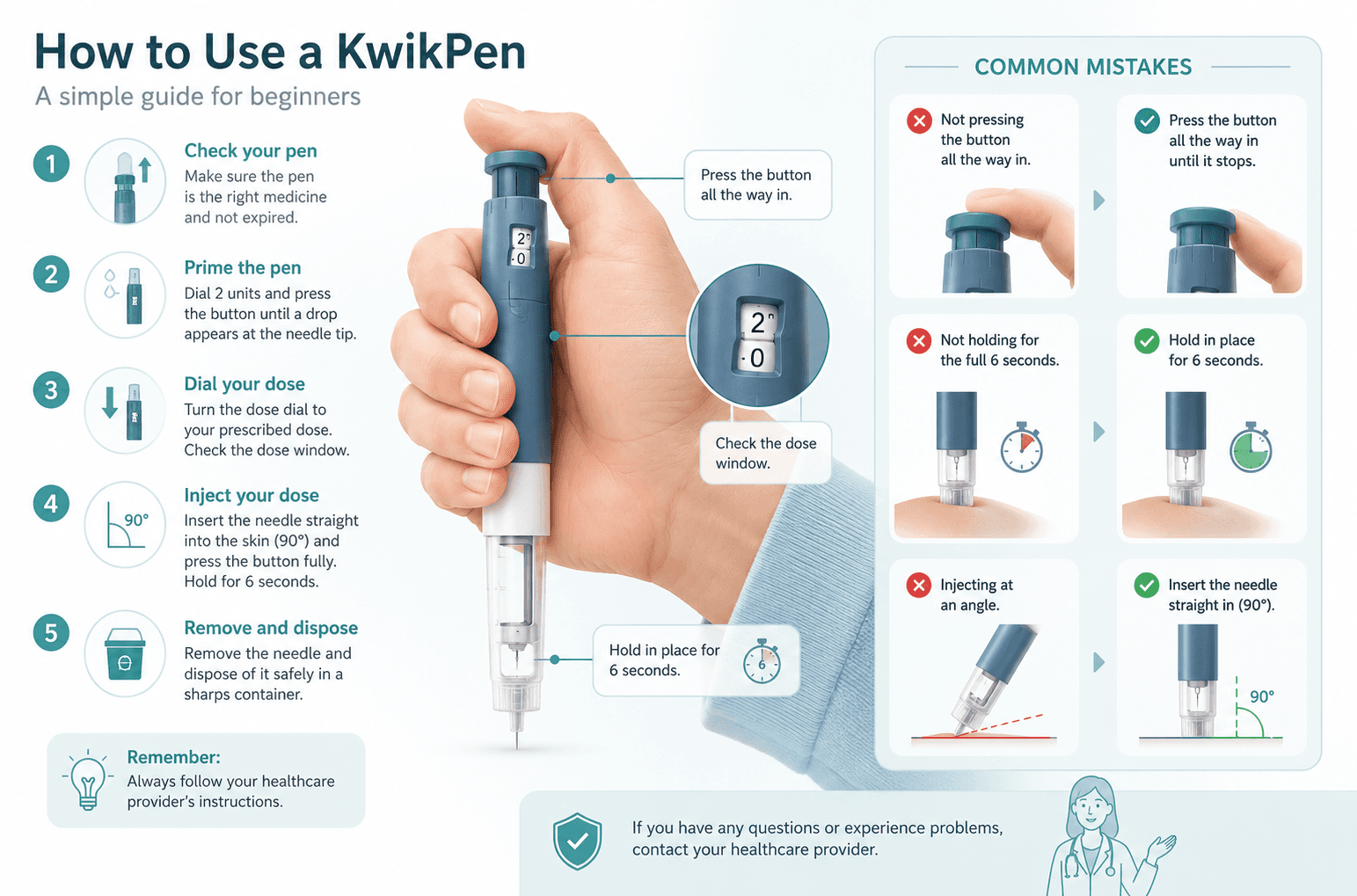
KwikPen Mistakes Beginners Make And How to Fix Them

I botched my third KwikPen shot on camera — here's exactly what went wrong.
It wasn't dramatic. There was no blood, no screaming, no dropped pen. It was quieter than that, and honestly, that's what made it so easy to miss. I held the pen in place, counted to ten in my head, pulled it out — and felt weirdly confident. Then I looked at the dose counter. It hadn't moved. The number was sitting exactly where I'd set it before the injection. I had just delivered zero medication into my body and had absolutely no idea until I checked.
If you're a first-time Zepbound KwikPen user, that story probably sounds either terrifying or completely foreign. Either way, it matters — because this kind of silent mistake is far more common than the instructional videos suggest, and the consequences aren't just wasted money. An undelivered dose means your weekly medication schedule is off, your body didn't get what it needed, and you may not even realize it until you wonder why the medication doesn't seem to be working.
This article is a real-world walkthrough of the most common KwikPen mistakes beginners make, how to verify your dose was actually delivered, and how to build a routine that makes the whole process feel second nature in under two minutes.
ACT 1: The Most Common KwikPen Injection Mistakes — And Why They Keep Happening
Mistake #1: Not Completing the Prime
Before your very first injection with a new pen, you're supposed to prime it. Priming removes air from the needle and ensures medication is ready to flow. The KwikPen uses a pre-attached needle system, and many beginners either skip the prime entirely or do it incorrectly by not holding the pen upright and watching for a small stream of medication at the needle tip.
According to the FDA's medication guidance for injectable pens, proper preparation steps matter because incorrect technique can lead to underdosing or inconsistent delivery.
Why This Happens
The instructions are tucked inside a folded leaflet, the font is small, and when you're anxious about giving yourself a shot, you tend to skim. You see a needle, you see a pen, and your brain says: let's just do this. The prime step feels like a delay rather than a necessity.
How to Fix It
Prime only once per new pen, not before every injection.
Use this quick sequence:
- Wash your hands first
- Hold the pen upright with the needle pointing upward
- Dial to 2 units
- Press the button fully
- Watch for a droplet or thin stream of medication
If nothing appears:
- Repeat the process carefully
- Make sure the pen stays upright
- Avoid shaking the pen aggressively
Once you see medication at the tip, the pen is ready for use.
Mistake #2: Injecting Too Quickly
This was part of my third-shot failure. I pressed the button, felt resistance ease, and pulled the pen out almost immediately.
What I didn't know is that the KwikPen requires you to hold the button down and keep the needle in place for a full 10 seconds after pressing. This is non-negotiable. Pull out early and you risk the medication not fully delivering — or worse, it follows the needle back out and you don't even see it happen.
Why This Happens
Most injections people have experienced in their lives — flu shots, vaccines, blood draws — are quick. You're conditioned to associate needles with fast in-and-out motion. The KwikPen works differently because the medication needs time to fully dispense into subcutaneous tissue.
How to Fix It
Build a repeatable rhythm:
- Press the button fully
- Keep pressure on the button
- Count slowly to ten
- Remove the pen only after the count is complete
Many beginners find it easier to:
- Count out loud
- Use a timer
- Watch a short video clip during the hold
That ten-second pause feels awkward at first. With repetition, it becomes automatic.
Mistake #3: Injecting Into the Wrong Spot or Tissue
Zepbound via KwikPen is a subcutaneous injection, meaning it needs to go into the fatty tissue just beneath the skin — not into muscle.
Approved injection sites include:
- The abdomen, at least two inches from the navel
- The front of the thigh
- The back of the upper arm
Beginners often inject too close to the belly button, use irritated tissue, or accidentally inject into muscle.
The CDC's injection safety guidance emphasizes proper injection technique and site rotation to reduce complications and tissue irritation.
Why This Happens
The pen looks like it should go straight in, and most people assume one angle works for everybody. But body composition matters. Someone with lower body fat may need a shallower approach.
How to Fix It
Use a simple site-check routine:
- Choose healthy, unbruised skin
- Avoid scars, irritation, or hardened areas
- Gently pinch a fold of skin
- Insert at 90 degrees for most users
- Use 45 degrees if you have less subcutaneous fat
Rotate Your Injection Sites
Repeated injections into the same area can increase irritation and may contribute to lipohypertrophy, which are thickened or hardened tissue areas beneath the skin.
A simple rotation pattern helps:
- Week 1: Left abdomen
- Week 2: Right abdomen
- Week 3: Left thigh
- Week 4: Right thigh
Consistency matters more than perfection.
Mistake #4: Forgetting to Check the Dose Counter Before and After
The dose counter on the KwikPen is your accountability system.
Before injecting:
- Confirm the correct dose appears
After injecting:
- Confirm the counter reads zero
Many beginners never check afterward. They assume if they pressed the button, the dose was delivered.
Why This Happens
The moment the injection ends, your brain shifts into relief mode. Checking the counter feels optional even though it's one of the most important verification steps.
How to Fix It
Create a two-second post-shot habit:
- Look at the counter immediately
- Confirm it reads zero
- Check the injection site for leakage
- Dispose of the needle safely
If the counter does not reach zero:
- Do not administer another dose
- Contact your healthcare provider or pharmacist for guidance
Mistake #5: Letting the Pen Get Too Cold
Zepbound KwikPens are stored in the refrigerator, but injecting cold medication often stings more and may feel harder to administer smoothly.
Many beginners take the pen directly from the fridge and inject immediately.
Why This Happens
Most instructions focus heavily on storage and expiration dates, but they don't always explain how temperature affects comfort during the actual injection.
How to Fix It
Remove your pen from the refrigerator about 30 minutes before your injection.
Let it rest naturally at room temperature:
- Keep it on a clean surface
- Avoid direct sunlight
- Do not microwave it
- Do not place it in hot water
This small step often makes injections noticeably more comfortable.
ACT 2: How to Tell If You've Administered the Dose Correctly
This is the part most beginner guides gloss over, and it's arguably the most important. A botched injection doesn't always announce itself.
Check 1: The Dose Counter Reads Zero
This is your primary confirmation step.
If the window reads zero after the injection, the pen likely dispensed the full dose correctly.
If the number remains visible:
- The injection may have been incomplete
- The button may not have been fully depressed
- The needle may have been removed too early
Do not guess. Reach out to your prescribing clinician if you're unsure.
Check 2: No Visible Medication on the Skin
After removing the needle, inspect the injection site.
A small droplet of medication on the skin surface may suggest leakage. This can happen if:
- The needle was removed too early
- The angle was incorrect
- The site had scar tissue
- The button was released too soon
Occasional minor leakage happens. Repeated leakage means it's time to reassess your technique.
Check 3: Mild Sensation at the Site
A properly delivered subcutaneous injection may cause:
- Mild pressure
- Brief stinging
- Temporary redness
- A small raised bump
These sensations are usually short-lived.
According to MedlinePlus guidance on subcutaneous injections, mild local irritation can occur and often resolves quickly without treatment.
Feeling nothing at all can still be normal. The key is evaluating the full picture:
- Did the counter hit zero?
- Was the button fully depressed?
- Was there leakage?
Check 4: The Button Is Fully Depressed
Some users stop pressing when they feel initial resistance release.
That is not necessarily the end of the injection.
Before removing the needle:
- Verify the button cannot go any farther
- Keep holding pressure during the 10-second count
- Remove the needle only after the count finishes
What to Do If You're Unsure
Do not attempt to re-inject the same dose on your own.
Instead:
- Contact your prescribing physician
- Speak with your pharmacist
- Reach out to the medication support line if provided
Trying to “correct” an uncertain dose without medical guidance can increase the risk of side effects.
ACT 3: Tips to Go From a 10-Minute Shot to Under 2 Minutes
The first injection often feels overwhelming. You reread instructions, double-check every step, and mentally rehearse the process before touching the pen.
That's normal.
With repetition, the process becomes much easier and less emotionally draining.
Build a Pre-Shot Checklist You Actually Use
Write a simple checklist and keep it with your supplies until the process feels automatic.
A helpful example:
- Pen at room temperature
- Hands washed
- Alcohol swab ready
- Injection site rotated
- Correct dose selected
- Sharps container nearby
This reduces anxiety because you stop relying on memory under stress.
Pick a Consistent Day and Time
Zepbound is typically used weekly. Consistency helps reduce missed doses and decision fatigue.
Many users pair injections with existing routines:
- Sunday morning coffee
- Friday evening wind-down
- After brushing teeth
- Before a favorite TV show
Habit stacking makes the process feel less disruptive.
Use Distraction Strategically
Distraction is not avoidance. It can reduce stress and improve consistency.
Try:
- Music
- Podcasts
- Guided breathing
- Watching a short video during the 10-second hold
The goal is to make the injection feel routine instead of emotionally loaded.
Keep Your Supplies Organized in One Place
Small frustrations create unnecessary resistance.
Keep everything together:
- Pen
- Alcohol swabs
- Sharps container
- Backup needles if applicable
- Reminder checklist
A dedicated pouch or drawer can make injection day feel significantly smoother.
Debrief After Each Shot for the First Month
Spend ten seconds reviewing the injection afterward.
Ask yourself:
- Did the counter hit zero?
- Did I hold for ten full seconds?
- Was there leakage?
- Did the injection feel smooth?
This quick mental review helps you catch technique problems early before they become habits.
Maryland Trim Clinic (MTC) in Laurel, MD
For some people, learning injection technique is only one part of a larger weight-management journey. Ongoing medical guidance, nutrition support, and body-composition tracking can also help patients stay consistent and informed over time.
Maryland Trim Clinic in Laurel, MD offers services related to medically supervised weight management and wellness support. Depending on individual needs, some patients may benefit from structured programs such as their medical weight loss program, individualized nutrition coaching support, or clinically supervised GLP-1 treatment options.
Some individuals also use tools like 3D body scanning assessments or metabolic testing and analysis to better understand progress beyond the scale alone. The right support approach depends on your medical history, goals, and your healthcare provider's recommendations.
Frequently Asked Questions
Q: How do I know if my Zepbound KwikPen dose was actually delivered?
A: The most reliable indicator is the dose counter window on the pen — it should read zero immediately after a successful injection. You can also check for the absence of visible medication on the skin surface and confirm the injection button was pressed fully down before removing the needle.
Q: How long do I need to hold the KwikPen in place after pressing the button?
A: You need to keep the needle inserted and the button held down for a full 10 seconds after pressing. Removing the pen too early is one of the most common causes of incomplete dose delivery. Counting slowly can help ensure you hold the pen long enough.
Q: Do I need to prime my KwikPen before every injection?
A: No. You only prime a KwikPen once before the very first use of a new pen. Priming removes air from the needle and helps ensure medication is ready to flow correctly.
Q: What should I do if the dose counter doesn't reach zero after my injection?
A: Do not attempt to re-inject the remaining dose yourself. Contact your prescribing physician, pharmacist, or medication support line for guidance on what to do next.
Q: Why does my KwikPen injection hurt more some weeks than others?
A: Injecting cold medication is one of the most common reasons injections sting more. Letting the pen sit at room temperature for about 30 minutes before use may improve comfort. Injection-site irritation, muscle injection, or tension during the shot can also contribute.
Q: Where are the approved injection sites for the Zepbound KwikPen?
A: Approved subcutaneous injection sites typically include the abdomen, front of the thigh, and back of the upper arm. Rotating sites regularly can help reduce irritation and tissue changes.
Q: What angle should I use when inserting the KwikPen needle?
A: Most users inject at a 90-degree angle. People with lower body fat may sometimes use a 45-degree angle to avoid injecting into muscle. Your healthcare provider can help determine the best technique for you.
Q: Is it normal to see a small drop of liquid at the injection site after removing the needle?
A: Occasional minor leakage can happen, especially while you're still learning injection technique. If leakage happens frequently, review your injection timing, angle, and site rotation habits with a healthcare professional.
Finding Support That Fits Your Goals
Some people feel comfortable managing injections independently after a few weeks. Others benefit from additional guidance, especially when building sustainable routines around medication, nutrition, and long-term lifestyle changes. If you want more structured support, exploring a medically supervised program such as the services available through Maryland Trim Clinic's patient-centered weight management care may help you better understand your options and discuss questions with qualified professionals.