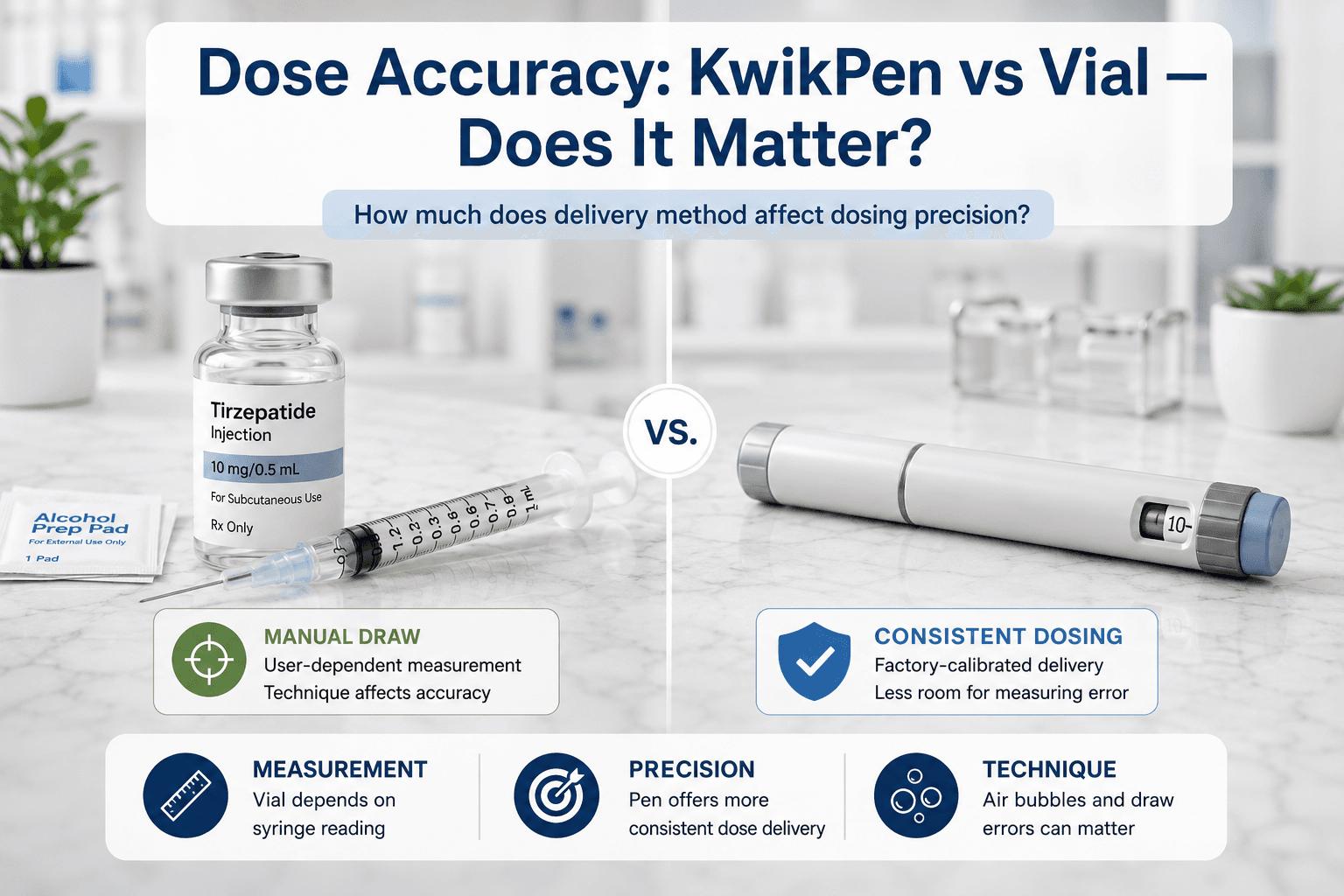
Dose Accuracy: KwikPen vs Vial - Does It Matter?


Dose accuracy is one of the most under-discussed parts of the Zepbound KwikPen vs vial conversation. Patients often ask whether a vial is "the same medicine," and that answer is usually yes: the active drug is tirzepatide. But the harder question is whether the same prescribed dose is being prepared and delivered with the same consistency every week.
At Maryland Trim Clinic, this matters because medication consistency affects how patients interpret progress. If someone is tracking weight, appetite, side effects, hunger return, or plateaus inside a medical weight loss program, dose variation can make the picture harder to read.
Factory-Guided Dose vs User-Measured Dose
The KwikPen is designed as a pen-based system for fixed weekly doses when used according to the instructions. The patient still has responsibilities: inspect the medicine, use a new compatible pen needle, prime when directed, dial and inject correctly, confirm the dose window, and dispose of the needle safely.
A vial shifts more of the measuring work to the user. The medication may be manufactured precisely, but the person drawing the dose becomes the measuring instrument. The full Zepbound prescribing information instructs clinicians to train patients on the correct presentation and notes that vial users should use a syringe appropriate for the dose, such as a 1 mL syringe capable of measuring 0.5 mL or 0.6 mL. See the official Zepbound prescribing information for the full label context.
That difference is the heart of the dose-accuracy question. The vial can be used carefully, but it creates more places where small errors can enter the routine.
Common Vial Errors That Can Shift the Dose

Air bubbles are the classic problem. If a bubble takes up space in the syringe barrel, the visible volume can look correct even though the amount of liquid medicine is lower. A small bubble may not create an emergency, but it can contribute to an underdose.
Syringe size matters too. A 1 mL syringe with fine markings is easier to read for small medication volumes than a larger syringe with wider spacing between marks. Reading the syringe from above or below the line can also create parallax error, especially when someone is nervous or rushing.
Temperature and handling can make the process feel less smooth. Cold liquid may draw more slowly. A shaky hand can move the plunger. A rushed routine can skip the final re-check. None of these issues makes vial use impossible. They simply explain why technique matters.
Patients who are still learning may also want to review practical injection guidance such as our Zepbound KwikPen injection tutorial, our overview of GLP-1 side effects, and the broader guide to how GLP-1 works.
Does a Small Dose Difference Actually Matter?
One small variation is unlikely to ruin a treatment plan. Tirzepatide is taken weekly and has a long pharmacokinetic profile, so a tiny one-week difference may be smoothed out over time. But repeated under-measuring or over-measuring can still matter, especially when a patient is trying to understand side effects, dose escalation, hunger return, or a plateau.
The official Zepbound how-to-use page emphasizes training, correct injection sites, rotation, and presentation-specific instructions. That is not just legal fine print. It is a reminder that the format changes the technique.
If a patient is unusually sensitive to dose changes, has had variable side effects, or is trying to determine whether a plateau is biological or technique-related, it is worth auditing the weekly routine before assuming the medicine has stopped working.
A Practical Vial Technique Checklist
A safer vial routine starts before the needle enters the vial. Confirm the medicine, dose, expiration date, and appearance. Use a new syringe and needle every time. Make sure the syringe is the right size for the dose volume. Wash hands, clean the vial stopper, and work on a clean surface.
Draw slowly. If bubbles appear, tap them up and re-check the volume after pushing air out. Read the syringe at eye level. Do not estimate from an angle. After injecting, dispose of the needle and syringe in a sharps container.
Most importantly, do not make up your own correction dose if you think something went wrong. If you are unsure whether the full dose was delivered, contact your prescriber or care team rather than guessing.
How Maryland Trim Clinic Helps Patients Troubleshoot Dose Concerns
At Maryland Trim Clinic, dose accuracy is part of the bigger weight-loss picture. We want patients to know whether a plateau is more likely related to biology, nutrition, activity, medication access, dose timing, or technique. That may include reviewing progress with 3D body scanning, checking metabolic context through metabolic testing and analysis, and strengthening the plan with nutritional counseling and coaching.
MTC can also help patients think through whether the format fits their life. A person who is comfortable with syringes may do well with a vial. A person who frequently second-guesses the draw may be better served by a pen pathway if access and cost allow. The right answer depends on skill, confidence, coverage, and clinical goals.
For patients comparing medication options more broadly, it may also help to review qualification criteria with a clinician, ask about future oral medication options, and consider supportive services such as appetite suppressant medications when clinically appropriate.
Bottom Line
The KwikPen usually has an accuracy advantage because it reduces the user's role in measuring the medicine. The vial can still be used responsibly, but it demands better technique, the right syringe, careful bubble control, and consistent attention.
If your weekly results or side effects feel inconsistent, do not assume the medication is failing. Review the routine. Check the format. Ask for training. And if you are not confident that you are drawing the dose correctly, treat that as a clinical question worth solving.
Frequently Asked Questions
Is the KwikPen more accurate than drawing from a vial?
In practical terms, it usually reduces measurement-related user error because the patient is not manually drawing medication into a syringe. Correct device technique is still required.
Can air bubbles change the dose?
Yes. Air takes up space in the syringe barrel, so the visible volume can overstate the amount of liquid medicine. This is why bubble removal and volume re-checking matter.
What syringe is best for small GLP-1 volumes?
Use the syringe type and size recommended by your prescriber or pharmacist. For small volumes, a 1 mL syringe with fine markings is generally easier to read than a larger syringe.
Could vial technique explain a plateau?
It is possible. A plateau can have many causes, including biology, nutrition, activity, sleep, dose timing, and medication tolerance. But inconsistent drawing technique is worth checking before drawing conclusions.
Unsure Whether Your Injection Routine Is Reliable?
Maryland Trim Clinic can help you review your medication technique, side effects, plateau concerns, and weight-loss goals so your weekly plan is safer and more consistent.