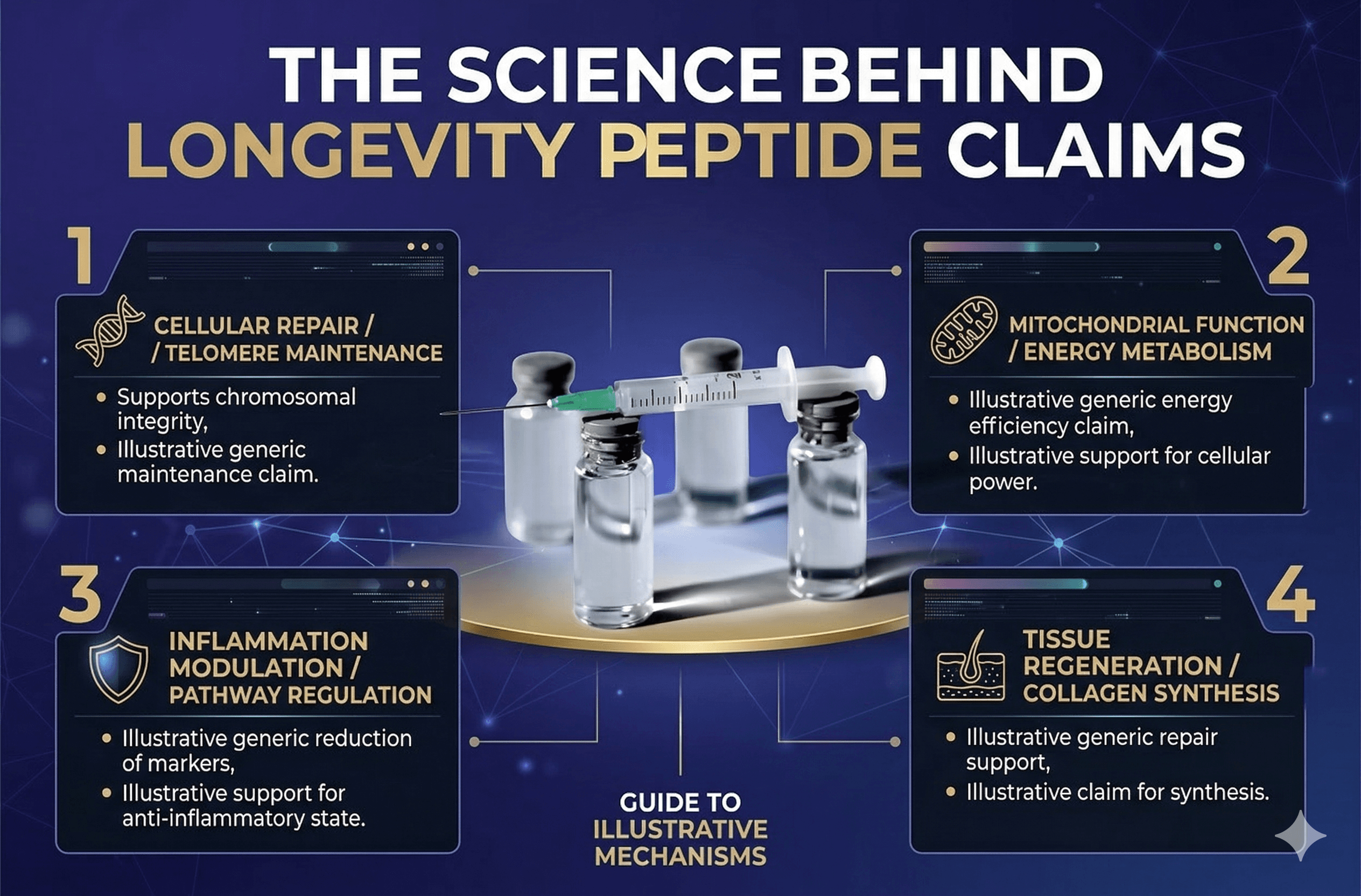
The Science Behind Longevity Peptides: What Actually Works?

They say one peptide could help you live to 120. Here's what the actual research says, and where it falls apart.
The promise is seductive, and it arrives dressed in the language of credibility: telomere extension, epigenetic reprogramming, IGF-1 axis modulation. Longevity peptides have graduated from fringe biohacking forums into mainstream wellness culture, carried there by glossy podcasts, celebrity endorsements, and an anti-aging industry projected to exceed $50 billion by 2030.
The problem isn't that these molecules are uninteresting. Many of them are genuinely fascinating to researchers. The problem is that the distance between "fascinating in a petri dish" and "proven to extend human lifespan" is vast. Almost nobody selling these compounds wants you to think carefully about that gap.
This is a deep-dive for people who want to understand what the science actually says, graded honestly, without the hype.
ACT 1: The Current State of Longevity Peptide Research
A Field Built Mostly on Animal Data
Longevity science is real. Aging biology is one of the most active and well-funded research domains in modern medicine. Institutions like the Buck Institute for Research on Aging, the Glenn Foundation, and academic groups at Harvard and Stanford are producing genuinely groundbreaking work. None of this is pseudoscience at its core.
But here is the foundational issue every consumer needs to understand: the overwhelming majority of longevity peptide data comes from non-human models. These include:
- C. elegans (a millimeter-long worm with a lifespan measured in weeks)
- Drosophila melanogaster (fruit flies)
- Mus musculus (laboratory mice, often inbred strains with artificially compressed lifespans)
- In vitro cell cultures (cells in a dish, entirely removed from systemic biological complexity)
These models are invaluable for hypothesis generation. A researcher can test whether a compound extends lifespan in a worm within a month. But that worm has roughly 300 neurons and no cardiovascular system. A mouse shares about 85% of protein-coding genes with humans, but its metabolic rate and immune profile are radically different from ours.
The history of medicine is littered with compounds that performed spectacularly in rodents and failed entirely — or caused harm — in humans. According to a 2021 analysis published in Aging Cell, an incredibly small percentage of compounds that extend lifespan in mice proceed to rigorous human clinical trials.
What "Clinical Evidence" Actually Means
When you see a longevity peptide company cite "clinical studies," it pays to understand the evidence hierarchy:
Randomized Controlled Trials (RCTs): The gold standard. Participants are randomly assigned to treatment or placebo, ideally double-blinded.
Observational cohort studies: Follows groups over time. Useful, but heavily confounded by lifestyle variables.
Open-label trials: No placebo group; high susceptibility to bias.
Case reports / Anecdotal evidence: Individual accounts. Zero statistical validity.
Animal studies: Mechanistically informative, but not clinically predictive for humans.
In vitro studies: The lowest translational relevance to a whole human body.
Most longevity peptide marketing leans heavily on categories 4 through 6, while using the authoritative vocabulary of category 1. This is the central deception of the industry.
ACT 2: Epitalon, Epithalon, and the Lifespan Peptide Landscape
Epitalon (Epithalon): The Most Studied Longevity Peptide
If any longevity peptide deserves serious discussion, it is Epitalon (a synthetic tetrapeptide). Developed primarily by Vladimir Khavinson and colleagues at the St. Petersburg Institute of Bioregulation and Gerontology in the 1980s, Epitalon has accumulated a relatively large body of research.
What the research shows — and its quality:
- Telomerase activation: Several studies report that Epitalon activates telomerase in human fibroblast cells, potentially slowing the shortening of telomeres. (Evidence grade: In vitro; low translational certainty).
- Lifespan extension in rodents: Multiple studies report 13–25% lifespan extension in mice and rats, alongside reductions in tumor incidence. (Evidence grade: Animal model; moderate mechanistic interest, but limited human relevance).
- Melatonin normalization: Some small studies report that Epitalon restores nighttime melatonin secretion in elderly patients. (Evidence grade: Small human studies, often open-label with very small sample sizes).
- Human trials: A small number of human studies exist, largely conducted by the same Russian research group, measuring biomarkers rather than actual lifespan.
The Honest Verdict: Epitalon is the longevity peptide with the most data, yet that data is still insufficient to make strong claims about human lifespan extension. The near-total lack of independent, large-scale, double-blind RCTs is disqualifying for broad clinical recommendation.
Other Notable Longevity Peptides
- BPC-157: Frequently marketed for systemic anti-aging and rapid tissue repair. While animal data suggests strong healing properties, human trial data for longevity claims is virtually nonexistent. Its marketing is entirely extrapolated from rodent studies.
- Thymosin Alpha-1: A thymic peptide tied to immune system modulation. It is actually FDA-approved in some countries as an immune adjuvant. Evidence grade: More credible than most for immune support, but still lacks rigorous independent replication for extending maximum lifespan.
- Humanin & MOTS-c: Mitochondria-derived peptides showing promise in metabolic regulation in mouse models. Essentially no human longevity trial data exists at present.
- FOXO4-DRI: Designed to selectively induce apoptosis in senescent ("zombie") cells. Early rodent studies showed impressive restoration of physical fitness in aged mice. Human data: none published as of this writing.
ACT 3: Why Promising Lab Results Rarely Translate
The failure of promising compounds to translate from animal models to human outcomes is not bad luck. It reflects fundamental biological realities.
1. Metabolic Scaling Mice live approximately 2–3 years and have metabolic rates roughly 7 times higher than humans per unit of body mass. A compound that extends a mouse's lifespan may have a negligible effect in the context of a 80-year human lifespan operating at a much slower metabolic speed.
2. The Complexity of Human Aging Aging in humans is not controlled by a single pathway. It involves the interaction of thousands of genetic variants, decades of environmental exposures, microbiome composition, and hormonal shifts. A peptide that targets one specific node (like telomerase activity) may simply be overwhelmed by the complexity of the surrounding system.
3. Bioavailability and Digestion The human digestive system is a highly efficient peptide-destruction machine. Most peptides administered orally are destroyed before they can exert systemic effects. This is why protocols often require subcutaneous injections, which introduce their own pharmacokinetic complications.
4. Surrogate Endpoints vs. Actual Lifespan Almost no human study measures what the marketing claims: extended lifespan. They measure "surrogate endpoints" like telomere length or inflammatory markers. Improving a biomarker in a lab test does not automatically translate to living longer.
What This Means for Consumers
This doesn't mean longevity peptide research should be dismissed. The science of aging is advancing rapidly. Senolytic approaches and mitochondrial therapies are legitimate frontiers. But a "legitimate frontier" is not the same as a "proven intervention."
Be skeptical. Grade the evidence. Ask for the RCTs. And remember: the most reliably lifespan-extending interventions in human history—exercise, adequate sleep, and managing cardiovascular disease—are profoundly unsexy and cost almost nothing.
Maryland Trim Clinic (MTC) in Laurel, MD
Navigating the landscape of anti-aging and longevity requires more than just reading supplement labels; it requires medical expertise and personalized clinical care. If you are interested in exploring evidence-based ways to optimize your healthspan, the Maryland Trim Clinic (MTC) in Laurel, MD, provides a medically supervised environment focused on sustainable results.
Longevity isn't just about experimental peptides; it is heavily rooted in maintaining a healthy body composition and optimal metabolic function. MTC offers a comprehensive medical weight loss program to help reduce the systemic inflammation and cardiovascular risks associated with excess weight. Furthermore, because hormonal decline plays a massive role in the aging process, exploring balanced hormone replacement therapy with a qualified provider can yield profound improvements in energy, muscle retention, and overall vitality. By partnering with the Maryland Trim Clinic, you gain access to targeted therapies and lab-guided protocols that prioritize your safety and actual health outcomes over internet hype.
Frequently Asked Questions
Q: What is Epitalon and why is it the most studied longevity peptide? A: Epitalon (or Epithalon) is a synthetic tetrapeptide developed in the 1980s by Russian researchers. It has accumulated more research than most longevity peptides, including animal lifespan studies and small human trials examining biomarkers like melatonin and telomeres. However, most of this research comes from a single group and lacks independent, large-scale, double-blind replication.
Q: Are longevity peptides legal to purchase and use? A: The legal status varies significantly. In the United States, most are not FDA-approved drugs and cannot be legally marketed with anti-aging claims. The FDA strictly regulates compounded peptides due to safety concerns. Many are sold online via a legal loophole as 'research chemicals not for human use.' Always consult a physician before using any compound.
Q: Why do compounds that work in mice so often fail in human trials? A: Mice have roughly 7x the metabolic rate of humans and entirely different immune system architectures. Furthermore, laboratory mice are often highly inbred strains living in sterile environments, which does not accurately represent the genetic and environmental complexity of human aging.
Q: What should I look for when evaluating longevity research claims? A: Apply an evidence hierarchy. Prioritize randomized controlled trials (RCTs) with placebo controls over animal data or in vitro (petri dish) results. Check if the studies were replicated by independent labs. Finally, determine whether the study measured actual clinical outcomes (disease incidence, mortality) or just surrogate biomarkers (like telomere length).
Q: Is telomere extension actually a reliable marker of longevity? A: It is complicated. Telomere length does correlate with biological age, but the causal relationship is not fully established. Interventions that artificially extend telomeres have actually been linked to increased cancer risk in some research, as cancer cells use telomerase activation to survive. Telomere length is just one biomarker, not a simple switch you can flip to live longer.
Q: Are there any evidence-backed longevity interventions that actually work in humans? A: Yes. The most robustly supported interventions for extending healthy human lifespan include regular aerobic and resistance exercise, not smoking, maintaining a healthy body weight, managing cardiovascular risk factors (blood pressure, cholesterol), and getting consistent sleep.
Ready to Optimize Your Healthspan Safely?
Would you like me to help you outline a checklist of foundational health metrics (like ApoB, fasting insulin, and VO2 Max) to discuss with your doctor at your next physical?