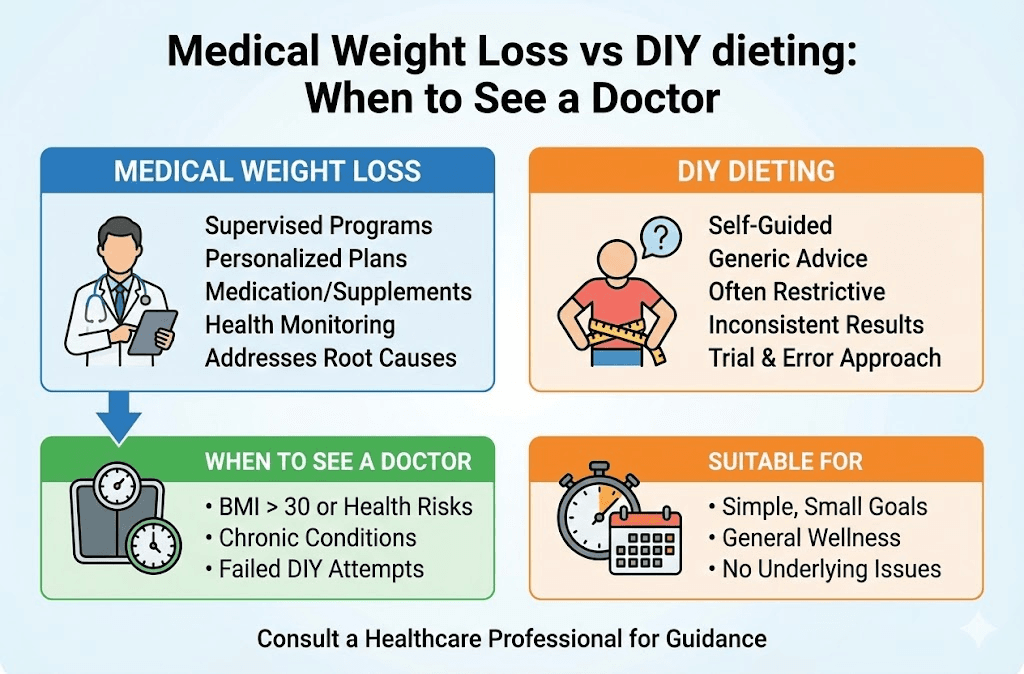
Medical Weight Loss vs DIY dieting: When to See a Doctor

Medical Weight Loss vs. DIY: When You Need a Doctor
Not all weight loss is the same. Here's when you need a doctor, not just a diet.
The commercial weight loss industry thrives on a simple, often misleading promise: willpower and the "right" program are all you need. But for millions of people, do-it-yourself (DIY) approaches fail not because of a lack of discipline, but because underlying medical conditions silently sabotage every attempt.
Understanding when weight management requires medical intervention versus lifestyle changes alone can save you years of physical frustration, emotional burnout, and potential health consequences.
The Critical Distinction: Lifestyle vs. Medical Weight Loss
Here is the uncomfortable truth: if you have genuine metabolic dysfunction, treating weight loss as purely a lifestyle issue is like treating clinical depression with positive thinking. The physiological mechanisms that regulate how your body stores and burns energy are broken. When this happens, no amount of calorie counting or sheer determination will fix the underlying hormonal chaos.
The core question isn't whether you should try basic diet and exercise first—you probably already have, multiple times. The question is whether continuing to push through a DIY approach is actually preventing you from addressing a legitimate medical condition that requires clinical treatment.
ACT 1: Medical Conditions That Demand Supervised Weight Loss
If you are struggling to lose weight, one of the following underlying health conditions may be acting as a physiological roadblock.
Metabolic Syndrome and Insulin Resistance
If you have three or more of specific health markers—such as a waist circumference over 40 inches (men) or 35 inches (women), elevated triglycerides, low HDL cholesterol, high blood pressure, or elevated fasting glucose—you likely meet the criteria for metabolic syndrome.
Metabolic syndrome isn't just "being unhealthy"; it is a complex cluster of conditions driven heavily by insulin resistance. Your body overproduces insulin to manage blood sugar, and chronically elevated insulin acts as a fat-storage hormone, making fat loss biochemically difficult. Standard severe calorie restriction often worsens this by tanking your metabolic rate while doing little to lower insulin levels.
- Why you need medical supervision: Treatment requires monitoring internal metabolic markers, not just stepping on a scale. A doctor can prescribe targeted medications (like metformin), adjust macronutrient ratios based on lab work, and track fasting insulin over time.
PCOS and Hormonal Disorders
Polycystic ovary syndrome (PCOS) affects roughly 1 in 10 women and creates a perfect storm for weight gain: severe insulin resistance, elevated androgens, and disrupted hunger hormones. Women with PCOS can follow diets identical to women without PCOS and lose significantly less weight.
- Why you need medical supervision: PCOS weight loss often requires medications (such as metformin, inositol, or spironolactone) alongside lifestyle changes. Your body's response to different carbohydrates may be dramatically different than the general population, requiring a highly personalized, doctor-led protocol.
Thyroid Dysfunction
Hypothyroidism (an underactive thyroid) slows your metabolic rate, sometimes by up to 20–30%. If your TSH is elevated or your Free T3 is low, you are essentially fighting weight loss with a severe metabolic handicap.
- Why you need medical supervision: Thyroid medication must be carefully titrated based on lab values and your physical symptoms. Trying to lose weight without treating the underlying thyroid condition is an exercise in frustration. Your "maintenance" calories might be 1,400 instead of 2,000, which requires medical management to navigate safely.
Pre-Diabetes and Type 2 Diabetes
Once your A1C crosses 5.7% (pre-diabetes) or 6.5% (type 2 diabetes), your body's ability to manage carbohydrates is formally compromised. Standard, generalized dietary advice may actually spike your blood sugar dangerously.
- Why you need medical supervision: You need regular glucose monitoring, potential medication adjustments, and careful carbohydrate management. Furthermore, rapid weight loss without medical oversight can cause dangerous blood sugar swings if you are already taking diabetes medications.
Significant Obesity (BMI ≥35, or ≥30 with Comorbidities)
According to major health organizations like the Centers for Disease Control and Prevention (CDC), obesity at these levels is recognized as a chronic, complex disease, not a lifestyle choice gone wrong. The physiological adaptations that defend against weight loss—such as metabolic adaptation, hormonal shifts, and exponentially increased hunger—are severe.
- Why you need medical supervision: You are at a higher risk for complications during weight loss, such as gallstones, electrolyte imbalances, and nutrient deficiencies. Your body will fight weight loss with every hormonal weapon it has; medical intervention levels the playing field.
Sleep Apnea
Obstructive sleep apnea doesn't just make you tired. The constant nighttime waking disrupts leptin and ghrelin (your hunger and fullness hormones), increases your stress hormone (cortisol), and actively worsens insulin resistance.
- Why you need medical supervision: While losing weight can improve sleep apnea, untreated sleep apnea makes losing weight significantly harder. You may need CPAP therapy while losing weight, and your doctor should monitor improvements in your apnea-hypopnea index (AHI) alongside your physical progress.
Cardiovascular Disease
If you have heart disease, heart failure, or have had a cardiac event, rapid weight loss or extreme dietary changes can place dangerous stress on your body.
- Why you need medical supervision: Exercise prescriptions must be strictly individualized. Certain diets (like very low-carb or keto) may interact poorly with cardiac medications. Your doctor must monitor your blood pressure, lipids, and cardiac function throughout the entire weight loss process.
ACT 2: When GLP-1 Medications Become Medically Appropriate
Medications known as GLP-1 receptor agonists (such as semaglutide and tirzepatide) have exploded in popularity. However, there is a crucial clinical difference between using them for medical management and using them for cosmetic purposes.
Clinical Criteria for GLP-1 Medications
FDA-approved indications for these weight loss medications generally include:
- A BMI of 30 or higher, OR
- A BMI of 27 or higher with at least one weight-related comorbidity (e.g., type 2 diabetes, hypertension, sleep apnea, cardiovascular disease, or dyslipidemia).
These are not arbitrary thresholds. They represent the point where excess weight itself becomes a medical condition requiring pharmaceutical intervention, rather than just lifestyle modification.
Beyond BMI: Metabolic Markers That Indicate Need
Your BMI might be 28, but if your fasting insulin is 20+ µIU/mL, your A1C is 5.9%, and you have high visceral fat accumulation, you have metabolic dysfunction that may warrant medication. Progressive physicians look beyond the scale at markers like:
- Fasting insulin: >10 µIU/mL suggests insulin resistance.
- HOMA-IR: >2.0 indicates insulin resistance.
- Triglyceride-to-HDL ratio: >3 suggests metabolic problems.
- A1C trends: A consistently rising A1C, even within the "normal" range.
Failed Lifestyle Interventions
This is a key indicator: GLP-1s are medically appropriate when you have made genuine lifestyle changes without success. If you've spent 12 to 24 months in a documented weight loss program with medical supervision, yet lost minimal weight or regained it rapidly, you have demonstrated that lifestyle changes alone are insufficient. This isn't a failure of willpower; it's clinical evidence that your metabolic dysfunction requires pharmaceutical help.
How GLP-1s Work for Metabolic Dysfunction
Options like GLP-1 weight loss injections do far more than just reduce your appetite. Physiologically, they:
- Slow gastric emptying, keeping you full longer.
- Reduce glucagon secretion to help lower blood sugar.
- Improve overall insulin sensitivity.
- Reduce systemic inflammation.
- Alter the reward pathways in the brain related to food cravings.
Medical Use vs. Vanity Use
- Medical use: A patient with a BMI of 32, an A1C of 6.1%, a family history of diabetes, and a history of failed lifestyle interventions.
- Vanity use: A patient with a BMI of 23 and normal metabolic markers who wants to lose 10 pounds for an upcoming wedding.
This difference matters because all medications carry potential side effects (such as nausea or potential thyroid risks). Using them without a true medical indication exposes you to risks without a commensurate health benefit.
ACT 3: Red Flags Indicating You Need Medical Evaluation
If you suspect your weight struggles are biological, it is time to look at the data.
Laboratory Red Flags
Request these specific tests from your doctor to get a true picture of your health. Getting metabolic testing and analysis can uncover hidden hurdles.
Essential Tests to Request:
- Fasting insulin (do not just accept a fasting glucose test)
- Hemoglobin A1C
- Lipid panel (ask for the calculated triglyceride-to-HDL ratio)
- TSH, Free T3, Free T4 (Comprehensive thyroid panel)
- Comprehensive metabolic panel (CMP)
Concerning Lab Results to Watch For:
- Fasting insulin >10 µIU/mL
- A1C >5.6%
- Triglycerides >150 mg/dL
- HDL <40 mg/dL (men) or <50 mg/dL (women)
- TSH >2.5 mIU/L (in functional medicine ranges)
Physical and Symptom Red Flags
- Acanthosis nigricans: Dark, velvety patches of skin on the neck, armpits, or groin (a hallmark visual sign of severe insulin resistance).
- Central obesity: Fat accumulation specifically around the abdomen while the limbs remain relatively spare.
- Extreme fatigue: Crushing exhaustion that does not improve with adequate sleep, suggesting thyroid or adrenal issues.
- Rapid weight regain: Losing 20 pounds over 12 weeks, then rapidly regaining 25 pounds in 8 weeks despite maintaining the same healthy habits.
- Inability to lose despite strict compliance: Maintaining a verified 500-calorie deficit for 12+ weeks while exercising, with less than 5 pounds lost.
Pattern Red Flags
- Multiple failed attempts: Three or more serious, sustained weight loss attempts over 5+ years that all resulted in eventual regain.
- Weight-altering medications: Taking antipsychotics, antidepressants, corticosteroids, or beta-blockers, which fundamentally alter your metabolism.
- Strong family history: Parents or siblings with type 2 diabetes, metabolic syndrome, or early cardiovascular disease.
Practical Guidance: Getting Medical Help
Start with your Primary Care Physician (PCP) if you have no previous diagnosis of metabolic conditions, your BMI is under 35, or you just need initial screening labs.
However, you should seek out an endocrinologist or an obesity medicine specialist if:
- You have diagnosed diabetes, PCOS, or thyroid disease.
- You've failed multiple medically supervised weight loss attempts.
- You're seriously considering weight loss medications.
Questions to Ask Your Doctor:
"Can you order a fasting insulin test along with fasting glucose? I want to understand my baseline insulin resistance."
"Based on these labs, do I meet the criteria for metabolic syndrome or pre-diabetes?"
"Are there medications that address the underlying metabolic issues, rather than just suppressing my symptoms?"
The Decision Framework
If you are unsure what path to take, use this quick diagnostic framework:
- If your situation involves: BMI <30, normal metabolic labs, no diagnosed conditions, and no medications that affect weight → Try: A structured, DIY lifestyle and nutrition plan.
- If your situation involves: BMI ≥30 (or ≥27 with comorbidities), abnormal lab results, diagnosed conditions like PCOS, or extreme metabolic adaptation → Try: Seeking medical supervision from an obesity specialist.
- If your situation involves: BMI ≥40, an A1C ≥6.5%, physical signs of cardiovascular disease, or rapid unexplained weight gain → Try: Seeking urgent medical evaluation.
Maryland Trim Clinic (MTC) in Laurel, MD
If you are realizing that a DIY approach is no longer serving you, finding the right clinical partner is the next critical step. For residents in the Laurel area, the Maryland Trim Clinic (MTC) offers a compassionate, science-backed environment designed to uncover and treat the root causes of weight resistance.
Rather than handing you a generic meal plan and wishing you luck, MTC focuses on comprehensive health. By offering a structured, supervised medical weight loss program, their team helps you navigate the complexities of hormonal imbalances, insulin resistance, and metabolic slowdowns. Having a dedicated medical team in your corner ensures that your weight loss journey is safe, sustainable, and tailored strictly to your unique biological needs.
Final Thoughts
The diet industry profits from convincing you that weight loss is always about sheer willpower. The medical reality, according to experts at the National Institutes of Health (NIH), is far more nuanced: sometimes it's lifestyle, sometimes it's metabolism, and very often, it is a complex combination of both.
If you've been fighting your weight for years, it is not a sign of weakness—it may be undiagnosed metabolic dysfunction. The right medical intervention can mean the difference between a lifetime of struggle and actually fixing the underlying biological problem. Get the labs, ask the hard questions, and find out if you've been fighting your biology without the proper tools.
Because not all weight loss is the same—and pretending otherwise wastes time you could spend actually healing.
Disclaimer: The information in this article is for educational purposes only and does not constitute medical advice. Always consult with a qualified healthcare provider before starting any new diet, exercise regimen, or medication, especially if you have underlying health conditions.
Frequently Asked Questions
Q: How do I know if my weight loss plateau is normal or indicates metabolic dysfunction? A: A normal plateau typically lasts 2 to 4 weeks despite maintaining a calorie deficit, after which progress naturally resumes. Metabolic dysfunction is indicated by zero weight loss for 8+ weeks despite a strict, verified calorie deficit, needing extremely low calories (under 1,200) to lose weight, or experiencing rapid regain when returning to normal maintenance calories.
Q: Can I qualify for GLP-1 medications if my BMI is under 30? A: Yes, if you have a BMI of 27 or higher accompanied by at least one weight-related comorbidity, such as type 2 diabetes, hypertension, dyslipidemia, cardiovascular disease, or sleep apnea. Some progressive physicians will also consider significant insulin resistance as a qualifying factor.
Q: What's the difference between regular weight loss doctors and obesity medicine specialists? A: Obesity medicine specialists are board-certified in treating obesity as a chronic, complex disease. They focus on internal metabolic markers, understand the hormonal mechanisms of weight regulation, and coordinate with endocrinologists. Standard weight loss clinics often focus purely on basic diet and exercise without addressing the root metabolic dysfunction.
Q: Should I try lifestyle changes first before seeing a doctor about weight loss? A: If you have already made multiple serious attempts (6+ months of tracked eating and consistent exercise) without success, you have already "tried lifestyle changes first." Do not delay medical evaluation if you have red flags like a BMI over 35, a strong family history of diabetes, or abnormal labs.
Q: What labs should I specifically request to assess metabolic health? A: Essential tests include fasting insulin (not just fasting glucose), hemoglobin A1C, a complete lipid panel, TSH, Free T3, Free T4, and a comprehensive metabolic panel (CMP). Many doctors only check fasting glucose, which can appear perfectly normal even while your insulin is severely elevated.
Ready to Stop Fighting Your Biology?
Schedule Your Medical Weight Loss Consultation Today If diet and exercise aren't working, it’s time to look deeper. Partner with the medical experts at MTC to uncover your metabolic roadblocks and build a plan that actually works.