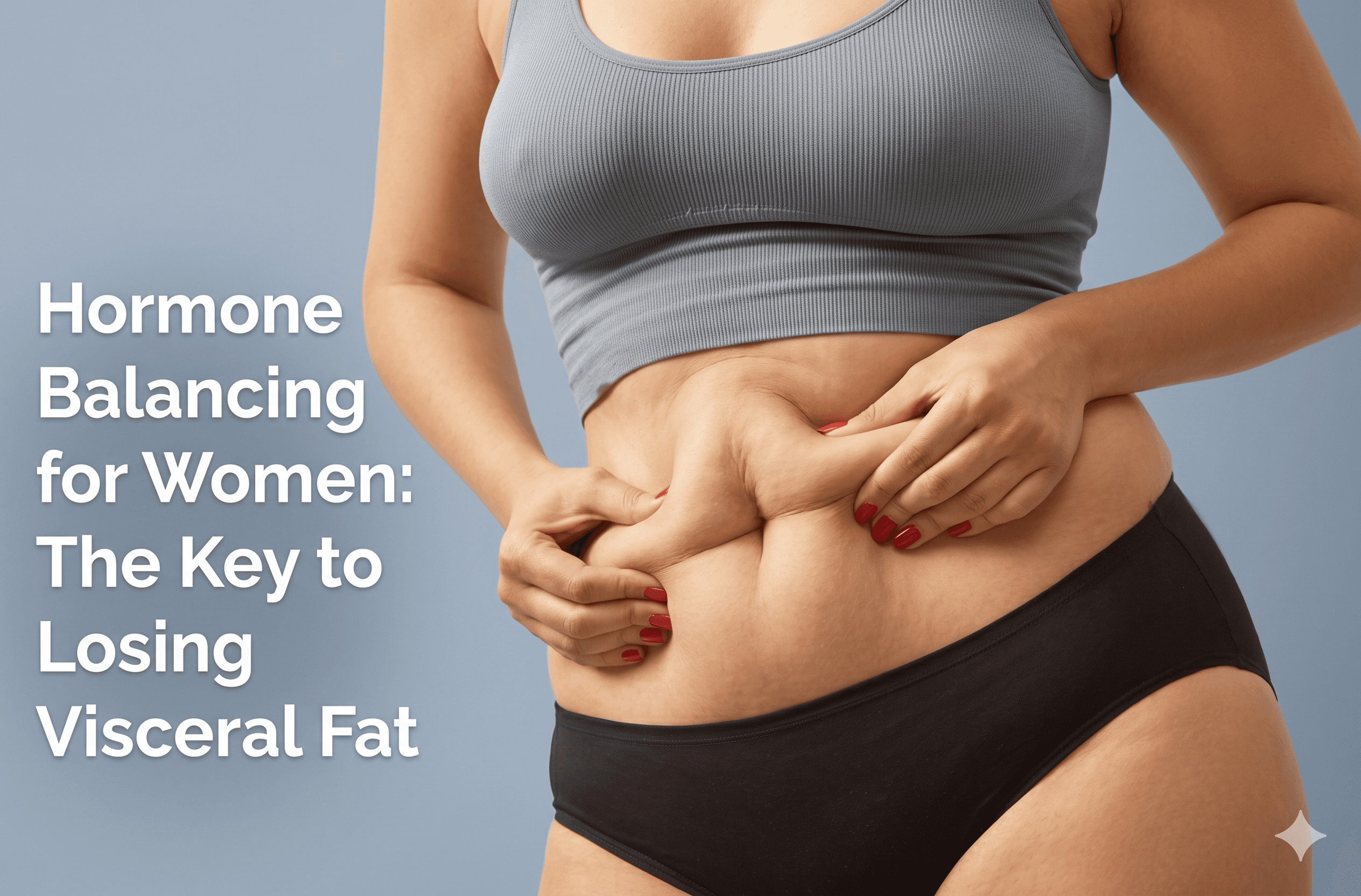
Hormone Balancing for Women: How to Lose Menopause Belly Fat

Menopause doesn't just change your hormones—it fundamentally rewires where and how your body stores fat.
If you are a woman between 40 and 55 and you have noticed a stubborn ring of fat forming around your midsection despite eating and exercising the exact same way you always have, you are not imagining it, and you are not failing. What you are experiencing is a deeply biological phenomenon driven by shifting hormonal chemistry—one that no amount of calorie counting alone can fully reverse.
This article breaks down exactly why dangerous visceral fat accumulates so rapidly during perimenopause and menopause, which hormones are responsible, and what medical evidence actually says about addressing it effectively.
Estrogen's Exit — Why Your Fat Migrated North
For most of their reproductive lives, women store fat preferentially in the hips, thighs, and buttocks. This is not accidental. Estrogen—specifically estradiol, the most potent form active during reproductive years—actively directs fat storage toward these lower-body areas. This "gynoid" fat pattern is metabolically benign. Subcutaneous fat in the lower body is largely inert; it doesn't infiltrate organs or drive dangerous inflammation.
Estrogen achieves this protective fat-routing through several mechanisms:
- Lipoprotein lipase (LPL) regulation: Estrogen suppresses LPL activity in abdominal fat cells while promoting it in the lower body. LPL is an enzyme that pulls fat out of the bloodstream and deposits it into fat tissue. When estrogen directs LPL away from the belly, fat doesn't accumulate there.
- Adiponectin production: Estrogen promotes the release of adiponectin, a hormone that improves insulin sensitivity. As estrogen declines, adiponectin drops, making abdominal fat cells highly receptive to storing fat.
- Buffering cortisol: Visceral fat cells (deep belly fat) have a high density of stress receptors. Estrogen acts as a buffer against cortisol's fat-storing effects in the abdomen. Remove estrogen, and those cells become dramatically more responsive to stress.
During perimenopause, estradiol levels become highly erratic before declining entirely. This volatility creates windows where estrogen's protective mechanisms vanish. Even before your last period, belly fat can begin accumulating noticeably.
According to the National Institutes of Health (NIH), the menopause transition is independently associated with a significant increase in visceral adipose tissue, even when total body weight remains completely stable.
The critical point: This is not a calorie problem; it is a hormonal signaling problem.
The Hormonal Pile-On — Progesterone, Testosterone, and Cortisol
Estrogen's decline sets the stage, but three additional hormonal players compound visceral fat accumulation in ways that are often ignored by mainstream diet advice.
Progesterone: The Forgotten Hormone
Progesterone typically declines even before estrogen does. While mostly known for menstrual regulation, it plays an important role in fat metabolism. Progesterone has a mild anti-cortisol effect—it partially blocks cortisol's fat-promoting signals.
As progesterone falls, this buffering effect disappears. Furthermore, low progesterone relative to estrogen (a condition sometimes called "estrogen dominance") promotes bloating, fluid retention, and fat cell inflammation.
Testosterone: The Metabolic Engine Stalling
Women produce testosterone in smaller amounts than men, but it is critically important for lean muscle maintenance and metabolic rate. The menopause transition can accelerate the decline of testosterone, with severe consequences for fat metabolism:
- Muscle loss: Testosterone is anabolic. As it declines, women lose muscle mass more rapidly. Because muscle burns calories at rest, losing it lowers your basal metabolic rate.
- Reduced fat oxidation: Low testosterone means the body preferentially burns glucose and stores dietary fat more readily.
Cortisol: The Stress Amplifier
Cortisol is the body's primary stress hormone. Visceral fat cells are biologically designed to respond aggressively to stress signals by expanding their fat stores. During perimenopause, the relationship between cortisol and visceral fat becomes vicious:
Sleep disruption: Hot flashes and anxiety fragment sleep. Poor sleep is a potent driver of elevated cortisol.
HPA axis dysregulation: As estrogen declines, the hypothalamic-pituitary-adrenal (HPA) axis becomes less efficiently regulated, leading to higher baseline cortisol levels.
The combined effect of low estrogen, low progesterone, declining testosterone, and elevated cortisol creates an environment perfectly engineered for belly fat.
Maryland Trim Clinic (MTC) in Laurel, MD
Navigating the profound hormonal shifts of perimenopause and menopause requires specialized clinical support, not another fad diet. The Maryland Trim Clinic (MTC) located in Laurel, MD, provides women with a comprehensive, medically supervised environment to safely restore hormonal balance and target stubborn visceral fat.
At MTC, treating menopause belly fat begins with understanding your unique endocrine profile. Patients enrolled in their medical weight loss program undergo precise metabolic testing and analysis to identify exactly which hormones are slowing their metabolism. Based on these insights, providers can formulate customized hormone replacement therapy to safely rebalance estrogen, progesterone, and testosterone levels. If deep visceral fat remains stubborn, MTC offers advanced interventions like GLP-1 weight loss injections to improve insulin sensitivity, alongside nutritional counseling and coaching to ensure your diet supports your new hormonal reality. By partnering with the Maryland Trim Clinic, women gain a dedicated medical team focused on healing their metabolism from the inside out.
What Actually Works — Evidence-Backed Strategies for Hormonal Fat Loss
Addressing hormonal visceral fat requires a strategy that targets underlying hormonal drivers rather than simply restricting calories. Here is what the clinical evidence supports.
1. Resistance Training: The Non-Negotiable Foundation
If there is one intervention that consistently demonstrates visceral fat reduction in menopausal women, it is progressive resistance training.
- Why it works: It increases insulin sensitivity, builds muscle mass (elevating resting metabolic rate), and promotes testosterone production.
- The protocol: Two to four sessions per week of compound, multi-joint resistance exercises (squats, deadlifts, presses) with progressively increasing weight.
2. Protein Prioritization
Dietary protein becomes dramatically more important during menopause.
- Why it works: The body burns up to 30% of protein calories just during digestion. Furthermore, targeting 1.6–2.2 grams of protein per kilogram of body weight is essential for preserving muscle mass when anabolic hormones decline.
- The protocol: Center every meal around high-quality protein (eggs, fish, poultry, Greek yogurt) before adding carbohydrates.
3. Blood Sugar Stabilization
Visceral fat is exquisitely sensitive to insulin. Chronically elevated insulin directly promotes visceral fat storage.
- Why it works: The Centers for Disease Control and Prevention (CDC) highlights that avoiding extreme blood sugar spikes helps prevent insulin resistance, a major driver of abdominal fat.
- The protocol: Reduce refined carbohydrates, prioritize fiber, and consider time-restricted eating (e.g., eating within a 10–12 hour window) to improve insulin sensitivity.
4. Sleep as a Therapeutic Tool
Improving sleep quality is not optional; it is therapeutic. Sleeping fewer than seven hours per night is associated with increased visceral fat and elevated cortisol.
- The protocol: Keep the bedroom cool (65–68°F), use moisture-wicking bedding to manage night sweats, and discuss vasomotor symptom management with your healthcare provider.
5. Hormone Replacement Therapy (HRT)
Hormone replacement therapy remains one of the most evidence-backed medical interventions for visceral fat reduction in post-menopausal women.
- The evidence: Estrogen therapy (with bioidentical progesterone) consistently reduces visceral adipose tissue and improves insulin sensitivity when initiated within 10 years of menopause.
- The caveat: HRT is not appropriate for every woman. Individual medical history and risk factors must be thoroughly evaluated by a qualified healthcare provider.
The Bottom Line
Visceral fat accumulation during perimenopause and menopause is not a personal failure. It is a predictable biological consequence of profound hormonal shifts. Estrogen's withdrawal dismantles the fat-routing system that protected your abdomen for decades. Declining progesterone removes a critical cortisol buffer, and falling testosterone slows muscle maintenance.
The body you are experiencing at 45 or 52 is not broken. It is operating under a completely different hormonal operating system than it was at 30. Addressing this reality requires moving beyond generic diet advice: lift weights to rebuild muscle, prioritize protein to stabilize insulin, optimize sleep to lower cortisol, and have an informed clinical conversation about hormonal support.
Frequently Asked Questions
Q: Why did I suddenly gain belly fat during menopause even though my diet hasn't changed? A: Estrogen actively directs fat storage toward the hips and thighs during reproductive years. When estrogen declines, this protective routing disappears, and visceral fat cells—which are naturally more reactive to stress and insulin—become the dominant storage sites. Your calorie intake may be identical, but your body's fat distribution system has been fundamentally reorganized.
Q: Is visceral fat more dangerous than regular body fat? A: Yes, significantly so. Visceral fat (deep belly fat) is metabolically active. It releases inflammatory cytokines, promotes insulin resistance, and increases cardiovascular disease risk. Subcutaneous fat (under the skin on hips and thighs) is relatively inert by comparison.
Q: Will hormone replacement therapy (HRT) help me lose belly fat? A: Clinical evidence suggests that estrogen-based HRT can meaningfully reduce visceral adipose tissue and improve insulin sensitivity in post-menopausal women, especially when initiated within 10 years of menopause. However, it is not a standalone weight-loss solution and is not safe for all women. You must discuss your specific health risks with a doctor.
Q: What type of exercise is most effective for reducing menopause belly fat? A: Resistance training (weight lifting) has the strongest evidence for reducing visceral fat in menopausal women. It preserves muscle mass, boosts testosterone, and improves insulin sensitivity far better than aerobic exercise (cardio) alone.
Q: How does cortisol contribute to belly fat during menopause? A: Visceral fat cells have an exceptionally high density of cortisol receptors. Estrogen normally buffers cortisol's effects in the abdomen. As estrogen declines, cortisol acts more aggressively on visceral fat cells, signaling them to store fat. Sleep disruption from hot flashes further elevates cortisol, creating a vicious cycle.
Q: Does a high-protein diet really help with hormonal belly fat? A: Yes. Adequate protein (1.6 to 2.2 grams per kg of body weight) is essential for maintaining muscle mass when hormones like estrogen and testosterone decline. Protein also stabilizes blood sugar, reducing the insulin spikes that drive visceral fat storage, and keeps you full longer.
Ready to Restore Your Hormonal Balance?
Don't let menopause dictate your health. Contact a certified medical clinic today to discuss comprehensive hormone testing, personalized HRT options, and safe, effective medical weight loss strategies.