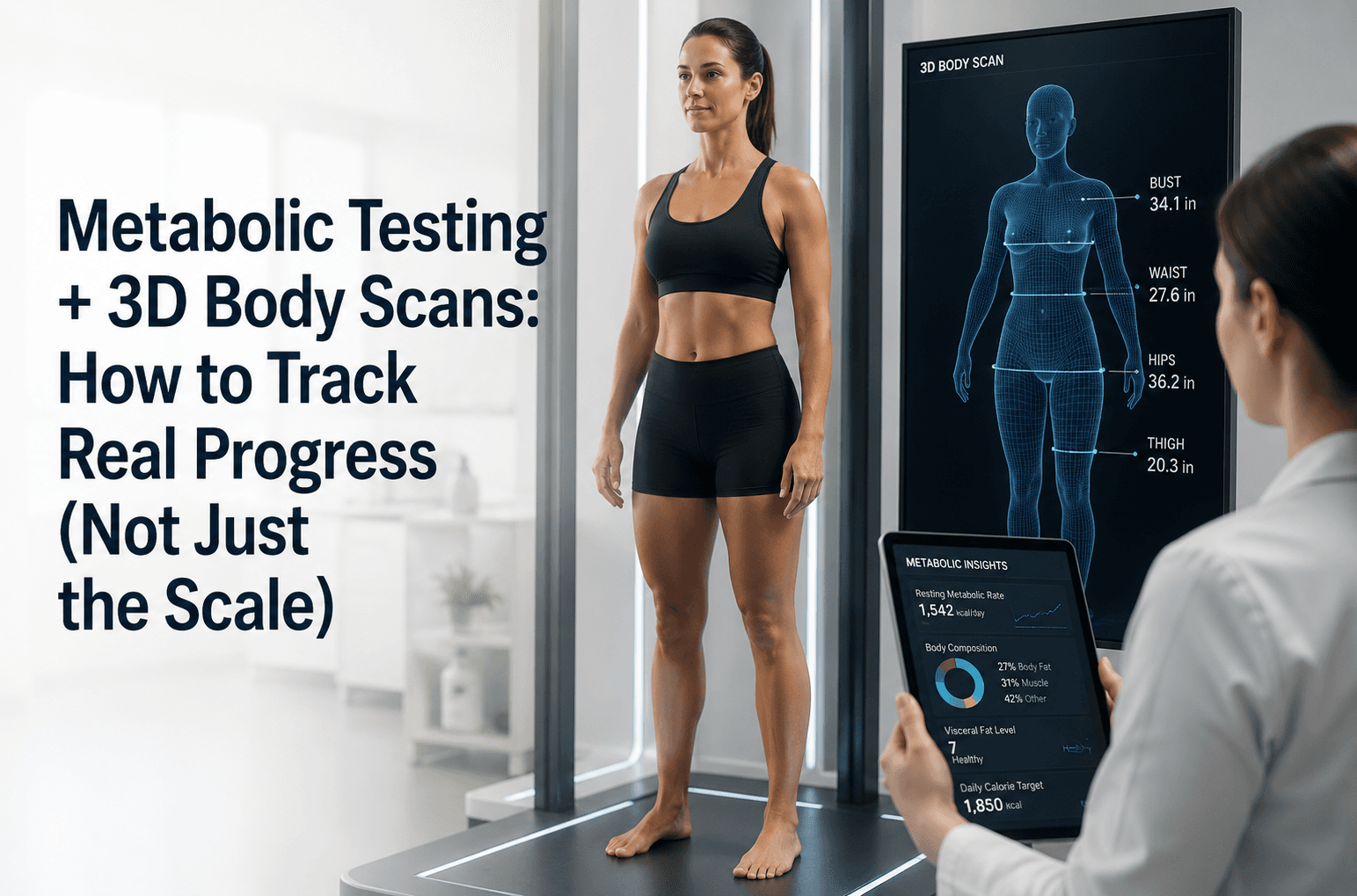
Metabolic Testing for Weight Loss + 3D Body Scans


The scale can tell you how much you weigh today. It cannot tell you why your weight changed, where your body changed, or how many calories your body uses at rest.
That distinction matters during weight loss. A person may lose inches at the waist while scale weight changes slowly. Another may see a rapid scale drop caused partly by fluid shifts. Someone following the same calorie target as a friend may have a different resting energy expenditure.
Metabolic testing for weight loss and 3D body scanning answer different questions. Indirect calorimetry measures resting energy expenditure by analyzing respiratory gases. A 3D body scan captures external body shape and measurements, with some systems also using algorithms to estimate body-composition metrics. Used as trend-tracking tools, they can add context that a bathroom scale alone cannot provide.
Quick Answer: What Do Metabolic Testing and 3D Body Scans Track?
Metabolic testing estimates how much energy your body uses at rest by measuring oxygen consumption and carbon dioxide production. A 3D body scan tracks body shape and circumferences and may estimate body-composition metrics. Together, they can help monitor energy needs and physical changes that scale weight may not explain.
Medical Disclaimer: Educational information only. Not a substitute for professional medical advice, diagnosis, or treatment. For personalized guidance, consult a qualified clinician.
Why Scale Weight Is Only One Part of Weight-Loss Progress
Body weight is useful. The problem starts when it becomes the only measurement that matters.
A standard scale combines everything into one number: body fat, lean tissue, bone, body water, and the contents of the digestive tract. It cannot separate those components or tell you where changes have occurred.
That means two people who each lose 10 pounds may not have experienced identical physical changes. One may have lost primarily fat while maintaining more lean tissue. Another may have lost a different combination of fat and fat-free mass.
Scale weight can also move before meaningful fat loss has occurred or temporarily hold steady while other measurements change.
This is why a more complete tracking plan may look at several trends rather than searching for one perfect number.
Measurement
What it can help show
What it cannot tell you alone
Scale weight
Total body mass and weight trend
Whether weight change is fat, lean tissue, or fluid
Waist and other circumferences
Changes in external body dimensions
Exact internal tissue composition
Body-composition estimate
Estimated fat and lean mass trends
A perfectly direct measurement of every tissue
Resting metabolic rate
Energy used under resting conditions
Total daily calorie expenditure by itself
Strength and function
Changes in physical performance
Exact fat loss
Clinical health markers
Changes in glucose, lipids, blood pressure, or other relevant measures
Body shape changes
The National Institute of Diabetes and Digestive and Kidney Diseases notes that BMI and waist size can provide different information about weight-related health risk. Waist size is relevant because where fat is stored, particularly around the abdomen, matters.
For patients using a structured medical weight loss program, reviewing multiple measurements may provide more useful decision support than reacting to each individual weigh-in. Maryland Trim Clinic describes body-composition analysis and ongoing monitoring as parts of its broader weight-management approach.
What Does Metabolic Testing for Weight Loss Actually Measure?
Metabolic testing using indirect calorimetry measures resting energy expenditure, often discussed as resting metabolic rate or RMR.
During an indirect calorimetry RMR test, respiratory gases are measured. Oxygen consumption and carbon dioxide production are used to calculate energy expenditure under resting conditions. A clinical review describes indirect calorimetry as a reference method for measuring resting energy expenditure.
At Maryland Trim Clinic's metabolic testing and analysis service, the clinic describes a noninvasive indirect calorimetry test that takes approximately 10 to 15 minutes and involves breathing into a testing device while at rest.
The test measures resting energy use, not every calorie you burn in a day
This is one of the most important distinctions missing from many articles about metabolic testing.
Your resting energy expenditure is only one component of total daily energy expenditure. Physical activity and the energy used in processing food also contribute to daily energy needs.
An RMR result of 1,600 calories per day does not automatically mean 1,600 calories is the correct weight-loss diet for that person.
Instead, the measurement can become one data point used alongside activity, body size, health history, goals, and observed weight trends when developing a nutrition plan.
Maryland Trim Clinic states that its metabolic testing results may be used to help inform personalized calorie and macronutrient goals. Patients who need help translating those numbers into an eating plan may also consider nutritional counseling and coaching.
RMR vs BMR: Are They the Same Thing?
RMR and BMR are closely related, but the terms are not technically identical.
Basal metabolic rate, or BMR, refers to energy expenditure measured under stricter basal conditions.
Resting metabolic rate, or RMR, refers to energy used while the body is resting and is the measurement more commonly discussed in outpatient metabolic testing.
The terms are sometimes used loosely in consumer weight-loss content, but a resting metabolic rate test performed in a clinic should not automatically be described as a measurement of someone's entire daily metabolism.
Research literature distinguishes basal metabolism from resting energy expenditure and describes indirect calorimetry as a useful clinical method for determining REE.
For most weight-loss patients, the practical question is not whether the report uses the label BMR or RMR. The useful questions are:
- What exactly did the device measure?
- Under what testing conditions was it measured?
- How should the result be applied to estimated daily calorie needs?
- When should the test be repeated?
- Does the result fit the patient's actual weight and intake trends?
Why Indirect Calorimetry Can Be More Useful Than a Calorie Calculator
Online calorie calculators usually estimate resting energy needs from variables such as age, sex, height, and weight.
Those equations are convenient, but they are still predictions.
Individual resting energy expenditure can differ from an equation's estimate. A validation study comparing commonly used predictive equations with indirect calorimetry found meaningful differences in accuracy across groups, reinforcing why measured RMR can add information when a more individualized assessment is needed.
This does not mean calorie equations are useless. They can provide practical starting estimates.
Metabolic testing becomes especially interesting when someone:
- Wants an individually measured resting energy expenditure
- Has lost a meaningful amount of weight
- Is entering weight maintenance
- Is experiencing a weight-loss plateau
- Has noticed that generic calorie estimates do not appear to match observed trends
- Is trying to better understand energy needs while preserving lean tissue
Maryland Trim Clinic specifically presents metabolic testing for personalized weight-loss planning as an option for patients starting weight management, addressing plateaus, or monitoring metabolic changes over time.
Your Resting Metabolic Rate Can Change During Weight Loss
A metabolic test is not necessarily a permanent number.
Resting energy expenditure often decreases as weight is lost. Part of that change can occur because the body is smaller and has less metabolically active tissue to support. Research also examines adaptive thermogenesis, meaning reductions in energy expenditure beyond changes explained by body composition alone. The magnitude and persistence of this response vary between individuals and studies.
This is why the statement "building muscle always speeds up your metabolism enough to let you eat much more food" needs context.
Lean tissue is associated with resting energy expenditure, and preserving muscle is important for physical function and body composition. However, exercise interventions do not automatically produce a dramatic increase in RMR, and the metabolic effect of gaining some muscle should not be exaggerated. A systematic review found no statistically significant overall increase in RMR from combined aerobic and resistance exercise interventions in the pooled analysis.
The more useful goal is to track the person in front of you.
If body weight, body composition, food intake, and activity have changed substantially, repeating a resting metabolic rate test may provide updated information for planning.
What a 3D Body Scan Can Show That a Scale Cannot
A 3D body scan captures the external geometry of the body.
Depending on the scanning technology and software, the system may generate a three-dimensional model and calculate circumferences, volumes, cross-sectional measurements, and estimated body-composition metrics.
Research has found that 3D body surface scanners can provide clinically relevant anthropometric measurements and body-composition estimates. Another study found 3D optical imaging was highly sensitive to changes in body shape over time when compared with DXA during intervention tracking.
Maryland Trim Clinic's high-precision 3D body scanning service states that its reports include circumference measurements, body fat percentage, muscle mass, posture information, and segmental analysis. The clinic recommends using repeat scans to visualize trends over time.
A 3D body scan is not the same as CT, MRI, or DXA
This distinction matters.
Optical 3D scanners analyze body surface shape. They do not directly see internal organs or image internal fat deposits in the same way as CT or MRI.
Body fat percentage and muscle mass reported by a 3D scanning system are generally estimates generated from the scan data and predictive models. They should not automatically be described as direct measurements of internal tissue.
Research supports the usefulness of 3D optical technology for anthropometric and body-composition assessment, but no measurement system should be treated as perfectly error-free.
That is why trends collected using the same system and reasonably consistent scanning conditions can be more informative than obsessing over one isolated body-fat percentage.
Why Can Inches Change When the Scale Does Not?
Yes, waist, hip, or thigh measurements can change while body weight remains similar.
One possible explanation is body recomposition. A person may lose fat while maintaining or gaining some lean tissue, reducing body dimensions without a large change in total mass.
But body recomposition is not the only explanation.
Water balance, glycogen, food in the digestive tract, bowel patterns, and measurement conditions may affect short-term scale readings. Circumference measurements may also vary with posture, breathing, clothing, and measurement technique.
This is why "muscle weighs more than fat" is a misleading explanation.
One pound of muscle and one pound of fat both weigh one pound. Muscle tissue is denser and takes up less volume than the same weight of fat tissue. Therefore, changes in the relative amount or distribution of fat and lean tissue may affect body shape even when total weight changes slowly.
Studies of 3D scanning have found strong reliability and reproducibility for measurements such as waist and hip circumference, supporting its use for following anthropometric trends when protocols are consistent.
A person whose scale has changed by only two pounds may therefore still have a smaller waist measurement.
That is progress worth investigating, not dismissing.
Metabolic Testing vs 3D Body Scanning: Which Do You Need?
The two tests are not competitors. They answer different questions.
If you want to know...
The more relevant tool may be...
How much energy does my body use at rest?
Indirect calorimetry RMR testing
Are generic calorie equations matching my measured resting needs?
Metabolic testing
Has my waist or hip circumference changed?
3D body scanning
Is my body shape changing even when scale weight is slow?
3D body scanning
How are estimated fat and lean mass trends changing?
Body-composition tracking
Have my energy needs potentially changed after substantial weight loss?
Repeat metabolic testing
Do I need a broader medical weight-management review?
Clinical evaluation using multiple data points
You may not need either test to lose weight.
Many people can make progress using scale trends, waist measurements, nutrition changes, physical activity, and clinical follow-up.
The value of advanced tracking is greater when the information will actually change a decision.
Before scheduling a test, ask:
What question am I trying to answer?
What metrics will this test report?
How accurate and repeatable is the measurement method?
Will I use the same system for future comparisons?
How will the results influence my nutrition, activity, or weight-management plan?
Data without interpretation can simply create more numbers to worry about.
What Metrics Matter Most for Fat-Loss Progress?
There is no single "best" metric for every patient.
For most structured weight-loss programs, the most useful picture comes from a combination of measurements.
1. Weight trend
Look at the direction of weight over time rather than treating every morning as a final result.
A single weight measurement is a snapshot. Several weeks of reasonably consistent measurements create a trend.
2. Waist circumference
Waist measurement can provide information beyond BMI and total weight. NIDDK notes that abdominal fat distribution is relevant to weight-related health risk.
A reduction in waist circumference may therefore be a meaningful result even when scale weight is moving more slowly than expected.
3. Estimated fat mass or body-fat percentage
These measurements can help examine whether estimated body composition is trending in a favorable direction.
The word estimated matters.
Compare results from the same measurement system when possible. Switching from a smart scale to a gym BIA machine and then to a 3D scanner can create apparent changes that reflect differences between technologies rather than real tissue change.
4. Lean mass trend
During weight loss, preserving lean tissue may be an important consideration.
A decline in estimated lean mass does not automatically prove that someone is losing skeletal muscle at a dangerous rate. Measurement error and changes in body water can influence some body-composition methods.
Still, a repeated downward trend may justify reviewing protein intake, resistance exercise, rate of weight loss, and other clinical factors.
Patients who need practical nutrition guidance may combine progress tracking with personalized nutrition counseling.
5. Resting energy expenditure
RMR is useful when the goal is understanding measured resting energy needs.
It should be interpreted with activity, intake, weight trend, and overall health rather than treated as a prescription by itself.
6. Strength and physical function
Can you lift more? Walk farther? Get out of a chair more easily? Maintain strength while losing weight?
A body-composition report may estimate muscle mass. It cannot replace real information about physical function.
7. Relevant health markers
Depending on the individual, blood pressure, glucose measures, lipids, liver-related tests, and other clinician-selected health markers may matter more than reaching a specific jeans size.
The right metrics depend on why the patient is losing weight in the first place.
How Often Should You Repeat Metabolic Testing or a 3D Body Scan?
There is no universal evidence-based schedule that every person must follow.
Testing too frequently can create noise. Testing too infrequently may miss an opportunity to reassess a plan after substantial change.
Maryland Trim Clinic currently recommends repeating its 3D body scans every two to three months to monitor progress. Its metabolic testing service recommends repeat testing every three to six months or when a weight-loss plateau occurs. These are MTC's current service recommendations, not universal medical rules.
A repeat assessment may be more useful after:
- Meaningful weight loss
- A prolonged plateau
- A major change in physical activity
- Entry into weight maintenance
- A significant nutrition-plan change
- A clinician wants updated metabolic or body-composition information
The timing should depend on whether enough change has occurred to make the new data actionable.
Consistency Matters When Tracking Body-Composition Progress
A strange scan result does not always mean your body suddenly changed.
Measurement conditions matter.
Posture and body position can influence 3D measurements. Research on 3D optical imaging has specifically examined standardized positioning because pose can affect body-composition estimates.
For progress comparisons, follow the scanner provider's preparation instructions and try to keep repeat conditions reasonably consistent.
That may include:
- Using the same scanning system
- Following the same clothing instructions
- Maintaining a consistent standing position
- Scanning at a similar time of day when practical
- Avoiding comparisons between unrelated measurement technologies
For metabolic testing, pre-test conditions also matter. Best-practice literature for RMR measurement discusses food intake, alcohol, nicotine, and physical activity as factors that may affect measurement protocols. Maryland Trim Clinic asks patients to fast for at least four hours, avoid caffeine and stimulants, and rest during its metabolic test.
Follow the clinic's specific preparation instructions rather than creating your own testing protocol.
How Maryland Trim Clinic Uses Data Beyond the Scale in Laurel, MD
Maryland Trim Clinic offers metabolic testing and analysis and 3D body scanning as separate weight-management services in Laurel, Maryland.
The metabolic test is designed to measure resting energy expenditure using indirect calorimetry. The clinic's 3D scanning service focuses on circumference, body shape, and reported body-composition metrics for progress tracking.
Depending on individual needs, those measurements may be considered alongside medical history, weight trends, nutrition, physical activity, and treatment goals within MTC's broader weight-loss services. Patients moving from active weight loss into longer-term planning may also use the clinic's weight loss maintenance program, which describes periodic metabolic testing and body-composition monitoring as potential parts of ongoing follow-up.
Not every patient needs every test. The useful question is whether the information will help clarify progress or guide an appropriate change in the plan.
Patients in Laurel and surrounding Maryland communities can contact Maryland Trim Clinic to discuss current testing options and whether a broader weight-management evaluation may be appropriate.
The Bottom Line
The scale is not useless. It is simply incomplete.
Metabolic testing can measure how much energy your body uses under resting conditions. A 3D body scan can track circumferences, external body shape, and estimated body-composition trends. Neither tool tells the entire story by itself.
Real progress may include a downward weight trend, a smaller waist, improved estimated fat-to-lean mass trends, preserved strength, changing energy needs, or better clinical health markers.
The most useful measurements are the ones collected consistently, interpreted accurately, and used to make better decisions.
Frequently Asked Questions
What does a resting metabolic rate (RMR) test measure?
A resting metabolic rate test measures estimated energy expenditure while your body is at rest. Indirect calorimetry does this by measuring oxygen consumption and carbon dioxide production. The result reflects resting energy use, not total daily calorie expenditure. Physical activity and other components of energy expenditure still need to be considered when estimating total daily needs.
How often should you do metabolic testing or body scans?
There is no universal schedule for everyone. Maryland Trim Clinic currently recommends 3D body scanning every two to three months and metabolic testing every three to six months or around a weight-loss plateau. Testing frequency should depend on your program, how much your body or weight has changed, and whether new information could influence your plan.
Why can inches change when weight doesn't?
Inches can change while weight remains similar because total scale weight does not identify where physical changes are occurring. Changes in fat and lean tissue may alter body volume and shape without producing an identical change on the scale. Fluid and digestive factors can also affect short-term weight. A smaller waist with stable weight should be interpreted alongside other progress measurements.
What metrics matter most for fat loss?
Weight trend, waist circumference, estimated body-fat and lean-mass trends, strength, and relevant health markers can all matter. The most useful combination depends on the person's health and goals. Scale weight alone cannot determine whether weight change represents fat, lean tissue, or fluid, so using several consistent measurements may provide better context.
Does metabolic testing tell you exactly how many calories to eat?
No. Indirect calorimetry measures resting energy expenditure, which can help inform calorie planning, but it does not directly measure every calorie you burn throughout a normal day. Physical activity and other components of energy expenditure also matter. A clinician or nutrition professional may use measured RMR alongside health history, activity, and weight trends when discussing calorie goals.
Is RMR the same as BMR?
RMR and BMR are related but not technically identical. Basal metabolic rate is measured under stricter basal conditions, while resting metabolic rate or resting energy expenditure is commonly measured under resting clinical conditions. The terms are often used interchangeably in consumer content, so patients should ask what their specific test actually measures.
Can a 3D body scan directly measure visceral fat?
A standard optical 3D body scan does not directly image internal visceral fat in the way CT or MRI can. It captures external body shape and anthropometric data, and some systems use predictive algorithms to estimate body-composition metrics. The exact outputs depend on the device and software. A 3D scan should therefore not be described as a direct image of internal fat deposits.
Is a 3D body scan better than weighing yourself?
A 3D body scan is not a replacement for every scale measurement, but it can provide additional information. Scale weight tracks total body mass, while 3D scanning can follow changes in circumference and body shape. Research suggests 3D optical imaging can be sensitive to body-shape changes over time, making it useful as a complementary tracking method. (PubMed)
See More Than a Number on the Scale
If the scale is not giving you enough context, Maryland Trim Clinic offers metabolic testing, 3D body scanning, and medically supervised weight-management services in Laurel, MD. An individualized consultation may help determine which measurements are relevant to your goals and how to interpret them alongside nutrition, activity, health history, and weight trends. Testing is most useful when the numbers lead to informed, realistic decisions.
See More Than a Number on the Scale
If the scale is not giving you enough context, Maryland Trim Clinic offers metabolic testing, 3D body scanning, and medically supervised weight-management services in Laurel, MD. An individualized consultation may help determine which measurements are relevant to your goals and how to interpret them alongside nutrition, activity, health history, and weight trends. Testing is most useful when the numbers lead to informed, realistic decisions.