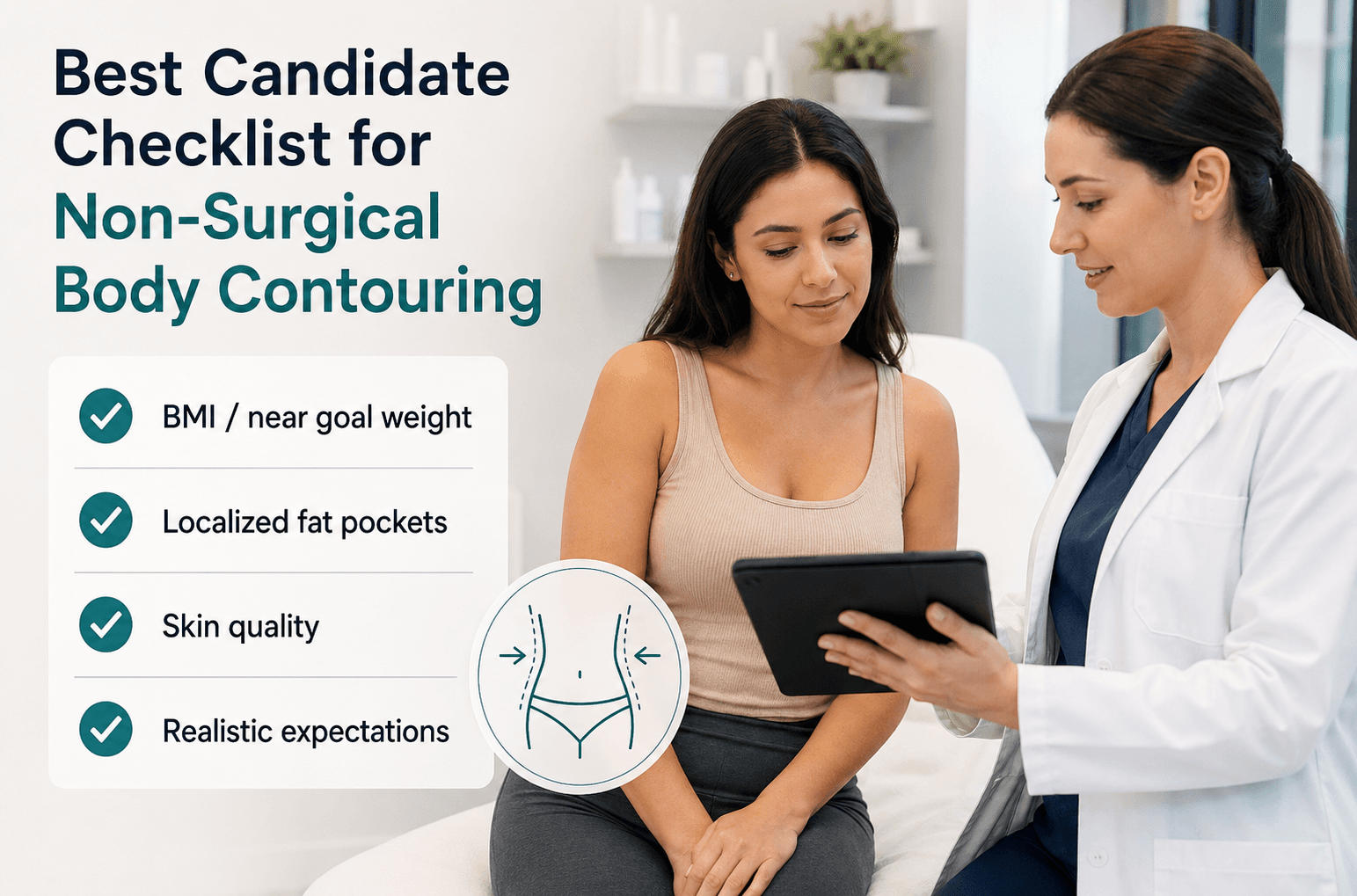
Non Surgical Body Contouring Candidate Checklist


A non surgical body contouring candidate is usually someone who wants targeted shape refinement, not major weight loss. The best fit is often a healthy adult near a stable weight, with localized subcutaneous fat, mild to moderate skin laxity, or muscle-toning goals, and realistic expectations about gradual, modest changes.
Body contouring can be useful when diet, exercise, medical weight loss, or GLP-1 support has helped overall progress, but a specific area still feels resistant. It is not designed to treat obesity, improve metabolic health, or replace a structured weight-loss plan. The FDA states that non-invasive body contouring does not treat obesity, does not improve health, and does not provide the health benefits associated with weight loss.
Quick Answer: Who Is the Best Candidate for Non-Surgical Body Contouring?
The best candidate for non-surgical body contouring is close to a stable goal weight, has pinchable subcutaneous fat or mild skin laxity, understands that results are gradual and limited, and can maintain healthy habits afterward. People seeking major weight loss, dramatic surgical-level changes, or treatment for visceral belly fat usually need a different approach first.
Medical Disclaimer: Educational information only. Results and suitability vary. A clinician should review your history, contraindications, and goals before recommending any medical/aesthetic treatment or prescription.
The Body Sculpting Candidate Checklist
Use this checklist as a starting point before scheduling a consultation. It cannot decide eligibility by itself, but it can help you understand whether your goals match what non-surgical treatments are designed to do.
Candidate factor
Better fit
May need another option first
Main goal
Shape refinement, small area reduction, tone, mild skin firmness
Major weight loss or treatment for obesity
Weight pattern
Stable or close to goal weight
Actively gaining weight or seeking large weight loss
Fat type
Pinchable subcutaneous fat
Firm deep abdominal fullness from visceral fat
Skin
Mild to moderate laxity
Significant hanging skin
Expectations
Modest, gradual, measurable changes
Immediate or dramatic transformation
Lifestyle
Willing to maintain nutrition, activity, and follow-up
Expects the device to replace habits
Medical safety
Cleared after health-history review
Contraindications, active infection, unsafe device fit
Maryland Trim Clinic’s non-invasive body contouring and sculpting service describes ideal candidates as individuals close to their ideal weight, people seeking muscle definition, those unwilling or unable to undergo surgery, and patients with mild to moderate skin laxity. The clinic also notes that a BMI under about 30 is generally more favorable for optimal results, with realistic expectations required.
BMI: Helpful Screening Tool, Not the Whole Decision
BMI can help screen whether someone is likely to benefit from non-surgical contouring, but it should not be treated as the only eligibility test.
Non-surgical body contouring is usually more effective for people who are near their target weight because the goal is to reduce or refine selected areas, not create large-scale weight loss. The American Board of Cosmetic Surgery describes non-surgical fat reduction as a treatment for isolated subcutaneous fat pockets in patients at or near their ideal body weight, with gradual, modest fat loss and little to no downtime.
A practical BMI framework may look like this:
BMI under about 30
This is often the strongest range for visible non-surgical contouring results, especially when the concern is a specific area such as the abdomen, flanks, thighs, arms, or bra line. MTC’s body contouring page specifically lists BMI under about 30 as favorable for optimal results.
BMI above about 30
This does not automatically mean no treatment is possible, but results may be less noticeable if the goal is fat reduction in a larger area. A patient may need medical weight-loss support first, or a combined plan that delays contouring until weight is more stable.
Higher BMI with weight-loss goals
If the main goal is to lose a significant amount of weight, contouring is usually the wrong first step. A medical weight loss program, nutrition support, metabolic testing, or GLP-1 therapy when clinically appropriate may be more relevant before body sculpting.
BMI does not show fat distribution, muscle mass, skin laxity, or medical safety. A consultation should still review body composition, treatment area, expectations, and health history.
Fat Type: Subcutaneous Fat vs Visceral Fat
Fat type is one of the most important candidate factors.
Subcutaneous fat
Subcutaneous fat sits beneath the skin and above the muscle. It is often soft or pinchable. This is the type of fat many non-surgical fat reduction technologies are designed to address.
The FDA describes cryolipolysis, or fat freezing, as a technology that draws a targeted area of pinchable fat into an applicator and cools it with the intent of damaging fat cells so the bulge becomes smaller over two to three months.
The American Board of Cosmetic Surgery similarly explains that non-surgical fat reduction targets subcutaneous fat pockets, not general body weight.
Visceral fat
Visceral fat is deeper abdominal fat around internal organs. It may make the abdomen feel firmer or rounder rather than pinchable. Non-surgical contouring devices are not designed to treat visceral fat.
If the main concern is deep belly fullness, a clinician may recommend medical weight-loss care, nutrition changes, activity, metabolic assessment, or evaluation of related health risks rather than body contouring.
Patients unsure whether their concern is subcutaneous fat, loose skin, muscle tone, or overall weight may benefit from 3D body scanning, which MTC describes as a non-invasive way to capture circumference, body-composition, posture, and segmental data for tracking progress.
Skin Elasticity: Why Loose Skin Changes the Plan
Skin quality affects results. A small area of soft fat with good skin tone may respond differently from the same area with significant laxity.
Non-surgical skin tightening can support mild to moderate firmness concerns, but it cannot remove large folds of excess skin. The FDA distinguishes non-invasive body contouring from surgery, noting that non-invasive treatments do not remove tissue, while procedures such as a tummy tuck remove excess skin through incisions.
You may be a better candidate for skin-tightening support if:
- Skin laxity is mild to moderate.
- You want gradual firmness improvement.
- You understand that results vary.
- You do not need major skin removal.
You may need a surgical consultation instead if:
- Skin hangs in folds.
- There is major laxity after large weight loss.
- The concern is excess skin more than fat.
- You want a dramatic tightening result.
Maryland Trim Clinic’s Ultimate Contour Body Sculpting page describes ultrasound body contouring and radiofrequency skin-tightening support for stubborn areas and smoother-looking skin, while repeatedly noting that results vary and consultation is required.
Muscle Tone: When HIFEM May Be the Better Fit
Some patients do not mainly want fat reduction. They want more tone, definition, or muscle engagement.
High-intensity focused electromagnetic therapy, often called HIFEM, uses electromagnetic energy to stimulate involuntary muscle contractions. A systematic review describes electromagnetic body contouring technologies as FDA-cleared for strengthening, firming, and toning selected areas such as the abdomen, buttocks, thighs, arms, and calves.
Maryland Trim Clinic’s muscle building and toning service describes EM Scope as combining magnetic muscle training with radiofrequency heat for body toning and contour support. This type of treatment may be more relevant when the goal is muscle definition rather than only reducing a fat pocket.
HIFEM body sculpting is not a replacement for resistance training. It may support tone, but lasting body composition still depends on nutrition, activity, strength habits, and weight stability.
Expectations: What Results Are Realistic?
The best body contouring candidate understands that results are usually gradual, targeted, and modest.
You may notice:
- A smaller treated bulge
- Subtle circumference change
- Smoother-looking contour
- Mild firmness improvement
- Better muscle definition
- Clothes fitting slightly differently
You should not expect:
- Major weight loss
- A flat stomach from one visit
- Surgical-level fat removal
- Guaranteed inch loss
- Treatment of obesity
- Removal of major loose skin
- Permanent results if weight significantly increases
The American Board of Cosmetic Surgery notes that non-surgical fat reduction can produce gradual, modest fat loss and that multiple treatments may be needed. It also states that no cosmetic procedure, surgical or non-surgical, is intended for weight loss.
Maryland Trim Clinic’s Ultimate Contour page states that some patients may lose up to one inch after the first treatment, but it qualifies this by saying results vary based on body composition, hydration, lifestyle, treatment area, individual response, and number of sessions.
A responsible consultation should help you understand likely outcomes for your body, not just general marketing claims.
What Areas Respond Best?
The best treatment areas are usually localized, clearly defined, and appropriate for the chosen technology.
Common areas may include:
- Abdomen
- Waist
- Flanks or love handles
- Arms
- Thighs
- Hips
- Back or bra-line area
- Under-buttock area
- Mild skin laxity concerns
- Muscle-toning areas such as abdomen, glutes, thighs, or arms
MTC lists common Ultimate Contour areas as the abdomen, waist, flanks, arms, thighs, back area, hips, skin laxity concerns, and cellulite appearance support.
Technology matters. Cryolipolysis is generally suited to pinchable fat. Radiofrequency may be chosen for skin firmness and contour support. Ultrasound may be used for localized body-shaping goals. HIFEM is more relevant to muscle tone.
The question is not simply “Can this area be treated?” The better question is, “Is this the right technology for this area, this tissue type, and this goal?”
Who Should Avoid Non-Surgical Body Contouring?
Some patients should avoid certain treatments or postpone treatment until a clinician reviews safety.
Avoiding or delaying treatment may be appropriate if you have:
- Pregnancy or breastfeeding
- Active infection or open wounds in the treatment area
- Significant uncontrolled medical conditions
- A pacemaker, defibrillator, or implanted electronic device for electromagnetic treatments
- Metal implants in or near the treatment area, depending on the device
- Poor circulation in the treatment area
- A cold-sensitivity disorder if considering fat freezing
- Severe skin laxity requiring surgical evaluation
- Unrealistic expectations
- A primary goal of major weight loss
The FDA specifically says patients should disclose medications, implanted devices, IUDs, mesh, scars, cosmetic implants, tattoos, prior surgery in the treatment area, and other risk factors before non-invasive body contouring. It also lists cold-sensitivity disorders such as Raynaud’s disease, cold urticaria, cryoglobulinemia, paroxysmal cold hemoglobinuria, and cold agglutinin disease as conditions that should prevent fat freezing procedures.
This is why a body sculpting candidate checklist should never replace a professional evaluation.
Candidate Checklist Before Booking a Consultation
Before booking Laurel MD body contouring, ask yourself:
Is my main goal shape refinement rather than weight loss?If you want significant weight loss, start with medical weight management.
Is my weight fairly stable?Ongoing weight changes can make results harder to maintain.
Can I pinch the area I want treated?Pinchable fat is more likely to be subcutaneous fat.
Is loose skin the main issue?If skin hangs significantly, non-surgical tightening may not be enough.
Am I expecting gradual change?Results may take weeks to months and may require multiple sessions.
Am I prepared to maintain results?Remaining fat cells can enlarge with weight gain.
Have I reviewed medical safety factors?Implants, pregnancy, device-specific contraindications, and medical history matter.
Do I need tracking before treatment?Measurements, photos, or 3D body scanning can help establish a baseline.
Maryland Trim Clinic may use consultation, measurements, body goals, and health-history review to determine whether body contouring in Laurel, MD is appropriate.
When Medical Weight Loss Comes Before Body Contouring
Some patients are not poor candidates forever. They may simply be early.
If the main goal is to lose 30, 50, or 80 pounds, body contouring is unlikely to provide the desired change. The better sequence may be medical weight loss first, then contouring later for specific areas.
Maryland Trim Clinic offers GLP-1 weight-loss injections, medical weight loss support, nutrition coaching, metabolic testing, and weight loss maintenance as part of its broader weight-management services.
For some patients, the right plan may look like:
- Start with weight-loss evaluation.
- Build nutrition and activity habits.
- Use medication if clinically appropriate.
- Track body composition and measurements.
- Reassess contouring once weight is more stable.
- Use body contouring for stubborn areas, tone, or skin firmness.
This sequencing can help prevent disappointment and support longer-lasting results.
How Maryland Trim Clinic Evaluates Body Contouring Candidates
At Maryland Trim Clinic, non-surgical body contouring is positioned as part of a broader medical wellness and weight-management model rather than a one-size-fits-all cosmetic shortcut. The clinic’s Ultimate Contour page states that consultation includes reviewing body goals, health history, treatment areas, expectations, and whether the treatment is appropriate.
An evaluation may consider:
- Current weight and weight stability
- BMI and body composition
- Subcutaneous vs deeper fat concerns
- Skin laxity
- Muscle-toning goals
- Medical conditions
- Implants or device contraindications
- Hydration, nutrition, and lifestyle factors
- Whether medical weight loss should come first
- How results will be measured
Patients in Laurel, Bowie, Columbia, Greenbelt, Silver Spring, College Park, and nearby Maryland communities can contact Maryland Trim Clinic to discuss whether non-surgical body contouring, Ultimate Contour, muscle toning, or a broader weight-management plan may fit their goals. MTC lists its clinic location as 9201 Cherry Lane, Laurel, MD 20708.
The Bottom Line
The best non-surgical body contouring candidate is not simply someone who wants to look different. It is someone whose goal matches what the treatment can reasonably do.
Good candidates are usually near a stable weight, have localized subcutaneous fat, mild skin laxity, or muscle-toning goals, and understand that results are gradual and limited. Patients seeking major weight loss, treatment for visceral fat, dramatic skin removal, or guaranteed transformation usually need a different starting point.
A consultation should answer three questions clearly: what are we treating, is this safe for you, and what result is realistic?
Frequently Asked Questions
Who is the best candidate for non-surgical contouring?
The best candidate is usually a healthy adult near a stable goal weight with localized subcutaneous fat, mild skin laxity, or muscle-toning goals. The person should understand that non-surgical contouring is for body shaping, not major weight loss. MTC notes that BMI under about 30 is often favorable for optimal results, but consultation is still needed.
What areas respond best?
Localized areas with clearly defined subcutaneous fat or mild laxity often respond best. Common areas may include the abdomen, waist, flanks, thighs, arms, hips, back area, and selected muscle-toning areas. The right area depends on the treatment technology and whether the concern is fat, skin firmness, or muscle definition.
What results are realistic?
Realistic results are usually modest, gradual, and targeted to the treated area. Patients may notice a smaller bulge, smoother contour, slight circumference change, firmer-looking skin, or improved tone. Non-surgical body contouring does not create major weight loss or surgical-level reshaping, and multiple sessions may be needed.
Who should avoid treatments?
People who are pregnant, have active infection in the treatment area, have incompatible implants or implanted devices, or have device-specific contraindications may need to avoid or postpone treatment. People seeking major weight loss or dramatic skin removal are usually better served by medical weight management or surgical consultation first. The FDA advises discussing personal risk factors before treatment.
Can body contouring treat visceral belly fat?
No. Non-surgical body contouring is designed for selected external shape concerns, often involving subcutaneous fat beneath the skin. Visceral fat is deeper fat around internal organs and is not treated by surface body-sculpting devices. Medical weight management, nutrition, activity, and clinical evaluation are more relevant for visceral-fat concerns.
Does BMI decide if I qualify?
BMI can help screen candidacy, but it does not decide everything. Body composition, fat type, skin laxity, treatment area, health history, implants, expectations, and weight stability also matter. MTC notes that BMI under about 30 may be more favorable for optimal results, but an individualized consultation is still necessary.
Is non-surgical body contouring permanent?
Some treatments damage or reduce targeted fat cells, but results depend on weight maintenance and lifestyle. Remaining fat cells can still enlarge if weight increases. Muscle-toning results may also require ongoing activity or maintenance. The FDA notes that body contouring results may not always meet expectations and may sometimes be temporary.
How do I know if I need weight loss first?
You may need weight loss first if your main goal is a large drop in weight, your BMI or health risks suggest medical weight-management support, or the area you want treated is not a localized contour concern. A medical evaluation can help decide whether body contouring, medical weight loss, or a staged plan is more appropriate.
Find Out If Body Contouring Fits Your Goals
If you are considering body sculpting in Laurel, MD, Maryland Trim Clinic can help you evaluate candidacy, treatment areas, expectations, and safety factors before recommending a plan. A consultation can clarify whether non-surgical body contouring, Ultimate Contour, muscle toning, medical weight loss, or progress tracking is the right next step for your goals.
Find Out If Body Contouring Fits Your Goals
If you are considering body sculpting in Laurel, MD, Maryland Trim Clinic can help you evaluate candidacy, treatment areas, expectations, and safety factors before recommending a plan. A consultation can clarify whether non-surgical body contouring, Ultimate Contour, muscle toning, medical weight loss, or progress tracking is the right next step for your goals.