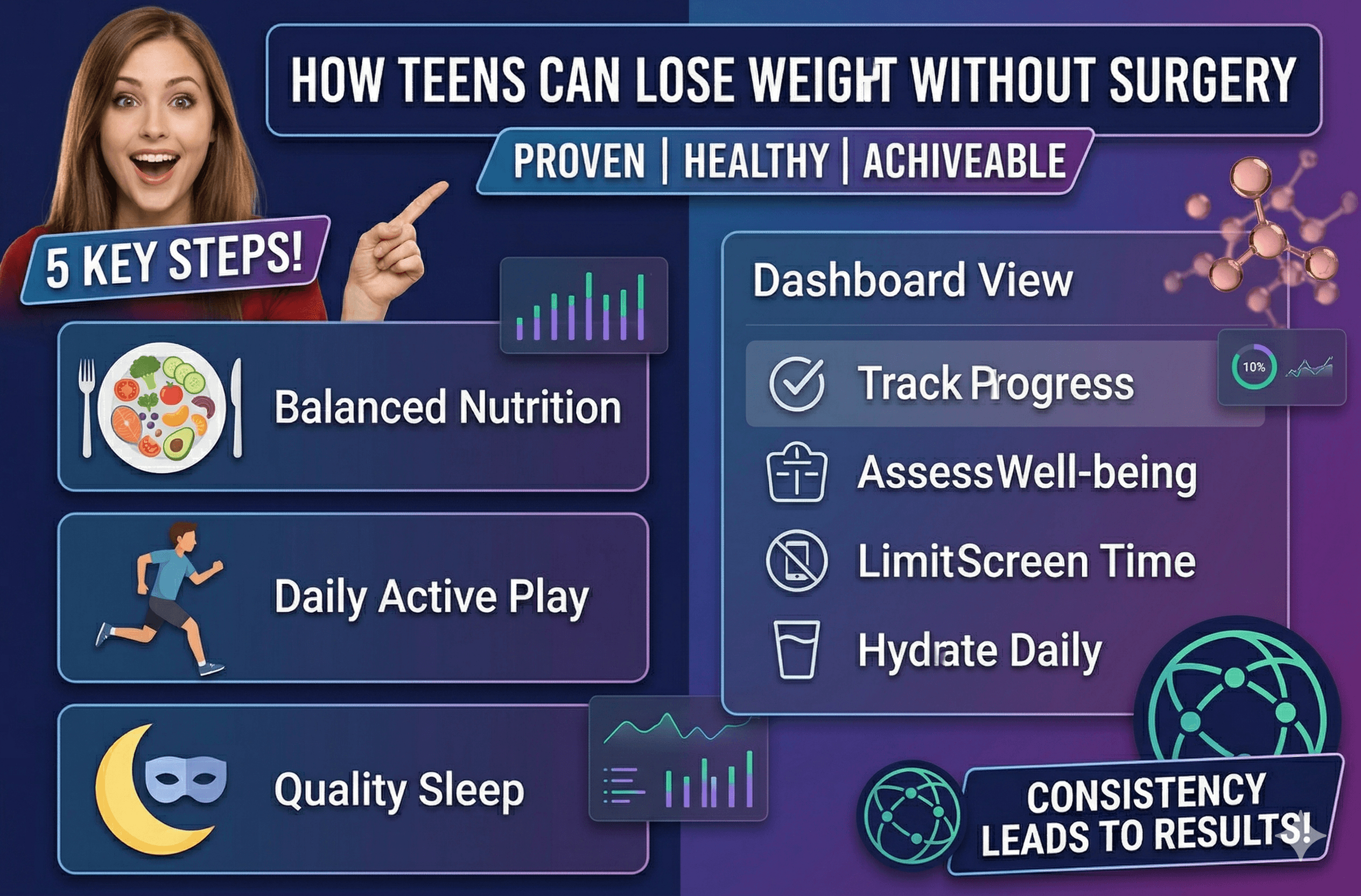
How Teens Can Lose Weight Without Bariatric Surgery

Teens are choosing surgery — but these non-surgical methods work just as well.
That sentence would have sounded implausible a decade ago. Today, it sits at the center of one of the most urgent debates in pediatric medicine. Adolescent obesity rates have more than tripled since the 1970s. In that climate of urgency, bariatric surgery has quietly graduated from a last resort to, for some families, a first serious conversation.
It is completely understandable. When a 16-year-old is carrying 100 extra pounds and facing early-onset Type 2 diabetes, severe sleep apnea, and joint damage, parents are desperate for a solution that works—and works fast. Surgery appears to offer exactly that.
But the story doesn't end at the operating table. And for most teenagers, it probably shouldn't start there, either.
Act 1: Why Teens Are Being Offered Surgery — And Why That's a Problem
The Rise of Adolescent Bariatric Surgery
In 2021, the American Academy of Pediatrics updated its clinical guidelines to acknowledge bariatric surgery as an appropriate option for adolescents with severe obesity. Shortly after, in 2023, those guidelines were revised even further—recommending earlier, more intensive intervention rather than prolonged "watchful waiting."
The shift was backed by genuine data: procedures like the sleeve gastrectomy and gastric bypass have demonstrated meaningful outcomes in teenagers, with studies showing a 25–35% total body weight reduction within the first year. For teens with a BMI over 40 (or over 35 with serious comorbidities), these numbers are medically life-changing. The surgical option isn't fringe anymore. It's mainstream.
The Risks Nobody Puts on the Brochure
Here is what the clinical enthusiasm sometimes glosses over: teenagers are not small adults. Their bodies are still developing in ways that make surgical intervention categorically different—and potentially much riskier—than the exact same procedure performed on a 35-year-old.
- Nutritional Vulnerability: Bariatric procedures drastically reduce the stomach's capacity and alter intestinal absorption. For an adult, managing lifelong vitamin supplementation is demanding. For a teenager who is still building peak bone density and going through massive hormonal shifts, nutritional deficiencies carry heightened, permanent consequences. Iron deficiency, vitamin D insufficiency, and B12 depletion are well-documented post-surgical risks.
- Psychological Readiness: Research consistently shows that the psychological factors driving adolescent obesity—emotional eating, trauma, depression—do not magically disappear after surgery. Without robust behavioral intervention, many teens regain significant weight within five years. Surgery restructures the stomach; it does not restructure the relationship with food.
- Long-Term Unknowns: The oldest cohort of adolescent bariatric patients is only now entering their late 30s. The 20- and 30-year outcome data simply does not exist yet. What happens to their reproductive health? To their metabolism across a full lifetime? These are open questions being answered on the bodies of young people.
- The Irreversibility Factor: A sleeve gastrectomy permanently amputates a large portion of the stomach. This is not a decision that can be undone if a teenager, at age 25, wishes they had tried a metabolic approach first.
None of this means surgery is always wrong. But surgery is increasingly being considered before structured non-surgical alternatives have been genuinely exhausted. That sequencing matters enormously.
Act 2: Non-Surgical Methods That Produce Real, Significant Results
The instinct to dismiss non-surgical approaches as "just diet and exercise" fundamentally misrepresents what modern clinical programs actually look like. The field has evolved considerably. What is now available to adolescents is medically supervised, behaviorally intensive, and demonstrably capable of producing the kind of weight loss most people assume only surgery can achieve.
1. Intensive Family-Based Behavioral Treatment (FBT)
Family-Based Treatment is one of the most rigorously studied approaches in pediatric obesity management. The core insight driving FBT is structural: adolescents do not control their food environment—their parents do. Treating the teen without treating the household is predictably ineffective.
In FBT programs, parents and teens work together with a multidisciplinary team (dietitians, behavioral psychologists, and physicians) over 6 to 24 months.
- Parents are coached on meal planning and restructuring the home food environment.
- Teens participate in behavioral sessions focused on emotional regulation and habit formation.
Clinical trials of intensive FBT have shown average losses of 20–35% of body weight in highly compliant adolescents.
2. Medically Supervised Nutrition Programs
A medically supervised meal plan—designed by a registered dietitian and monitored by a physician—is fundamentally different from a teenager "going on a diet" unsupervised.
These programs often use highly structured protocols that preserve lean muscle mass while producing rapid fat loss. The medical oversight ensures the approach remains safe, tracking lab values and vital signs throughout the process. When implemented in a clinical setting, these protocols have helped significantly obese adolescents lose 40–80 pounds over 6–12 months safely.
3. FDA-Approved Weight-Loss Medication for Teens
This is the area that has changed the landscape most dramatically. In 2022, the FDA approved semaglutide (Wegovy) for chronic weight management in adolescents aged 12 and older with obesity.
The clinical trial that drove that approval—the STEP TEENS study—was striking: participants lost an average of 16.1% of their body weight over 68 weeks. For a teen weighing 250 pounds, that is a 40-pound loss without ever touching a scalpel.
These medications (GLP-1 receptor agonists) work by mimicking a gut hormone that regulates appetite and slows gastric emptying, making patients feel full sooner. They are not a standalone magic bullet—they are most effective when combined with behavioral support—but they represent a genuine pharmacological bridge that makes non-surgical intervention highly viable.
4. Psychological and Behavioral Health Integration
No non-surgical approach is complete without addressing the emotional components of adolescent obesity. Cognitive Behavioral Therapy (CBT) adapted for weight management helps teens identify emotional eating triggers, challenge distorted thinking around body image, and build sustainable coping mechanisms. When integrated into a comprehensive program, behavioral therapy substantially reduces the risk of relapse.
Act 3: How Parental Accountability Replaces the Surgical Safety Net
One of the underappreciated psychological functions of bariatric surgery is what might be called the "structural forcing function." When a teen's stomach physically cannot accommodate large amounts of food, the behavioral decision to overeat is removed. For exhausted families, that removal of choice feels like relief.
But stomachs stretch. Eating behaviors adapt. Without underlying behavioral work, the weight returns. The surgical safety net has massive holes in it. Non-surgical programs must deliberately build the accountability structures that surgery imposes physically.
The Parent as Primary Agent of Change
For teenagers under 16, parental involvement isn't just helpful—it is the primary driver of outcomes. Parents who restock the kitchen, restructure meal timing, and model healthy eating create an environment that makes healthy behavior the path of least resistance.
This requires an honest, often uncomfortable conversation with parents about their own habits and relationship with food. It is frequently the most important conversation in the entire program.
Peer Support and Community
Adolescent behavior is profoundly shaped by peer norms. Clinical programs that build peer communities—through group therapy sessions or structured cohort programs—leverage that social drive in favor of healthy behavior. Teens who identify as part of a community working toward health goals show significantly better adherence than those navigating the process in isolation.
Maryland Trim Clinic (MTC) in Laurel, MD
Navigating adolescent and young adult obesity is overwhelming for any family. Attempting to manage severe metabolic issues with restrictive fad diets usually leads to frustration and rebound weight gain. If your family is looking for a structured, medical alternative to bariatric surgery, professional clinical support is essential.
At the Maryland Trim Clinic (MTC) in Laurel, MD, families have access to a compassionate, evidence-based medical weight loss program designed to address the root causes of obesity without the need for irreversible surgery. For patients who qualify and require metabolic assistance to manage severe appetite dysregulation, MTC provides physician-monitored GLP-1 weight loss injections.
Because long-term success requires behavioral and environmental change, the clinic pairs these medical interventions with dedicated nutritional counseling and coaching. This ensures that patients are not just losing weight, but actively learning how to fuel their bodies, preserve their muscle mass, and build sustainable habits. By partnering with the medical professionals at the Maryland Trim Clinic, families can secure the accountability and clinical tools necessary to achieve massive, life-changing weight loss safely.
The Bottom Line
Surgery solves a problem temporarily. Comprehensive, non-surgical medical programs build a person who doesn't have the problem anymore. That distinction matters—especially for a 15-year-old who has 70 more years of living to do.
Teens and their parents deserve to know that the operating room is not the only door open to them. With the right clinical program, strong family engagement, and modern medical support, 50, 75, and 100-pound weight loss without surgery is a documented, reproducible outcome. The question is not whether non-surgical methods can work. The question is whether families are being given a real, structured opportunity to try them first.
Frequently Asked Questions
Q: At what age can a teenager safely begin a medically supervised weight loss program? A: Most pediatric weight management programs accept adolescents as young as 12, and some intensive family-based programs work with children as young as 8. The appropriate age depends entirely on the teen's specific health situation. A board-certified pediatrician should always be the starting point.
Q: Is weight-loss medication safe for teenagers? A: Yes, when properly prescribed. Semaglutide (Wegovy) and liraglutide (Saxenda) are both FDA-approved for adolescents aged 12 and older with obesity. Clinical trials have demonstrated meaningful safety and efficacy in this age group. However, these medications must be prescribed and closely monitored by a physician and should always be used alongside behavioral and nutritional support.
Q: How long does it typically take for a teen to lose 50+ pounds without surgery? A: Timelines vary depending on the teen's starting weight and program adherence. In well-structured, medically supervised programs—especially those incorporating GLP-1 medications and nutritional guidance—teens have safely achieved 50+ pound losses in 9 to 18 months.
Q: What makes family-based treatment more effective than programs focused only on the teen? A: Teenagers do not control their food environment; parents do. Grocery shopping, meal preparation, and household food availability are managed by adults. Programs that engage parents restructure the entire home environment, which is far more powerful than coaching the teen and sending them back into an unchanged, highly processed household.
Q: Are there risks to non-surgical weight loss for teens? A: When medically supervised, non-surgical weight loss is highly safe. However, unsupervised aggressive caloric restriction (crash dieting) can cause severe muscle loss, stunt bone growth, create nutritional deficiencies, and trigger eating disorders. Any weight loss effort for a developing teenager must involve a physician.
Q: What should a parent do if their teen's doctor recommends bariatric surgery? A: Ask specifically whether structured, non-surgical medical alternatives have been fully explored. Request a referral to a pediatric obesity medicine specialist. Surgical intervention may ultimately be appropriate, but families are entitled—and should be encouraged—to exhaust intensive medical and behavioral options first.
Ready to Explore Non-Surgical Weight Loss Options?
If you and your family are ready to take a comprehensive, medically supervised approach to lasting health, the team at Maryland Trim Clinic is here to help. Contact us today to schedule a personalized consultation and discover a safer path forward.