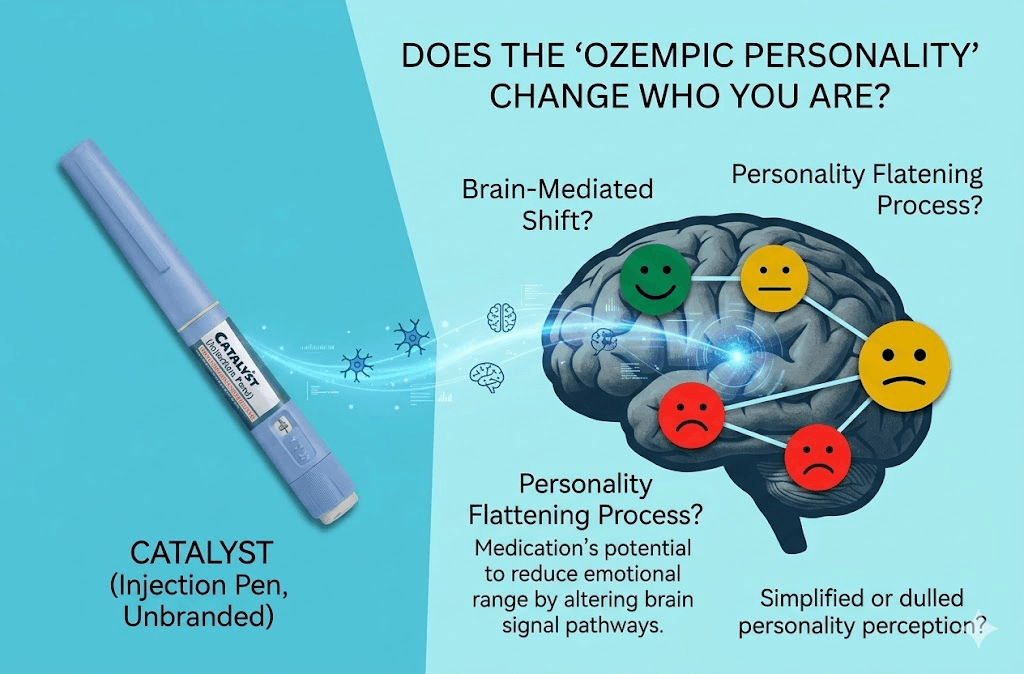
Does the "Ozempic Personality" Change Who You Are?

Some Zepbound users say they feel less like themselves — not just less hungry. Is this a side effect or something more serious?
If you have been scrolling through GLP-1 forums lately, you have probably seen a version of the same unsettling post: "I've lost 30 pounds and I should be thrilled, but I just... don't care about anything anymore." Or maybe it came from your partner, sitting across the dinner table, telling you that you seem different. Quieter. Flatter. Less you.
This phenomenon—increasingly dubbed the "Ozempic personality" in online communities—is one of the most quietly discussed and least clinically acknowledged aspects of GLP-1 receptor agonist therapy. While the weight loss results of medications like Zepbound (tirzepatide) continue to generate headlines, the emotional and behavioral shifts some users experience deserve an honest, thorough conversation.
This isn't about scaring you away from a medication that may be genuinely transforming your health. It is about making sure you have the full picture—because if your personality is part of the cost, you deserve to know that going in.
What People Are Actually Saying
The Forum Posts Nobody's Talking About
In online communities, a recurring thread pattern has emerged over the past two years regarding GLP-1 side effects. Users report things like:
- "Food noise" goes quiet — but so does everything else. Many users celebrate the silencing of obsessive food thoughts, but some describe a broader cognitive quietness that bleeds into hobbies, relationships, and ambitions. "I used to love cooking, planning meals, trying new restaurants," one user wrote. "Now I just... don't think about much of anything."
- Reduced motivation and drive. Multiple users describe an "ambition flatline." The drive to pursue goals or start projects feels inexplicably muted.
- Emotional blunting. Users describe feeling less reactive to both good and bad news. Less anxious, yes—but also less joyful.
- Social withdrawal. Going out feels effortful in a new way. Canceling plans feels easier.
- Reduced interest in alcohol. This is well-documented and often framed as a positive, but it points to something far more complex happening in the brain's reward system.
Is This Just Weight Loss Adjustment?
It is tempting to attribute these changes to the psychological complexity of rapid weight loss itself: identity shifts, changes in how others perceive you, and the loss of food as an emotional coping mechanism. Those factors are real and should not be dismissed.
However, many users report that the personality shifts preceded significant weight loss, emerging in the early weeks of dosing. Others say the flatness correlates directly with dose increases. That timing matters, and it points toward a pharmacological issue rather than a purely psychological one.
The Neuroscience — Your Brain on GLP-1s
GLP-1 Receptors Aren't Just in Your Stomach
Here is where it gets genuinely fascinating—and a little complicated.
GLP-1 (glucagon-like peptide-1) receptors were originally studied in the context of the pancreas and gut, where they regulate insulin secretion and slow gastric emptying. But research supported by the National Institutes of Health (NIH) has revealed a far more distributed picture: GLP-1 receptors are present throughout the central nervous system, including in regions heavily associated with mood, motivation, and reward.
Specifically, GLP-1 receptors have been identified in:
- The hypothalamus (appetite regulation, stress response, and emotional processing)
- The ventral tegmental area (VTA) and nucleus accumbens (the core of the brain's dopamine reward circuit)
- The prefrontal cortex (executive function and decision-making)
GLP-1 is increasingly understood as a neuromodulator—a molecule that helps regulate how the brain responds to rewarding stimuli across the board, not just food.
The Dopamine Connection
Dopamine is the neurotransmitter most associated with motivation, anticipation, and reward. Research suggests that GLP-1 receptor agonists modulate dopamine signaling in the nucleus accumbens. In practical terms, this may be why users experience reduced cravings for alcohol, gambling, or impulsive shopping.
But here is the catch: dopamine does not distinguish neatly between "bad" cravings and "good" drive. The same system that makes you reach for a second slice of cake is the one that makes you excited to call a friend or start a new project. If GLP-1 agonists are broadly dampening dopamine reactivity, it is entirely plausible that some users experience a blunting of motivation and pleasure.
Tirzepatide's Dual Mechanism Adds Complexity
Zepbound (tirzepatide) is distinct from older GLP-1 medications because it is a dual agonist—it activates both GLP-1 receptors and GIP receptors. GIP receptors are also present in areas of the brain involved in mood and cognition. Because tirzepatide produces more pronounced effects on appetite, it is reasonable to ask whether its central nervous system effects might also carry more pronounced neurological side effects.
What the Research Says (and Doesn't Say)
The clinical trial data for GLP-1 medications does not prominently feature "personality change" as an adverse event. In fact, several studies have found improvements in depression scores in GLP-1 users.
However, clinical trials aren't always powered to detect subtle neurological shifts that users struggle to articulate. According to the U.S. Food and Drug Administration (FDA), post-market surveillance is critical for understanding exactly how these drugs affect the central nervous system over time. The science isn't settled, but it isn't dismissible either.
When to Talk to Your Prescriber — and What to Say
First, Normalize the Conversation
One of the most significant barriers to addressing mood-related side effects is reluctance. After years of struggling with weight, the idea of potentially jeopardizing access to a working medication can feel terrifying.
But your quality of life is part of your health outcomes. A medication that helps you lose weight while making you withdrawn and emotionally flat is not an unambiguous success story. Your prescriber needs accurate information to help you.
Signs That Warrant a Real Discussion
Emotional complexity is normal during major life changes. But consider reaching out to your prescriber if you notice:
- Persistent emotional flatness or anhedonia (reduced ability to feel pleasure) lasting more than a few weeks.
- A significant drop in motivation, particularly if work or relationships are suffering.
- Social withdrawal that feels involuntary.
- Symptoms that correlate directly with recent dose increases.
- Thoughts of self-harm or hopelessness (These require immediate emergency contact with a healthcare provider, regardless of cause).
What the Conversation Might Look Like
Come to your appointment prepared. Keep a simple mood journal for a week or two before the visit. Concrete observations are far more useful than "I feel kind of different."
Your prescriber may consider several options:
- Dose adjustment: A lower dose may maintain meaningful weight loss while reducing neurological side effects.
- Medication reassessment: Switching to a different class of medication if personality changes are severe.
- Referral to a mental health professional: Disentangling medication effects from psychological factors.
Maryland Trim Clinic (MTC) in Laurel, MD
Navigating the nuanced, systemic effects of weight loss medications requires an expert, holistic approach to patient care. You should not have to choose between metabolic health and your emotional well-being. The Maryland Trim Clinic (MTC) located in Laurel, MD, provides a secure, medically supervised environment to ensure your weight management journey enhances your entire life.
At MTC, patients don't just receive a prescription; they receive active medical oversight through a comprehensive medical weight loss program. If you are experiencing fatigue or emotional flattening from GLP-1 weight loss injections, their providers can adjust your dosage safely. Furthermore, if you have lost the emotional coping mechanism of food, MTC offers nutritional counseling and coaching to help you rebuild healthy routines. To combat the physical lethargy that often accompanies dopamine blunting, they can integrate vitamin B12 & lipotropic injections or conduct precise metabolic testing and analysis to ensure your body is optimally fueled. By partnering with the experts at Maryland Trim Clinic, you gain a care team dedicated to protecting both your physical progress and your vibrant personality.
The Bottom Line
GLP-1 receptor agonists like Zepbound are genuinely remarkable medications. For many people, the metabolic, physical, and psychological benefits are profound.
But the brain is not a bystander in GLP-1 therapy. These medications interact with dopamine pathways and affect the neural architecture of motivation and reward. You are allowed to want both things: to lose weight and to feel fully like yourself. If you are noticing the "Ozempic personality" phenomenon in your own life, the answer isn't to suffer quietly—it is to have an honest conversation with your medical provider.
Disclaimer: The information in this article is for educational purposes only and does not constitute medical advice. Always consult a licensed healthcare provider before starting or stopping any medication. If you are experiencing severe depression or thoughts of self-harm, seek emergency medical care immediately.
Frequently Asked Questions
Q: What is the 'Ozempic personality' and does it apply to Zepbound users too? A: The 'Ozempic personality' is a colloquial term describing changes in mood, motivation, and emotional engagement that some users experience beyond simple appetite suppression. While the term references Ozempic, the phenomenon has been widely discussed among Zepbound (tirzepatide) users as well.
Q: Is emotional blunting on GLP-1 medications a recognized medical side effect? A: Emotional blunting is not currently listed as a formally recognized adverse event in clinical trial data. However, growing anecdotal reports and emerging neuroscience research suggest that GLP-1 receptors in the brain's reward circuits may contribute to these effects. It absolutely warrants clinical attention.
Q: Why might GLP-1 medications affect motivation and dopamine beyond just appetite? A: GLP-1 receptors are present in the brain's dopamine reward system. Since dopamine governs motivation and anticipation across all domains (not just food), medications that modulate GLP-1 receptor activity may broadly affect how rewarding everyday activities feel.
Q: How do I know if my mood changes are from Zepbound or just the stress of weight loss? A: Timing and dose correlation are key clues. If your emotional changes appeared early in treatment or intensified after dose increases—before significant weight loss occurred—that suggests a pharmacological cause. A mental health professional can help disentangle medication effects from psychological adjustments.
Q: Should I stop taking Zepbound if I feel emotionally flat or less motivated? A: Do not stop taking Zepbound without speaking to your prescriber first. Abrupt discontinuation can cause metabolic rebound. There are several options short of stopping entirely, including dose adjustments.
Q: What should I tell my doctor if I think my personality is changing on GLP-1 medication? A: Be concrete. Track your mood and motivation for a week before your appointment. Describe when the changes started, whether they correlate with dose changes, and how they are affecting your relationships and work. Most prescribers will take this seriously and work with you to find a solution.
Ready to Prioritize Your Whole Health?
Don't navigate the complex side effects of weight loss medications alone. Contact a specialized medical provider today to ensure your treatment plan supports your physical goals without compromising your emotional well-being.