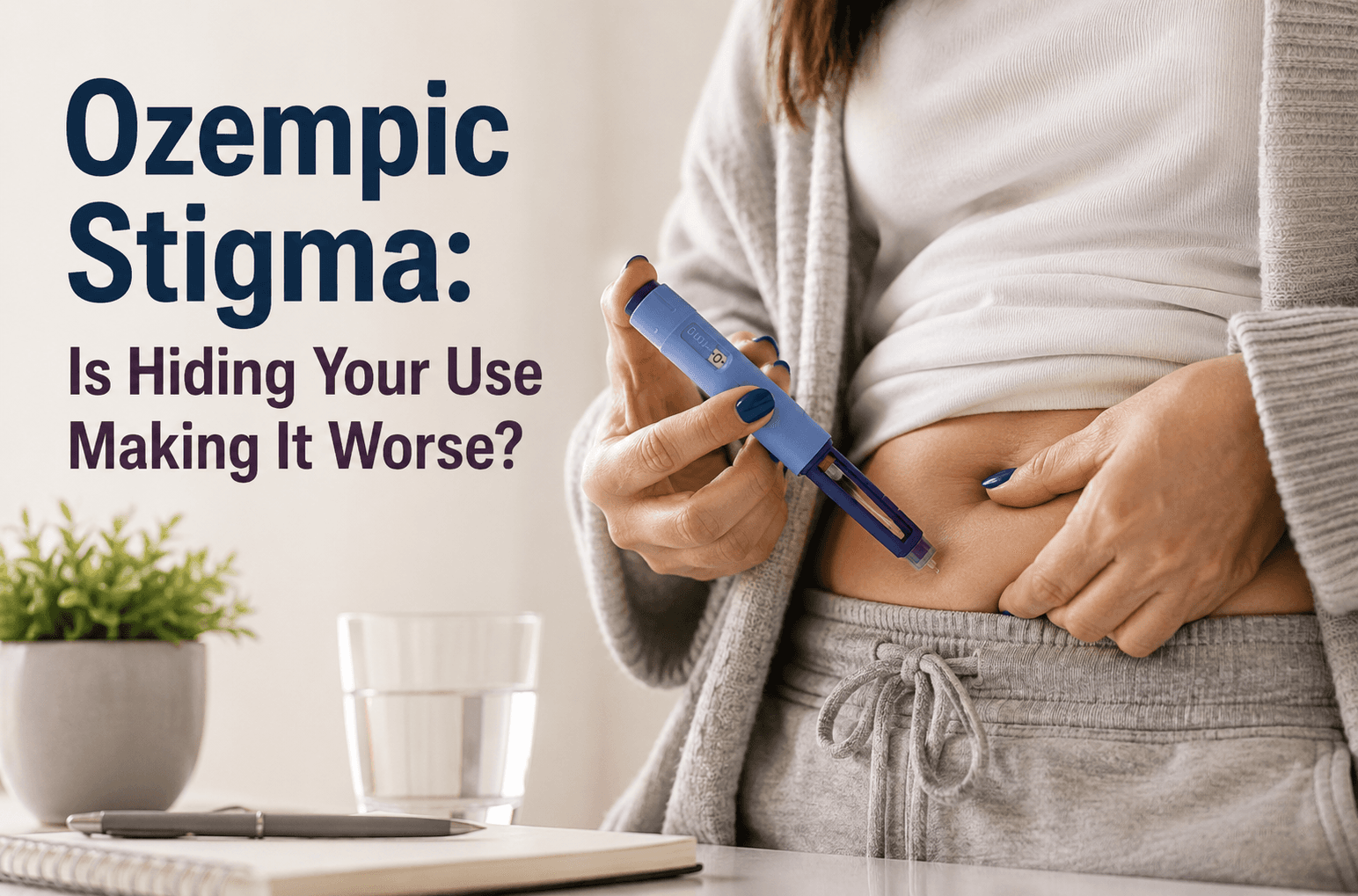
Ozempic Stigma: Is Hiding Your Use Making It Worse?


80 kilos lost. And she told no one how she did it. Until now.
Sarah — not her real name — spent fourteen months deflecting questions at dinner parties, family gatherings, church events, work lunches, and casual conversations in grocery store aisles.
“You look amazing. What did you do?”
She had a script.
“I cleaned up my diet.”
“I started walking more.”
“I finally got serious.”
“I cut out sugar.”
Sometimes those answers were partly true. She had changed how she ate. She was walking more. She did become more intentional. But they were not the whole truth.
The whole truth was that she was using semaglutide.
Every time someone praised her discipline, Sarah felt a strange kind of shame. Not because she had lost weight. Not because she had improved her health. Not because the medication was illegal or unsafe under medical supervision. The shame came from the gap between what people thought had happened and what she felt she was allowed to admit.
Her body had changed, but so had her relationship with honesty.
Sarah’s experience is not unusual. As GLP-1 receptor agonists like Ozempic and Wegovy have become more visible, a quiet culture of secrecy has grown around them. People are losing significant weight, improving metabolic markers, changing their appetite patterns, and rethinking their relationship with food — while also building cover stories to protect themselves from judgment.
Some people keep it private because they are naturally private. That is valid.
But others are not choosing privacy from peace. They are hiding from shame.
And that distinction matters.
Ozempic is semaglutide, a prescription GLP-1 receptor agonist approved for adults with type 2 diabetes. Semaglutide is also used under other brand names for chronic weight management in eligible patients. The FDA prescribing information for Ozempic explains its approved use, dosing, and safety warnings.
So the question is not whether you owe everyone your medical history.
You do not.
The deeper question is this:
Is hiding your Ozempic use protecting your peace — or quietly making the emotional burden heavier?
The Shame Economy
Why weight loss is treated like a moral achievement
To understand why people hide Ozempic use, you have to understand how deeply body weight has been moralized.
For decades, thinness has been treated as more than a body size. It has been treated as proof of discipline, restraint, control, attractiveness, ambition, and even respectability.
Weight gain, on the other hand, is often unfairly read as evidence of laziness, indulgence, weakness, or lack of willpower.
Those assumptions are not medically fair, but they are culturally powerful.
They show up in:
- casual comments about “letting yourself go”
- workplace bias
- dating preferences
- family pressure
- social media before-and-after culture
- medical appointments where symptoms are blamed on weight
- compliments that reward thinness without asking about health
- wellness messaging that treats weight loss as personal redemption
This creates what we might call a shame economy.
In that economy, weight loss only receives full cultural approval if it appears to be earned through visible effort: dieting, exercise, sacrifice, self-denial, and discipline.
So when someone loses weight with medication support, the cultural response can shift from admiration to suspicion.
The unspoken question becomes:
Did you really earn it?
That question is the root of much of the secrecy.
Why medication feels like “cheating” to some people
Ozempic disrupts the old weight-loss story.
For many people, GLP-1 medications reduce appetite, increase fullness, slow stomach emptying, and quiet food-related thoughts. MedlinePlus explains that semaglutide injection may decrease appetite and cause weight loss, while also emphasizing that it should be used exactly as prescribed.
That matters because many people using these medications are not simply trying harder. Their hunger signals, fullness cues, and food noise may feel biologically different.
To someone who has never experienced constant food noise, this can be hard to understand. They may see medication-assisted weight loss as an unfair shortcut.
But that criticism depends on a faulty idea: that weight is controlled mainly by willpower.
In reality, weight is influenced by a complex mix of:
- genetics
- hormones
- appetite regulation
- insulin resistance
- sleep
- stress
- medications
- medical conditions
- mental health
- environment
- access to food
- activity patterns
- trauma history
- culture and family habits
GLP-1 medications do not bypass biology. They work within biology.
Calling that “cheating” is like calling blood pressure medication cheating at cardiovascular health, or calling antidepressants cheating at mood regulation.
We usually do not shame people for using medication to treat complex systems in the body.
Weight is the exception because society has decided, wrongly, that body size is a character report.
The difference between privacy and shame
Not everyone needs to disclose Ozempic use.
Privacy is healthy. You are not required to explain your prescriptions to coworkers, relatives, social media followers, church members, neighbors, or anyone who asks invasive questions about your body.
There is a difference between privacy and shame.
Privacy sounds like:
- “I’m not discussing my medical care publicly.”
- “That’s something I’m working on with my doctor.”
- “I appreciate your concern, but I’d rather keep that private.”
- “I’ve made some health changes, and I’m not going into details.”
Shame sounds like:
- “If they know, they’ll think I cheated.”
- “My progress doesn’t count.”
- “I have to lie or people will judge me.”
- “I can’t ask for support because then I’ll have to admit it.”
- “I don’t deserve the compliments.”
The problem is not secrecy itself. The problem is secrecy that grows from fear, self-rejection, or the belief that your medical care makes your progress less real.
You can be private without being ashamed.
What secrecy can do to self-worth
When Sarah said, “I just cleaned up my diet,” she was not only protecting herself from other people’s judgment. She was also slowly teaching herself that the fuller truth was unacceptable.
That can become emotionally corrosive.
Over time, secrecy may create a split between the public story and the private experience. Publicly, people praise your discipline. Privately, you may feel like a fraud. Publicly, you look successful. Privately, you may feel like the success does not belong to you.
That split can make it harder to feel proud of real effort.
Because even with Ozempic, effort still exists.
People still have to:
- attend appointments
- manage side effects
- plan meals
- eat enough protein
- handle constipation or nausea
- build strength
- pay for treatment
- monitor health markers
- make decisions about dose and duration
- deal with other people’s comments
- live in a changing body
Medication support does not erase your role.
It changes the conditions under which you are doing the work.
The Hidden Price of Secrecy
Secrecy may feel protective at first.
It can help you avoid rude questions. It can protect you from family members who moralize weight. It can reduce unsolicited opinions from people who do not understand GLP-1 medications. It can preserve boundaries.
But secrecy can also carry hidden costs, especially when it becomes isolation.
Secrecy can weaken support systems
Long-term health changes are easier when people have support.
That does not mean everyone needs a public announcement. It means most people benefit from at least one safe person who knows what is really happening.
When you hide Ozempic use from everyone, you may lose the ability to say:
- “I’m struggling with side effects this week.”
- “I’m scared to stop.”
- “My appetite is too low and I don’t know what to eat.”
- “I’m losing weight, but I feel weaker.”
- “I’m worried people will judge me.”
- “I need help staying consistent with protein.”
- “I don’t know how to respond to all the comments about my body.”
That kind of honesty matters because GLP-1 treatment is not only about the injection. It involves food, identity, emotions, cost, side effects, body changes, and long-term planning.
If no one knows, no one can support you.
It can make side effects harder to discuss
Ozempic and related medications can have side effects.
Common issues may include nausea, vomiting, diarrhea, constipation, reflux, reduced appetite, fatigue, and difficulty eating enough. Some people also worry about hair shedding, muscle loss during weight loss, or mood changes.
If you are hiding medication use, you may be less likely to tell someone:
- why you cannot eat much at dinner
- why certain foods suddenly bother you
- why you feel tired after dose day
- why you are prioritizing protein
- why you are trying resistance training
- why you need to call your clinician
That secrecy can become practical, not just emotional.
For example:
- If you feel nauseated: it helps to have someone understand why you need smaller meals.
- If you are constipated: it helps to talk honestly with your clinician before it becomes severe.
- If you are losing strength: it helps to get support around protein and resistance training.
- If you feel emotionally flat: it helps to say that out loud to a trusted person or professional.
- If you want to stop: it helps to have medical guidance before making changes.
The more hidden the medication is, the easier it becomes to underreport what is happening.
It fuels misinformation
When people with real experience stay silent, the public conversation gets filled by speculation.
Then Ozempic becomes whatever the loudest voices say it is:
- a celebrity secret
- a vanity shortcut
- a dangerous trend
- a miracle cure
- a moral failure
- an easy way out
- a punchline
None of those extremes is the full truth.
The real story is more nuanced. Some people use semaglutide for type 2 diabetes. Some use semaglutide under another brand for chronic weight management. Some tolerate it well. Some do not. Some experience major health improvements. Some stop because of cost, side effects, pregnancy plans, supply issues, or personal preference. Some feel relief. Some feel conflicted.
When the most honest users stay quiet because they fear shame, the public loses access to balanced, lived experience.
That can hurt people who might benefit from a medically supervised conversation but avoid it because the stigma feels too heavy.
Research on weight stigma has repeatedly shown that weight bias can affect mental health, health behaviors, and quality of care. A review on weight bias and stigma in health care describes how stigma can influence patient experiences and health outcomes.
In other words, stigma is not just a feeling.
It can affect whether people seek care, trust clinicians, continue treatment, or talk honestly about what they need.
It can make success feel undeserved
One of the most painful effects of hiding Ozempic use is that success can start to feel fake.
People may say:
“You look so disciplined.”
“You’re such an inspiration.”
“You finally did it.”
“I knew you could do it if you tried.”
Those comments may be intended as praise. But if you are hiding medication use, they can land strangely.
You may feel like the compliment is being given to a version of you who does not exist — the version who supposedly conquered hunger through willpower alone.
That can make it hard to internalize progress.
A healthier way to think about it is this:
Medication can be part of your story without being the whole story.
You can acknowledge that Ozempic helped while still recognizing your effort.
Both can be true:
- The medication changed your appetite.
- You still made choices.
- The medication reduced food noise.
- You still had to nourish your body.
- The medication helped you lose weight.
- You still had to manage side effects and follow-up care.
- The medication supported the process.
- Your progress still belongs to you.
A healthier disclosure framework
You do not need to tell everyone.
A healthier goal is not total transparency. It is selective honesty.
Try this framework:
- Tell your healthcare providers fully. They need accurate information to keep you safe.
- Tell one trusted person if secrecy feels heavy. Choose someone who can respond with maturity.
- Use boundaries with everyone else. You can be honest without overexplaining.
- Prepare simple language. It helps reduce panic when people ask.
- Do not debate your medical decisions with unsafe people. Access to your story is earned.
Helpful responses may sound like:
- “I’m working with my doctor on my metabolic health.”
- “I’m using medical support and lifestyle changes.”
- “I’d rather not discuss the details, but I’m feeling supported.”
- “It has been a combination of medical care, nutrition changes, and follow-up.”
- “I’m not looking for opinions on my treatment, but I appreciate your concern.”
The goal is not confession.
The goal is freedom from unnecessary shame.
The Conversation We're Not Having
Weight is biology, not just willpower
The conversation we are not having is the one that starts with this truth:
Weight is not simply a reflection of character.
The body regulates weight through a complicated system involving hormones, appetite signals, genetics, sleep, stress, medications, environment, food access, and brain reward pathways.
Willpower exists, but it is not the whole system.
This matters because shame thrives in oversimplification.
When people believe weight is only about discipline, then medication looks like cheating. But when people understand weight as biology, medication looks like what it is: one possible medical tool among many.
This does not mean everyone needs Ozempic.
It does not mean lifestyle habits do not matter.
It means the conversation should be more honest, less cruel, and less obsessed with proving who “deserves” help.
GLP-1s are medical tools, not moral shortcuts
Ozempic is not a personality trait. It is not a moral confession. It is not proof of laziness. It is not proof of failure.
It is a prescription medication that may be appropriate for some patients and inappropriate for others.
A responsible GLP-1 conversation should include:
- medical eligibility
- approved indications
- side effects
- nutrition
- muscle preservation
- cost
- long-term maintenance
- blood sugar monitoring when relevant
- pregnancy planning when relevant
- mental health
- what happens if treatment stops
That is very different from the internet’s favorite question: “Did they cheat?”
The “cheating” conversation is shallow because it ignores the complexity of both obesity and treatment.
A better question is:
Is this person receiving safe, appropriate, medically supervised care that supports their long-term health?
That question is useful.
What a healthier conversation would sound like
A healthier public conversation about Ozempic would sound less like gossip and more like medical literacy.
It would include statements like:
- “GLP-1 medications can help some people, but they are not for everyone.”
- “Weight loss medication should be medically supervised.”
- “Side effects and long-term planning matter.”
- “People deserve privacy around prescriptions.”
- “Using medication does not erase effort.”
- “Obesity and weight regulation are complex.”
- “Shaming people does not improve health.”
- “Nutrition and strength matter during weight loss.”
- “Stopping medication should be discussed with a prescriber.”
- “We can talk about risks without mocking people.”
That last point matters.
It is possible to discuss side effects, misuse, celebrity culture, access issues, cost, and overprescribing without humiliating patients who are using these medications responsibly.
The public conversation needs more maturity.
How to be honest without overexposing yourself
Honesty does not require you to hand your medical history to everyone who notices your body.
You can choose levels of disclosure.
Level 1: Full privacy
Use this with coworkers, acquaintances, or unsafe people.
- “I’m focusing on my health.”
- “I’d rather not talk about my body.”
- “That’s personal, but thank you for understanding.”
Level 2: General honesty
Use this when you want to be truthful but not detailed.
- “I’m working with a clinician.”
- “It has been a combination of medical support and lifestyle changes.”
- “I’ve had help managing my metabolic health.”
Level 3: Trusted disclosure
Use this with safe people who can support you.
- “I’m using semaglutide under medical supervision.”
- “It has helped, but I’m also dealing with side effects.”
- “I’m trying to build habits so I’m not relying on medication alone.”
- “I could use support without judgment.”
This approach protects your boundaries without forcing you into shame.
You are allowed to be private.
You are also allowed to be honest.
Maryland Trim Clinic (MTC) in Laurel, MD
Maryland Trim Clinic (MTC) in Laurel, MD can support patients who want a medically guided approach to weight management, GLP-1 conversations, nutrition, body composition, and long-term planning.
How a clinic can support the medical and emotional side of GLP-1 treatment
A clinic like MTC can help patients move away from secrecy and toward structured care. That may include discussing whether medication is appropriate, how to manage side effects, how to protect nutrition, how to monitor progress, and how to think about long-term maintenance without shame.
For patients considering medication-based weight support, MTC lists GLP-1 treatment options among its services. Patients who need a broader plan may also benefit from medical weight management support, especially when weight, metabolism, appetite, and health goals need to be reviewed together.
Some patients may also need help making sure weight loss does not come at the expense of strength or nourishment. In that context, nutrition coaching programs or metabolic review may help patients build a plan that feels safer, more practical, and less isolating.
For people in or near Laurel, MD, Maryland Trim Clinic can be a local starting point for a more honest, medically supervised conversation about weight management and GLP-1 treatment.
Medical disclaimer: This article is for educational purposes only and is not a substitute for medical advice, diagnosis, or treatment. Ozempic, Wegovy, semaglutide, and other prescription medications should only be used under the supervision of a qualified healthcare professional. Do not start, stop, switch, or change your medication without speaking with your prescriber.
You do not have to explain yourself to everyone.
But you should not have to hide from everyone either.
If you are currently using or considering a GLP-1 medication, the most important place to be fully honest is with your healthcare provider. They need to know what you are taking, how you are responding, what side effects you are experiencing, and what fears or pressures are shaping your decisions.
Beyond that, consider choosing at least one safe person who can know the truth without turning it into gossip, judgment, or unsolicited advice.
That person might be a spouse, sibling, close friend, therapist, dietitian, or support group member.
The goal is not public confession.
The goal is not to win an argument about whether medication-assisted weight loss is legitimate.
The goal is to stop carrying shame that was never yours to begin with.
Sarah eventually told her sister. Then one close friend. Then a small group of people who had been quietly carrying similar secrets.
What she received was not the rejection she feared.
It was relief.
Sometimes, a healthier conversation begins when one person finally says, “This is what really happened.”
And someone else answers, “Me too.”
Frequently Asked Questions
Q: Why do so many people hide the fact that they’re using Ozempic or other GLP-1 drugs?
Many people hide GLP-1 use because they fear judgment.
Weight loss is often treated as a moral achievement, so people worry that medication support will make others think they cheated, lacked discipline, or did not “earn” their results.
Others hide it because they do not want unsolicited medical opinions, gossip, family criticism, workplace comments, or body-focused attention.
It is important to separate privacy from shame. You do not owe everyone your medical information. But if secrecy is making you feel fake, isolated, or unable to ask for help, it may be worth telling one trusted person or speaking with a professional.
Q: Does hiding Ozempic use actually affect health outcomes?
It can.
Hiding medication use may make it harder to get support with side effects, nutrition, protein intake, fatigue, constipation, mood changes, or long-term planning. It can also make people less likely to ask questions or seek help when something feels wrong.
The most important person to be honest with is your healthcare provider. They need accurate information to guide safe treatment.
You do not need to disclose publicly, but having at least one safe support person can reduce emotional burden and improve accountability.
Q: Is using Ozempic for weight loss actually “cheating”?
No.
Medication-assisted weight management is not cheating. It is a medical approach that may be appropriate for some patients when prescribed and monitored correctly.
Body weight is influenced by hormones, genetics, appetite regulation, environment, sleep, stress, medications, and medical conditions. GLP-1 medications work by affecting biological pathways related to appetite, fullness, and blood sugar.
That does not mean everyone needs them or that they are risk-free. It simply means using medication does not make your effort fake.
Q: How does individual secrecy about Ozempic contribute to broader misinformation?
When people with real experience stay silent, the public conversation is often shaped by rumors, celebrity gossip, extreme anecdotes, and judgment.
That can create a distorted picture where Ozempic is treated either as a miracle shortcut or a dangerous vanity trend. Neither extreme is helpful.
More honest, medically grounded conversations can help people understand the real tradeoffs: benefits, side effects, cost, eligibility, long-term planning, and the importance of clinical supervision.
Q: Do I have to disclose Ozempic use publicly to benefit from being more open about it?
No.
You do not have to post about it, announce it, or explain it to anyone who asks about your body.
Openness can simply mean telling your doctor the full truth, telling one trusted person, or joining a private support space where you can discuss your experience without shame.
The goal is not public exposure. The goal is support.
Q: What should I say if someone asks how I lost weight?
You can choose how much to share.
Simple responses include:
- “I’m working with my doctor on my health.”
- “It has been a combination of medical support and lifestyle changes.”
- “I’m not really discussing my body, but I appreciate your kindness.”
- “I’ve made some changes, but I’d rather keep the details private.”
- “I’m focusing on my health in a way that works for me.”
You do not have to lie, but you also do not have to disclose more than feels safe.
Q: What if my family or friends judge me for using Ozempic?
Their reaction may say more about their beliefs around weight than about your medical decision.
It can help to prepare a boundary before the conversation:
- “I’m making this decision with my healthcare provider.”
- “I’m not looking for debate or judgment.”
- “I’m happy to talk about support, not criticism.”
- “My medical care is not up for group discussion.”
If someone cannot respond respectfully, they may not be the right person to include in this part of your life.
Q: What would a healthier public conversation about GLP-1 medications look like?
A healthier conversation would treat GLP-1 medications as medical tools, not moral shortcuts or celebrity scandals.
It would include the full picture:
- who may be eligible
- what the medications can and cannot do
- why medical supervision matters
- what side effects can happen
- why nutrition and strength training still matter
- how cost and access affect treatment
- why stigma can keep people from getting care
- why privacy should be respected
Most importantly, it would stop treating shame as a public health strategy.
When to Consider Professional Support
Some people benefit from structured medical guidance when they feel unsure about GLP-1 treatment, side effects, nutrition, body changes, or the emotional burden of keeping everything private. If you are in Maryland and want a careful, nonjudgmental conversation about your options, Maryland Trim Clinic can help you explore weight management support in a way that respects both your health goals and your privacy.