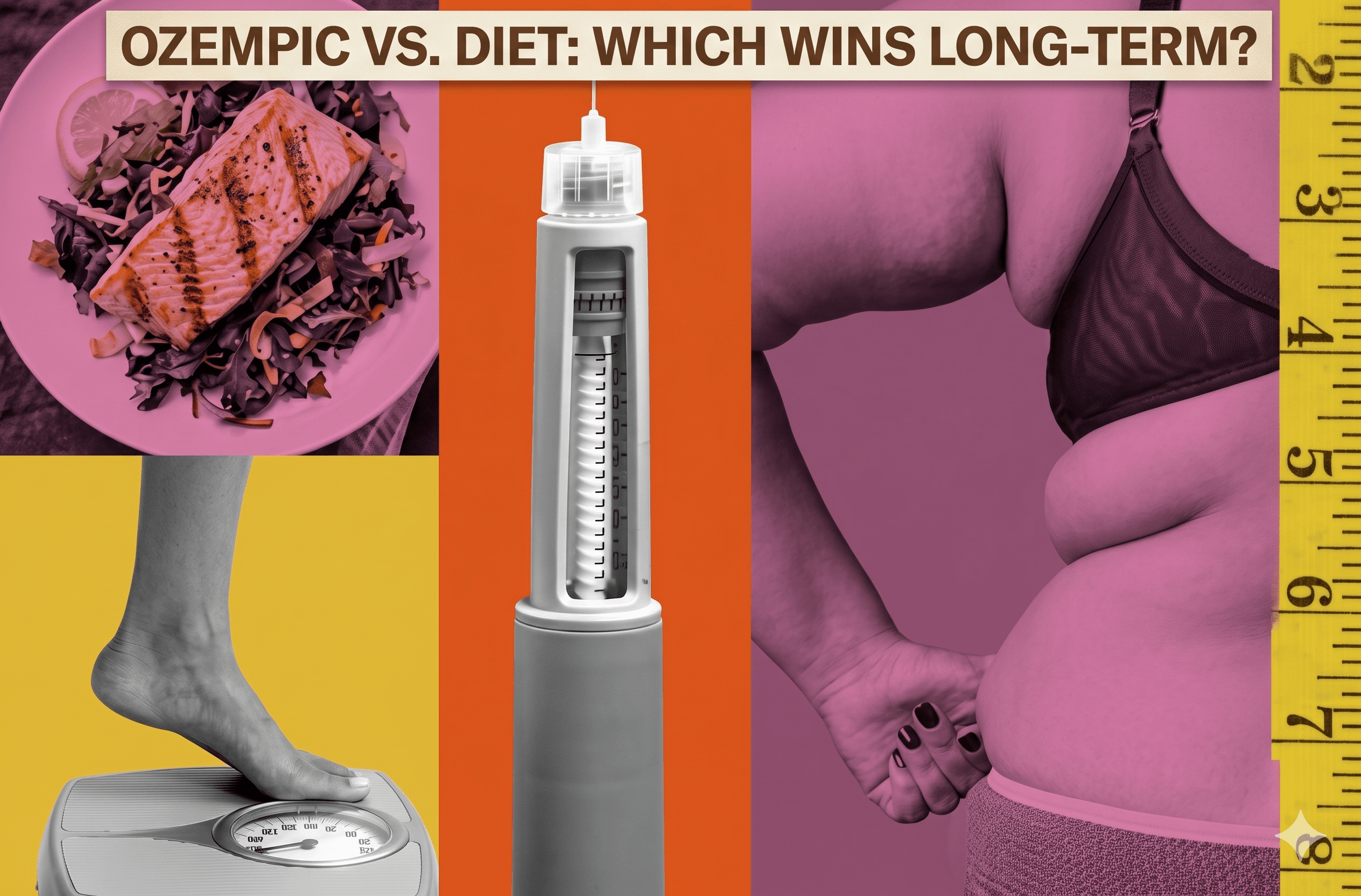
Ozempic vs. Diet: Which Wins Long-Term Weight Loss?

The drug works fast. The diet lasts. Here's what the clinical data actually says.
If you've found yourself standing at a crossroads — prescription pad in one hand, a meal-planning app in the other, you're not alone. Millions of people are wrestling with the same question right now: Is Ozempic the answer, or is it just a shortcut that leads right back to where you started? And conversely, can dietary change alone actually compete with a drug engineered to suppress appetite and rewire your hunger hormones?
The answer is more nuanced than either camp wants to admit, and it has serious consequences for how you plan the next chapter of your health. Let's go head-to-head — drug versus diet — and let the data do the talking.
ACT 1: THE FAST LANE — WHAT OZEMPIC ACTUALLY DOES TO YOUR BODY
Semaglutide, sold under the brand names Ozempic and Wegovy, belongs to a class of drugs called GLP-1 receptor agonists. Originally developed to manage blood sugar in type 2 diabetics, it was quickly discovered to have a powerful secondary effect: significant, rapid weight loss.
In the landmark STEP 1 clinical trial, participants using semaglutide lost an average of 14.9% of their body weight over 68 weeks. For context, that's roughly 30 pounds for a 200-pound person. That is not a trivial number.
The Mechanism of Action
The mechanism is elegant in its simplicity. According to the National Institutes of Health (NIH), GLP-1 agonists mimic a naturally occurring gut hormone that slows gastric emptying and signals fullness to the brain, effectively reducing appetite at the neurological level. You don't just want less food — your brain genuinely stops demanding it with the same urgency. For people who have spent decades fighting intense, biochemically driven hunger, this can feel like a revelation.
But here's where the story gets complicated.
The Rebound Reality
The same STEP 1 trial team published a follow-up study tracking participants after they stopped taking semaglutide. The results were sobering:
- Within one year of discontinuation, participants had regained an average of two-thirds of their lost weight.
- Their hunger returned.
- Their cardiometabolic markers worsened.
- Their body weight trended heavily back toward its original set point.
This is the critical distinction. Ozempic suppresses the symptom — excess caloric intake driven by dysregulated hunger signaling — but it does not repair the underlying metabolic machinery that created the problem. The moment the drug leaves your system, that machinery picks up right where it left off. For many users, this means Ozempic is effectively a lifelong commitment, or it becomes a very expensive round trip back to baseline.
That doesn't make it a bad tool. It makes it a specific tool with specific limitations — limitations that are rarely foregrounded in the conversations happening around it.
ACT 2: THE ROOT FIX — WHY DIET GOES DEEPER
While semaglutide manages hunger signals from the top down, dietary intervention works from the bottom up — targeting the actual metabolic dysfunction that drives obesity, cravings, and chronic disease in the first place.
The Problem of Insulin Resistance
The root issue for the majority of people struggling with weight is insulin resistance. When cells stop responding efficiently to insulin, blood sugar becomes chronically elevated, fat storage accelerates, and hunger regulation breaks down. Your body is essentially stuck in a biochemical state that prioritizes fat accumulation and fights fat release. No amount of willpower fully overrides a hormonal environment that is wired against you.
This is where strategic dietary change becomes not just effective, but mechanistically corrective.
How Diet Rewires the System
Research consistently shows that diets reducing refined carbohydrate intake directly improve metabolic health. A 2020 meta-analysis published in BMJ Open Diabetes Research & Care found that low-carbohydrate diets produced significant reductions in HbA1c, fasting glucose, and triglycerides compared to low-fat dietary controls.
Key Dietary Benefits:
- Lowers fasting insulin levels.
- Improves insulin sensitivity at the cellular level.
- Reduces inflammatory markers associated with metabolic syndrome.
Time-restricted eating and Mediterranean-style dietary patterns show similar corrective effects. These aren't just calorie-reduction strategies; they are metabolic rehabilitation protocols.
The Limitation of Dieting
The honest limitation here is speed and adherence. Dietary change is slow. Where an appetite suppressant medication might deliver 10% body weight loss in sixteen weeks, a disciplined dietary intervention might deliver 5-8% over the same period. Furthermore, the cognitive load of restructuring how you eat in a modern food environment is genuinely enormous, leading to notoriously poor long-term adherence rates.
But here's the clincher: the people who do sustain dietary change show metabolic improvements that persist and compound over time. Their weight loss, though slower, is defended by a body that has actually changed its internal baseline — not suppressed it artificially.
ACT 3: THE REAL WINNER — AND IT'S NOT WHAT YOU EXPECTED
If this were a simple boxing match, diet wins on points over the long term, while Ozempic wins the early rounds on speed and drama. But the most compelling evidence doesn't ask you to choose one corner.
The strongest outcomes in the current research literature belong to patients who use GLP-1 agonists as a bridge — a metabolic runway — while simultaneously building the dietary infrastructure that makes the landing sustainable.
The "Metabolic Bridge" Framework
Ozempic's greatest clinical value may not be as a permanent intervention, but as a temporary metabolic reset window.
- Phase 1 (The Drug): Dramatically reduces hunger and caloric intake in the short-to-medium term.
- Phase 2 (The Breathing Room): The neurological war with hunger is temporarily suspended, lowering the cognitive bandwidth required to change habits.
- Phase 3 (The Habit Construction): Patients use this window to build low-glycemic eating patterns and engage in nutritional counseling and coaching.
- Phase 4 (The Handoff): The medication is tapered off, and the newly established dietary habits take over to sustain the weight loss.
A 2023 observational study out of the Cleveland Clinic found that patients who combined GLP-1 therapy with structured dietary coaching maintained significantly greater weight loss at the two-year mark compared to those who used the drug alone. The dietary scaffolding protected them from the severe rebound seen in drug-only users.
The question isn't which intervention wins. The question is how to sequence them intelligently.
Maryland Trim Clinic (MTC) in Laurel, MD
Navigating the intersection of medication and sustainable lifestyle change is not something you should do alone. Located in Laurel, MD, the Maryland Trim Clinic (MTC) specializes in combining pharmaceutical support with the essential dietary foundations required for long-term success.
At MTC, a comprehensive medical weight loss program does not view medication as a standalone cure. For patients utilizing GLP-1 weight loss injections, the clinic provides concurrent nutritional guidance to ensure you are utilizing the "metabolic bridge" effectively. By addressing the root causes of insulin resistance while the medication manages your appetite, MTC’s specialized team helps you build the habits necessary to maintain your progress long after the prescription pad is put away.
THE BOTTOM LINE
If you're making this decision today, here's the honest synthesis the data supports:
Ozempic works — but it works best when it's working toward something, not just working alone. Dietary change is the durable foundation, but you don't have to build it in a burning building. If pharmaceutical support makes the construction possible, that's not cheating. That's strategy. According to guidelines from the Centers for Disease Control and Prevention (CDC), safe and sustainable weight loss requires a comprehensive approach.
The drug works fast. The diet lasts. The smartest play is using the first to build the second — and then letting go of the scaffolding when the structure can stand on its own.
Medical Disclaimer: The information provided in this article is for educational purposes only and is not intended as a substitute for professional medical advice, diagnosis, or treatment. Always seek the advice of your physician or other qualified healthcare provider regarding a medical condition, treatment options, or before starting any new weight loss program or medication.
Frequently Asked Questions
Q: How much weight can you realistically lose on Ozempic? A: Clinical trials show an average weight loss of approximately 10-15% of total body weight over 68 weeks with semaglutide. However, results vary significantly based on dosage, individual metabolism, and whether concurrent dietary changes are made.
Q: Is dietary change alone enough to lose weight without medication? A: For many people, yes — but the speed and ease of progress depend heavily on the severity of underlying insulin resistance. Low-glycemic, whole-food dietary approaches have strong clinical evidence for producing lasting weight loss, though results are typically slower than pharmaceutical intervention.
Q: What happens when you stop taking Ozempic? A: Research shows that most users regain a significant portion of lost weight — roughly two-thirds on average — within one year of discontinuation if no lifestyle changes were made. Hunger levels return and metabolic markers typically worsen, which is why building dietary habits during treatment is critical.
Q: Can you take Ozempic and follow a special diet at the same time? A: Absolutely. Using GLP-1 agonists as a short-term metabolic bridge while simultaneously building whole-food dietary habits produces significantly better long-term outcomes than either approach used in isolation.
Q: Does Ozempic fix insulin resistance or just manage appetite? A: Primarily the latter. While GLP-1 agonists improve blood sugar regulation and have beneficial effects on insulin sensitivity as a secondary result of weight loss, they do not directly correct the root metabolic dysfunction. Dietary interventions have stronger evidence for directly rehabilitating insulin sensitivity at the cellular level.
Q: Who is the best candidate for combining Ozempic with dietary changes? A: People who have significant weight to lose, have struggled with intense hunger that undermines diet adherence, and have a clear plan to transition off medication while maintaining lifestyle changes tend to see the best outcomes.
Ready to Build a Weight Loss Strategy That Lasts?
If you are tired of yo-yo dieting and want an evidence-based plan that utilizes the best of both medication and nutritional science, we can help. Visit the Maryland Trim Clinic homepage today to schedule a consultation and learn how our medical team in Laurel, MD, can guide you toward sustainable health.