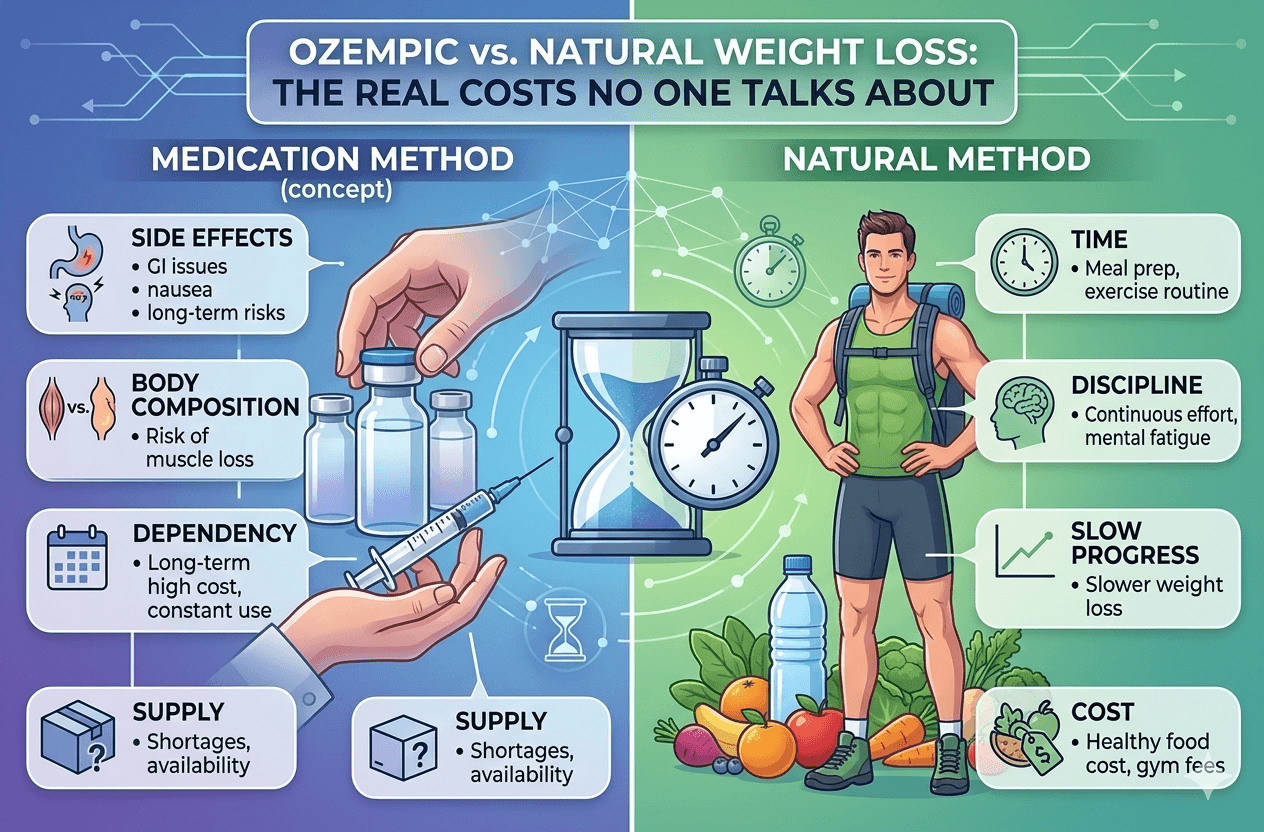
Ozempic vs. Natural Weight Loss: The Hidden Cosmetic Cost

Medical Disclaimer: The information provided in this article is for educational purposes only and does not constitute medical advice. Weight loss medications like GLP-1 receptor agonists have significant metabolic effects and should only be used under the supervision of a licensed healthcare provider.
Ozempic can shrink your body — but it might age your face 10 years. Here's what no one tells you.
If you've been scrolling through before-and-after photos of people who've lost dramatic amounts of weight on semaglutide drugs like Ozempic or Wegovy, you've probably noticed something strange. The bodies look transformed. But the faces? Sometimes they look hollowed out, gaunt, older — like someone pressed fast-forward on the aging clock.
This isn't a fringe observation whispered in online forums. Dermatologists, plastic surgeons, and cosmetic physicians have given it a clinical nickname: Ozempic face.
For the millions of adults between 30 and 55 who are seriously considering GLP-1 receptor agonists as a weight loss solution, this is not a vanity footnote. It's a real, measurable physical consequence that deserves a seat at the decision-making table — right next to blood sugar levels, cardiovascular risk, and the cost per injection.
This article breaks down exactly what Ozempic face is, why it happens, how natural weight loss compares, and what the true cosmetic costs look like once the weight is gone.
ACT 1: What 'Ozempic Face' Actually Is — And Why It Happens
The Science of Fat and Facial Aging
Your face is not just skin draped over bone. It is a complex, layered architecture of fat compartments, ligaments, muscle, and collagen. As you age naturally, these fat pads — particularly in the cheeks, under the eyes, and around the temples — gradually deflate and descend. This is why faces look fuller and more youthful in your 20s and progressively hollower as you move into your 40s and 50s.
When you lose weight rapidly, your body doesn't selectively pull fat from your waistline while politely leaving your face alone. Fat loss is systemic. Facial fat, particularly the subcutaneous fat that gives your cheeks their lift and your under-eye area its smooth transition, gets depleted along with everything else.
The problem with Ozempic and similar GLP-1 drugs is the speed at which this happens.
Why Speed Is the Enemy of Your Face
Clinical trials for semaglutide (the active ingredient in Ozempic and Wegovy) show an average weight loss of 15–20% of total body weight over 68 weeks. That is significant — and for many people with obesity-related health conditions, it's genuinely life-changing. But losing 30, 40, or 50 pounds in under a year is a pace that the skin and soft tissue of your face simply cannot adapt to gracefully.
Here is what happens physiologically during rapid, drug-induced weight loss:
- Collagen synthesis lags behind: Collagen is the protein responsible for skin's firmness and elasticity. When fat beneath the skin disappears faster than collagen can tighten or reposition, the skin sags.
- Facial fat deflates unevenly: The buccal fat pad (mid-cheek), malar fat pad (under the eyes), and temporal fat all shrink rapidly. The result is a skeletonized appearance—sharp cheekbones, sunken temples, and deepened nasolabial folds.
- Muscle mass is depleted: GLP-1 drugs reduce appetite dramatically, but they don't distinguish between fat and muscle. According to research highlighted by the National Institutes of Health (NIH), a significant percentage of weight lost on semaglutide may be lean muscle mass. Less muscle means less structural support for overlying facial tissue.
- Skin elasticity fails to retract: In younger patients, skin has enough recoil to snap back somewhat. In patients 40 and older — the exact demographic most likely to be prescribed these drugs — skin laxity is already naturally declining. Rapid deflation leaves visible loose skin and deepened wrinkles.
The net visual effect? A person who has lost 40 pounds in eight months may look dramatically thinner from the neck down, but noticeably older from the neck up.
ACT 2: How Natural, Slower Weight Loss Preserves What Drugs Destroy
The Case for Gradual Change
Natural weight loss — achieved through a sustained caloric deficit, improved nutrition, and regular exercise — is rarely fast. The Centers for Disease Control and Prevention (CDC) recommends losing 1 to 2 pounds per week for sustainable results. This isn't a flaw in the approach; this measured pace is its greatest cosmetic advantage.
Why Slow Weight Loss Protects Your Appearance
1. Skin Elasticity Has Time to Adapt Skin is living tissue with a remarkable capacity to remodel — but only if given adequate time. When weight loss is gradual, the skin's fibroblasts can keep pace with the reducing volume beneath. The skin contracts progressively, maintaining better tone and texture. Think of it like deflating a balloon slowly versus popping it. Slow deflation leaves the rubber relatively intact; rapid deflation leaves it collapsed and wrinkled.
2. Facial Fat is Partially Preserved The face tends to be more resistant to fat loss during gradual, diet-and-exercise-based weight loss than during drug-assisted rapid loss. Moderate caloric restriction triggers fat loss preferentially from visceral (abdominal) fat stores before heavily attacking subcutaneous facial fat.
3. Muscle Scaffolding is Maintained Resistance training actively helps preserve and build muscle mass, including the muscles of the face and neck. This maintains the structural scaffolding that keeps facial skin from sagging.
4. Optimal Protein for Collagen Synthesis A well-structured natural weight loss plan emphasizes high protein intake (0.7–1 gram per pound of body weight). Protein provides the amino acids necessary for collagen synthesis. In contrast, the dramatically suppressed appetite caused by GLP-1s often leads to severe protein deficiency, starving the skin of the raw materials needed to maintain elasticity.
ACT 3: The Hidden Cosmetic Costs — And the Real Price Tag
What Comes After the Weight Loss
The conversation around weight loss injections almost always focuses on the monthly drug cost and the immediate side effects (nausea, gastroparesis risk). What rarely gets discussed is the cosmetic expenditure that follows.
Dermatologists and plastic surgeons are seeing a massive surge in post-GLP-1 patients seeking corrective treatments to fix their gaunt appearance.
Common Restorative Interventions and Estimated Costs:
- Dermal fillers (Hyaluronic acid): Restores lost cheek volume and hollow under-eyes. (Cost: $600–$2,000 per session; needs repeating every 6–18 months)
- Biostimulators (Sculptra, Radiesse): Stimulates collagen to restore overall facial volume. (Cost: $800–$3,000 per treatment; often requires 2–3 sessions)
- Radiofrequency skin tightening: Addresses skin laxity on the face and neck. (Cost: $1,500–$4,000 per treatment area)
- Surgical interventions (Facelift, neck lift): For patients with significant skin excess. (Cost: $8,000–$25,000+)
For someone who develops significant facial hollowing, the realistic cosmetic restoration bill could easily run $5,000–$15,000 on top of the original drug cost.
The Muscle Loss Problem Has Downstream Consequences
Beyond the face, losing lean muscle mass has severe medical consequences, including:
- A reduced basal metabolic rate, making rapid weight regain highly likely if the drug is discontinued.
- Increased risk of osteoporosis, particularly in women over 40.
- A "skinny fat" body composition, where the scale reads well but body fat percentage remains metabolically unhealthy.
Is Drug-Assisted Weight Loss Ever the Right Choice?
Yes. For individuals with clinically severe obesity (BMI 35+), type 2 diabetes, or serious cardiovascular conditions, the health gains—reduced blood pressure, improved insulin sensitivity—are profound and life-saving.
But for adults considering these drugs primarily for cosmetic or moderate weight loss goals (e.g., losing 15-20 pounds for a wedding), the risk-benefit calculus is very different. The face you see in the mirror after 8 months may be considerably thinner, but considerably older than the one you expected.
Maryland Trim Clinic (MTC) in Laurel, MD
If you are exploring your weight loss options and want a balanced approach that prioritizes both your metabolic health and your physical appearance, professional guidance is essential. The Maryland Trim Clinic (MTC) in Laurel, MD, offers comprehensive care that looks beyond the number on the scale.
Whether you are interested in a structured medical weight loss program that focuses on sustainable fat loss while preserving muscle, or you are exploring medically supervised GLP-1 weight loss injections and want to ensure you are doing so safely, MTC provides the necessary clinical oversight. Their holistic approach often incorporates nutritional counseling and coaching to guarantee you are meeting your protein requirements to protect your collagen and muscle mass. By partnering with the Maryland Trim Clinic, you can achieve your body composition goals without sacrificing your facial volume or long-term metabolic health.
The Bottom Line
GLP-1 medications are remarkable tools for specific populations. But the version of the story being sold on social media — effortless transformation and a slimmer body — is missing crucial chapters. It misses the chapter about the face that looks a decade older, the muscle that disappears along with the fat, and the massive cosmetic bills that arrive six months later.
Natural, supervised weight loss is slower. It requires more discipline. But it gives your skin time to follow your body. It preserves the muscle that keeps your metabolism healthy. Whatever path you choose, make your decision with your eyes fully open — and not just to what the scale will say. Look at your face, too.
Frequently Asked Questions
Q: What exactly is 'Ozempic face' and is it permanent? A: Ozempic face refers to the gaunt, aged, hollowed appearance some people develop after rapid weight loss on GLP-1 drugs. It's caused by accelerated deflation of facial fat combined with collagen and muscle loss. It is not necessarily permanent—volume can be partially restored through dermal fillers or biostimulators. However, significant skin laxity may require surgical correction.
Q: Does everyone who takes weight loss injections develop facial aging? A: No. The risk is significantly higher in adults over 40, those who lose weight very rapidly, those who fail to maintain adequate protein intake, and those who don't strength train. People who lose weight gradually on lower doses while implementing protective nutritional strategies experience far less severe facial volume loss.
Q: How much slower is natural weight loss compared to GLP-1 drugs? A: Clinical trials show GLP-1 users can lose 15–20% of body weight over 68 weeks. Sustainable natural weight loss is typically recommended at 1 to 2 pounds per week. A 40-pound loss might take 16 months on medication, while taking 2 years naturally. That slower natural timeline is a cosmetic advantage for your skin.
Q: Can you take weight loss injections and still minimize the facial aging effect? A: Yes. The most effective strategies include maintaining a high protein diet, performing regular resistance training to preserve muscle, using a slower medication titration schedule, and considering preventive cosmetic interventions (like Sculptra) before dramatic volume loss occurs.
Q: What are the cosmetic costs of fixing rapid weight loss facial deflation? A: Cosmetic restoration can be substantial. Dermal fillers run $600–$2,000 per session. Biostimulators cost $800–$3,000. Radiofrequency skin tightening ranges from $1,500–$4,000. Surgical facelifts can cost $8,000–$25,000+. Patients often spend $5,000–$15,000 on corrective procedures.
Q: Is muscle loss from rapid weight loss medications a significant concern? A: Yes. Research suggests up to 40% of the weight lost on these drugs may be lean muscle mass. This reduces your metabolic rate (making weight regain highly likely if you stop the drug) and increases the risk of osteoporosis and functional weakness.
Q: Are weight loss injections ever the right choice despite these cosmetic risks? A: Absolutely. For individuals with clinically severe obesity, type 2 diabetes, or serious cardiovascular risks, the health benefits of these medications (lower blood pressure, improved insulin sensitivity) substantially outweigh the cosmetic drawbacks.
Ready to Explore Safe Weight Loss Options?
Would you like me to help you draft a list of questions to ask your doctor about preserving muscle mass during your weight loss journey?