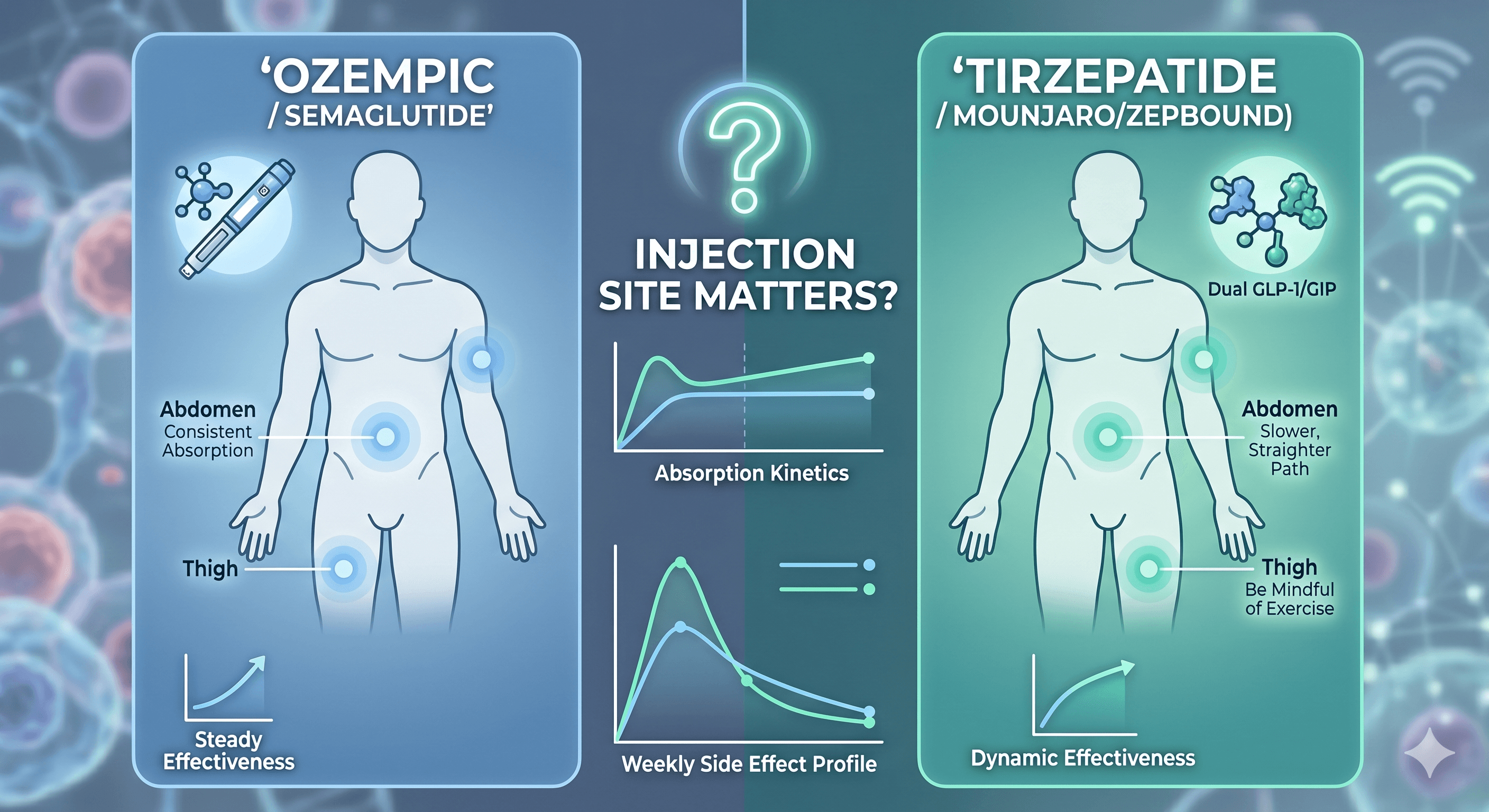
Ozempic vs. Tirzepatide: Does Your Injection Site Matter?

Injecting Tirzepatide the exact same way as Ozempic? You could be unintentionally blunting your results or worsening your side effects without even realizing it.
This is one of the most overlooked challenges among GLP-1 beginners and patients transitioning between semaglutide and tirzepatide. The assumption makes sense on the surface: both are injectable GLP-1 medications, both are delivered under the skin, so the identical technique must work equally well for both.
However, that assumption can cost people progress. The molecular structure, half-life, and absorption kinetics of these two medications differ enough that where and how you inject genuinely matters. The difference can show up on the scale, in your day-to-day appetite control, and in how tolerable your side effects feel from week to week.
Let's break this down properly so you can feel confident in your routine.
Why Absorption Speed Varies Between Semaglutide and Tirzepatide
To understand why your injection site matters differently for each medication, it helps to understand what each drug actually does in the body.
Semaglutide (the active ingredient in Ozempic and Wegovy) is a single GLP-1 receptor agonist. It mimics the naturally occurring glucagon-like peptide-1 hormone, which signals fullness to your brain, slows gastric emptying, and triggers insulin release in response to meals. According to the National Institute of Diabetes and Digestive and Kidney Diseases (NIDDK), these types of medications are designed for long-term weight management alongside lifestyle changes. Semaglutide has a half-life of approximately seven days, which perfectly aligns with its once-weekly dosing schedule.
Tirzepatide (the active ingredient in Mounjaro and Zepbound) operates differently. It is a dual agonist—meaning it activates both GLP-1 receptors and GIP (glucose-dependent insulinotropic polypeptide) receptors simultaneously. This dual-action mechanism is why tirzepatide has shown highly significant average weight loss in clinical trials. It also has a half-life of roughly five days, which is slightly shorter than semaglutide. Because of this, its absorption curve behaves a little differently across the week.
The Role of Subcutaneous Tissue
Both medications are delivered subcutaneously, meaning they are injected into the fatty tissue just beneath the skin. Here is the critical variable: subcutaneous blood flow is not uniform across your body. * High vascularization (more blood flow) / Thinner fat: Absorbs medication faster.
- Lower vascularization / Thicker fat: Absorbs medication more slowly and steadily.
For semaglutide, with its long half-life and very gradual week-long activity curve, the initial speed of absorption matters less. The drug's pharmacokinetics are forgiving; moderate variations between injection sites still produce a fairly consistent blood concentration over time.
Tirzepatide's slightly shorter half-life and dual-receptor mechanism make it marginally more sensitive to absorption rate differences. For example, injecting into a highly vascular area when you are already managing nausea on a new dose can intensify those early side effects. Conversely, injecting into a slower-absorbing area when you need robust, consistent appetite suppression for the week may blunt the drug's early peak effectiveness.
The Takeaway: Neither drug becomes "ineffective" from a suboptimal injection site. But optimizing the site for the specific drug you're on is a simple, zero-cost way to improve your overall experience and comfort.
Stomach vs. Thigh vs. Upper Arm — Pros and Cons for Each Drug
Choosing the right site is about balancing absorption speed with your personal side-effect tolerance.
The Abdomen (Stomach)
The abdomen is the most commonly recommended injection site for both drugs, and for good reason. The subcutaneous tissue here is generally easy to access, consistent in depth, and offers reliable absorption across most body types.
For Semaglutide (Ozempic/Wegovy):
- The Strategy: The abdomen is an excellent primary site. Because of the drug's long half-life, you don't need to worry about a sharp early peak causing immediate nausea.
- Best Practice: Rotate within the abdominal zone, keeping at least two inches away from the navel.
For Tirzepatide (Mounjaro/Zepbound):
- The Strategy: The abdomen is the preferred primary site, particularly for patients prone to nausea on higher doses. The slightly slower and steadier absorption from abdominal fat can soften the drug's initial peak concentration, which is often when nausea hits hardest.
- Best Practice: If you are titrating up to a new dose and side effects are a challenge, leaning toward abdominal injections during those escalation weeks is a clinically sensible strategy.
Quick Summary: Abdomen
- Pros: Easy to self-administer, consistent depth, plenty of surface area for rotation.
- Cons: Can develop scar tissue with over-use. You must avoid areas close to the waistband or belt line where clothing friction occurs.
The Thigh (Anterior/Lateral)
The outer thigh is the second most commonly used injection site. It provides a reliable subcutaneous layer and is very easy to access without assistance.
For Semaglutide:
- The Strategy: The thigh is a perfectly viable rotation site. Absorption is slightly slower here than the abdomen due to lower regional blood flow, but semaglutide's week-long activity curve accommodates this delayed onset effortlessly.
For Tirzepatide:
- The Strategy: The thigh is useful, but beware of physical activity. Exercise dramatically increases blood flow to the legs. If you inject tirzepatide into the thigh and then go for a run or do a heavy leg workout within a few hours, you may experience faster absorption. This can lead to a sharper concentration peak and a stronger-than-expected wave of nausea or fatigue.
- Best Practice: Avoid thigh injections on days when moderate-to-intense lower-body activity is planned within 4–6 hours post-injection.
Quick Summary: Thigh
- Pros: Great for site rotation, easy to reach, moderate absorption speed.
- Cons: Exercise-related absorption spikes for tirzepatide; the thigh muscle is closer to the surface in leaner patients, increasing the risk of an accidental intramuscular injection if your technique is rushed.
The Upper Arm (Posterior/Lateral)
The back of the upper arm (the tricep region) is the third approved site. It's commonly used in clinical settings but requires a bit more flexibility or a mirror to self-administer at home.
For Semaglutide:
- The Strategy: A reliable third rotation site. Absorption is broadly comparable to the abdomen, though individual variation is higher due to differences in arm fat distribution. Great for giving your stomach or thighs a rest.
For Tirzepatide:
- The Strategy: Generally well-tolerated and a solid option to minimize nausea. Because arm subcutaneous tissue tends to be thinner, there is a slightly higher risk of accidentally injecting too shallowly (into the dermis) or too deeply (into the muscle).
- Best Practice: Pinching the skin firmly before injection is crucial here.
Quick Summary: Upper Arm
- Pros: Excellent rotation option, comparable absorption to the abdomen.
- Cons: Harder to self-administer without practice; requires careful "pinching" technique; not ideal for very lean patients.
Step-by-Step Injection Protocol to Maximize GLP-1 Effectiveness
Regardless of your prescribed medication, a consistent injection protocol protects the quality of absorption, minimizes side effects, and prevents skin complications over the long term. The Centers for Disease Control and Prevention (CDC) emphasizes that proper injection hygiene is crucial for preventing site infections.
Universal Preparation Steps
Warm the pen: Remove the medication from the refrigerator 30 minutes before injection. Cold medication injected directly from the fridge increases stinging and may momentarily affect local absorption.
Wash up: Wash hands thoroughly with soap and water for a minimum of 20 seconds.
Sanitize the site: Clean the chosen injection site with an alcohol swab and allow it to dry completely. Injecting through wet alcohol causes unnecessary stinging and skin irritation.
Inspect the medication: Check that the liquid inside the pen is clear, colorless, and free of particles. Do not use it if it appears cloudy or discolored.
Drug-Specific Injection Steps
For Semaglutide (Ozempic/Wegovy)
Select your site: Abdomen (preferred), thigh, or upper arm.
Prep the skin: Pinch a skin fold lightly if administering to a leaner site (not always necessary for the abdomen).
Inject: Insert the pen needle at a 90-degree angle and press the dose button firmly.
Hold: Hold the pen in place for 6 seconds after pressing the button. Semaglutide has a higher viscosity formulation; this hold ensures the full dose is delivered.
Finish: Withdraw the needle. Do not rub the site, as this can accelerate local absorption and increase bruising. Dispose of the needle safely in a sharps container.
For Tirzepatide (Mounjaro/Zepbound)
Select your site strategically: During titration weeks (dose increases), favor the abdomen to reduce nausea risk. Once stable, rotate freely. Avoid the thigh on heavy exercise days.
Prep the skin: Pinch the skin firmly before inserting, especially on the upper arm or thigh.
Inject: Insert at a 90-degree angle and press the button until it clicks.
Hold: Hold for 10 seconds before withdrawing. Tirzepatide's auto-injector design benefits from a longer hold to confirm complete delivery.
Finish: Withdraw and do not rub the site.
Log it: Note the injection date and site in a journal or phone app to ensure proper rotation.
Rotation Strategy: The Four-Zone Method
A sustainable rotation strategy prevents lipohypertrophy (scar tissue buildup) and maintains consistent absorption. Try dividing your body into four zones:
- Zone 1: Left abdomen
- Zone 2: Right abdomen
- Zone 3: Left thigh or Left upper arm
- Zone 4: Right thigh or Right upper arm
Rotate sequentially week to week. Within each zone, vary the exact spot slightly each cycle. This gives any previously used skin roughly four weeks to fully recover.
Red Flags to Watch
- Hardened Tissue: Lumpy areas under the skin signal lipohypertrophy. Avoid these spots immediately, as medication will not absorb properly through scar tissue.
- Site Reactions: Persistent redness, warmth, or swelling beyond 24 hours post-injection may indicate an allergic reaction or infection. Contact your healthcare provider.
- Mid-Week Hunger: Consistently poor appetite suppression mid-week may simply be a sign of suboptimal injection technique or site selection—not necessarily a need for a higher dose.
Medical Disclaimer: The information provided in this article is for educational purposes only and does not substitute for professional medical advice. Always consult your prescribing physician or healthcare provider regarding injection techniques, dose adjustments, and the management of side effects. Individual results with GLP-1 medications vary.
Maryland Trim Clinic (MTC) in Laurel, MD
Embarking on a weight management journey involves more than just picking up a prescription. Having a supportive, medically supervised environment can make a significant difference in how you tolerate medications and achieve your goals. For patients in the DMV area, Maryland Trim Clinic provides personalized, compassionate care out of their Laurel, MD office.
A structured medical weight loss program ensures that your progress is monitored safely and effectively. The clinical team at MTC understands the nuances of modern obesity treatments, offering dedicated guidance on GLP-1 weight loss injections to help you manage side effects like nausea while optimizing your weekly dosing. Because weight loss changes your body composition, the clinic also offers advanced 3D body scanning to track your physical transformations beyond what the scale shows, ensuring your plan is genuinely working for your unique biology.
Frequently Asked Questions
Q: Can I inject tirzepatide and semaglutide in exactly the same spots?
A: Yes, the same three general sites—abdomen, thigh, and upper arm—are approved for both drugs. However, tirzepatide users should be more strategic, favoring the abdomen during dose titration weeks and avoiding thigh injections right before intense lower body exercise to prevent nausea spikes.
Q: Does the injection site actually affect how well the drug works?
A: Yes, to a meaningful degree. Subcutaneous blood flow differs across your body. For tirzepatide in particular, faster absorption from a highly vascular site can intensify early side effects, while slower absorption from thicker fat can reduce the drug's peak effectiveness early in the week.
Q: How long should I hold the pen in place after injecting?
A: For semaglutide pens (Ozempic/Wegovy), hold for at least 6 seconds after pressing the dose button. For tirzepatide pens (Mounjaro/Zepbound), hold for at least 10 seconds. This guarantees the full dose makes it into your tissue.
Q: What is lipohypertrophy and how do I prevent it?
A: Lipohypertrophy is the formation of lumpy, hardened scar tissue under the skin from repeatedly injecting the exact same spot. It is easily preventable by using the Four-Zone Method—rotating sites consistently and giving each area roughly four weeks to recover between uses.
Q: Should I inject tirzepatide in the abdomen if I'm experiencing a lot of nausea?
A: Yes. Abdominal injections are generally recommended during tirzepatide dose escalation because abdominal fat produces a slightly slower, more gradual absorption curve. This softens the drug's early concentration peak, which is when nausea typically hits.
Q: Can I inject in the same site as last week if I rotate within that zone?
A: You should always vary the exact spot, even when returning to a general zone. For example, if you injected on the left side of your abdomen last week, move the needle at least one to two inches away from that exact puncture mark this week.
Q: Why should I take the pen out of the refrigerator before injecting?
A: Cold medication causes sharper stinging at the injection site and can temporarily shock local absorption. Letting the pen reach room temperature for 30 minutes makes the process significantly more comfortable.
Q: I'm switching from Ozempic to Mounjaro. Do I need to change my entire injection routine?
A: Not entirely, but you should make a few adjustments. Keep your rotation approach, but be much more deliberate about site selection during your first few weeks on tirzepatide. Favor your abdomen during titration, avoid the thigh before workouts, and remember to extend your needle hold time from 6 seconds up to 10 seconds.
Ready to Optimize Your Weight Management Journey?
Navigating GLP-1 medications can feel overwhelming, but you don’t have to do it alone. Reach out to a qualified healthcare provider to build a personalized plan that addresses your unique metabolic needs, helps manage side effects, and keeps you on track toward your wellness goals safely and effectively.