Best Peptide Skincare for Mature Skin (Ranked & Reviewed)

Medical Disclaimer: The information provided in this article is for educational and informational purposes only. It is not intended as medical advice. Always consult with a board-certified dermatologist or healthcare provider before starting new skincare regimens, especially if you have sensitive skin or underlying dermatological conditions.
Not all peptide serums are equal, and most won't do anything for mature skin unless they contain specific, clinically backed compounds.
If you've ever spent $80 on a serum that promised to "visibly reduce fine lines" and felt absolutely nothing after 12 weeks of faithful use, you're not imagining things. The peptide skincare market is one of the most oversaturated corners of the beauty industry. The gap between a product that genuinely works and one that merely sounds impressive on a shelf is almost impossible to detect with the naked eye.
For women over 40, that gap is especially costly. Mature skin has specific, well-documented structural needs that generic, low-concentration peptide blends simply don't address.
This guide cuts through the noise. We're breaking down the best peptide skincare for mature skin based on formulation science, ingredient transparency, and real evidence, not influencer endorsements or elegant packaging.
ACT 1: The Peptide Hierarchy — Which Compounds Actually Work on Mature Skin
Before you can evaluate a single product, you need to understand that "peptides" is not a monolithic category. There are hundreds of peptide compounds used in cosmetic formulations, and they do not all perform the same function.
For mature skin specifically — skin that has experienced decades of collagen depletion, reduced cellular turnover, and cumulative UV damage — only a handful of peptide classes have robust evidence behind them.
Matrixyl 3000: The Gold Standard
Matrixyl 3000 is not a single peptide. It's a trademarked combination of two distinct peptides: palmitoyl tripeptide-1 and palmitoyl tetrapeptide-7. Together, they operate as what researchers call "matrikines." These are tiny fragments that signal to your fibroblasts (your skin's collagen-producing factory cells) that the extracellular matrix has been damaged and urgently needs repair.
In practice, Matrixyl 3000 doesn't just temporarily mask the appearance of wrinkles; it triggers the skin to produce more collagen and elastin from within. According to research indexed by the National Institutes of Health (NIH), collagen production declines by roughly 1% per year after our mid-twenties. Triggering native collagen synthesis is one of the most effective ways to support aging skin.
- What to look for: Palmitoyl tripeptide-1 and palmitoyl tetrapeptide-7 should both appear in the ingredient list. If only one is present, you're only getting half the documented benefit.
Argireline: The Topical Botox Conversation
Argireline (acetyl hexapeptide-3 or acetyl hexapeptide-8) is frequently marketed as a "natural alternative to Botox." This claim deserves some nuance. Argireline works by inhibiting the release of neurotransmitters at the neuromuscular junction — the same basic mechanism as botulinum toxin, but at a vastly smaller scale and without an injection.
Clinically, Argireline has been shown to visibly reduce the depth of expression lines, particularly around the eyes and forehead. This makes it genuinely useful for mature skin, where dynamic wrinkles (caused by repeated muscle movement) have had decades to etch themselves into the dermis.
- The catch: Concentration matters enormously. Below 5%, Argireline has a negligible effect. Effective products will either disclose their percentage (look for 5–10%) or come from clinical-grade brands known for active-level formulations.
Leuphasyl: Argireline's Synergistic Partner
Less well-known but increasingly important in advanced formulations, Leuphasyl (pentapeptide-18) works through a different but complementary mechanism to Argireline. While Argireline blocks the protein complex involved in muscle contraction, Leuphasyl acts on enkephalin receptors to reduce the signal that initiates the contraction in the first place.
When used together, Argireline and Leuphasyl create a powerful synergy, significantly reducing wrinkle depth more than either compound alone. If you're evaluating a product specifically for expression-line reduction, look for both acetyl hexapeptide-3 and pentapeptide-18 in the same formula.
ACT 2: Why Korean Peptide Formulations Are Outperforming Western Brands
This isn't a matter of cultural preference — it's a fundamental formulation philosophy difference that has measurable consequences on your skin's appearance.
The Layering Architecture Advantage
Korean skincare is built on a multi-step layering system. This matters for peptides because their efficacy is dramatically affected by the delivery environment. Many high-molecular-weight peptides cannot penetrate the stratum corneum (the outermost skin layer) without help. They need a carrier system, a penetration-enhancing base, or a properly structured routine.
Korean formulations routinely address this by pairing peptide ampoules with essence layers designed to optimize skin pH and hydration levels before the active ingredient is applied.
Standout Korean Peptide Frameworks for Mature Skin
If you are looking to integrate K-beauty principles, look for these types of formulations:
- Hydration-Peptide Pairings: Products like COSRX Advanced Snail 96 Mucin Power Essence increasingly integrate oligopeptide-1 (EGF) alongside hydrating factors, creating a base layer that supports the absorption of subsequent actives.
- Retinol-Peptide Synergies: Formulations like Some By Mi Retinol Intense Reactivating Serum pair retinol with palmitoyl tripeptide-1 to minimize irritation while amplifying collagen signaling—perfect for mature skin that finds standalone retinol too harsh.
- Concentrated Ampoules: Products like Mediheal N.M.F Peptide Tox Ampoule often utilize the Argireline/Leuphasyl pairing. The ampoule format ensures a higher active concentration than standard watered-down serums.
- Soothing Peptide Blends: Formulas combining peptides with anti-inflammatories like centella asiatica help reduce the oxidative stress that degrades peptide activity before it reaches target cells.
The Transparency Gap
South Korea has incredibly strict labeling requirements for cosmetic actives, meaning Korean brands are generally more accustomed to disclosing actual concentration ranges. Western luxury brands frequently hide behind "proprietary blend" designations, making it essentially impossible to verify if you are getting an effective dose of peptides.
ACT 3: How to Read an Ingredient Label and Verify Peptide Concentration Is Actually Effective
Even with the best product recommendations, the ingredient label remains your most important tool. Unfortunately, most consumers read them incorrectly.
The INCI Order Rule
As mandated by organizations like the U.S. Food and Drug Administration (FDA), cosmetic ingredients must be listed in descending order of predominance. This means the first ingredient is present in the highest amount, and the last is present in the smallest amount.
The Preservative Benchmark: Preservatives like phenoxyethanol or sodium benzoate are almost always used at concentrations of 0.5–1%. If your target peptide appears after these preservatives in the ingredient list, it is likely present at a sub-effective concentration. A genuinely active-level formulation will list its primary peptides before or right alongside the preservatives.
The Carrier System Checklist
A peptide is useless if it can't reach the dermis. Look for one or more of these penetration-enhancing carriers in the formula:
- Liposomal delivery systems: Often indicated by "liposome" or "lecithin" in the ingredient list.
- Palmitoyl conjugation: The "palmitoyl" prefix (e.g., palmitoyl tripeptide-1) indicates a fatty acid chain that improves skin permeability.
- Niacinamide (2–5%): Supports barrier function and improves transit.
- Co-solvents: Ingredients like butylene glycol or propylene glycol.
Red Flags to Reject Immediately
- "Peptide complex" without INCI names: This is a marketing term, not a scientific disclosure.
- Fragrance appearing before peptides: Fragrance is typically used at 0.5–2%. If it precedes your target peptide, the peptide is merely a decoration.
- Alkaline pH: Most peptides are most stable at a slightly acidic pH (4.5–6.5).
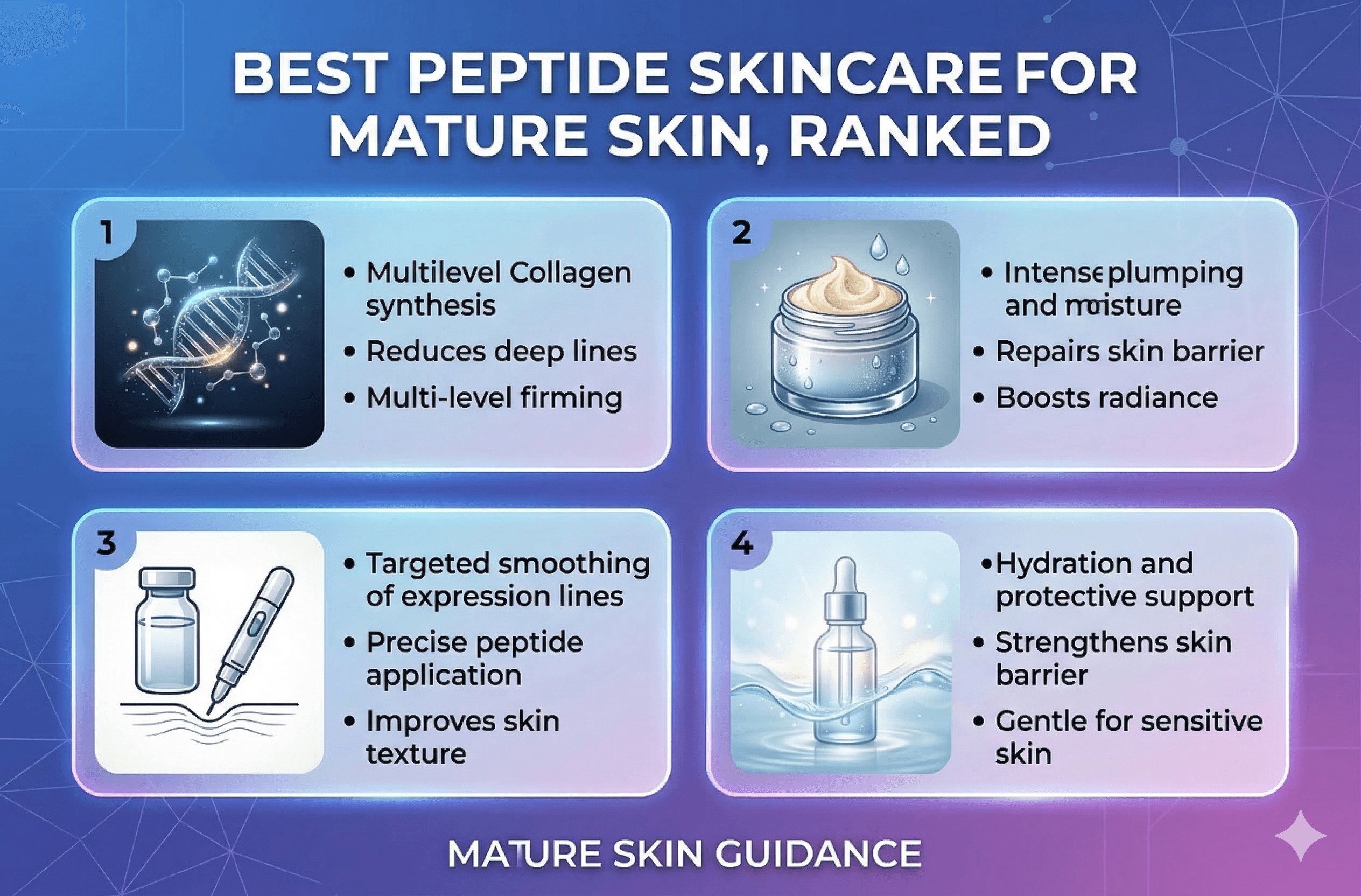
Quick Reference: Final Rankings Summary for Mature Skin
Instead of guessing at the cosmetic counter, use this quick hierarchy to prioritize your purchases:
- Priority 1: Matrixyl 3000 (palmitoyl tripeptide-1 + palmitoyl tetrapeptide-7)
- Primary Benefit: Collagen synthesis stimulation.
- Look For: Both peptides listed before preservatives.
- Priority 2: Argireline (acetyl hexapeptide-3/8)
- Primary Benefit: Expression line reduction.
- Look For: 5–10% concentration or a clearly disclosed active range.
- Priority 3: Leuphasyl (pentapeptide-18)
- Primary Benefit: Synergistic muscle-signal reduction.
- Look For: Paired alongside Argireline for maximum effect.
- Priority 4: Copper peptides (GHK-Cu)
- Primary Benefit: Wound healing and structural remodeling.
- Look For: Blue-tinted formulas, listed in the first half of the INCI list.
Maryland Trim Clinic (MTC) in Laurel, MD
While a highly optimized topical peptide routine can work wonders for skin texture, hydration, and fine lines, creams and serums eventually reach their biological limits. When mature skin begins to experience significant volume loss, deeper tissue laxity, or systemic changes brought on by menopause, clinical interventions provide the structural support that topicals simply cannot.
If you are looking for advanced, medical-grade support, the Maryland Trim Clinic (MTC) in Laurel, MD, offers comprehensive aesthetic and wellness care. To address sagging or deeper wrinkles without going under the knife, MTC provides highly effective non-surgical skin tightening treatments designed to stimulate deep collagen production. Furthermore, because skin health is deeply tied to our internal chemistry, exploring hormone replacement therapy can address the root cause of age-related collagen decline. Taking a whole-body approach with a trusted Maryland Trim Clinic provider ensures your skin is supported both from the outside in and the inside out.
Frequently Asked Questions
Q: What is the most effective peptide for mature skin over 40? A: Matrixyl 3000 — a combination of palmitoyl tripeptide-1 and palmitoyl tetrapeptide-7 — has the strongest clinical evidence for stimulating collagen production in mature skin. It works by sending repair signals to fibroblasts, triggering new collagen synthesis from within the dermis rather than just temporarily filling the appearance of wrinkles.
Q: How do I know if a peptide serum has enough concentration to actually work? A: Check where the peptide appears in the INCI ingredient list. If your target peptide appears after preservatives like phenoxyethanol (which are usually capped around 1%), the peptide is likely at sub-effective levels. Effective formulations disclose specific INCI names and often publish concentration percentages.
Q: Can I use Argireline every day on mature skin? A: Yes, Argireline (acetyl hexapeptide-3 or hexapeptide-8) is well-tolerated for daily use at concentrations up to 10%. It does not cause the photosensitivity associated with retinol and can be used morning or evening. Consistency over at least 30 days is required before wrinkle depth reduction becomes truly visible.
Q: Why are Korean peptide skincare products often considered better than Western brands? A: Korean skincare formulations tend to outperform Western equivalents due to a multi-layered application philosophy that optimizes skin pH and hydration before applying actives, greatly improving peptide penetration. Furthermore, strict regulatory standards often result in better ingredient transparency.
Q: What is the difference between Argireline and Leuphasyl, and do I need both? A: Argireline blocks the protein complex to reduce muscle contraction, while Leuphasyl targets receptors to reduce the nerve signal that initiates the contraction in the first place. Because they work at different points in the same pathway, combined use has been shown to reduce wrinkle depth significantly more than either ingredient alone.
Q: At what age should women start using peptide skincare? A: Peptide skincare is beneficial starting in the mid-to-late 20s when natural collagen synthesis begins its gradual decline. However, it becomes essential after 40, when that decline accelerates and the skin has less capacity for self-repair.
Ready to Upgrade Your Skincare Routine?
Would you like me to help you build a customized morning and evening skincare checklist incorporating these proven peptides?