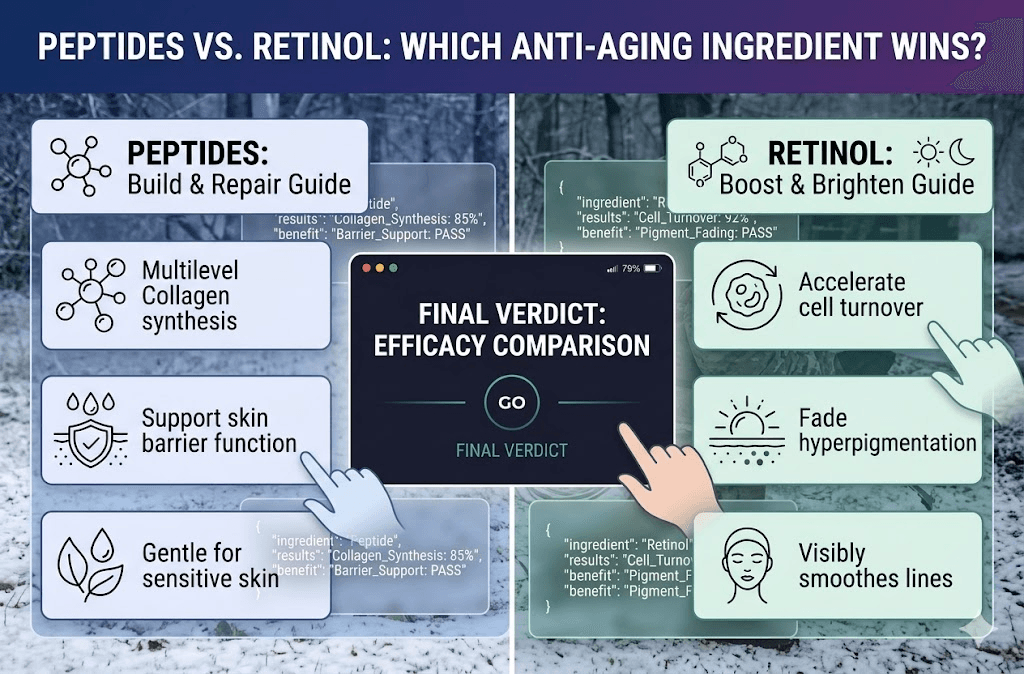
Peptides vs. Retinol: Which Anti-Aging Ingredient Wins?

If you've ever stood in the skincare aisle (or scrolled endlessly through online reviews) wondering whether to grab the retinol serum or the peptide moisturizer, you're not alone. The anti-aging market is saturated with complex chemical names and miraculous claims, leading most people to choose their products based on what is currently trending rather than what their skin actually needs.
That fundamental disconnect between marketing hype and biological reality is the real problem. This breakdown will fix it, giving you a clear, evidence-based understanding of how these two powerhouse ingredients operate so you can make the smartest choice for your skin.
Two Ingredients, Two Completely Different Strategies
To understand which ingredient is best for you, you first need to understand how they interact with your biology. They may share the same ultimate goal—smoother, firmer, younger-looking skin—but they take completely different roads to get there.
The Retinol Approach: Forced Renewal
Retinol is a derivative of Vitamin A. According to decades of dermatological research, including comprehensive reviews published by the National Institutes of Health (NIH), topical retinoids work by penetrating the skin and physically binding to cellular receptors.
This forces your skin to change its behavior. It drastically accelerates cell turnover, signals your fibroblasts to produce more structural collagen, and helps fade deep-set pigmentation.
The results are exceptionally well-documented and often dramatic. However, so are the side effects. Because retinol is actively forcing cellular turnover, it frequently causes a disrupted skin barrier. Redness, flaking, peeling, and prolonged sensitivity — commonly called the "retinol uglies" or the adjustment period — are real hurdles, especially for first-time users.
The Peptide Approach: Gentle Communication
Peptides take a much quieter, more diplomatic approach. Peptides are short chains of amino acids, which are the literal building blocks of essential proteins like collagen, elastin, and keratin.
Applied topically, specific peptides function as chemical messengers. When collagen breaks down naturally with age, it releases tiny peptide fragments. Applying peptide serums effectively "tricks" your skin into thinking it has recently lost collagen, signaling it to produce more.
They don't force the process; they request it. That makes them significantly gentler, with virtually no irritation risk for most skin types.
The Quick Analogy:
- Retinol is like an aggressive personal trainer demanding you do 50 pushups right now. It gets results, but you're going to be sore tomorrow.
- Peptides are like a skilled nutritionist, quietly giving your body the exact building blocks and signals it needs to rebuild itself organically over time without the strain.
Who Should Prioritize What
There is no "one size fits all" in skincare. Your choice should be dictated by your skin's current resilience, your age, and your tolerance for potential irritation.
The Retinol Profile
Choose retinol as your primary active if:
- You want maximum efficacy: You are in your late 20s to 40s and noticing early fine lines, uneven skin tone, or texture issues.
- You have resilient skin: Your skin tolerates active ingredients well without significant redness or reactivity.
- You can commit to the process: You are willing to slowly build up your tolerance and deal with a few weeks of potential flaking to achieve faster, more visible, clinically proven results.
The Peptide Profile
Choose peptides as your primary active if:
- You have a compromised barrier: You have sensitive, reactive, or rosacea-prone skin that simply cannot handle harsh actives.
- You are a beginner: You want to dip your toes into anti-aging skincare without the risk of a harsh, painful reaction.
- You are dealing with mature, fragile skin: If you are 50+ and your skin barrier is already thinning and dry, aggressive retinol can sometimes worsen fragility. Peptides offer structural support without the stripping effect.
- You are pregnant or breastfeeding: High-dose Vitamin A derivatives (retinoids) are generally strictly contraindicated during pregnancy due to the risk of systemic absorption. Peptides are widely considered a safe, effective alternative.
Quick Swap Framework:
- If you feel excessive stinging from your nighttime routine → Try swapping your retinol for a soothing copper peptide serum → Avoid pushing through the pain, which leads to barrier damage.
Can You Use Both? Yes — But With Rules
Retinol and peptides are not enemies. In fact, when used correctly, they are the ultimate complementary pair. Retinol drives aggressive cellular renewal, while peptides reinforce collagen rebuilding and actively repair the moisture barrier that retinol tends to stress. Together, they target aging from two directions at once.
However, you have to layer them strategically to avoid deactivating the ingredients or overwhelming your skin.
The Ideal Layering Framework:
Divide by Time of Day: Use your peptides in the morning under your sunscreen. Use your retinol strictly at night, as Vitamin A is photosensitive and degrades when exposed to UV light.
The "Buffer" Method: If you want to use them in the same nighttime routine, apply your retinol to clean, dry skin. Wait 15 minutes for it to fully absorb, and then apply a rich, peptide-infused moisturizer on top. This acts as a calming barrier that seals in hydration and provides building blocks for overnight repair.
The Acid Warning: Avoid mixing peptides with strong direct acids (like AHAs, BHAs, or high-strength Vitamin C/Ascorbic Acid) in the same exact step. According to molecular research featured by the National Institutes of Health (NIH), low-pH environments can break down peptide chains before they can penetrate the skin, effectively neutralizing their benefit.
Maryland Trim Clinic (MTC) in Laurel, MD
While topical ingredients like retinol and peptides are the absolute foundation of a good skincare routine, they can only penetrate so far. Aging is a whole-body process, and treating it often requires looking beneath the surface of the skin.
For those seeking comprehensive, medically supervised anti-aging and wellness support, the Maryland Trim Clinic (MTC) in Laurel, MD, offers customized solutions. When topical creams aren't enough to address deeper structural volume loss or systemic changes, a trusted clinic in Laurel, MD, like MTC, can support your journey from the inside out.
For example, declining estrogen levels dramatically reduce natural collagen production; medically supervised hormone replacement therapy can help address these root causes of skin thinning and elasticity loss. Additionally, if you are looking for more dramatic aesthetic results to complement your skincare routine, exploring non-surgical skin tightening can stimulate collagen in the deep dermal layers that your serums simply cannot reach. By combining high-quality at-home skincare with clinical treatments, you can achieve a truly comprehensive anti-aging strategy.
The Verdict
There is no universal winner — only the right ingredient for your skin's current needs and specific tolerance levels.
Retinol delivers faster, more aggressive, and deeply studied results, but it demands patience and care through an inevitable irritation phase. Peptides are the ultimate long-game players — consistent, incredibly gentle, hydrating, and compatible with almost every skin type and routine.
- For Beginners and Sensitive Skin: Start with peptides to build strength.
- For Resilient Skin Seeking Accelerated Change: Lean on retinol as your heavy hitter, and use peptides as your daily support system.
- For Everyone: Stop choosing based on viral trends. Your skin's actual tolerance, your age, and the health of your moisture barrier are infinitely better guides than a popular TikTok video.
Both are legitimate, scientifically backed anti-aging heavyweights. The real win isn't picking a side — it's knowing which one your skin is ready to handle right now.
Frequently Asked Questions
Q: Can beginners use retinol, or should they always start with peptides? A: Beginners can absolutely use retinol, but it requires a highly careful, low-concentration start (0.025%–0.05%) and slow frequency — applying it just two to three nights per week at most, followed by heavy moisturization. However, peptides are genuinely the lower-risk starting point. They deliver meaningful anti-aging benefits without the dreaded adjustment period, making them ideal for anyone new to active ingredients who wants structural results without the learning curve.
Q: How long does it take to see results from peptides compared to retinol? A: Retinol typically shows noticeable skin texture improvement and a brighter complexion within 4–8 weeks, with full collagen-remodeling and line-smoothing results peaking at 3–6 months. Peptides work much more gradually. Most users begin to see improvements in overall firmness, bounce, and hydration around the 8–12 week mark of consistent daily use. Retinol tends to be faster, but peptides offer results without the downtime of red, flaky skin.
Q: Is it safe to use retinol and peptides in the same routine? A: Yes — and it can actually be incredibly beneficial for your skin barrier. The key is timing and proper layering. You can use retinol at night as your active treatment, and apply peptides in the morning. Alternatively, you can apply a calming, peptide-rich moisturizer after your nighttime retinol has fully absorbed to help mitigate irritation. Just avoid applying peptides simultaneously with highly acidic products (like glycolic acid), as acidic environments break down delicate peptide chains.
Q: Are peptides effective enough to replace retinol entirely? A: For sensitive, mature, rosacea-prone, or pregnant skin — yes, peptides can serve as a complete retinol alternative and are often the much smarter, safer choice. For those seeking the absolute most clinically validated speed of results in wrinkle reduction and dark spot correction, retinol still holds the edge. That said, peptides are not a weak substitute; they are a genuinely powerful class of ingredients that work through a different, equally valid biological pathway.
Ready to Optimize Your Anti-Aging Strategy?
Would you like me to help you map out a customized, step-by-step morning and evening skincare routine that safely incorporates both peptides and your preferred retinol?