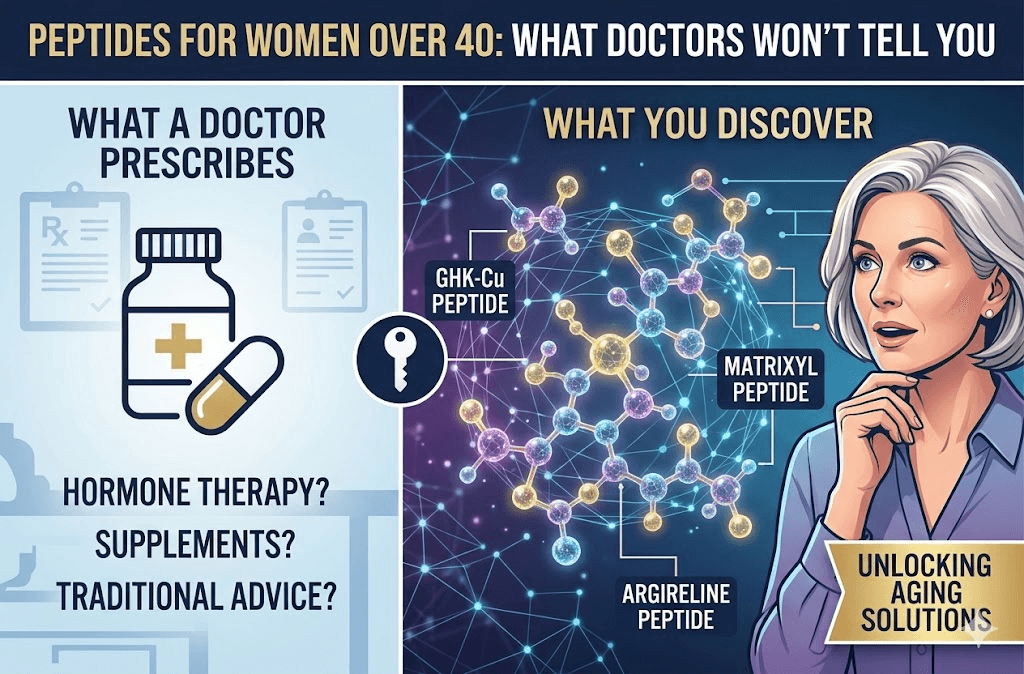
Peptides for Women Over 40: What Doctors Won't Tell You

A top peptide doctor is warning women over 40 about the compounds they're taking — here's what she said.
The wellness world has officially gone peptide-crazy. Walk through any anti-aging clinic, scroll through a biohacking forum, or open a health-focused Instagram account, and you will be flooded with promises: faster recovery, tighter skin, deeper sleep, and a metabolism that feels like you're 30 again.
And the demographic being most aggressively marketed to? Women over 40.
This is precisely the group that is the most hormonally complex and, therefore, the most at risk when these protocols go wrong.
The problem isn't that peptides are universally dangerous. Many have legitimate, evidence-supported applications. The problem is the massive gap between how they are sold online and how they actually work inside a female body navigating perimenopause or menopause. That gap is where women are getting hurt—sometimes subtly, sometimes seriously.
So, what do peptide-literate clinicians actually want women over 40 to know before they inject, capsule, or nasal-spray their way into a new protocol? Let's break it down.
ACT 1: The Peptides Most Commonly Misused by Women in Midlife — and Why
Not all peptides carry the same risk profile. However, there are four specific compounds that consistently show up in clinical conversations as sources of harm or deep disappointment for women in midlife.
1. BPC-157 (Body Protection Compound-157)
BPC-157 is arguably the most popular peptide in wellness circles right now. Originally studied for gut healing and tissue repair in animal models, it has been enthusiastically adopted by women seeking relief from leaky gut, joint pain, and systemic inflammation. The appeal is understandable, and some early data is genuinely promising.
- The Misuse Pattern: Women are sourcing it from unregulated online vendors and self-administering it without any evaluation of their underlying gut microbiome or autoimmune history. In women over 40, autoimmune conditions (like Hashimoto's thyroiditis, lupus, or rheumatoid arthritis) are significantly more prevalent. Introducing a powerful immunomodulatory compound without clinical oversight is a massive gamble. Furthermore, the human clinical trial data for BPC-157 remains extremely limited.
2. CJC-1295 / Ipamorelin (Growth Hormone Secretagogues)
This combination stack is the absolute darling of the anti-aging space. CJC-1295 is a growth hormone-releasing hormone (GHRH) analogue; Ipamorelin is a peptide that stimulates the pituitary gland to produce and release more growth hormone (GH). Sounds perfect for women over 40 watching their muscle mass decline and belly fat accumulate, right?
- The Misuse Pattern: Women are using these without measuring their baseline IGF-1 levels, without ruling out insulin resistance, and without understanding that elevated IGF-1 has a highly complex relationship with hormone-sensitive cancers. For women with a personal or family history of breast cancer, or those currently navigating estrogen-dominant conditions like fibroids, aggressively stimulating the GH/IGF-1 axis is a conversation that must happen with an oncology-aware clinician.
3. PT-141 (Bremelanotide)
PT-141 is prescribed for hypoactive sexual desire disorder (HSDD), and it actually has full FDA approval for women under the brand name Vyleesi. That makes it one of the most legitimately prescribed peptides on this list. The issue? Women are bypassing pharmacies, sourcing grey-market versions, and using them at frequencies far beyond what is clinically studied.
- The Misuse Pattern: Nausea, severe hyperpigmentation, and acute blood pressure spikes are well-documented side effects. Women with cardiovascular risk factors—which increase meaningfully post-menopause—need to be exceptionally cautious.
4. AOD-9604
Marketed aggressively as a "miracle fat-loss peptide," AOD-9604 is a modified fragment of the human growth hormone molecule. It is not FDA-approved, it failed its pivotal clinical trials for weight loss in humans, and it is currently sold via legal loopholes as a "research chemical."
- The Misuse Pattern: Beyond the glaring lack of human efficacy data, the sourcing problem is acute. Without pharmaceutical-grade manufacturing standards, purity and dosing accuracy cannot be guaranteed. Women are injecting unknown substances into their bodies based on TikTok trends.
ACT 2: How Hormonal Changes After 40 Rewire How Peptides Work
Here is the crucial piece of biology that rarely makes it into a 60-second wellness video: your hormonal environment doesn't just affect how you feel—it fundamentally changes how peptides are metabolized.
The Estrogen Factor
Estrogen is a systemic master regulator. As estrogen naturally declines during perimenopause and menopause, your cellular receptor sensitivity shifts. This means a peptide dose that produced mild, well-tolerated effects in your 30s may produce amplified or highly unpredictable responses in your 50s.
For example, peptides targeting collagen synthesis (like topical Copper Peptides) are now working against a backdrop of declining estrogen—the very hormone that previously did the heavy lifting for your skin's elasticity. Using peptides as a standalone solution without addressing your baseline estrogen status is like trying to fill a bathtub with the drain open.
The Growth Hormone Axis and Insulin
By the time most women reach their mid-40s, natural growth hormone production has declined substantially. But here is the nuance clinicians want you to hear: stimulating a declining axis is not the same as restoring a healthy one. Overdriving GH secretion in a woman who has underlying insulin resistance—which is extraordinarily common during perimenopause—can actually worsen that insulin resistance, elevate fasting glucose, and contribute to the exact metabolic dysfunction she is trying to reverse.
Cortisol Dysregulation
Chronically elevated cortisol is an epidemic among women over 40 who are juggling careers, caregiving, and hormonal transitions. Several peptides interact directly with the HPA (hypothalamic-pituitary-adrenal) axis. Layering stimulating peptides onto an already exhausted, dysregulated stress system without first testing your cortisol patterns is building a house on a fractured foundation.
ACT 3: The Red Flags to Watch Before Starting Any Peptide Protocol
This is the section most wellness content skips entirely. These are the non-negotiables that protect you from becoming a cautionary tale.
- 🚩 Red Flag #1: No Baseline Bloodwork If a provider suggests a peptide protocol without first running comprehensive labs—including IGF-1, fasting insulin, HbA1c, a full thyroid panel, sex hormones, and inflammatory markers—walk away immediately. There is no responsible way to design a protocol without knowing your biological starting line.
- 🚩 Red Flag #2: The Source Is Not a Licensed Pharmacy In the United States, peptides prescribed by a physician must come from an FDA-registered, 503A or 503B-compliant compounding pharmacy. If your peptides are arriving from an unverified online vendor labeled "for research purposes only," you have zero quality assurance. Contaminated peptide preparations have caused serious systemic infections.
- 🚩 Red Flag #3: There Is No Monitoring Plan A responsible medical protocol includes scheduled follow-up labs and dose adjustments. If your provider hands you a vial and says, "Let me know if anything feels off," that is an abdication of clinical responsibility.
- 🚩 Red Flag #4: Ignoring Cancer History Any peptide that influences the GH/IGF-1 axis or stimulates cell proliferation requires an explicit, documented discussion of your personal and family cancer history (particularly breast, ovarian, and uterine cancers). If this conversation hasn't happened, the protocol is highly unsafe.
- 🚩 Red Flag #5: The Promise Sounds Too Complete Peptides are sophisticated tools, but they are not hormones, and they are not replacements for sleep, nutrition, or proper Hormone Replacement Therapy (HRT). Any practitioner suggesting a single peptide will solve the complex metabolic picture of midlife is selling you snake oil.
Maryland Trim Clinic (MTC) in Laurel, MD
Navigating the transition through perimenopause and menopause requires an incredibly nuanced, medically sound approach. Guessing with unregulated peptides purchased online is not a healthcare strategy; it is a massive risk to your endocrine system.
If you are a woman over 40 experiencing weight-loss resistance, muscle loss, fatigue, or hormonal chaos, the Maryland Trim Clinic (MTC) in Laurel, MD, provides the comprehensive, lab-guided care you actually need. Rather than relying on internet fads, MTC focuses on foundational health. By exploring expertly managed hormone replacement therapy, you can safely address the root cause of your symptoms—declining estrogen, progesterone, and testosterone.
For women struggling with the metabolic slowdown of midlife, the clinic offers a highly structured medical weight loss program, which may include FDA-approved GLP-1 weight loss injections to safely correct insulin resistance. When combined with their dedicated nutritional counseling and coaching, you receive a holistic, medically supervised blueprint for aging with strength and vitality. Stop guessing with your hormones, and let the medical professionals at the Maryland Trim Clinic help you safely reclaim your health.
The Bottom Line
Women over 40 absolutely deserve access to every legitimate tool in the longevity toolkit—including peptides that are genuinely backed by evidence and appropriately prescribed. But the democratization of peptide information has vastly outpaced peptide literacy, and that gap is where harm lives.
The most powerful thing you can do before starting any protocol is to slow down. Get the comprehensive labs. Find a clinician who understands both peptide pharmacology and midlife women's health. Ask the uncomfortable questions about your personal cancer risk profile.
Be deeply skeptical of any voice on your feed that treats the extraordinary complexity of the female body over 40 as a problem that can be solved with a single injection and a monthly subscription code.
Frequently Asked Questions
Q: Are peptides safe for women over 40? A: Some peptides have legitimate, evidence-supported applications and can be used safely by women over 40—but only when prescribed by a knowledgeable clinician, sourced from a licensed compounding pharmacy, and monitored with regular bloodwork. The hormonal changes of menopause significantly alter how peptides are metabolized, making self-prescribing highly risky.
Q: What is the most dangerous peptide mistake women over 40 make? A: The single most dangerous mistake is starting a growth hormone secretagogue stack (like CJC-1295/Ipamorelin) without first measuring IGF-1 levels, assessing insulin resistance, and discussing cancer risk. Elevating the GH/IGF-1 axis in a woman with a history of hormone-sensitive cancer can have severe consequences.
Q: Can peptides replace hormone replacement therapy (HRT) in menopause? A: No. Peptides and hormone therapy work through entirely different mechanisms. Peptides cannot replace estrogen, progesterone, or testosterone when those hormones are in clinical decline. In fact, many peptides only work optimally when your foundational hormone levels are balanced first.
Q: What labs should I get before starting a peptide protocol? A: At a minimum: IGF-1, fasting insulin, HbA1c, a full thyroid panel, a complete sex hormone panel (estradiol, progesterone, free testosterone, SHBG), inflammatory markers (hsCRP), and a complete metabolic panel.
Q: Is BPC-157 proven to work in humans? A: Not yet. The majority of BPC-157 research has been conducted in animal models. While the preclinical data regarding tissue repair is genuinely interesting, claiming it is "proven" for human gut healing overstates the current evidence base. Women with autoimmune conditions must be especially cautious.
Q: How do I find a qualified peptide prescriber? A: Look for a physician or nurse practitioner with specific training in functional endocrinology or midlife women's health. Ask them directly: What baseline labs do you run? Which FDA-registered compounding pharmacy do you use? If they cannot answer those questions clearly, find a different provider.
Ready to Stop Guessing with Your Hormones?
If you're tired of internet trends and want a safe, lab-guided approach to managing your metabolism and hormones after 40, the team at Maryland Trim Clinic is here to help. Contact us today to schedule a comprehensive consultation.