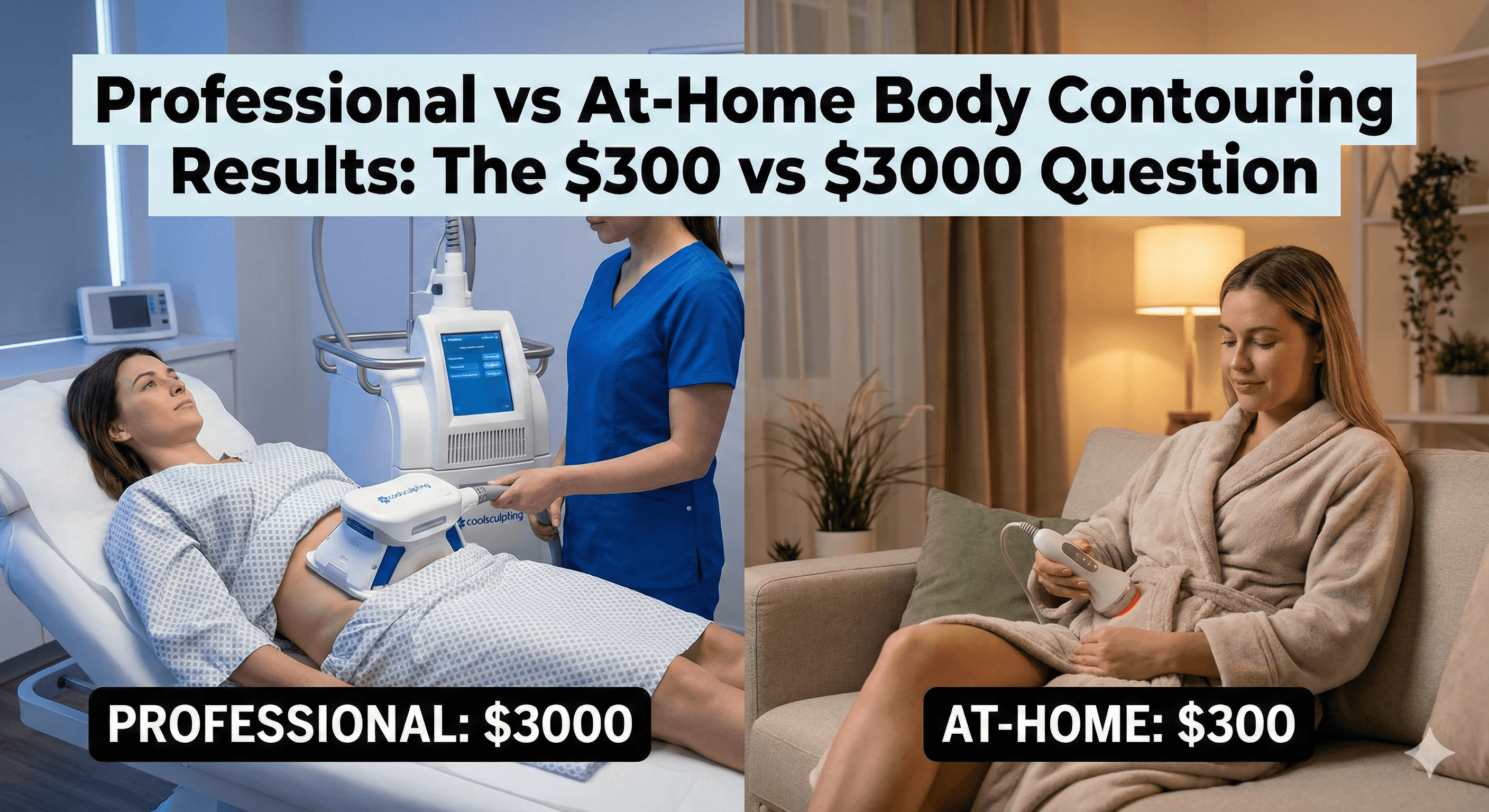
Professional vs At-Home Body Contouring Results: The $300 vs $3000 Question

Can a $300 home device really compete with a $3,000 professional treatment? Here is the unvarnished truth.
We’ve all been there. You’ve scrutinized the dramatic before-and-after photos on Instagram. You’ve scrolled past impossibly sleek ads for high-tech medical spa treatments, followed immediately by targeted ads for convenient, handheld at-home devices promising the exact same results from your couch.
The price difference is, quite frankly, staggering. Professional body contouring can set you back anywhere from $2,000 to $5,000 per treatment area, while home devices generally hover in the $200 to $500 range. But does the old adage "you get what you pay for" hold true when it comes to sculpting your physique? Or have technological advances finally democratized effective body contouring, putting med-spa power into the palm of your hand?
This million-dollar (or rather, three-thousand-dollar) question keeps thousands of potential clients paralyzed, hovering endlessly between the "Book Consultation" button on a trusted local site like Maryland Trim Clinic and the "Add to Cart" button on Amazon. Let's cut through the marketing jargon and break down the actual science, the true hidden costs, and most importantly, exactly when each option makes the most sense for your unique body, goals, and budget.
Act 1: The Technology Gap—Power, Precision, and Penetration
Energy Output: The Fundamental Divide
The most critical difference between professional and at-home body contouring devices isn't the sleekness of the packaging or the price tag—it is raw, unadulterated power. Professional-grade devices operate at high energy frequencies that are legally restricted from consumer products for your own safety.
Take non-invasive body contouring treatments like radiofrequency (RF), a gold standard in the industry. Professional RF devices deliver energy deep into the body—up to 15-20mm into your adipose (fat) tissue. They safely heat the fat layer to an intense 42-45°C. This targeted thermal stress triggers apoptosis—the biological term for programmed fat cell death—while simultaneously stimulating massive collagen remodeling.
Home RF devices, by stark contrast, typically only penetrate 2-5mm and are capped at surface temperatures of 38-40°C. They can absolutely tighten the superficial layers of skin and provide a modest, beautiful improvement in texture, but they simply lack the horsepower to reach the depths necessary to melt away substantial fat.
Treatment Protocols: Customization vs Standardization
When you hand over your credit card for a professional body contouring session, you are paying for the machine, yes—but you are primarily investing in the operator's clinical expertise. Highly trained practitioners don't just push a button; they thoroughly assess your unique anatomy:
- Body composition: Identifying your specific fat distribution patterns.
- Skin integrity: Testing your skin's laxity, thickness, and elasticity.
- Medical history: Screening for contraindications that could cause adverse reactions.
- Outcome mapping: Aligning the physics of the machine with your realistic expectations.
They then act as a tailor, customizing every parameter. A professional cryolipolysis session, for instance, utilizes an arsenal of applicators—from petite curves for the chin to large volume panels for the abdomen—each calibrated to freeze fat cells at precisely -11°C for optimal destruction without causing frostbite to the surrounding tissue.
Home devices, necessarily, offer one-size-fits-most settings. While this standardization makes them incredibly safe for you to use while watching Netflix, it also means they cannot adapt to your specific physiology.
FDA Clearances: What They Actually Mean
It is easy to be swayed by a shiny "FDA Cleared" badge on a $300 box. Both professional and reputable home devices carry these clearances, but the specific language the FDA permits them to use reveals a massive gap in efficacy.
- Professional devices are typically cleared for the "reduction of fat" or "body contouring," backed by clinical data allowing for specific claims (e.g., "average circumference reduction of 2-4cm after a single treatment").
- Home devices are usually only cleared for a "temporary improvement in appearance" or "temporary reduction in the appearance of cellulite." > The Candid Truth: Pay close attention to the word "temporary." Home devices are legally not allowed to claim permanent fat cell destruction because they simply don't do it. They work, but their FDA clearances reflect much more modest, transient outcomes.
Safety Parameters: The Double-Edged Sword
Consumer devices are brilliantly engineered with a suite of "training wheels" or fail-safes: automatic thermal shutoffs, lower maximum energy outputs, limited treatment timers, and built-in cooling mechanisms. These features are fantastic because they prevent you from injuring yourself at home.
However, these very safety parameters limit their effectiveness. Professional treatments operate right on the razor's edge of therapeutic thresholds—the exact point where permanent physical changes happen. With body contouring, the potential for dramatic results inherently comes with the requirement for professional risk management.
Act 2: The Real Cost Breakdown—Beyond the Sticker Price
Professional Treatments: The Full Investment
That $3,000 professional treatment quote rarely tells the complete financial story. Here is what a realistic, full-scope investment looks like for a medical spa treatment (focusing on a single target area, like the lower abdomen):
- Initial Consultation: $100 - $200 (Often waived or applied to your treatment cost if you book.)
- Single Treatment Area: $2,000 - $4,000
- Required Sessions: Most technologies require a series of 2 to 4 sessions spaced 4-6 weeks apart to see full results.
- Annual Maintenance: $1,000 - $2,000 (Yearly touch-ups are recommended to combat natural aging.)
- Total 1-Year Cost: $6,000 - $12,000+
The Upside: Professional treatments offer highly compressed timelines. You spend the money upfront, but you might achieve your ultimate desired results in just 2-3 months, after which your time commitment drops significantly.
At-Home Devices: The Hidden Costs
A $300 home device feels like an absolute steal, but you must factor in the "time tax" and recurring consumable costs required to keep the machine running:
- Base Device Cost: $200 - $500 (A one-time purchase.)
- Conductive Gel: $100 - $250 per year (Required for most RF/Microcurrent tools; averages $20-$40 per bottle.)
- Replacement Parts: $50 - $150 per year (Applicator heads, specific chargers, etc.)
- Total 1-Year Direct Cost: $400 - $800
- The "Time Tax": 150 - 400 Hours (This equates to 3-5 sessions per week, lasting 30-60 minutes each.)
The Upside: The financial barrier to entry is dramatically lower. However, if you value your personal free time at an hourly rate, the "cheap" home device suddenly becomes quite expensive in terms of sweat equity.
The Break-Even Analysis
If a single professional treatment area costs roughly $9,000 overall, a home device only needs to deliver similar results for about 10% of the cost to be considered a massive bargain. But reality isn't a simple math equation:
- If results matter most and time is scarce: Professional treatments win. They deliver stronger results, much faster.
- If budget is the strict primary constraint: Home devices provide the most accessible entry point to body contouring.
- If you're targeting multiple areas (arms, stomach, thighs): Home devices become exponentially more cost-effective since one $300 device can be used virtually everywhere.
- If long-term maintenance is your goal: Home devices excel at protecting the massive financial investment you made in professional treatments.
Insurance and Financing
Neither option is typically covered by your health insurance, as body contouring is strictly classified as an elective cosmetic procedure. However, the medical aesthetics industry is well aware of the sticker shock. Most reputable clinics offer third-party medical financing plans. Snagging a 0% APR promotion for 12-24 months can effectively spread a terrifying $9,000 professional treatment into manageable $375 monthly payments, making the "impossible" professional route much more realistic.
Act 3: The Verdict—When Each Option Makes Sense
Choose Professional Treatments When:
You have specific, localized fat deposits: If you're dealing with genetic areas that simply refuse to respond to a pristine diet and rigorous exercise, professional targeted fat reduction treatments can permanently destroy 20-25% of fat cells in the treated area per session.
You want dramatic results in a compressed timeline: Preparing for a wedding or a tropical vacation in 3 months? Professional treatments deliver visible, structural changes within 6-12 weeks.
You have significant skin laxity: Professional-grade treatments stimulate deep, foundational collagen remodeling for non-surgical skin tightening that home devices cannot physically replicate.
You value convenience and accountability: Booking an expensive appointment forces you to commit. You show up, lie down, let the expert do the work, and go home.
Budget isn't your primary concern: If dropping several thousand dollars will not cause you financial stress, professional treatments offer the most direct path to your desired physique.
Choose At-Home Devices When:
You're targeting overall skin quality and mild contouring: If your primary goals are smoothing out cellulite, general skin tightening, and a modest circumference reduction (1-2 inches over half a year), high-quality home devices are fantastic tools.
Budget is a significant factor: When $300 is a splurge but $3,000 is rent money, home devices provide highly accessible technology.
You're maintaining professional treatment results: Many practitioners highly recommend home devices as maintenance tools. A $300 device that extends your $3,000 professional results by an extra year pays for itself ten times over.
You fiercely protect your privacy and flexibility: Home devices let you sculpt your jawline while in your pajamas at 11 PM without dealing with scheduling conflicts.
You are ruthlessly consistent: Home devices reward extreme dedication. If you never skip a skincare routine or a morning workout, you have the discipline required to make a home device work for you.
The Hybrid Approach: The Best of Both Worlds
Increasingly, the smartest and most effective strategy in aesthetics isn't an either/or scenario—it’s a carefully planned combination of both:
- Phase 1 (The Heavy Lifting): Invest in professional treatments for dramatic, initial fat reduction and deep tissue remodeling.
- Phase 2 (The Sustainer): Purchase a high-quality home device for maintenance and continued surface-level improvement.
This approach front-loads your results with professional power, then sustains and enhances that massive investment with consistent at-home maintenance.
Setting Realistic Expectations
Regardless of which path you ultimately choose, ground yourself in these universal, undeniable truths:
- Neither option is a weight loss solution. Both professional and home body contouring work exclusively for people who are already close to their ideal weight and are looking to sculpt specific, stubborn areas.
- Results require lifestyle maintenance. You cannot out-sculpt a bad diet. If you gain weight, your body will create new fat cells or expand the remaining ones, entirely erasing your results.
- "Before and After" photos are best-case scenarios. Marketing materials show the top 1% of responders. Expect professional treatments to deliver about 70-80% of the dramatic transformations you see online, and home devices to deliver about 40-60%.
A Local Partner in Your Journey: Maryland Trim Clinic (MTC) in Laurel, MD
Navigating the overwhelming world of body contouring can feel like a lonely endeavor, especially when you are weighing a significant financial investment. If you are trying to definitively answer the "$300 vs $3000" question for your unique body, partnering with a trusted local professional is the smartest first step.
For those in the Washington D.C., Maryland, and Virginia (DMV) area, Maryland Trim Clinic (MTC) in Laurel, MD represents exactly the kind of clinical expertise you should look for.
A specialized clinic like MTC bridges the gap between your aesthetic goals and your physiological reality. Instead of leaving you to guess which applicator to use or how many minutes to run a device, their medical professionals provide:
- Comprehensive Assessments: They evaluate your holistic health, metabolic standing, and lifestyle to ensure you are a viable candidate for professional treatments.
- Targeted Protocols: They create a customized roadmap that might combine a foundational medical weight loss program with localized body contouring for maximum impact.
- Honest Accountability: They give you the candor you need about what is actually achievable, preventing you from wasting money on underpowered at-home fads if your goals truly require clinical intervention.
By booking a consultation at a dedicated facility like Maryland Trim Clinic, you remove the decision fatigue. You are no longer just buying a treatment; you are investing in a medical partnership dedicated to your long-term confidence and structural transformation.
The Bottom Line
Can a $300 home device compete with $3,000 professional treatments? The answer requires nuance: it entirely depends on your definition of "compete."
If your goal is targeted fat reduction, dramatic body remodeling, and a fast timeline, professional treatments remain undisputed champions. The technology is vastly more powerful, the protocols are clinically customized, and the results are profound.
But if you are looking for skin tightening, modest surface contouring, long-term maintenance, and budget-conscious improvements, high-quality home devices offer entirely legitimate value. They won't match the peak performance of a clinic, but they will deliver visible improvements for a fraction of the cost.
Weigh your goals, your timeline, your budget, and your personal discipline. Whatever you choose, remember that technology is only half the equation. Your results require a committed partnership between the device and your own dedication to a healthy lifestyle.
Frequently Asked Questions
Q: How long do professional body contouring results last compared to at-home devices?
A: Professional treatments permanently destroy a percentage of fat cells in the treated area.
Because adults do not naturally regenerate fat cells, those results can last for years—provided you maintain a stable weight. At-home devices provide temporary improvements that require ongoing maintenance sessions 2-3 times a week to sustain.
Q: Can I achieve the same results with a home device if I just use it more frequently?
A: Not quite. Home devices are hard-capped by safety regulations. They physically cannot reach the tissue depths or the therapeutic temperatures required to trigger fat cell apoptosis, no matter how long you leave them on. Think of it like walking versus running—more walking helps, but it won't magically turn into a sprint.
Q: Which body contouring technology translates best to at-home use?
A: Radiofrequency (RF) and LED technologies are the most successful for home devices. They are inherently safer for unsupervised use while still delivering noticeable skin tightening. You should avoid any at-home devices claiming to replicate cryolipolysis (fat freezing) or High-Intensity Focused Ultrasound (HIFU), as these require professional calibration to be safe.
Q: How many professional sessions equal one home device's total results?
A: It’s an apples-to-oranges comparison. A single professional session typically delivers more permanent fat reduction than 6 months of religious home device use. However, a home device excels at improving overall skin quality across large surface areas, which a highly-targeted professional fat-freezing applicator doesn't address as comprehensively.
Q: Is it actually worth buying a home device if I'm already planning to pay for professional treatments?
A: Absolutely. Think of the home device as your insurance policy. A quality home RF device used between professional sessions, and regularly after your treatment series concludes, can extend your peak results by 6 to 12 months, effectively saving you thousands on touch-up appointments.
Ready to Make the Right Investment for Your Body
Deciding between a $300 at-home gadget and a $3,000 clinical treatment shouldn't be a guessing game. Your body, your timeline, and your hard-earned money deserve a scientifically sound approach, not a one-size-fits-all sales pitch. Take the guesswork out of your transformation. Contact Maryland Trim Clinic in Laurel, MD, today to schedule your comprehensive consultation and take the first definitive step toward the results you deserve.