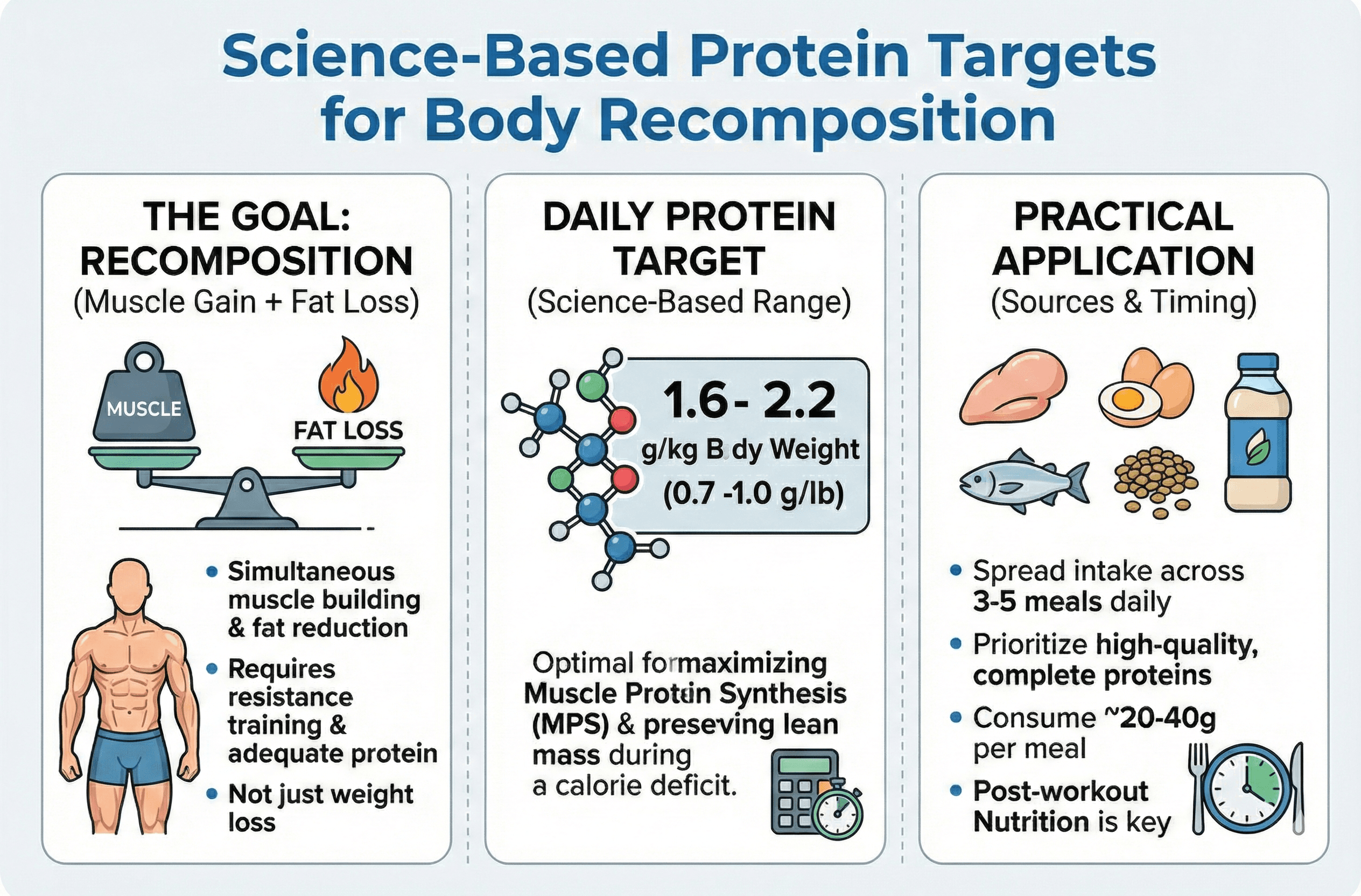
Science-Based Protein Targets for Body Recomposition

Stop guessing on protein, here is what the research actually shows.
As a nutrition coach or fitness enthusiast, few questions arise more frequently than: "How much protein should I eat?" Your resistance-training clients want muscle gain. They want fat loss. Ideally, they want both simultaneously (a process known as body recomposition). And while protein's fundamental importance is universally acknowledged, the specific daily targets remain maddeningly unclear in popular discourse.
Social media delivers endlessly conflicting messages. Some influencers claim that the standard dietary recommendation of 0.8g/kg is sufficient, while bodybuilders insist on 1.5g/lb or higher. Others dismiss protein timing entirely, while their competitors swear by eating chicken breast within a 30-minute post-workout window.
This confusion isn't just theoretical, it directly impacts your clients' physical results and your professional credibility. Set protein too low, and you are potentially limiting muscle protein synthesis and recovery. Set it unnecessarily high, and you create major adherence challenges without any additional physiological benefit, effectively wasting a dietary "budget" that could be allocated to carbohydrates for workout performance or fats for hormonal health and satiety.
Let's cut through the noise and look at what the scientific literature actually demonstrates.
Act 1: What the Meta-Analyses Tell Us About Protein Targets
The most comprehensive data we have comes from systematic reviews and meta-analyses. These studies pool findings across dozens of controlled trials, effectively canceling out the noise of small, individual studies. These provide our gold-standard foundation for evidence-based recommendations.
The Baseline: 1.6g/kg for Muscle Protein Synthesis
The landmark 2018 meta-analysis by Morton and colleagues, published in the British Journal of Sports Medicine, is widely considered the definitive text on this subject. They analyzed 49 studies involving 1,863 participants to determine the exact protein intake that maximizes resistance training-induced gains in fat-free mass.
Their conclusion: 1.6 grams of protein per kilogram of body weight per day (approximately 0.73g/lb) represents the precise point where the dose-response curve plateaus.
Crucially, their analysis revealed that protein intakes beyond this threshold provided zero additional benefit for muscle accretion in the vast majority of individuals. The upper confidence interval suggested that a small minority of genetic outliers might benefit from intakes up to 2.2g/kg (1.0g/lb), but these represent statistical exceptions rather than the norm.
The Math in Action: For a 180-lb (82 kg) client, this translates to approximately 131 grams of protein daily. This is far more achievable, and far cheaper, than the 270+ grams sometimes recommended in hardcore bodybuilding magazines.
Energy Deficit Changes the Equation
It is vital to understand that the 1.6g/kg target applies to eucaloric (maintenance) or hypercaloric (bulking) conditions. During active fat loss phases, protein requirements change. They must increase to preserve existing lean mass against the highly catabolic pressures of energy restriction.
Helms and colleagues (2014) demonstrated in their systematic review that protein intakes of 2.3–3.1g/kg of fat-free mass are optimal during aggressive caloric deficits in lean, resistance-trained individuals.
For practical, day-to-day application with clients who aren't getting weekly DEXA scans, this translates to:
- 2.0–2.4g/kg of total body weight during cutting phases.
- This is particularly important for those who are already relatively lean (men under 15% body fat, women under 25%).
A subsequent 2020 meta-analysis by Longland and team reinforced this. They showed that higher protein intakes (2.4g/kg vs. 1.2g/kg) during energy restriction resulted in significantly greater retention of lean muscle mass and greater loss of fat mass in resistance-trained individuals.
Body Composition Matters More Than Scale Weight
There is a major caveat to these calculations. For clients carrying significant amounts of body fat, calculating protein needs from total body weight can result in unnecessarily high (and logistically impractical) targets.
A 250-lb individual at 35% body fat does not require 220g of protein (using the 2.0g/kg cutting recommendation) because a large portion of that weight is metabolically inert adipose tissue, which does not require protein for maintenance.
The Better Approach: * Use lean body mass estimates.
- Alternatively, calculate protein needs based on the client's goal body weight. This is a highly practical compromise, particularly for clients with a BMI over 30.
Act 2: Training Status Modulates Protein Requirements
The research clearly indicates that a person's training experience significantly impacts their protein utilization and overall requirements. This information should directly inform your coaching protocols.
The Novice Advantage
Beginning trainees are exquisitely responsive to new training stimuli. The phenomenon often called "newbie gains" is exceptionally well-documented: untrained individuals can often achieve simultaneous muscle gain and fat loss even with suboptimal protein intake and less-than-perfect programming.
Moore and colleagues (2009) found that novice trainees showed robust muscle protein synthesis elevations with post-workout protein doses as low as 20g, hitting maximal stimulation at approximately 20-25g of high-quality protein.
This does not mean beginners should intentionally consume less protein overall—the 1.6g/kg target remains highly appropriate. But it does mean they have a much greater margin for error. A novice client who only hits 1.4g/kg on a given day will likely still make excellent progress, whereas this same intake might cause an advanced trainee to stall.
Advanced Trainees: Diminished Returns, Same Requirements
As clients progress over the years, training-induced muscle protein synthesis becomes increasingly difficult to stimulate. Advanced trainees demonstrate:
- Blunted anabolic responses to standard training stimuli.
- Reduced sensitivity to protein feeding.
- Much slower absolute rates of muscle accretion.
Counterintuitively, this does not mean advanced trainees need dramatically more protein—the 1.6g/kg target still firmly applies during maintenance or gaining phases. What changes is their tolerance for suboptimal intake. An advanced client operating at 1.2g/kg will likely experience complete stagnation, whereas a novice might still progress.
The Practical Takeaway: Protein targets don't increase exponentially with training age, but daily precision becomes vastly more important.
Energy Balance: The Critical Context
Protein requirements exist exclusively within the context of total energy intake. Research consistently shows that adequate caloric intake is "protein-sparing." When energy from carbs and fats is abundant, the body is highly unlikely to oxidize valuable amino acids for fuel.
How to adjust targets based on the caloric environment:
- During lean bulks (+10-20% surplus): The 1.6g/kg target is entirely sufficient, possibly even slightly conservative.
- During maintenance: 1.6–1.8g/kg provides a very comfortable margin of error.
- During aggressive cuts (-25% or more): Push toward 2.0–2.4g/kg, especially for lean individuals trying to protect muscle.
Always coach your clients to understand that protein targets aren't static—they should flex dynamically with their current training phase and dietary context.
Act 3: Timing, Distribution, and Individual Nuance
Once total daily protein intake is optimized, the next level of precision involves how and when that protein is consumed. While vastly less impactful than hitting your total daily intake, these factors provide marginal gains that matter deeply for advanced clients.
The Protein Timing Debate: What Actually Matters
The mythological "anabolic window" has been both oversold by supplement companies and overcorrected by evidence-based practitioners. The truth occupies a sensible middle ground.
Schoenfeld and Aragon's 2018 meta-analysis found that when total daily protein intake is equated and sufficient, the specific timing of protein consumption relative to training provides minimal additional benefit for muscle hypertrophy. The effect size was incredibly small (0.03) and not statistically significant.
However, this doesn't render timing entirely irrelevant. Here is what does matter:
Pre-sleep protein (30-40g): Has demonstrated real benefits for overnight muscle protein synthesis, particularly when the client is in a caloric deficit.
Per-meal distribution: Matters much more than how close a meal is to a workout.
Fasting protocols: Consuming protein early in feeding windows may optimize synthesis for those utilizing time-restricted eating (intermittent fasting).
For coaching applications: Tell clients not to stress over rushing to drink a shake within a 30-minute post-workout window, but do ensure they aren't going 6 to 8 hours without protein intake during their waking hours.
Meal Distribution: The 0.4-0.55g/kg Sweet Spot
Research has established that muscle protein synthesis is maximally stimulated by approximately 0.4g/kg of protein per meal (roughly 25-35g for most average-sized individuals) when consuming high-quality, leucine-rich protein sources.
Macnaughton and colleagues (2016) found that larger 40g doses produced slightly superior whole-body protein synthesis compared to 20g doses in trained individuals performing whole-body resistance training. This suggests the per-meal target might optimally sit at 0.4-0.55g/kg for those with substantial muscle mass or those following very high-volume training programs.
Practical framework for a 180-lb (82 kg) client targeting 1.8g/kg (148g daily):
- Option A: 4 meals containing ~37g of protein per meal (0.45g/kg).
- Option B: 3 meals containing 30g + 1 pre-sleep meal containing 40g.
Both approaches distribute protein highly effectively across the day to maximize muscle protein synthesis opportunities.
Individual Variation: The Genetic Reality
Despite our best efforts to create universal, mathematical prescriptions, individual variation is very real. Some clients will thrive at the absolute lower end of these recommendations; others clearly require the upper bounds.
Factors influencing individual protein requirements include:
- Genetic polymorphisms affecting protein metabolism.
- Gut health and digestive capacity influencing amino acid absorption.
- Training volume and intensity creating a greater stimulus for physical adaptation.
- Chronic stress and sleep quality impacting recovery demands.
- Age-related anabolic resistance (particularly in individuals over 50 years old).
As a coach, use the research-based targets as firm starting points, then adjust based on the client's real-world response over 4-to-8 week assessment periods. Track their strength progression, body composition changes, and subjective recovery markers.
Special Considerations for Body Recomposition
Clients pursuing simultaneous muscle gain and fat loss (true body recomposition) represent a unique physiological case. This 'holy grail' of fitness is most achievable in:
- True novice trainees.
- Previously trained individuals returning from a long layoff (muscle memory).
- Individuals with substantial body fat to lose.
For recomposition, err toward the higher protein recommendations: 2.0–2.4g/kg provides the dual benefits of maximum muscle protein synthesis support and enhanced satiety, which helps clients stick to the modest caloric deficit required for fat loss. If you or your clients need help navigating the complexities of muscle retention during fat loss, utilizing muscle building and toning protocols can provide a structured path forward.
The Evidence-Based Coaching Protocol
To synthesize all of this research into actionable coaching guidelines, use the following quick-reference frameworks:
For Muscle Gain (Maintenance or Caloric Surplus):
- Target: 1.6–2.0g/kg of body weight.
- Distribution: 4–5 meals with 0.4–0.55g/kg per meal.
- Timing: Don't stress acute post-workout windows; simply ensure a maximum of 3-4 hours between protein feedings.
For Fat Loss (Caloric Deficit):
- Target: 2.0–2.4g/kg of body weight (or 2.3–3.1g/kg of fat-free mass).
- Distribution: Favor higher per-meal doses (0.5–0.6g/kg) to maximize the satiating effect of protein.
- Timing: Strongly consider a pre-sleep protein feeding (30-40g) to preserve lean mass overnight.
For Body Recomposition:
- Target: 2.0–2.4g/kg of body weight.
- Deficit: Keep it modest (10-20% below maintenance calories).
- Patience: Warn the client that visual progress will be inherently slower than dedicated, aggressive bulking or cutting phases.
Maryland Trim Clinic (MTC) in Laurel, MD
Navigating the complexities of macros, protein targets, and body recomposition can be overwhelming, especially when trying to balance muscle gain with sustainable fat loss. Having clinical guidance ensures you aren't just guessing, but are actively working with your biology. Located in Laurel, MD, the Maryland Trim Clinic (MTC) offers personalized, evidence-based care tailored to your specific metabolic needs.
Whether you need professional nutritional counseling and coaching to dial in your protein requirements, or you are looking for advanced metabolic testing and analysis to precisely determine your caloric baseline, our medical team is equipped to support you. We move beyond generic online calculators to provide highly tailored strategies for changing your body composition safely. If you are tired of plateauing in the gym or struggling with your diet, visit the Maryland Trim Clinic online to see how our expertise can accelerate your results.
Conclusion: Precision Over Dogma
The clinical research provides incredibly clear direction: for most resistance-trained individuals, 1.6–2.2g/kg during maintenance or gaining phases, and 2.0–2.4g/kg during fat loss phases represents the evidence-based sweet spot.
These targets are notably higher than the government's general population recommendations, but significantly lower than much of the aggressive bodybuilding folklore. They are achievable without excessive supplementation or miserable dietary rigidity, and they are backed by the highest quality scientific evidence available.
As a nutrition coach or educated athlete, your value lies not in recycling internet dogma, but in applying nuanced, research-informed recommendations tailored to individual contexts. Use these targets as your unshakeable foundation, then systematically refine them based on training status, goals, and individual response.
The science isn't perfect, and it won't cleanly answer every single edge case. But it is substantially better than guessing, and that is exactly what separates evidence-based coaching from nutritional noise.
Disclaimer: The information provided in this article is for educational purposes only and is not intended as a substitute for professional medical advice, diagnosis, or treatment. Always seek the advice of your physician or other qualified health provider before drastically changing your diet, especially if you have pre-existing kidney conditions or other metabolic disorders.
Frequently Asked Questions
Q: Is 1.6g/kg really enough for muscle growth, or should I recommend more just to be safe? A: Yes, the 1.6g/kg target represents the precise point where the dose-response curve plateaus, according to massive meta-analytic data. While individual variation exists and some may benefit from up to 2.2g/kg, recommending substantially higher intakes "just to be safe" creates unnecessary adherence challenges and limits carbohydrate intake without proven additional benefit. For most clients in a maintenance phase or caloric surplus, 1.6–2.0g/kg provides optimal results while maintaining enjoyable dietary flexibility.
Q: How do I calculate protein needs for clients with high body fat percentages? A: For clients with significant adiposity (a BMI over 30 or body fat over 30%), calculating protein from total body weight can result in impractically high, uncomfortable targets. Instead, use adjusted body weight, goal body weight, or lean body mass estimates. A highly practical approach: calculate their protein needs based on where you would expect their body weight to be at a healthy, sustainable body fat percentage (e.g., 15-20% for men, 22-28% for women).
Q: Does protein timing actually matter if my total daily intake is optimized? A: When total protein intake is adequate and distributed reasonably across the day, rushing to hit the acute post-workout "anabolic window" has minimal impact on long-term muscle growth. However, per-meal distribution (aiming for 0.4–0.55g/kg per meal) and avoiding extended periods without protein (going >6-8 hours while awake) do matter. Pre-sleep protein (30-40g) may also provide additional recovery benefits, particularly during caloric deficits.
Q: Should I increase protein recommendations for older clients or those over 50? A: Yes. Age-related "anabolic resistance" is very well-documented in the literature. Older adults demonstrate blunted muscle protein synthesis responses to both resistance training and protein feeding. While the same general targets apply (1.6–2.2g/kg), older clients benefit from staying at the higher end of these ranges and often require much larger per-meal doses (0.5–0.6g/kg, or a 40g minimum per meal) to maximally stimulate muscle protein synthesis.
Q: What is the exact evidence for higher protein intake (2.0-2.4g/kg) during fat loss phases? A: Multiple rigorous studies demonstrate that higher protein intakes during caloric restriction preserve lean mass and enhance fat loss. Helms et al. (2014) recommended 2.3–3.1g/kg of fat-free mass for lean, actively dieting athletes. Longland's 2020 meta-analysis showed that 2.4g/kg significantly outperformed 1.2g/kg for improving body composition during energy restriction. The mechanism is simple: protein is highly thermic (burns calories to digest), highly satiating (keeps you full), and provides the necessary amino acids to combat the catabolic, muscle-wasting environment of a diet.
Ready to Dial in Your Nutrition for Real Results?
Stop guessing with your macros and start building a plan based on your unique biology. Contact Maryland Trim Clinic today to schedule a comprehensive consultation. Let our medical experts help you establish precise protein targets and build a sustainable body recomposition strategy tailored just for you.