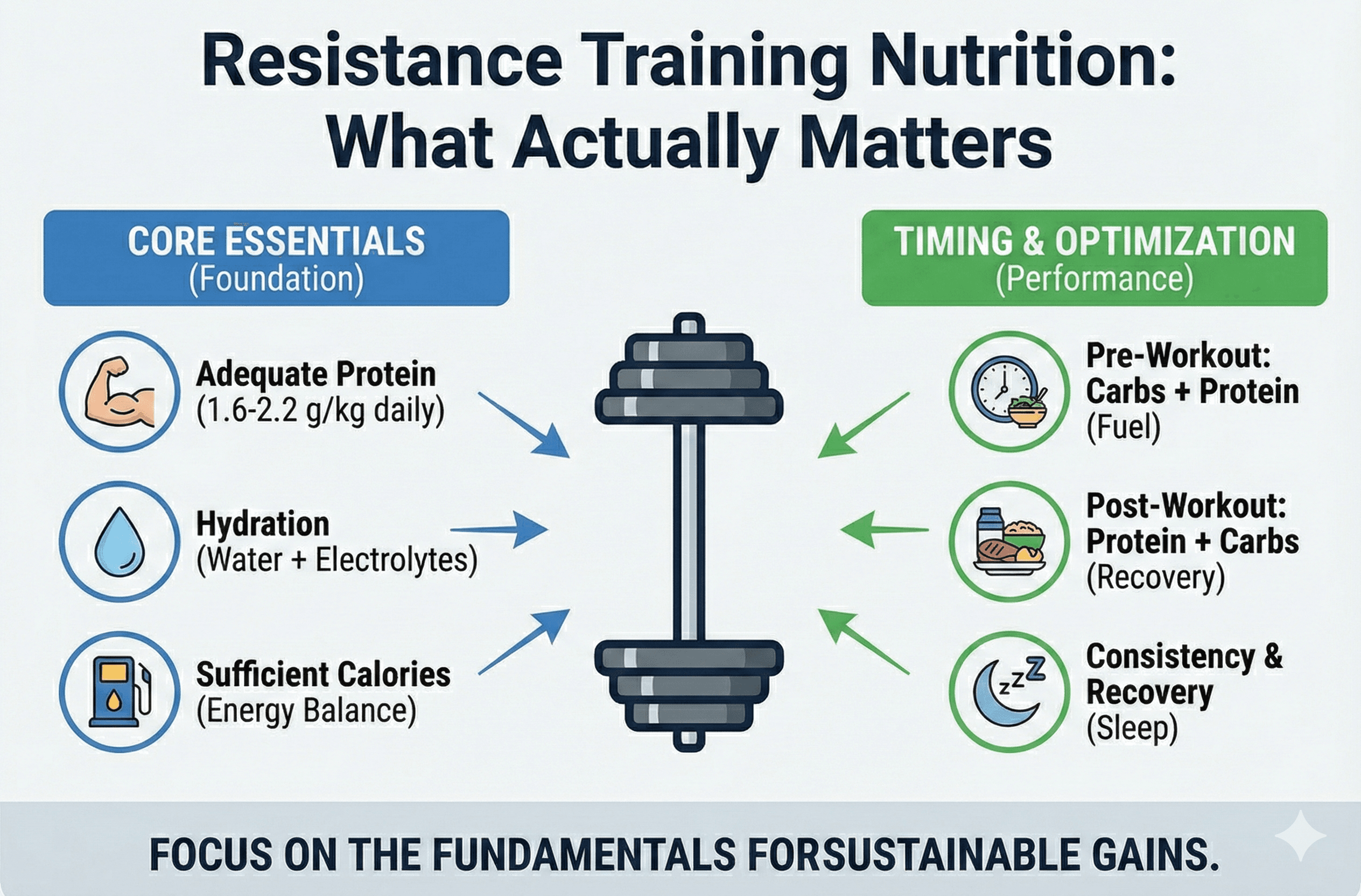
Resistance Training Nutrition: What Actually Matters

3 hours of science distilled: what really matters for muscle.
As a nutrition coach working with strength training clients—or a lifter trying to manage your own diet—you are likely drowning in conflicting information. One fitness guru swears by fasted training, while another insists you absolutely must drink intra-workout carbs. Supplement companies promise the world, while minimalist coaches claim everything except protein is entirely negotiable. You are left wondering about nutrient timing, the mythical "anabolic window," and whether you are sabotaging your gains by eating carbs after 6:00 PM.
Here is the truth: most of what fills your social media feed is pure noise.
The physiological fundamentals that actually drive body composition results are surprisingly simple. However, the devil lives in knowing exactly where nuance matters and where it absolutely doesn't. Let's cut through the confusion and focus purely on what moves the needle for muscle growth, strength gains, and body recomposition.
Act 1: The Non-Negotiables
When it comes to resistance training nutrition, three specific factors stand head and shoulders above everything else. Get these wrong, and no amount of supplement timing or macronutrient juggling will save your results.
Protein Intake: The Cornerstone
If there is one single nutritional variable that separates successful body recomposition from spinning your wheels, it is adequate protein intake. The research here is remarkably consistent: resistance-trained individuals need significantly more protein than sedentary populations to maximize Muscle Protein Synthesis (MPS) and support tissue recovery.
The Evidence-Based Target: Aim for 1.6 to 2.2 grams per kilogram of body weight per day. For most US-based clients, this translates to roughly 0.7 to 1.0 grams per pound of body weight.
- Example: A 180-pound client should aim for 125 to 180 grams daily.
This isn't "bro-science"—it is the convergence point of massive meta-analyses examining dozens of clinical studies.
- Going below 1.6g/kg: Reliably underperforms for muscle growth.
- Going significantly above 2.2g/kg: Shows minimal additional benefit for muscle accretion in most populations (though higher intakes can sometimes be useful for satiety during deep fat-loss phases).
What Actually Matters for Protein:
- Hitting your total daily protein target range consistently.
- Ensuring protein sources include sufficient leucine (the amino acid that triggers MPS; aim for 2-3g of leucine per meal).
- Distributing your intake across 3 to 5 meals to support consistent protein synthesis.
What Doesn't Matter Nearly As Much:
- Whether it is exclusively animal or plant protein (as long as your total amino acids are adequate).
- Your exact timing down to the minute.
- The specific type of protein powder (whey vs. casein vs. beef) for 99% of applications.
Coach your clients to hit their daily total first, distribute it reasonably, and stop obsessing about the rest.
Energy Balance: The Metabolic Context
You cannot coach body recomposition without a firm grasp of energy balance. Muscle growth is an incredibly energetically expensive process. The human body preferentially builds new tissue when it is in an energy surplus, and it preferentially preserves essential vital functions (while dropping weight) in a deficit.
The Metabolic Hierarchy:
Muscle Gain Priority: Requires a modest caloric surplus (200-500 calories above maintenance). This optimizes the anabolic environment while minimizing unnecessary fat gain.
Fat Loss Priority: Requires a moderate caloric deficit (300-500 calories below maintenance). Steeper deficits heavily increase the risk of muscle loss, even with adequate protein and a perfect training stimulus.
Recomposition (Simultaneous fat loss and muscle gain): This occurs at or slightly below maintenance calories, but it is realistically primary reserved for:
- Absolute training beginners.
- Detrained individuals returning to lifting (muscle memory).
- Those carrying significant excess body fat.
- Enhanced athletes taking performance-enhancing drugs (which is outside standard nutrition coaching).
The biggest mistake coaches make is promising aggressive "recomp" results to intermediate and advanced clients. It is physiologically challenging and frustratingly slow. Set realistic expectations: most intermediate lifters will achieve far better total results by dedicating distinct, focused phases to "gaining" (bulking) and "cutting" (fat loss).
Energy balance always trumps macronutrient ratios. A client eating 40% carbs in a proper caloric surplus will out-gain the same client eating 60% carbs who is undereating their total calories.
Progressive Overload Support: Fueling Performance
Here is what frequently gets lost in body composition discussions: your nutrition must support progressive overload in the gym. If a client cannot recover between sessions, cannot add weight to the bar, or constantly feels depleted, they are not building muscle optimally—regardless of having "perfect" macros. Carbohydrate sufficiency matters immensely for most clients. While protein gets the glory and fats support essential hormonal function, carbohydrates are the premium fuel for high-intensity resistance training. They replenish glycogen stores, support high training volume, and create a more anabolic hormonal environment.
Practical Carbohydrate Targets:
- Muscle Gain Phases: 3 to 5g/kg of body weight.
- Maintenance/Recomposition: 2 to 4g/kg of body weight.
- Fat Loss Phases: 2 to 3g/kg minimum (adjust based on training volume and individual response).
While some clients do fine on lower carbohydrate intakes (particularly if they are highly fat-adapted or training with very low volume), if a client is running an intensive 4-to-6 day lifting program and complaining about poor recovery on 100g of carbs daily, you have found the problem.
Note: Dietary fats should fill the remainder of the caloric budget after protein and carbs are set, typically making up 20-35% of total calories. Going below 15-20% can severely compromise hormone production.
Act 2: Where Nuance Matters vs Where It Doesn't
This is the exact trap where coaches and athletes get stuck—applying extreme precision to things that don't matter, while ignoring the variables that actually deserve attention.
Nuance That Doesn't Matter (For 95% of Clients)
- The Anabolic Window Panic: The idea that you have 30 to 60 minutes post-workout to slam a protein shake or you will "waste your session" is entirely outdated. Muscle protein synthesis actually remains elevated for 24 to 48 hours after heavy training. Total daily protein matters infinitely more than post-workout timing. (Exception: If you train completely fasted and haven't eaten in 12+ hours, getting protein within a few hours post-workout becomes much more relevant.)
- Intra-Workout Supplementation: For typical 45 to 75-minute resistance training sessions, plain water is perfectly sufficient. Intra-workout carbs and BCAA/EAAs might provide marginal benefits during extremely grueling, high-volume sessions (2+ hours), but they are firmly in the "1% optimization" category, not the "necessary" category.
- Carb and Fat Timing: Eating carbohydrates at 8:00 PM doesn't magically store them as fat any more than eating them at 8:00 AM does. Overall energy balance determines fat storage, not the clock.
Nuance That Actually Deserves Attention
- Protein Distribution: While total daily protein is king, how you distribute it matters secondarily. Spreading your protein across 3 to 5 meals, with each containing 25-40g (or roughly 0.4g/kg per meal), appears to optimize muscle protein synthesis compared to eating the exact same total amount in just one or two massive daily servings. Why? Because MPS has a "refractory period"—flooding the system with 100g of protein at once doesn't produce double the anabolic effect of 50g. You get diminishing returns per feeding.
- Pre-Training Fueling: While post-workout timing is overrated, pre-training nutrition can significantly impact training quality. A client training completely glycogen-depleted will underperform. A mixed meal 2 to 3 hours before training, or a lighter carb/protein snack 60 to 90 minutes prior, supports much better workout volume and intensity.
- Dietary Adherence and Preference: The most scientifically perfect meal plan is worthless if the client won't follow it. A client who despises eating breakfast will struggle with forced morning meals. Someone who loves large family dinners will suffer on a front-loaded eating pattern. Coach the fundamentals within a lifestyle framework they can actually sustain.
Act 3: Coaching Body Recomposition Effectively
Knowing the science is one thing; translating it into sustainable client results is another entirely.
Start with the Hierarchy
When establishing a new nutrition protocol, assess and address variables in this specific order:
Energy intake appropriate for goals (surplus, maintenance, or deficit).
Protein target hit consistently (1.6-2.2g/kg).
Carbohydrate sufficiency to fuel the required training volume.
Dietary adherence and realistic meal structure.
Everything else (timing, precise supplementation, nutrient partitioning strategies).
Most clients never need to progress beyond step 4. If they are not getting results at that stage, the problem usually lives in their training programming, their sleep/recovery, or their unrealistic expectations—not in their nutritional minutiae.
Monitoring and Adjustment
Body recomposition is not a "set it and forget it" protocol. You must establish clear monitoring systems.
Weekly metrics to track:
- Body weight (look at the 7-day average, not daily fluctuations).
- Training performance (are the weights on the bar progressing, stalling, or declining?).
- Subjective recovery, sleep quality, and daily energy levels.
Adjustment triggers:
- Weight stalling for 3+ weeks during a planned bulk? Increase calories by 100-200.
- Weight dropping faster than 1% per week during a cut? Increase calories slightly to prevent muscle loss.
- Training performance sharply declining? Assess sleep, life stress, and consider bumping up carbohydrate intake.
The Conversation Framework
How you communicate this science matters as much as what you recommend.
- Set hierarchy expectations: "We are focusing on three things right now: hitting your protein target, eating enough to support your lifts, and building a meal schedule you can sustain. Everything else is just noise until these are dialed in."
- Contextualize supplements: "Creatine and caffeine have incredibly solid evidence for performance benefits. Everything else on the shelf is marginal at best. Let's get your actual food foundation solid first."
- Address stalls proactively: "Your weight hasn't moved in three weeks. That is normal—bodies adapt. We have options: we can slightly increase calories, reassess if you are actually tracking accurately, or stay patient for another week. How is your hunger and your gym performance right now?"
Maryland Trim Clinic (MTC) in Laurel, MD
Navigating the complexities of macronutrients, energy balance, and body recomposition can be overwhelming, especially when you are trying to balance muscle gain with sustainable fat loss. Having clinical guidance ensures you aren't just guessing, but are actively working with your biology. Located in Laurel, MD, the Maryland Trim Clinic (MTC) offers personalized, evidence-based care tailored to your specific metabolic needs.
Whether you need professional nutritional counseling and coaching to dial in your protein requirements and meal timing, or you are looking for advanced metabolic testing and analysis to precisely determine your caloric baseline, our medical team is equipped to support you. We move beyond generic online calculators to provide highly tailored strategies for changing your body composition safely. If you are tired of plateauing in the gym or struggling with your diet, visit the Maryland Trim Clinic online to see how our expertise can accelerate your results.
The Bottom Line
Resistance training nutrition is simultaneously much simpler, and slightly more nuanced, than social media suggests. The fundamentals—adequate protein, appropriate energy balance, and sufficient carbohydrates to fuel training—drive the vast majority of your visual and strength results.
The real nuance isn't found in supplement timing or calculating macronutrient ratios to the decimal point. It is found in understanding where individual variation matters, how to structure nutrition for lifelong adherence, and knowing exactly when to adjust based on real-world feedback rather than chasing theoretical perfection.
Coach the big rocks first. Add complexity only when the fundamentals are consistently executed and results have genuinely plateaued. You don't need another complicated protocol—you need clarity, consistency, and the ability to distinguish scientific signal from marketing noise.
That is what actually matters.
Disclaimer: The information provided in this article is for educational purposes only and is not intended as a substitute for professional medical advice, diagnosis, or treatment. Always seek the advice of your physician or other qualified health provider before making drastic changes to your diet or exercise routine.
Frequently Asked Questions
Q: How much protein do resistance training clients really need? A: Research consistently supports 1.6 to 2.2 grams per kilogram of body weight daily (roughly 0.7 to 1.0 grams per pound) for individuals engaged in regular resistance training. This range optimally maximizes muscle protein synthesis and recovery. Going below 1.6g/kg typically underperforms, while exceeding 2.2g/kg shows minimal additional benefit for most people regarding muscle growth.
Q: Is the post-workout 'anabolic window' real? A: The traditional 30 to 60-minute 'anabolic window' is largely a myth perpetuated by the supplement industry. Muscle protein synthesis actually remains elevated for 24 to 48 hours after a heavy training session, making your total daily protein intake far more important than precise post-workout timing. The only real exception is for clients training completely fasted—they do benefit more from getting protein within a few hours of finishing their session.
Q: Can intermediate lifters really build muscle while losing fat? A: True body recomposition (doing both simultaneously) becomes increasingly difficult as your training age advances. While true beginners and previously detrained individuals can successfully build muscle while in a caloric deficit, intermediate and advanced lifters typically achieve far better total results with dedicated, separate "gaining" and "cutting" phases. Trying to recomp at an advanced level is physiologically challenging and frustratingly slow.
Q: How important is carbohydrate intake for muscle growth? A: While protein gets the most attention for muscle repair, carbohydrates play a crucial support role by actually fueling high-intensity training, replenishing depleted glycogen stores, and creating a more anabolic hormonal environment. Most clients do best with 3 to 5g/kg of body weight during gaining phases, and a minimum of 2 to 3g/kg during fat loss phases. If your recovery is poor despite eating adequate protein and calories, insufficient carbohydrates are often the culprit.
Q: Does protein distribution throughout the day actually matter? A: Yes, but it is entirely secondary to hitting your total daily intake. Spreading your protein across 3 to 5 meals, with 25-40g per serving (approximately 0.4g/kg per meal), appears to optimize muscle protein synthesis compared to consuming the same total amount in just one or two massive meals. This is because muscle protein synthesis has a "refractory period"—consuming massive amounts at once produces diminishing returns per feeding.
Ready to Stop Guessing and Start Growing?
If you are tired of putting in the work at the gym without seeing the physical results you deserve, it is time to dial in your nutrition with medical precision. Contact the experts at Maryland Trim Clinic today to schedule a consultation, and let us help you build a science-backed, personalized nutrition plan designed for your specific goals.