Resting Metabolic Rate Test Explained: RMR Guide


If calorie calculators have never seemed to match your real-life results, a resting metabolic rate test may help explain part of the gap. This resting metabolic rate test explained guide breaks down what RMR testing measures, how indirect calorimetry works, who may benefit from it, and how the results can be used without treating one number as a complete weight-loss plan.
RMR testing is not a magic answer for metabolism. It does not diagnose every reason for weight gain, fatigue, or a plateau. It can, however, provide a measured estimate of how much energy your body uses at rest, which may help guide calorie planning, nutrition targets, and follow-up decisions within a medically supervised program.
Resting Metabolic Rate Test Explained: The Quick Answer
An RMR test measures how much energy your body uses while resting. Indirect calorimetry estimates this by analyzing oxygen consumption and carbon dioxide production while you breathe normally. The result can help personalize calorie planning, but it does not measure your total daily calorie burn or replace medical evaluation.
Medical Disclaimer: Educational information only. Not a substitute for professional medical advice, diagnosis, or treatment. For personalized guidance, consult a qualified clinician.
What Is an RMR Test?
A resting metabolic rate test measures resting energy expenditure, meaning the calories your body uses in a resting state to support essential functions such as breathing, circulation, body temperature regulation, and cellular activity.
Many people use online calculators to estimate calorie needs. Those calculators use formulas based on details such as age, height, weight, and sex. They can be useful starting points, but they do not directly measure your body.
An RMR test is different because it is based on physiological measurement. It gives a more individualized estimate of resting energy use, which can be helpful when someone is starting a weight-loss program, adjusting a nutrition plan, or trying to understand a plateau.
At Maryland Trim Clinic in Laurel, MD, metabolic testing and analysis is described as a noninvasive indirect calorimetry test that measures resting metabolic rate and calorie needs. The clinic states that the test takes about 10 to 15 minutes and involves breathing into a testing device while at rest.
What Is Indirect Calorimetry?
Indirect calorimetry is a testing method that estimates energy expenditure by measuring respiratory gases. In simple terms, it looks at how much oxygen you use and how much carbon dioxide you produce while resting. Those measurements are then used to calculate resting energy expenditure.
That is why RMR testing is often called a breathing test. You are not doing an exercise test. You are not being scanned with radiation. You are usually resting quietly while the device collects breathing data.
What the test may report
Depending on the device and report, an indirect calorimetry test may include:
- Resting metabolic rate or resting energy expenditure
- Estimated daily calorie needs when activity is later factored in
- Comparison with predicted values for someone with similar characteristics
- Respiratory exchange ratio, sometimes called RER, which reflects the mix of fuels being used at that moment
RER should be interpreted carefully. It can reflect short-term fuel use during the test, but it should not be oversold as a complete diagnosis of “metabolic efficiency” or a permanent statement about whether your body is healthy.
RMR vs BMR: What Is the Difference?
RMR and BMR are related, but they are not exactly the same.
BMR, or basal metabolic rate, refers to energy expenditure measured under stricter basal conditions, often after a longer fast and under more controlled testing circumstances.
RMR, or resting metabolic rate, is measured while the body is at rest, but the testing conditions are usually more practical for clinical or outpatient settings.
Many weight-loss clinics and wellness centers use the terms loosely because both describe energy used at rest. Still, a clinic-based calorie needs test is usually measuring RMR or resting energy expenditure rather than a strict laboratory BMR.
The practical question is not just what label appears on the report. The better questions are:
- Was the test measured by indirect calorimetry?
- Were preparation instructions followed?
- Was the patient truly resting?
- How will the number be applied to a real nutrition plan?
- Will the result be interpreted with body composition, activity, and health history?
What an RMR Test Does and Does Not Tell You
RMR testing is useful because it gives a measured resting baseline. It also has limits.
Question
Can RMR testing help?
What else is needed?
How many calories does my body burn at rest?
Yes, it estimates resting energy expenditure
Accurate testing conditions and clinician interpretation
How many calories do I burn all day?
Partly, but not directly
Activity level, exercise, digestion, daily movement, and weight trends
Why am I not losing weight?
It may provide one clue
Nutrition review, medical history, medications, labs, sleep, activity, and adherence
Do I have a slow metabolism?
It can compare measured RMR with predicted values
Context, body composition, health conditions, and repeat trends
What calorie target should I use?
It can inform the target
A personalized plan and follow-up adjustment
This distinction matters. An RMR result of 1,550 calories per day does not automatically mean the person should eat exactly 1,550 calories. Total daily energy needs also include physical activity, routine movement, digestion, and individual goals.
A measured number becomes most useful when it is interpreted within a broader medical weight loss program. Maryland Trim Clinic describes its medical weight-loss care as physician-led, individualized, and supported by health assessments, nutrition planning, behavioral coaching, medical interventions when appropriate, and ongoing monitoring.
Who Benefits Most From an RMR Test for Weight Loss?
Not everyone needs metabolic testing before losing weight. Many people can make progress with nutrition changes, activity, medical guidance, and consistent follow-up.
An RMR test for weight loss may be more useful when the result will guide a decision.
You may benefit from RMR testing if:
- You are starting a structured weight-loss or maintenance program.
- Generic calorie estimates have not matched your observed results.
- You have reached a weight-loss plateau despite consistent habits.
- You have lost a significant amount of weight and need updated calorie guidance.
- You want a more individualized nutrition starting point.
- You are trying to preserve lean mass while losing fat.
- You are an athlete or fitness-focused patient seeking more precise fueling guidance.
- You have a medical history that may affect weight-management planning.
Maryland Trim Clinic lists adults starting weight-loss or maintenance programs, people with plateaus or concerns about slow metabolism, athletes and fitness enthusiasts, and people with conditions that may affect metabolism as potential candidates for metabolic testing. The clinic also notes that patients should be able to breathe normally into a tube for the test and should postpone testing if a respiratory issue would interfere with accuracy.
Who May Not Need RMR Testing Right Away?
An RMR test is not mandatory for every patient.
You may not need it immediately if you are new to weight management and have not yet tried a structured plan, if the number will not change your next step, or if basic nutrition consistency has not been established.
It may also be reasonable to delay testing if you are currently sick, have an acute respiratory infection, cannot breathe comfortably through the test device, or cannot follow the preparation instructions. Maryland Trim Clinic states that people with acute respiratory infections or those unable to breathe comfortably through a mouthpiece should postpone the test until recovered.
RMR testing works best when the result has a clear purpose. Data without an action plan can create confusion rather than clarity.
How to Prepare for an Indirect Calorimetry Test
Preparation matters because RMR testing is sensitive to recent food intake, stimulants, nicotine, alcohol, exercise, and rest conditions. Best-practice literature for RMR measurement emphasizes following standardized protocols so the person has reached a resting state before measurement.
Maryland Trim Clinic advises patients to fast for at least four hours, avoid caffeine and stimulants, avoid strenuous exercise before the test, and relax during testing.
Your clinic may give slightly different instructions based on its equipment and protocol, so follow the instructions from the testing provider.
A typical preparation checklist may include:
- Avoid food for the required fasting window.
- Avoid caffeine if instructed.
- Avoid nicotine, alcohol, or stimulant products if instructed.
- Avoid strenuous exercise before testing.
- Arrive with enough time to sit and rest.
- Tell the provider about current medications or illness.
- Reschedule if you have an acute respiratory illness that affects breathing.
What Happens During the Test?
The test is usually simple and noninvasive.
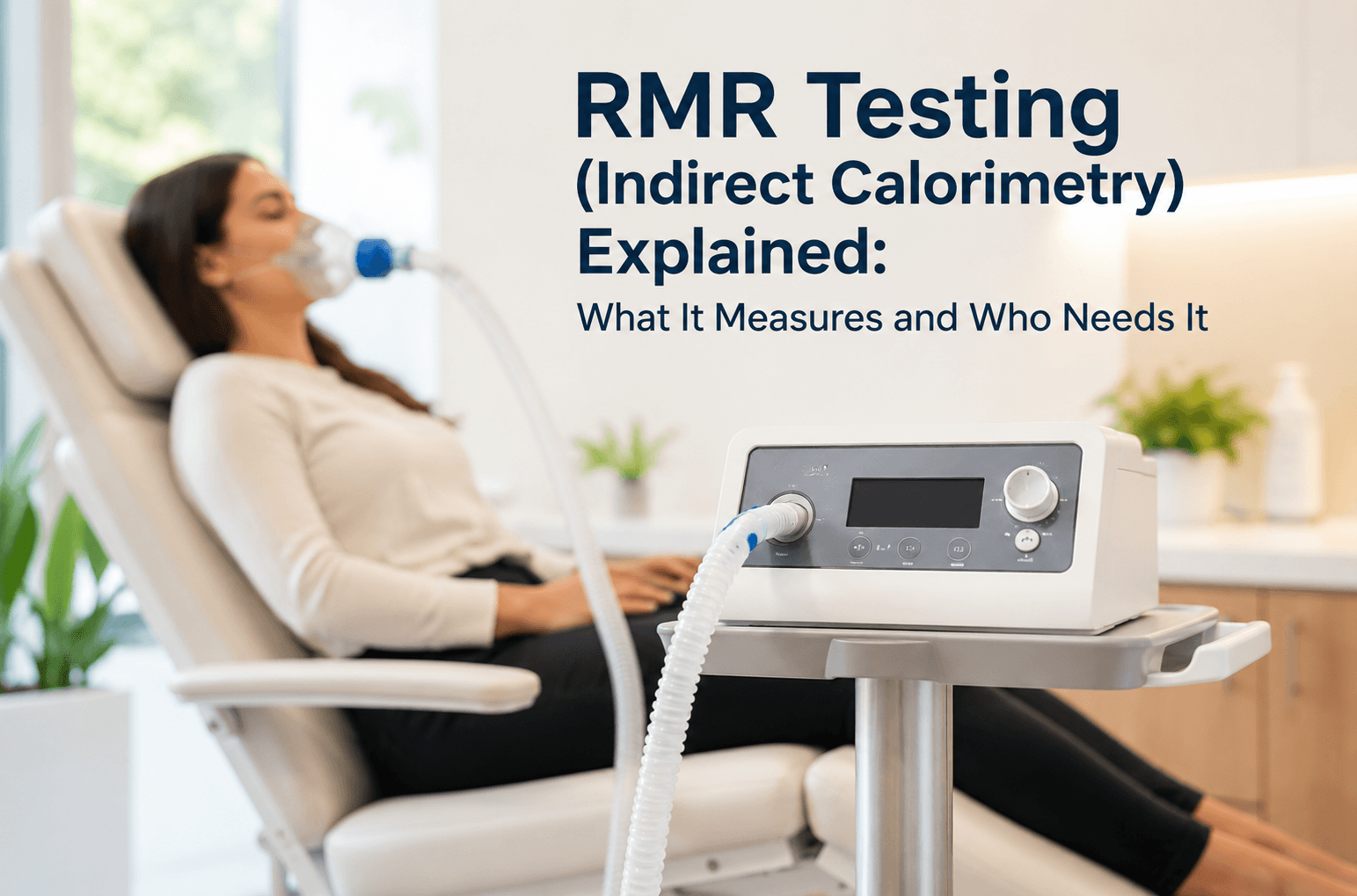
You may sit or recline quietly. A provider places a mask, mouthpiece, or breathing device so the analyzer can measure respiratory gases. You breathe normally while resting. The machine collects oxygen and carbon dioxide data and calculates your resting energy expenditure.
MTC describes the process as a 10-to-15-minute noninvasive test that involves breathing into a tube while at rest.
Afterward, the provider may explain:
- Your measured resting energy expenditure
- How it compares with predicted values
- What the result may mean for calorie planning
- Whether nutrition or activity targets should be adjusted
- Whether repeat testing may be useful later
The test itself is only the beginning. Interpretation is where the number becomes useful.
How Should RMR Results Change Your Plan?
RMR results should usually change your plan through better calibration, not by creating a rigid rule.
A clinician or nutrition professional may use the result to:
Set a more realistic calorie starting point.If a calculator overestimated your needs, the test may explain why a previous target felt ineffective.
Avoid under-eating.If a patient has been eating far below measured needs, the plan may need to focus on adequacy, protein, strength training, and sustainability.
Adjust for plateaus.If weight loss has slowed, measured RMR can help separate true energy needs from assumptions.
Support maintenance planning.After weight loss, resting energy expenditure may be lower than before. Periodic reassessment may help update the plan.
Guide macronutrient and meal planning.RMR does not prescribe protein, carbohydrates, or fat by itself, but it can support broader nutrition planning.
This is where nutritional counseling and coaching can be useful. Maryland Trim Clinic describes nutritional counseling as individualized support that reviews eating habits, medical history, lifestyle factors, calorie goals, macronutrient ratios, portion strategies, and meal timing.
Why RMR Testing Should Not Be Used Alone
Metabolism is only one part of weight management.
If someone is not losing weight, the answer may involve more than resting energy expenditure. Sleep, stress, medications, fluid shifts, hormonal factors, medical conditions, food tracking accuracy, alcohol intake, weekend patterns, physical activity, and changes in lean mass may all matter.
That is why RMR testing pairs well with other progress tools.
Maryland Trim Clinic offers high-precision 3D body scanning, which the clinic describes as a fast, noninvasive scan that reports circumferences, body composition, posture, and segmental analysis. The clinic recommends repeat scans every two to three months for progress tracking.
A scale may say your weight is stable, while a body scan may show circumference changes. A metabolic test may help estimate resting calorie needs, while nutrition counseling helps turn the number into meals. A medical evaluation may identify conditions or medications that affect weight.
The best plan uses the right measurement for the right question.
Metabolic Testing Near Me: What to Ask Before Booking
If you are searching for metabolic testing near me, do not choose a test based only on convenience. Ask what the test measures and how the results will be used.
Before booking, ask:
- Is this indirect calorimetry or an equation-based estimate?
- Does the test measure resting energy expenditure?
- What preparation instructions should I follow?
- How long does the test take?
- Who interprets the results?
- Will I receive calorie and nutrition guidance afterward?
- Should the test be repeated later?
- Are there reasons I should postpone the test?
- Is the service part of a broader medical weight-loss plan?
A good testing experience should not leave you with a number and no next step.
How Often Should You Repeat RMR Testing?
There is no single schedule for everyone.
Maryland Trim Clinic recommends repeating metabolic testing every three to six months or whenever a weight-loss plateau occurs. The clinic also states that metabolic rate can change as weight is lost, which is why periodic testing and adjustments may be useful.
Repeating a test may make sense after:
- Significant weight loss
- A long plateau
- A major change in exercise or strength training
- A transition into weight maintenance
- A major nutrition-plan adjustment
- A clinician wants updated data to guide calorie targets
Testing too often may create noise. Testing at meaningful checkpoints may provide clearer direction.
Patients moving from active weight loss into maintenance may also benefit from a weight loss maintenance program, especially if calorie needs, appetite, activity, or body composition have changed over time. MTC describes its maintenance program as ongoing support, monitoring, accountability, and personalized adjustments as metabolism and lifestyle change.
Getting RMR Testing Support at Maryland Trim Clinic in Laurel, MD
Maryland Trim Clinic provides metabolic testing and analysis in Laurel, MD as part of its broader weight-management services. The clinic describes the test as quick, noninvasive, and designed to measure resting metabolic rate using indirect calorimetry.
Depending on the patient, RMR testing may be combined with medical weight-loss evaluation, nutrition guidance, 3D body scanning, or maintenance planning. The goal is not simply to collect data. The goal is to understand what the data means for food intake, exercise planning, weight-loss expectations, and long-term sustainability.
Patients in Laurel and nearby Maryland communities can contact Maryland Trim Clinic to ask whether a calorie needs test, medical weight-loss consultation, or broader progress-tracking plan may fit their goals.
The Bottom Line
RMR testing with indirect calorimetry measures how much energy your body uses at rest. It can be more individualized than an online calculator, but it is not a complete picture of total daily calorie burn, health status, or weight-loss success.
The test may be most useful for people starting a structured program, dealing with plateaus, entering maintenance, or wanting a clearer calorie planning baseline. The result should be interpreted with medical history, nutrition habits, body composition, activity, and real-world progress.
A measured number is useful only when it leads to a smarter plan.
Frequently Asked Questions
What is indirect calorimetry?
Indirect calorimetry is a method of estimating energy expenditure by measuring oxygen consumption and carbon dioxide production. During an RMR test, you breathe normally while resting, and the device uses respiratory gas data to estimate how many calories your body uses at rest. It is commonly used to measure resting energy expenditure.
How is RMR different from BMR?
RMR and BMR both describe energy used at rest, but BMR is measured under stricter basal conditions. RMR is more commonly measured in practical outpatient settings. Many consumer articles use the terms interchangeably, but patients should ask what their specific test measures and how the result will be interpreted.
Who benefits most from RMR testing?
People who may benefit most include those starting a structured weight-loss plan, experiencing a plateau, transitioning into weight maintenance, questioning generic calorie estimates, or needing a more individualized nutrition baseline. Athletes and people focused on body composition may also find it useful. The test is most valuable when the result will guide an actual plan.
How should RMR results change your plan?
RMR results may help adjust calorie targets, avoid overly aggressive restriction, guide nutrition planning, explain why generic estimates were not helpful, or support maintenance planning after weight loss. The number should not be used alone. It should be combined with activity level, body composition, food intake, medical history, and progress trends.
Is an RMR test the same as a calorie needs test?
An RMR test can be part of a calorie needs assessment, but it does not measure total daily calorie needs by itself. It measures resting energy expenditure. A clinician or nutrition professional may then factor in activity, goals, body composition, and health history to estimate a more practical daily calorie target.
How accurate is RMR testing?
Indirect calorimetry is widely used to measure resting energy expenditure, but accuracy depends on proper equipment, preparation, rest conditions, and test protocol. Eating, caffeine, nicotine, exercise, illness, stress, and poor test conditions may affect results. Following preparation instructions helps make the result more useful.
How long does an RMR test take?
Many outpatient RMR tests take about 10 to 20 minutes, depending on the device and clinic protocol. Maryland Trim Clinic describes its metabolic testing service as a 10-to-15-minute noninvasive test involving breathing into a tube while at rest.
Do you need RMR testing to lose weight?
No, not everyone needs RMR testing to lose weight. Many people can make progress with structured nutrition, activity, medical guidance, and follow-up. RMR testing may be helpful when generic estimates are not enough, progress has stalled, or a more personalized calorie baseline would change the plan.
Understand Your Calorie Needs With Better Data
If you want a clearer picture of your resting calorie needs, Maryland Trim Clinic offers metabolic testing and medical weight-loss support in Laurel, MD. A consultation can help determine whether RMR testing, nutrition coaching, 3D body scanning, or a broader weight-management plan is appropriate for your goals. The right next step depends on your health history, current habits, and what decisions the data will help guide.
Understand Your Calorie Needs With Better Data
If you want a clearer picture of your resting calorie needs, Maryland Trim Clinic offers metabolic testing and medical weight-loss support in Laurel, MD. A consultation can help determine whether RMR testing, nutrition coaching, 3D body scanning, or a broader weight-management plan is appropriate for your goals. The right next step depends on your health history, current habits, and what decisions the data will help guide.