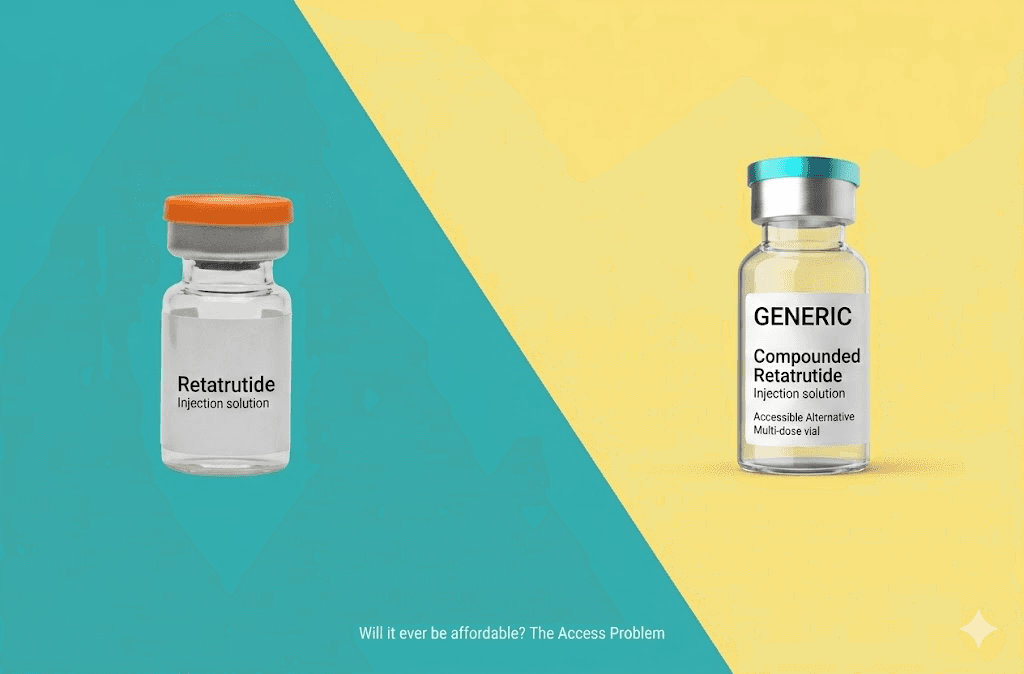
Will Retatrutide Be Affordable? Cost, Insurance & Access

Retatrutide could be the best weight loss drug ever made — and most people may never be able to afford it.
That tension sits at the heart of one of the most pressing conversations in obesity medicine right now. Clinical trial data has positioned retatrutide as a potential game-changer. Participants have lost upward of 24% of their body weight—numbers that dwarf anything previously seen in a pharmaceutical trial. Eli Lilly's triple-hormone agonist targets GLP-1, GIP, and glucagon receptors simultaneously, creating a metabolic effect that researchers describe as unprecedented. The excitement is real, and the science is compelling.
But excitement doesn't pay a $1,000-per-month drug bill.
If the trajectory of every other GLP-1 medication tells us anything, it is that the gap between clinical promise and patient access can be vast, painful, and deliberately engineered. Understanding why retatrutide may remain out of reach for most Americans—and what can be done about it—requires looking at three interconnected problems: the compounding pharmacy landscape, the insurance coverage reality, and the alternative pathways that exist right now.
ACT 1: The Compounding Pharmacy Battlefield
Before retatrutide even receives official U.S. Food and Drug Administration (FDA) approval, a quiet but consequential war is already being fought over who gets to manufacture it.
Compounding pharmacies have served as a critical pressure valve in the GLP-1 access crisis. When semaglutide (Ozempic, Wegovy) and tirzepatide (Mounjaro, Zepbound) faced severe nationwide shortages, the FDA placed them on its official drug shortage list. This designation legally permitted state-licensed compounding pharmacies to produce and sell copies of those medications at significantly lower prices. Patients who couldn't afford the $900–$1,300 monthly brand-name cost found relief through compounded versions priced anywhere from $150 to $400 per month.
Eli Lilly has watched this dynamic closely, and not with approval.
The company aggressively lobbied for tirzepatide's removal from the FDA shortage list. While that decision triggered immediate legal challenges, the direction of travel is clear: brand manufacturers want compounded competition eliminated, and they have significant regulatory leverage to make that happen.
With retatrutide, Eli Lilly has an opportunity to get ahead of the curve. If the company manages supply chains carefully at launch—avoiding the shortage designations that opened the door for compounders in the first place—it can potentially prevent compounded retatrutide from ever achieving a legal foothold.
- No shortage listing = no compounding exemption = no $200-a-month alternative.
For patients sitting on the sidelines waiting for retatrutide because they believe cheaper compounded versions will eventually become available, this is the single most important thing to understand: that door may never open.
ACT 2: What Insurance Coverage Will Actually Look Like
The second layer of the access problem is insurance, and the precedent is genuinely discouraging.
Despite years of clinical evidence demonstrating that obesity is a chronic disease with serious downstream health consequences—type 2 diabetes, cardiovascular disease, sleep apnea—the majority of U.S. insurance plans still classify GLP-1 weight loss medications as "lifestyle" drugs rather than medical necessities. The practical result is that coverage is either denied outright, buried under impossible prior authorization requirements, or capped with lifetime limits.
The Coverage Landscape
- Medicare: Medicare Part D was prohibited by law from covering obesity medications. While recent legislation has made limited headway, coverage remains highly inconsistent.
- Medicaid: Coverage varies drastically by state.
- Employer-Sponsored Plans: These plans, which cover the largest share of insured Americans, have actually been cutting GLP-1 obesity coverage due to the massive cost burden on their formularies.
When Wegovy launched, analysts predicted that treating obesity upfront would prevent more expensive interventions later, pushing insurers toward broader coverage. While the National Institutes of Health (NIH) supports the clinical benefits of these medications, the economic argument has not translated into the sweeping coverage expansion that patients need.
Retatrutide will enter this exact same landscape. Eli Lilly will likely set a launch price in the $1,000–$1,500 monthly range based on competitive positioning. Insurers will also watch efficacy and safety data with intense scrutiny. Drugs with greater effectiveness often carry more complex side effect profiles, and retatrutide's unique glucagon receptor activity raises questions that payers will use as justification for restrictive prior authorization criteria.
Expect requirements like documented BMI thresholds, proof of failed previous weight loss interventions, and mandatory comorbidity diagnoses before coverage kicks in—if it kicks in at all.
ACT 3: The Paths That Remain
So what options actually exist for patients who want access to retatrutide but can't navigate the price wall? The honest answer is limited, but not zero.
Clinical Trials
Retatrutide is still moving through clinical development, meaning trials are ongoing. Participating in a clinical trial provides access to the medication at no cost, alongside close medical monitoring. The tradeoff is significant: trial participation involves randomization (you may receive a placebo), strict eligibility criteria, and frequent clinic visits. ClinicalTrials.gov is the starting point for finding active studies.
Patient Assistance Programs
Eli Lilly operates patient assistance programs for its existing medications, offering income-based discounts and savings cards that reduce out-of-pocket costs. However, these programs typically exclude patients on government insurance (like Medicare and Medicaid), and eligibility thresholds don't always reflect the true financial strain of middle-income households.
Advocacy and Policy Pressure
The longer-term lever is policy change. Legislative efforts aim to mandate Medicare and Medicaid coverage for obesity medications. Growing pressure on employer-sponsored plans, combined with mounting evidence of cardiovascular benefits, is slowly moving the needle. Patients who engage with advocacy organizations amplify the political pressure that ultimately shapes coverage mandates.
Maryland Trim Clinic (MTC) in Laurel, MD
While the wait for affordable retatrutide continues, you do not have to put your metabolic health on hold. Managing obesity requires consistent medical support, and local clinics provide immediate, accessible pathways to care. The Maryland Trim Clinic (MTC) in Laurel, MD, specializes in creating individualized, evidence-based health plans that do not rely on waiting for future pharmaceutical approvals.
MTC focuses on what is available and effective right now. Through their comprehensive medical weight loss program, patients undergo thorough metabolic testing and analysis to understand exactly how their body burns fuel. If prescription medication is appropriate, their medical providers can guide you through accessible GLP-1 weight loss injections or appetite suppressant medications that fit your budget and insurance reality. Furthermore, MTC offers holistic support like nutritional counseling and coaching to ensure your lifestyle changes are sustainable. By partnering with the Maryland Trim Clinic, you can take immediate action on your health goals today with expert, supervised care.
The Uncomfortable Bottom Line
Retatrutide represents a genuine breakthrough in obesity medicine—a drug that delivers results previous medications couldn't approach. But that makes the access problem not just a financial issue, but a public health crisis. The patients who stand to benefit most from dramatic weight loss interventions are often those with the fewest resources to navigate a $1,200-per-month drug bill.
Patients who want retatrutide need to go in clear-eyed: the path to access will likely be harder than the clinical data suggests it should be. The drug may be extraordinary, but the system surrounding it is not.
Frequently Asked Questions
1. When will retatrutide be available to the public? Retatrutide is currently in Phase 3 clinical trials and has not yet received FDA approval. While Eli Lilly has not announced an official projected approval date, industry analysts expect a submission to the FDA within the next one to two years, provided trial results continue to support its safety and efficacy.
2. Will compounded retatrutide be available like compounded semaglutide was? This is highly unlikely. Compounded versions of GLP-1 drugs were permitted strictly because those drugs appeared on the FDA's drug shortage list. Eli Lilly has demonstrated that it will actively work to prevent or remove shortage designations, which legally prohibits compounding pharmacies from producing copies.
3. How much will retatrutide cost per month? No official price has been announced. However, based on the pricing of comparable medications (Wegovy at ~$1,350/month and Zepbound at ~$1,060/month), analysts anticipate retatrutide will be priced similarly, potentially between $1,000 and $1,500 per month at list price.
4. Will insurance cover retatrutide for weight loss? Insurance coverage for weight loss medications is currently highly restrictive. Most private plans, Medicare, and many Medicaid programs have limited or zero coverage for GLP-1 obesity drugs. Retatrutide will likely face the same barriers, requiring prior authorizations, strict BMI thresholds, and documentation of other comorbidities before coverage kicks in.
5. Can I join a clinical trial to access retatrutide for free? Yes, clinical trial participation is one of the few ways to access the drug before approval at no cost. However, trials involve randomization (you might receive a placebo) and demand strict commitment to frequent clinic visits.
6. Does Eli Lilly have a patient assistance program? Eli Lilly operates savings programs for its existing medications, offering income-based discounts for commercially insured patients. A similar program will likely be established for retatrutide upon launch. However, these programs generally exclude people on Medicare, Medicaid, or other government insurance.
7. Is retatrutide more effective than Ozempic or Wegovy? Clinical trial data strongly suggests retatrutide produces significantly greater weight loss. Phase 2 trial participants lost an average of ~24% of their body weight over 48 weeks, compared to roughly 15–17% with semaglutide and 20–22% with tirzepatide. Long-term Phase 3 safety data is still pending.
8. What is the difference between retatrutide and other GLP-1 drugs? Most current GLP-1 medications target one or two hormone receptors (semaglutide targets GLP-1; tirzepatide targets GLP-1 and GIP). Retatrutide is a "triple-agonist," targeting GLP-1, GIP, and glucagon receptors simultaneously. This unique addition of glucagon receptor activation is believed to significantly boost resting metabolic rate and fat burning.
Ready to Take Control of Your Health Today?
Don't wait for future approvals to start prioritizing your metabolic health. Schedule a consultation with a medical weight loss professional today to build an effective, affordable, and personalized care plan based on solutions available right now.