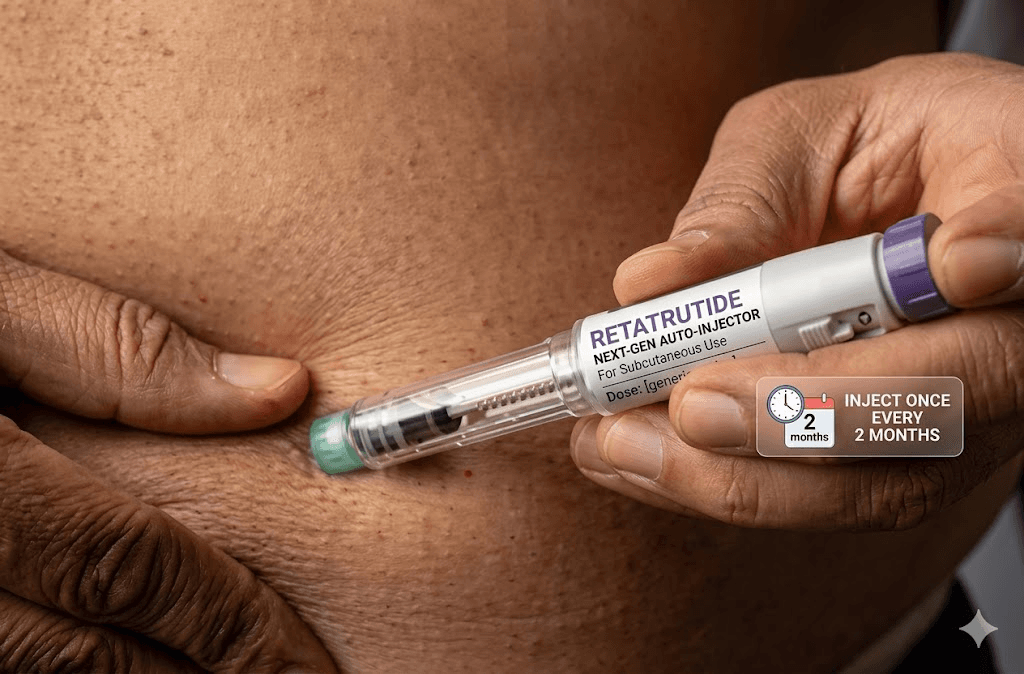
The Future of Retatrutide: 2-Month Injections & Muscle Growth

What if you only had to inject a weight loss medication once every two months, and it actually helped you build muscle instead of losing it?
While most people tracking the GLP-1 space are still focused on weekly dosing protocols, a small cohort of researchers is already looking past that. They are directing their attention toward next-generation retatrutide derivatives that could make weekly injections completely obsolete.
Understanding this horizon requires a look at how peptides work, the limitations of current treatments, and the fascinating intersection of metabolic and musculoskeletal medicine.
The Half-Life Problem — And How Follistatin Solves It
Retatrutide’s current clinical appeal is already formidable. As an experimental "triple agonist" targeting GLP-1, GIP, and glucagon receptors simultaneously, it has shown remarkable fat-loss metrics in early clinical trials. But like many current prescription weight loss medications evaluated by the National Institute of Diabetes and Digestive and Kidney Diseases (NIDDK), it comes with a major practical limitation: its half-life.
At roughly 6 days, retatrutide's half-life still chains users to a weekly injection schedule.
The next frontier involves conjugating (joining) retatrutide’s core peptide structure with carrier domains derived from a protein called follistatin. Here is how this architectural leap works:
- The Follistatin Scaffold: Follistatin is a naturally occurring glycoprotein best known for binding and neutralizing myostatin (a protein that limits muscle growth).
- The Slow Release: Follistatin has an underappreciated structural property—its heparin-binding domains allow engineered peptides to anchor loosely to tissue proteins.
- The Resulting Timeline: When researchers fuse retatrutide analogs to these follistatin scaffolds, the resulting compound does not clear through the kidneys at the usual rate. Instead, it slowly releases into the bloodstream.
Early preclinical modeling suggests these engineered compounds could achieve half-lives in the range of 45 to 60 days. This would effectively turn a weekly injectable into a bi-monthly one.
This isn’t science fiction. Long-acting fatty acid conjugation and albumin-binding strategies have already successfully extended older medications from daily to weekly requirements. Follistatin-based scaffolding is simply the next evolution, applying lessons from biologic engineering to peptide pharmacokinetics.
One Compound, Two Goals — Fat Loss Meets Muscle Gain
Here is where the narrative gets genuinely disruptive. The standard medical criticism of current GLP-1 therapies—even powerful ones like retatrutide—is the risk of lean mass loss.
Rapid fat reduction comes with a metabolic cost. Without aggressive resistance training and high protein intake, some muscle inevitably goes with the fat. For obesity medicine specialists and patients alike, safeguarding skeletal muscle health is a top priority, as muscle is crucial for longevity, mobility, and maintaining a healthy metabolic rate.
Follistatin-retatrutide hybrids don’t just solve the dosing frequency problem. They introduce a powerful secondary biological signal that actively fights muscle loss:
- The Fat Loss Axis: The GLP-1/GIP/glucagon triple agonist activity continues to drive profound fat oxidation, delayed gastric emptying, and appetite suppression.
- The Muscle Preservation Axis: The embedded follistatin fragments inhibit myostatin and activin A. Because these two proteins normally suppress skeletal muscle growth, blocking them effectively releases the "brakes" on muscle development.
The theoretical result—demonstrated in early animal models—is genuine body recomposition rather than simple weight loss. Subjects show preserved or even increased lean mass alongside significant fat reduction. For anyone who has watched a patient lose 40 pounds only to look metabolically fragile and physically weak, this distinction matters enormously.
Furthermore, this dual-signal design has impressive downstream hormonal effects. Myostatin inhibition supports insulin sensitivity independently of GLP-1 receptor activity, potentially creating additive metabolic benefits that neither mechanism could achieve alone. You aren't just stacking two drugs; you are engineering a compound where the mechanisms work synergistically by design.
Timeline and Realistic Expectations
So, when does this actually reach the public? Measured, medically responsible honesty is required here.
As of early 2025, formal Investigational New Drug (IND) filings for follistatin-conjugated GLP-1 derivatives are not yet public. These compounds exist primarily in academic preprints, preclinical animal data, and the quiet pipeline conversations of a few biotech firms.
The Realistic Clinical Timeline:
- Phase I Trials: If initiated in 2025 or 2026, these early safety trials will take time.
- FDA Approval: Under standard, rigorous regulatory pathways, legitimate clinical availability would occur no earlier than 2029 to 2031.
The Danger of the Gray Market: For the gray-market and research-peptide community, the horizon is shorter but incredibly murky. Simplified, unverified analogs mimicking the follistatin scaffold concept could surface from unregulated synthesis labs within 12 to 24 months.
However, patients must exercise extreme caution. Gray-market peptides carry severe risks:
- Unknown Purity: Illicit labs lack FDA oversight, leading to contamination with heavy metals or bacteria.
- Unverified Pharmacokinetics: There is no guarantee these black-market compounds will accurately replicate the slow-release safety profile of properly engineered versions.
- Systemic Risk: Injecting untested myostatin inhibitors could have unforeseen consequences on heart muscle and other organ tissues.
The potential upside of this compound class is genuinely novel—a category-defining shift in what a single injectable can accomplish. But until it passes rigorous human safety trials, it remains an experimental hope rather than a clinical reality. Watch the preprint servers and the biotech funding rounds; the next generation of retatrutide is a research direction with massive momentum.
Maryland Trim Clinic (MTC) in Laurel, MD
While bi-monthly, muscle-building peptides are still years away from FDA approval, you do not have to wait until 2030 to achieve safe, sustainable body recomposition. For those looking to transform their health today, the Maryland Trim Clinic (MTC) in Laurel, MD, offers cutting-edge, medically supervised solutions tailored to your immediate needs.
MTC provides a comprehensive, evidence-based medical weight loss program designed to help patients lose fat while safely preserving lean muscle. Their highly trained medical providers specialize in utilizing currently approved, highly effective GLP-1 weight loss injections, combining them with targeted strategies to mitigate the muscle loss often associated with rapid weight drop. To address the exact "recomposition" goals that next-gen peptides aim for, MTC actively supports patients with advanced muscle building and toning protocols and precise nutritional coaching. By partnering with a premier weight management clinic like MTC, you ensure your health journey is guided by licensed professionals using safe, proven, and currently available medical advancements.
Frequently Asked Questions
Q: What makes next-gen retatrutide derivatives different from current retatrutide? A: Current experimental retatrutide has a half-life of roughly 6 days, requiring weekly injections. Next-generation derivatives use follistatin-based scaffolding to theoretically extend the half-life to 45–60 days. They also incorporate myostatin-inhibiting signals designed to support muscle preservation or growth alongside fat loss.
Q: How does follistatin extend the half-life of a peptide compound? A: Follistatin contains heparin-binding domains that allow engineered peptides to anchor safely to extracellular matrix proteins in your tissues. This utilizes a slow-release "tissue depot" mechanism, significantly slowing renal clearance (how fast the kidneys filter it out) compared to unmodified peptide structures.
Q: Can a single compound really promote both fat loss and muscle gain simultaneously? A: In early preclinical (animal) models, follistatin-retatrutide hybrids show exactly this effect. The GLP-1/GIP/glucagon triple agonist activity drives fat oxidation and appetite suppression, while the embedded follistatin fragments block myostatin—a primary suppressor of skeletal muscle growth.
Q: When might these compounds realistically be available to the public? A: Under standard, safe FDA regulatory pathways, legitimate clinical availability is estimated between 2029 and 2031, assuming Phase I human trials begin in 2025 or 2026. While simplified research-grade analogs may appear in illicit gray-market channels sooner, their safety, purity, and accuracy remain highly dangerous and uncertain.
Q: Is the lean mass loss problem with current GLP-1 drugs significant enough to matter? A: Yes, it is one of the most pressing clinical concerns among obesity medicine specialists. Rapid weight loss from current GLP-1 agonists can include meaningful lean muscle reduction if patients do not engage in aggressive resistance training and high protein intake. A future compound that addresses this at the molecular level represents a massive clinical advancement.
Ready for Sustainable, Medically Supervised Weight Loss?
You don’t have to wait years for experimental drugs to start your health journey. Contact a licensed medical weight loss clinic today to explore safe, FDA-approved treatments tailored to your unique biology and goals.