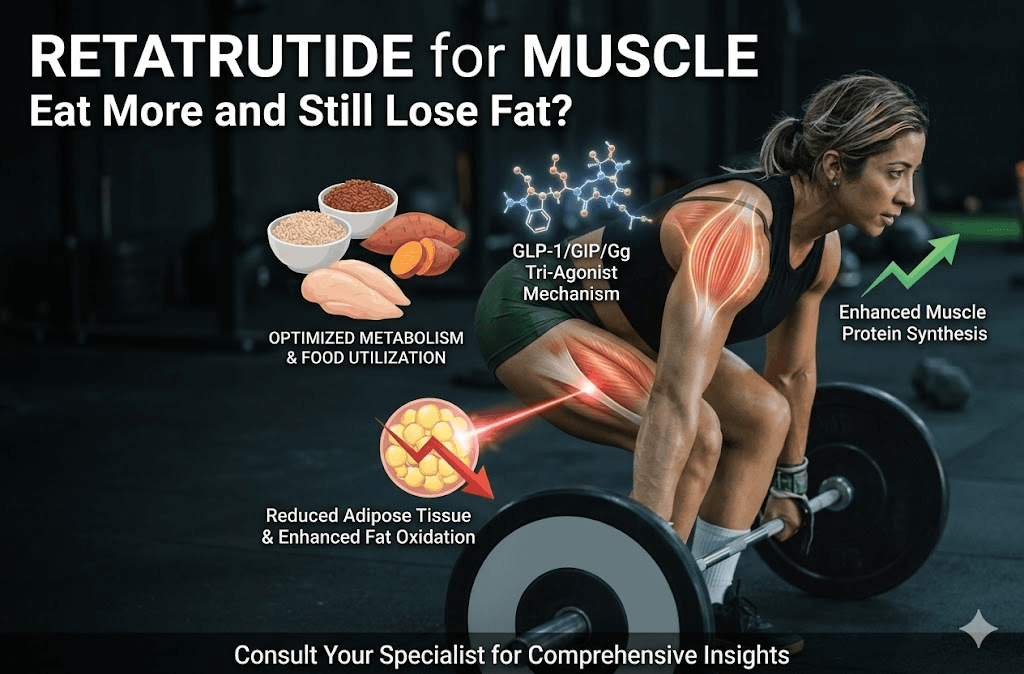
Retatrutide for Muscle: Can You Eat More and Still Lose Fat?

Every GLP-1 drug makes you eat less—but retatrutide might let you eat more and still lose fat.
That single sentence upends the narrative that has made gym-goers and competitive athletes deeply suspicious of the entire class of weight-loss medications. If you have been following the explosion of GLP-1 discourse over the last few years, you already know what the fear looks like: dramatic weight loss that strips away not just fat, but the muscle mass you have spent years building.
With retatrutide, however, the mechanism is genuinely different. That difference matters enormously for anyone whose goals extend beyond simply seeing a lower number on the scale. Let's break down exactly why, starting at the molecular level and working all the way up to what you should actually be doing in the gym and at the dinner table.
The Triple-Agonist Difference — Why Glucagon Changes Everything
To understand why retatrutide behaves differently from semaglutide or tirzepatide, you need to understand what it is actually doing biochemically. Retatrutide is an investigational triple-agonist. It activates three distinct receptors simultaneously: GLP-1, GIP, and glucagon receptors. That third receptor is the key variable that most mainstream coverage glosses over entirely.
GLP-1 receptor agonism, which drugs like semaglutide (Ozempic, Wegovy) rely on almost exclusively, works primarily by suppressing appetite and slowing gastric emptying. You eat less. You feel full faster. The caloric deficit is created almost entirely through reduced intake. The problem for muscle-focused individuals is straightforward: when you eat dramatically less, you consume less protein, and your body's anabolic signaling takes a massive hit.
Glucagon receptor agonism introduces an entirely different pathway. In the context of a triple-agonist formulation, its primary relevant action is dramatically increasing hepatic glucose production and, more importantly, thermogenesis and fatty acid oxidation.
In plain terms, glucagon tells your liver and metabolic machinery to burn more fuel. It increases your resting energy expenditure (your metabolic rate) even when you are not moving.
Why This Matters for Muscle: If your total daily energy expenditure increases through thermogenesis rather than through appetite suppression alone, you can theoretically maintain a higher caloric intake while still achieving a meaningful caloric deficit. More calories consumed means more room for protein. More protein means better muscle protein synthesis signaling. The math on muscle preservation starts to look significantly better.
What the Clinical Data Actually Shows
Retatrutide is still in clinical development and has not yet received FDA approval. However, the Phase 2 trial data published by researchers in the New England Journal of Medicine was striking. Participants receiving the highest dose achieved mean weight loss of approximately 24.2% over 48 weeks.
But the question that matters here isn't total weight loss—it is the composition of that weight loss. While detailed DEXA scan analyses of lean mass versus fat mass are still pending in Phase 3 trials, the data we do have offers meaningful inference points:
- Disproportionate Fat Loss: Investigators noted that the clinical presentation of participants—specifically reduced waist circumference—was consistent with preferential fat loss rather than indiscriminate tissue loss. Visceral fat showed dramatic reductions.
- The Thermogenic Edge: Early mechanistic arguments suggest retatrutide's enhanced thermogenic profile could improve on the ratios seen in dual-agonists. Glucagon's role in lipolysis is well-established; the biochemical literature demonstrates preferential mobilization of fatty acid stores rather than lean tissue.
- Protein Thresholds Still Apply: Critically, even the most favorable drug mechanism cannot fully override inadequate protein intake. Retatrutide does not eliminate the risk of muscle loss—it likely reduces it, but the nutritional homework remains non-negotiable.
Practical Strategies — How to Protect Your Muscle While on Retatrutide
If you are a gym-goer or competitive athlete considering this class of medications, the following framework is built on principles that experienced sports medicine physicians apply with their patients. This is not generic weight-loss advice; it is a muscle-preservation strategy.
Protein: Non-Negotiable and Aggressively Prioritized
The single most important nutritional variable is protein intake. The target for active individuals should be a minimum of 1.6 grams of protein per kilogram of body weight, with most sports nutrition researchers recommending 2.0–2.4 g/kg during active weight-loss phases.
If retatrutide's appetite suppression makes hitting these targets difficult, protein should come first at every meal before any other macronutrient. Prioritize whole food sources: eggs, lean meats, fish, and Greek yogurt.
Resistance Training: The Non-Pharmacological Muscle Signal
No drug replicates the anabolic stimulus of mechanical loading. Resistance training sends a direct muscle-preservation signal that operates independently of your caloric status.
- Maintain Training Frequency: Do not reduce lifting sessions just because you are eating less.
- Prioritize Compound Movements: Squats, deadlifts, presses, and rows recruit the largest muscle mass and generate the strongest systemic anabolic response.
- Track Strength Metrics: Strength retention is your leading indicator for muscle retention. If your lifts are holding within 5–10% of your pre-deficit numbers, your muscle is substantially intact.
Caloric Deficit Depth: Don't Go Deeper Than You Need To
Because retatrutide can produce aggressive weight loss, there is a real risk that appetite suppression pushes users into deficit levels that are counterproductive for body composition. Aim for a deficit of 400–600 calories per day rather than allowing ad libitum (unrestricted) appetite suppression to drive intake dramatically lower.
Sleep, Stress, and Recovery
Testosterone, growth hormone, and IGF-1—the primary anabolic hormones that support muscle retention—are regulated substantially by sleep quality. Aggressive weight-loss phases are metabolically stressful. Prioritize 7–9 hours of quality sleep and manage cortisol through deliberate recovery practices.
Maryland Trim Clinic (MTC) in Laurel, MD
For athletes and active individuals, maintaining muscle mass while losing fat requires exact science, not guesswork. The Maryland Trim Clinic (MTC) in Laurel, MD, specializes in evidence-based body composition strategies tailored for high-performance patients.
Instead of relying on standard BMI charts, MTC utilizes precision 3D body scanning and metabolic testing and analysis to establish your baseline resting metabolic rate and exact lean muscle mass percentage. This data allows their medical providers to customize a highly specific medical weight loss program that ensures you are losing fat, not hard-earned muscle. If you are exploring medication options, MTC can guide you through the use of GLP-1 weight loss injections while simultaneously providing structured muscle building & toning protocols. By partnering with the experts at Maryland Trim Clinic, you ensure your metabolism is optimized for performance, not just weight loss.
The Bottom Line
Retatrutide is not magic, but it is mechanistically distinct. Its glucagon receptor agonism creates a thermogenic pathway that, in theory and early clinical evidence, supports more favorable fat-to-lean-mass loss ratios than pure GLP-1 drugs.
For gym-goers and athletes, this is highly meaningful. It suggests retatrutide may be the most body-composition-compatible weight-loss drug yet developed—provided that nutrition and training are managed deliberately. The drug can do a lot, but it cannot do the heavy lifting for you.
Frequently Asked Questions
1. How is retatrutide different from semaglutide (Ozempic/Wegovy) for muscle preservation? Semaglutide is a pure GLP-1 receptor agonist that works almost exclusively through appetite suppression. Retatrutide is a triple-agonist (GLP-1, GIP, and glucagon). The glucagon component increases thermogenesis and resting energy expenditure, meaning it creates a caloric deficit partially through burning more energy rather than solely through eating less. This allows for higher protein intake, which is a massive advantage for muscle preservation.
2. Is there direct clinical evidence that retatrutide preserves more muscle than other GLP-1 drugs? Definitive head-to-head DEXA-measured lean mass data is pending as retatrutide completes Phase 3 clinical development. However, Phase 2 data showed impressive fat loss, and the mechanistic rationale for improved lean mass preservation via glucagon's thermogenic profile is strongly supported by current U.S. Food and Drug Administration (FDA) drug evaluation standards for metabolic therapies.
3. How much protein should I eat while using retatrutide? Active individuals should target a minimum of 1.6 grams of protein per kilogram of body weight, with an optimal range of 2.0–2.4 g/kg during active weight-loss phases. Because retatrutide severely blunts appetite, protein should always be eaten first at every meal.
4. Should I change my training program while on retatrutide? You should maintain, not reduce, your resistance training frequency. The mechanical stimulus from lifting is a critical muscle-preservation signal. You may need to modestly reduce your overall volume to account for reduced recovery capacity during caloric restriction, but do not sacrifice frequency or intensity.
5. What caloric deficit is appropriate while on retatrutide for body composition goals? Aim for a structured deficit of approximately 400–600 calories per day. Allowing retatrutide to push your caloric intake drastically below this threshold can accelerate lean mass loss.
6. Can retatrutide help me build muscle, or only preserve it? During an active weight-loss phase, building net new muscle mass is extremely difficult due to the anabolic limitations imposed by a caloric deficit. Retatrutide's primary advantage is muscle preservation. However, because its mechanism may allow for relatively higher caloric and protein intake compared to other GLP-1 drugs, it creates a much more favorable environment for body recomposition.
Ready to Optimize Your Body Composition?
Don't risk losing your hard-earned muscle to extreme caloric deficits. Contact a medical weight loss professional today to get a customized, data-driven plan that prioritizes your lean mass and metabolic health.