Retatrutide: The New Weight Loss Drug Explained

Retatrutide: The New Weight Loss Drug Explained
A new experimental weight loss drug just posted trial results that beat everything before it — so why isn't everyone talking about the catch?
If you've been following the explosion of interest in GLP-1 medications over the past few years, you already know the familiar pattern: a new drug arrives, headlines call it a revolution, and then the critical nuances get buried under the hype. Retatrutide is following that exact trajectory, but with a twist: the underlying science genuinely justifies some of the excitement.
However, the catch is real. It deserves just as much attention as the headline numbers. Whether you are currently exploring a medical weight loss program or just keeping up with the latest pharmaceutical developments, this breakdown covers what retatrutide actually is, what the data genuinely shows, and what remains dangerously unknown.
What Makes Retatrutide Different — The Triple Agonist Mechanism
To understand why retatrutide is generating serious scientific interest, you first need to understand what it is doing inside the body that its predecessors do not.
The GLP-1 Foundation
Semaglutide (sold as Ozempic for type 2 diabetes and Wegovy for weight management) works primarily by mimicking glucagon-like peptide-1 (GLP-1). This is a hormone your gut naturally releases after eating. The GLP-1 hormone does three main things:
- Signals the pancreas to produce insulin.
- Slows gastric emptying so you feel full longer.
- Acts on the brain's appetite-regulating centers to reduce hunger.
That single mechanism is enough to produce meaningful weight loss in most patients and has revolutionized medications for weight management.
Adding GIP to the Mix
Tirzepatide (sold as Mounjaro and Zepbound) added a second receptor into the equation: glucose-dependent insulinotropic polypeptide, or GIP. This dual GLP-1/GIP agonism proved more effective than GLP-1 alone. The addition of GIP appears to enhance insulin sensitivity and works synergistically with GLP-1 to amplify the appetite suppression signal.
The Third Receptor: Glucagon
Retatrutide, developed by Eli Lilly, takes the architecture one step further by adding a third target: the glucagon receptor. This makes it the first "triple agonist" to reach human clinical trials.
Glucagon is typically understood as a counter-regulatory hormone. It raises blood sugar when levels drop too low, essentially opposing insulin. On the surface, activating glucagon receptors sounds counterproductive for a drug designed to help people with metabolic dysfunction. But glucagon has a powerful secondary effect: it significantly increases energy expenditure in the liver. When glucagon receptor agonism is layered on top of GLP-1 and GIP activity, the theory is that you are not just reducing caloric intake through appetite suppression — you are also increasing the rate at which the body burns energy, particularly fat stored in the liver.
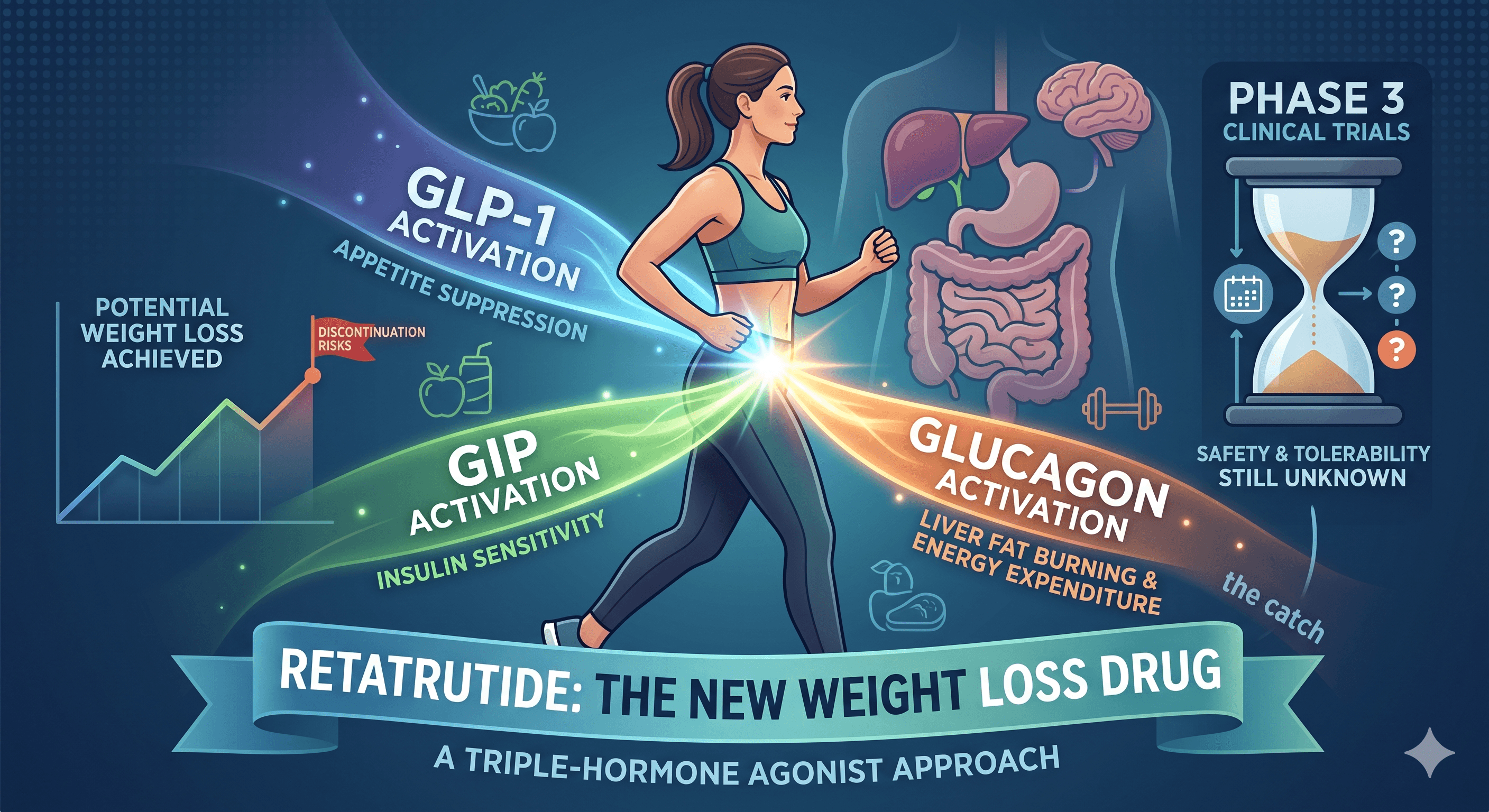
The Retatrutide Three-Pronged Approach:
- GLP-1 activation: Reduces appetite, slows digestion, improves insulin secretion.
- GIP activation: Enhances insulin sensitivity, works synergistically with GLP-1 on appetite centers.
- Glucagon activation: Increases hepatic energy expenditure and fat oxidation.
What the Trial Data Actually Shows
In June 2023, results from a Phase 2 clinical trial of retatrutide were published in The New England Journal of Medicine, one of the most rigorously peer-reviewed journals in the medical field. The numbers were striking enough to make even veteran obesity researchers pause.
The Headline Figures
In the 48-week trial, participants receiving the highest dose of retatrutide (12 mg) lost an average of 24.2% of their body weight.
To put that percentage into perspective against currently approved medications:
- Semaglutide (Wegovy): Produced approximately 14.9% average body weight reduction in its landmark STEP 1 trial over 68 weeks.
- Tirzepatide (Zepbound): Produced approximately 20.9% average body weight reduction in its SURMOUNT-1 trial over 72 weeks.
- Retatrutide: Produced 24.2% average body weight reduction in just 48 weeks.
Critically, the retatrutide data also showed that weight loss had not plateaued by the end of the trial period. Participants were still actively losing weight at week 48.
For a person weighing 250 pounds, a 24% reduction represents roughly 60 pounds. Historically, results of this magnitude were almost exclusively seen following bariatric surgery.
The Dose-Response Relationship
The trial enrolled adults with obesity (BMI ≥ 30) or overweight (BMI ≥ 27) with at least one weight-related health condition, excluding people with type 2 diabetes.
One of the most promising findings was a clear dose-response pattern. As doses increased (from 1 mg to 4 mg to 8 mg to 12 mg), weight loss outcomes increased in a consistent progression. In pharmacology, this is a highly positive signal. It suggests the drug is working reliably through its intended mechanism rather than producing results via a confounding factor.
The Honest Reality Check — What Remains Unknown
Medical Disclaimer: The information provided in this article is for educational purposes only. Retatrutide is an investigational drug and is not currently FDA-approved. Always consult a licensed healthcare provider for medical advice and before starting any weight loss program.
Here is where the hype needs a reality check. Phase 2 trials are proof-of-concept studies. They do not constitute FDA approval, nor do they provide long-term safety data. While retatrutide passed Phase 2 impressively, Phase 3 is where the full clinical picture will be drawn.
Side Effects: Familiar but Potentially Amplified
The side effect profile of retatrutide largely mirrors its GLP-1 predecessors. The most commonly reported adverse events include:
- Nausea
- Vomiting
- Diarrhea
- Constipation
These are generally dose-dependent and most pronounced during the dose escalation phase. However, because retatrutide adds glucagon receptor agonism, there are new variables to consider. Glucagon increases heart rate and can impact cardiac function. The trial also noted increases in certain liver enzymes in some participants, requiring further investigation.
What Phase 3 Must Answer
Phase 3 trials must enroll thousands of diverse participants and track them for years. The critical unknowns include:
- Cardiovascular Safety: The glucagon component requires independent, long-term evaluation in populations with a high risk of heart disease.
- Weight Regain: Like all GLP-1s, stopping the medication will likely result in weight regain. The specific magnitude and speed of this regain with retatrutide are unknown.
- Muscle Mass Preservation: Aggressive weight loss often reduces lean muscle. It is unclear how retatrutide's glucagon component affects overall muscle composition at scale.
- Long-Term Tolerability: We need to know if the side effects remain manageable over years of continuous use.
Approval Timeline and Gray-Market Dangers
If Phase 3 trials succeed, realistic estimates place a potential FDA submission in the 2026–2027 range.
In the meantime, dangerous compounded versions of various experimental peptides circulate online. These "gray-market" drugs bypass FDA manufacturing and purity standards. Anyone considering clinical weight management should always work with a licensed healthcare provider at an established medical clinic rather than sourcing unregulated substances online.
Maryland Trim Clinic (MTC) in Laurel, MD
While experimental drugs like retatrutide undergo years of rigorous testing, safe, FDA-approved medical weight loss options are available right now. For individuals looking for professional guidance, the Maryland Trim Clinic (MTC) in Laurel, MD, offers a comprehensive, physician-guided approach to sustainable health.
At MTC, the focus is on personalized, medically responsible care rather than chasing unregulated online trends. A comprehensive clinic understands that medication is only one piece of the puzzle. MTC provides access to FDA-approved GLP-1 weight loss injections administered under strict clinical supervision to monitor your body's response safely.
Because sustainable weight loss requires a holistic foundation, MTC pairs these medical interventions with expert nutritional counseling and coaching. This ensures patients preserve lean muscle mass, adopt healthy dietary habits, and build a lifestyle capable of maintaining long-term results. By working with the team at Maryland Trim Clinic, patients receive the exact kind of evidence-based, compassionate care necessary for successful metabolic health management.
The Bottom Line
Retatrutide is the most pharmacologically ambitious weight loss drug to reach human trials, and its 24% average body weight reduction at 48 weeks is legitimately impressive. The triple agonist mechanism offers a coherent, powerful scientific rationale.
But Phase 2 is just the beginning. The long-term safety profile remains a question mark, and pharmacy availability is years away. Furthermore, the fundamental reality of obesity treatment remains unchanged: it requires lifelong, holistic management rather than a quick fix. Retatrutide deserves serious attention, but it requires serious scrutiny in equal measure.
Frequently Asked Questions
Q: What is retatrutide and how is it different from Ozempic or Mounjaro?
A: Retatrutide is an experimental triple agonist drug developed by Eli Lilly that targets three receptors: GLP-1, GIP, and glucagon. Ozempic targets only GLP-1, while Mounjaro targets GLP-1 and GIP. The addition of glucagon is designed to increase energy expenditure in the liver.
Q: How much weight loss did retatrutide show in clinical trials?
A: In a 2023 Phase 2 trial, participants on the highest dose (12 mg) lost an average of 24.2% of their body weight over 48 weeks, and they had not yet reached a weight loss plateau.
Q: Is retatrutide FDA approved?
A: No. Retatrutide has only completed Phase 2 trials. It requires extensive Phase 3 trials before an FDA application can be submitted, meaning approval is likely several years away (estimates point to 2026–2027 at the earliest).
Q: What are the side effects of retatrutide?
A: The most common side effects are gastrointestinal (nausea, vomiting, diarrhea, constipation). Because of the glucagon component, it also caused an increased heart rate in some participants.
Q: Can I get retatrutide now?
A: No legitimate, regulated form of retatrutide is available to the general public. Compounded or gray-market versions sold online carry severe safety risks and bypass all FDA purity standards.
Q: Why does retatrutide target the glucagon receptor if glucagon raises blood sugar?
A: While glucagon raises blood glucose, it also significantly increases fat oxidation and energy expenditure in the liver. When combined with GLP-1 and GIP (which manage insulin and appetite), the net result is an increased metabolic rate without problematic blood sugar spikes.
Q: Who would be a candidate for retatrutide if it gets approved?
A: It would likely be indicated for adults with obesity (BMI ≥ 30) or adults with overweight (BMI ≥ 27) plus at least one weight-related health condition (like hypertension or sleep apnea), mirroring the guidelines for current GLP-1 medications.
Ready to Take Control of Your Health?
You don't have to wait years for experimental drugs to achieve your health goals. Safe, proven, and medically supervised weight loss solutions are available right now. Reach out to Maryland Trim Clinic in Laurel, MD, to build a personalized plan that prioritizes your long-term success and safety.