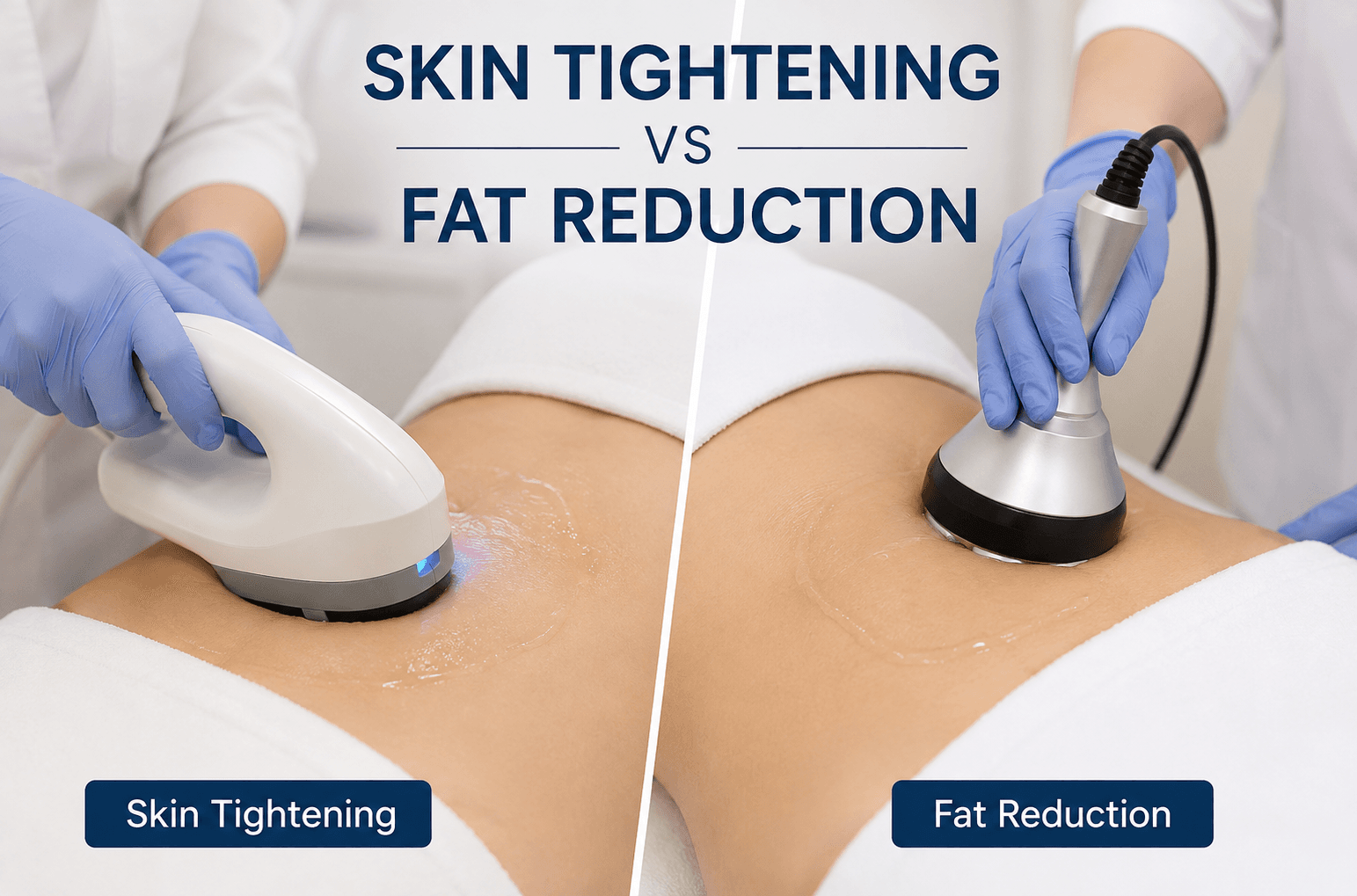
Skin Tightening vs Fat Reduction: Key Differences


Body contouring can be confusing because many treatments are marketed with similar words: sculpting, tightening, toning, smoothing, fat reduction, skin firming, inch loss, and cellulite improvement. But these treatments do not all solve the same problem.
That is why understanding skin tightening vs fat reduction matters before you book a consultation. Fat reduction targets localized fat under the skin. Skin tightening targets laxity, firmness, and collagen-related support. Muscle toning targets muscle contraction and definition. Cellulite treatments target dimpling and texture. These concerns can overlap, but they are not identical. If you choose a fat-reduction treatment when your main concern is loose skin, the result may disappoint you. If you choose skin tightening when the main issue is a stubborn fat pocket, the change may be too subtle.
Skin Tightening vs Fat Reduction: The Quick Answer
Fat reduction treatments are designed to reduce small, localized fat bulges. Skin tightening treatments are designed to improve mild to moderate skin laxity by warming tissue and supporting collagen-related remodeling. Fat reduction does not automatically tighten skin, and skin tightening does not remove major fat pockets or large folds of loose skin.
Medical Disclaimer: Educational information only. Results and suitability vary. A clinician should review your history, contraindications, and goals before recommending any medical/aesthetic treatment or prescription.
The Main Difference: Fat, Skin, Muscle, and Texture
Before comparing devices, separate the concern.
What you notice
What it may be
Better starting point
Pinchable pocket on abdomen, flanks, thighs, arms, or back
Localized subcutaneous fat
Fat-reduction consultation
Crepey, soft, or mildly sagging skin
Skin laxity
Skin-tightening consultation
Hanging folds after major weight loss
Significant loose skin
Medical review or surgical consultation may be needed
Low firmness or reduced tone
Muscle tone and body composition
Strength training, muscle-toning support, nutrition
Dimpled texture on thighs or buttocks
Cellulite
Cellulite-focused evaluation, realistic expectations
Unsure whether it is fat or skin
Mixed concern
3D scanning, measurements, and clinician assessment
The FDA explains that non-invasive body contouring procedures are done on the skin surface, do not involve incisions, and do not remove tissue from the body. The same FDA resource also distinguishes non-invasive body contouring from tummy-tuck surgery, which removes excess skin, and liposuction, which removes fat through a small incision.
That distinction is the foundation of a realistic treatment plan.
What Fat Reduction Treatments Can Do
Fat reduction treatments target small pockets of fat that remain despite nutrition, activity, medical weight loss, or body-composition work. They are not designed for overall weight loss or obesity treatment.
The American Academy of Dermatology states that good candidates for non-invasive fat removal usually have a small fat bulge that remains despite diet and exercise, with weight within the normal range for height. AAD also notes that a dermatologist may recommend another procedure first if loose skin is present.
Cryolipolysis, or fat freezing
Cryolipolysis uses controlled cold to damage fat cells in a targeted area. The FDA describes cryolipolysis as using cold temperatures intended to kill fat cells and reduce visible fat bulges without surgery. The damaged fat is then slowly cleared by the body’s immune system, usually within two to three months.
Best for:
- Pinchable fat
- Small, specific bulges
- Stable weight
- Patients who understand gradual change
Limits:
- Does not treat obesity
- Does not remove loose skin
- May not be appropriate for certain cold sensitivity conditions
- Results vary
- Side effects can include redness, swelling, bruising, discomfort, numbness, or skin discoloration
Laser lipolysis fat reduction
Laser lipolysis uses light-based energy to heat tissue. FDA guidance notes that carefully controlled infrared light can heat tissue under the skin and is thought to damage fat cells and shrink connective strands under the skin. It also warns that light-based energy procedures can injure the eyes, so protective goggles should be used.
Best for:
- Localized fat concerns
- Patients who prefer non-surgical options
- Selected treatment areas after consultation
Limits:
- Not a replacement for weight loss
- Results are gradual
- Not the same as surgical liposuction
- Light sensitivity, tanning, skin pigment concerns, and medications may affect candidacy
Ultrasound fat reduction
Ultrasound uses sound-wave energy. FDA guidance explains that therapeutic ultrasound may be applied to the skin surface, and when the energy enters the fat layer, it can cause fat cells to rupture and may reduce circumference in the treated area. The FDA also warns that ultrasound can cause burns and requires full contact with the skin, usually with ultrasound gel.
Best for:
- Localized circumference reduction
- Non-surgical body contouring
- Selected areas after evaluation
Limits:
- Not ideal for major weight loss
- Not for open wounds, compromised skin surfaces, certain active implants, or metal under the skin in the treatment area
- Temporary redness, swelling, discomfort, blisters, burns, or nerve-related risks may occur
Radiofrequency fat reduction
Radiofrequency, or RF, uses heat. FDA guidance states that RF energy can cause heating in the fat layer under the skin and in the strands connecting skin to fat. Some procedures may temporarily improve cellulite appearance or reduce body circumference in the treated area, and some may make skin look or feel tighter because of skin shrinking or collagen increases.
Best for:
- Localized shaping
- Patients with mixed fat and mild laxity concerns
- Combination plans where heat-based support is appropriate
Limits:
- Results vary by device and patient
- Not all RF devices are intended for cosmetic use
- Heat-related discomfort, redness, swelling, bruising, burns, or other complications may occur
- It should not be treated as a weight-loss solution
What Skin Tightening Treatments Can Do
Skin tightening treatments target laxity, texture, and firmness, not major fat volume. Many devices work by heating deeper tissue layers to support collagen-related remodeling over time.
The American Society for Dermatologic Surgery states that many non-invasive skin-tightening devices use laser energy, radiofrequency energy, ultrasound energy, or combinations of these energies to heat skin tissue. ASDS also notes that results from collagen-stimulating skin-tightening procedures can often take at least three to six months to appear.
Radiofrequency skin tightening
Radiofrequency skin tightening uses controlled heat to warm tissue and support collagen activity. Maryland Trim Clinic’s non-invasive body contouring and sculpting page describes RF treatments as heating deeper skin layers to stimulate collagen production, improving skin texture and firmness, and being suitable for mild to moderate skin laxity.
Best for:
- Mild to moderate looseness
- Skin texture concerns
- Areas where firmness, not fat loss, is the main goal
- Patients who understand results are gradual
Limits:
- Does not remove hanging skin folds
- Does not replace surgery for major laxity
- May need multiple sessions
- Results vary by skin quality, age, weight stability, area, and device
Ultrasound-based tightening
Some ultrasound treatments focus energy deeper in tissue to create a tightening or firming response. This is different from ultrasound fat reduction, even though both use ultrasound energy. The depth, settings, device, and treatment goal matter.
Best for:
- Mild lifting or firmness goals
- Selected areas with skin laxity
- Patients who want gradual non-surgical tightening
Limits:
- Not a fat-loss treatment
- Not for major loose skin
- Can involve discomfort
- May not be appropriate for patients with certain implants, metal, open wounds, or compromised skin surfaces in the treatment area
RF microneedling
RF microneedling combines microneedles with radiofrequency energy. It is more commonly discussed for skin texture, acne scars, crepiness, and laxity, depending on the device and body area. It may be useful for selected skin-quality concerns, but it is not the same as reducing a fat pocket.
Best for:
- Skin texture
- Mild laxity
- Crepey areas
- Selected patients with appropriate skin and medical history
Limits:
- Not a major fat-reduction treatment
- Not appropriate for all skin types or medical histories
- Requires careful provider selection and aftercare
- Risks may include redness, swelling, discomfort, pigment changes, infection, or scarring
Does Fat Reduction Tighten Skin Automatically?
No. Fat reduction does not automatically tighten skin. Some heat-based devices may provide mild skin-firming support, but reducing fat volume can make laxity more noticeable if the skin cannot retract well.
This is one of the most common body-contouring mismatches. A person may think, “I need to remove fat,” when the main issue is actually loose skin. Another person may think, “I need skin tightening,” when the main issue is a localized fat bulge.
A good consultation should ask:
- Is the concern pinchable fat, loose skin, cellulite, muscle tone, or a mix?
- Is your weight stable?
- How much skin elasticity is present?
- Have you recently lost weight?
- Is the area crepey, folded, or just fuller than desired?
- Would fat reduction make the skin look looser?
- Should skin tightening come before or after fat reduction?
AAD notes that when loose skin is also present, a dermatologist may recommend treating that first before non-invasive fat removal to help improve the outcome.
Cryolipolysis vs RF: Which One Fits Which Goal?
Cryolipolysis and RF are often compared, but they do not work the same way.
Question
Cryolipolysis
Radiofrequency
Main energy
Cold
Heat
Main target
Pinchable fat cells
Fat layer, skin, connective tissue, depending on device
Skin tightening effect
Not the main purpose
May support mild tightening with some devices
Best fit
Small fat bulges
Mild laxity, contouring, cellulite appearance, mixed concerns
Timeline
Gradual, often months
Gradual, often multiple sessions
Main limitation
Does not tighten loose skin
Does not remove major fat or skin folds
Common sensations
Cold, pulling, numbness
Warmth, heat, mild discomfort
Maryland Trim Clinic’s page describes cryolipolysis as controlled cooling for fat pockets, laser lipolysis as heat-based fat-cell targeting with results appearing in six to twelve weeks, RF treatments as collagen-supportive for skin texture and firmness, and ultrasound as sonic-wave fat reduction.
What Tightens Skin, and What Only Smooths It Temporarily?
The phrase “tightens skin” can be used too loosely. Some treatments may temporarily reduce puffiness or improve texture. Others may stimulate collagen-related remodeling over time. None can remove major excess skin without surgery.
Goal
More realistic option
What to expect
Dry or rough skin
Moisturizer, barrier support
Better feel, not structural tightening
Crepey texture
Skin care, RF, ultrasound, RF microneedling
Gradual improvement, variable response
Mild laxity
RF or ultrasound tightening
Firmer appearance over months
Moderate laxity
Combination plan may be discussed
Improvement may be limited
Hanging skin folds
Surgical consultation
Non-invasive treatment usually cannot remove folds
Cellulite dimples
Cellulite-specific therapies
Improvement may be temporary or partial
The FDA states that non-invasive procedures do not remove tissue from the body. That means a device cannot cut away extra skin the way surgery can.
What Results Are Realistic for Cellulite?
Cellulite is not simply “fat.” It involves the way skin, connective bands, fat, and tissue structure interact. That is why fat reduction alone may not erase dimpling.
Mayo Clinic states that some cellulite treatments may improve the skin’s appearance, but results are not always immediate or long lasting, and a combination of treatments may produce the most satisfying results. The American Academy of Dermatology also notes that some cellulite treatments can make cellulite less noticeable, at least for a while, and that several treatments may be needed for some approaches.
Realistic cellulite expectations:
- Texture may improve, not disappear.
- Results may be temporary.
- More than one session may be needed.
- Fat reduction alone may not fix dimples.
- Skin quality, genetics, hormones, age, and body composition matter.
- Maintenance may be needed.
Maryland Trim Clinic’s Ultimate Contour Body Sculpting page lists cellulite appearance support among possible common concerns reviewed during consultation and describes ultrasound and radiofrequency support for targeted areas and smoother-looking skin. Results vary by individual factors.
What Is Downtime Like?
Downtime depends on the technology, treatment area, intensity, patient sensitivity, and whether treatments are combined.
For non-invasive fat removal, AAD states that most people return to everyday activities immediately after treatment, although swelling, bruising, discomfort, burning, stinging, or temporary pins-and-needles sensations may occur. It also notes that most people need more than one session, with sessions often lasting 30 to 90 minutes.
Maryland Trim Clinic describes many non-invasive body-contouring treatments as outpatient and often completed in under an hour, with no surgery and little downtime. MTC’s Ultimate Contour page also describes the treatment as non-surgical, comfortable, convenient, and designed with minimal downtime for many patients.
Possible short-term effects may include:
- Redness
- Swelling
- Bruising
- Warmth
- Tenderness
- Numbness
- Firmness
- Tingling
- Temporary discomfort
More serious or longer-lasting complications can happen, depending on device and patient factors. FDA guidance emphasizes that each technology has its own risks, certain patients may not be treated safely, and patients should discuss personal risk factors, benefits, limits, and alternatives with a healthcare provider.
How to Choose the Right Treatment Path
A better decision starts with diagnosis of the concern, not the device name.
Choose fat reduction discussion if:
- You are near a stable weight.
- The area is pinchable.
- The concern is a small bulge, not loose hanging skin.
- You understand this is not weight loss.
- You can maintain results with nutrition and activity.
Choose skin tightening discussion if:
- The area looks loose, crepey, or mildly sagging.
- You have mild to moderate laxity.
- You are not expecting skin removal.
- You are patient with gradual collagen-related change.
- You understand multiple sessions may be needed.
Choose body-composition support if:
- Your weight is still changing.
- You are not sure whether the issue is fat or skin.
- You want to track progress beyond the scale.
- You are working on muscle tone and fat loss together.
Maryland Trim Clinic’s 3D body scanning service captures circumference, cross-sectional data, body fat percentage, muscle mass, posture, and segmental analysis. The clinic states scans can be repeated every two to three months to visualize fat loss and muscle gain.
Choose surgical consultation if:
- You have large hanging folds of skin.
- Loose skin causes rashes, hygiene issues, or mobility problems.
- You want skin removed, not only firmed.
- Non-invasive treatments are unlikely to match your goal.
Non-invasive devices can help selected concerns, but they should not be expected to do the work of major weight loss or surgery.
How Maryland Trim Clinic Evaluates Body Contouring Goals in Laurel, MD
Maryland Trim Clinic in Laurel, MD offers body-contouring support within a broader medical weight-loss and wellness model. This is helpful because many patients are not sure whether their concern is fat, skin laxity, muscle tone, cellulite, or a combination.
Relevant MTC services may include:
- Non-Invasive Body Contouring & Sculpting
- Ultimate Contour Body Sculpting
- 3D Body Scanning
- Medical Weight Loss Program
- Nutritional Counseling and Coaching
- Weight Loss Maintenance Program
MTC’s non-invasive body-contouring page describes options including cryolipolysis, HIFEM, laser lipolysis, radiofrequency, and ultrasound. It also states that ideal candidates are usually close to their ideal weight, have realistic expectations, and understand that the treatments are not a weight-loss substitute.
MTC’s Ultimate Contour page states that consultation includes reviewing goals, health history, treatment areas, expectations, personalized recommendations, measurements, and follow-up or maintenance guidance.
A consultation may help answer:
- Is my concern fat, loose skin, cellulite, muscle tone, or a mix?
- Would fat reduction make loose skin more obvious?
- Do I need skin tightening before fat reduction?
- Is my weight stable enough for contouring?
- How should results be measured?
- How much downtime should I expect?
- Are there health or skin factors that affect candidacy?
- Would body scanning help track progress?
Maryland Trim Clinic is located at 9201 Cherry Lane, Laurel, MD 20708, and lists its phone number as (301) 960-4811.
The Bottom Line
Skin tightening and fat reduction are related, but they are not the same. Fat reduction targets small areas of localized fat. Skin tightening targets mild to moderate laxity and firmness. Cellulite treatments focus on texture and dimpling. Muscle-toning treatments focus on contraction and definition.
The right plan depends on what is actually causing the concern. If the issue is pinchable fat, fat reduction may be discussed. If the issue is mild laxity, radiofrequency skin tightening or ultrasound-based tightening may be more relevant. If the issue is major loose skin, non-invasive treatment may not be enough. If the issue is mixed, a combination plan may make more sense.
A responsible consultation should match the technology to your tissue type, health history, weight stability, expectations, and maintenance plan.
Frequently Asked Questions
Does fat reduction tighten skin automatically?
No. Fat reduction does not automatically tighten skin. Some heat-based technologies may support mild tightening, but removing or reducing fat volume can make loose skin more noticeable if skin elasticity is limited. AAD notes that if loose skin is present, a clinician may recommend treating that first before non-invasive fat removal.
Which treatments target skin laxity?
Treatments that target skin laxity often use radiofrequency, ultrasound, laser energy, RF microneedling, or combination approaches to warm tissue and support collagen-related remodeling. ASDS states that most non-invasive skin-tightening devices use laser, radiofrequency, ultrasound, or combined energy to heat skin tissue, with results often taking three to six months.
What results are realistic for cellulite?
Realistic cellulite results are usually improvement, not total removal. Mayo Clinic notes that some treatments may improve the appearance of cellulite, but results are not always immediate or long lasting, and combinations may be more satisfying. Cellulite is affected by skin structure, connective tissue, fat distribution, genetics, hormones, and body composition.
What is downtime like?
Downtime is usually minimal for many non-invasive fat-reduction and skin-tightening treatments, but temporary redness, swelling, bruising, tenderness, numbness, warmth, burning, or tingling may occur. AAD states that most people return to everyday activities immediately after non-invasive fat removal, though multiple sessions are often needed.
Is cryolipolysis better than RF?
Cryolipolysis and RF are used for different goals. Cryolipolysis uses controlled cold to target pinchable fat. RF uses heat and may be used for circumference reduction, cellulite appearance, or skin tightening depending on the device and settings. The better option depends on whether the concern is fat, skin laxity, texture, or a combination.
Can skin tightening remove loose skin after major weight loss?
Non-invasive skin tightening may improve mild to moderate laxity, but it cannot remove large folds of loose skin. The FDA states that non-invasive body contouring procedures do not remove tissue from the body. Patients with significant loose skin after major weight loss may need a surgical consultation if removal is the goal.
Is laser lipolysis fat reduction the same as liposuction?
No. Non-invasive laser lipolysis uses light-based energy to heat tissue and is different from surgical liposuction, which removes fat through a small incision. FDA guidance distinguishes non-invasive body contouring from surgical procedures such as liposuction and tummy-tuck surgery.
How do I know whether I need fat reduction or skin tightening?
A clinician can help determine whether the concern is pinchable fat, skin laxity, cellulite, muscle tone, or a mix. Measurements, photos, physical evaluation, and 3D body scanning may help clarify the issue. Maryland Trim Clinic’s 3D scanning service tracks circumference, body fat percentage, muscle mass, posture, and segmental data.
Match the Treatment to the Real Concern
If you are comparing skin tightening vs fat reduction, Maryland Trim Clinic can help you evaluate what is actually changing your body shape. A consultation may review your treatment area, skin laxity, fat distribution, cellulite appearance, weight stability, 3D scan data, and goals so you can choose a realistic, medically reviewed path instead of guessing based on device names.
Match the Treatment to the Real Concern
if you are comparing skin tightening vs fat reduction, Maryland Trim Clinic can help you evaluate what is actually changing your body shape. A consultation may review your treatment area, skin laxity, fat distribution, cellulite appearance, weight stability, 3D scan data, and goals so you can choose a realistic, medically reviewed path instead of guessing based on device names.