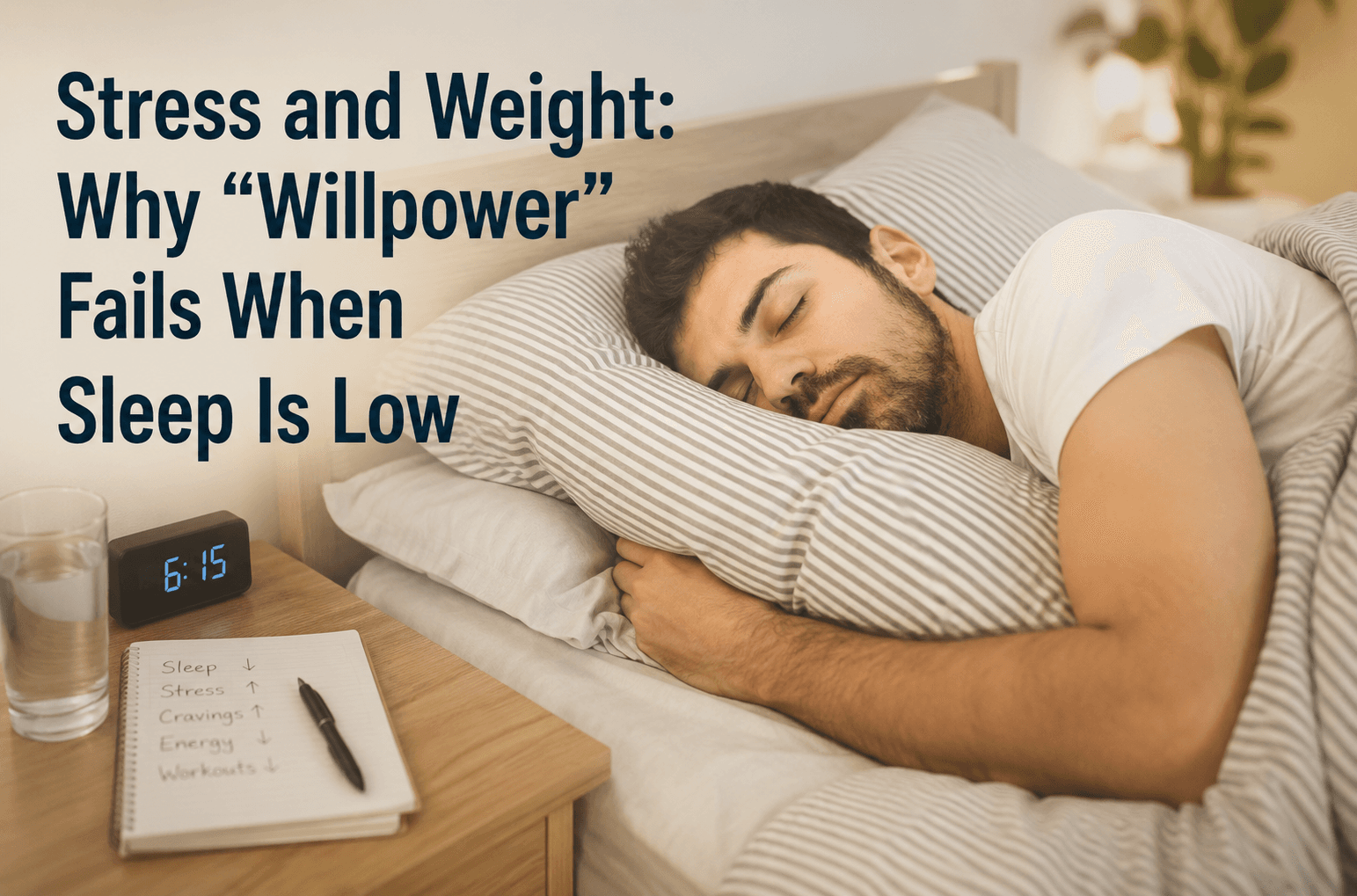
Stress and Weight Loss Sleep: Why Willpower Fails

Many people blame themselves when weight loss feels harder during a stressful season. They assume the problem is discipline, motivation, or willpower. But if sleep is low, the body is not operating under normal conditions. Hunger can feel stronger. Cravings can feel louder. Energy drops. Workouts become harder. Food decisions become more reactive.
That is why stress and weight loss sleep belong in the same conversation. Poor sleep and stress can change appetite, food choices, daily movement, and consistency. They do not make weight loss impossible, and they do not remove personal choice. But they can make the “just try harder” approach fail because the body is asking for quick energy, comfort, and rest at the same time.
Stress, Weight Loss, and Sleep: The Quick Answer
Low sleep can make weight loss harder by increasing hunger, cravings, fatigue, stress reactivity, and impulsive food decisions. It may also reduce daily movement and make tracking less consistent. A realistic plan does not rely on willpower alone. It improves sleep routine, stress coping, meal structure, and medical support when symptoms suggest a sleep disorder.
Medical Disclaimer: Educational information only. Not a substitute for professional medical advice, diagnosis, or treatment. For personalized guidance, consult a qualified clinician.
Why Willpower Feels Different When Sleep Is Low
Willpower is not a stable fuel source. It is affected by sleep, stress, hunger, environment, emotions, and fatigue.
When sleep is low, the body often pushes toward fast relief. That may look like:
- More cravings for sweet, salty, or high-fat foods
- More snacking at night
- Less patience with meal prep
- Skipping workouts because energy is low
- More caffeine, which may then affect sleep again
- Less movement outside formal exercise
- More emotional or stress eating
- Lower tolerance for discomfort
A review on sleep deprivation and weight loss reports that disturbed sleep patterns are linked with increased energy intake, including more snacking and preference for foods high in fat and carbohydrates. It also discusses changes in hormones and metabolic regulation that may make weight control harder when sleep is poor. (pmc.ncbi.nlm.nih.gov)
This does not mean every craving is caused by sleep loss. It means sleep should be treated as part of the weight-management foundation, not an optional extra.
How Low Sleep Increases Cravings
Sleep affects appetite signals, reward pathways, and decision-making. That is why cravings can feel stronger after a short night.
Ghrelin and leptin may shift
Ghrelin is often described as a hunger-related hormone. Leptin is involved in fullness signaling and energy balance. A well-known sleep restriction study in healthy young men found that short sleep was associated with lower leptin, higher ghrelin, and increased hunger and appetite. (pubmed.ncbi.nlm.nih.gov)
These hormones are not the whole story, but they help explain why “I should not be hungry” may not match what your body feels after repeated short nights.
The brain may seek quick energy
When you are tired, high-calorie foods can feel more appealing because they offer fast reward and energy. This is not simply a lack of character. It is a predictable pattern when the brain is sleep deprived and stressed.
Late nights create more eating opportunities
Being awake longer creates more time to snack. It also places more eating decisions in the evening, when many people are tired, less structured, and closer to stress triggers.
Fatigue lowers movement
Poor sleep can reduce non-exercise movement, including steps, errands, chores, and active breaks. Even if your workout plan stays the same, your daily activity may quietly drop.
Maryland Trim Clinic’s medical weight loss program includes personalized nutrition and exercise planning, behavioral support, and ongoing monitoring, which can help patients identify patterns like low sleep, low movement, and stress eating before cutting calories too aggressively. (marylandtrimclinic.com)
Cortisol and Cravings: What Stress Really Does
Cortisol is one of the body’s stress hormones. It helps the body respond to challenges, but chronic stress can affect appetite, eating behavior, sleep, and energy.
The strongest practical takeaway is not “cortisol automatically stores belly fat.” That is too simplistic. A more careful explanation is that stress can influence food choices, cravings, reward-driven eating, sleep quality, and metabolic health in ways that make weight management harder.
A review on stress and eating behaviors notes that stress can increase the desire for highly palatable foods in some people and may contribute to obesity risk through interactions between stress biology, reward pathways, and eating behavior. (pmc.ncbi.nlm.nih.gov)
Another study on stress, cortisol, and appetite-related hormones found that chronic stress, cortisol, insulin, leptin, ghrelin, and food cravings can be part of the pathway associated with future weight change, although individual responses vary. (pmc.ncbi.nlm.nih.gov)
That nuance matters. Some people eat more under stress. Some eat less. Some eat normally during the day, then overeat at night. A good plan looks for your pattern.
The Sleep-Deprivation Weight-Loss Loop
Poor sleep and stress can create a loop that looks like this:
Pattern
What may happen next
Stress increases
Sleep gets shorter or more fragmented
Sleep gets worse
Hunger, cravings, and fatigue increase
Fatigue rises
Steps, workouts, and meal prep decline
Cravings increase
More snacking, takeout, or emotional eating
Progress slows
Stress and self-blame increase
Self-blame rises
Sleep and food choices worsen again
This is why “try harder” often does not fix the problem. The loop needs interruption at several points: sleep timing, food structure, movement, stress recovery, and sometimes medical evaluation.
What Is a Realistic Sleep Goal?
For most adults, the goal is at least 7 hours of sleep in a 24-hour period. CDC states that adults 18 to 60 need 7 or more hours per night, while adults 61 to 64 generally need 7 to 9 hours and adults 65 and older need 7 to 8 hours. (cdc.gov)
A realistic sleep goal is not always “sleep perfectly tonight.” For many people, the better goal is to gradually increase sleep opportunity.
Start with one of these:
- Move bedtime 15 to 30 minutes earlier.
- Keep wake time consistent most days.
- Create a 20-minute wind-down routine.
- Stop work email and stressful scrolling earlier.
- Reduce caffeine after midday.
- Get morning light exposure.
- Keep the bedroom cooler, darker, and quieter.
- Avoid using alcohol as a sleep aid.
CDC’s adult sleep data also notes that the recommended amount for adults is at least 7 hours and identifies less than 7 hours as short sleep duration. (cdc.gov)
The goal is consistency, not perfection.
A Clinician-Style Sleep Routine for Weight Loss
A sleep routine for weight loss should be simple enough to repeat.
Step 1: Set a sleep opportunity window
Choose a realistic time to be in bed, not just a time you hope to fall asleep.
If you currently sleep 5.5 to 6 hours, do not demand 9 hours immediately. Start by adding 20 to 30 minutes.
Step 2: Protect the final hour
The final hour before bed should reduce stimulation.
Try:
- Dim lights
- Put phone away or use strict app limits
- Prepare tomorrow’s breakfast or lunch
- Take a warm shower
- Read something calm
- Stretch gently
- Write down tomorrow’s top tasks
- Avoid arguments or work decisions close to bedtime when possible
Step 3: Stabilize caffeine
Caffeine can help fatigue, but late caffeine can worsen sleep for some people. Try setting a caffeine cutoff and observe whether sleep improves.
Step 4: Plan the evening meal
Going to bed either too hungry or overly full can disrupt sleep. A balanced evening meal with protein, fiber, and enough calories may reduce late-night grazing.
Maryland Trim Clinic’s nutritional counseling and coaching can help patients build meal timing and protein strategies that support fullness without relying on late-night snacking. (marylandtrimclinic.com)
Step 5: Track the right signals
For two weeks, track:
- Sleep duration
- Wake time consistency
- Evening cravings
- Step count
- Hunger level
- Late-night eating
- Energy
- Weight trend
Do not use sleep tracking to create anxiety. Use it to see patterns.
Stress Eating: How to Tell If It Is Showing Up
Stress eating is not always dramatic. It may look small, frequent, and easy to miss.
Signs include:
- Craving food when you are emotionally overloaded
- Eating while standing, scrolling, or rushing
- Snacking after a stressful call or workday
- Eating past fullness because you feel tense
- Using food as the only reliable break
- Feeling guilty afterward
- Night eating after a day of restriction
- Strong cravings on low-sleep days
Stress eating does not mean you lack discipline. It means food has become one coping tool. The goal is to add more tools, not shame yourself for having one.
A 60-second stress eating pause
Before eating, ask:
Am I physically hungry?
What am I feeling?
Did I sleep poorly last night?
Would a balanced meal help, or am I looking for relief?
What is one non-food action I can take first?
Possible actions include a 5-minute walk, water, a protein snack, a short prayer or breathing pause, a shower, journaling, or calling someone supportive.
Why Cutting Calories First Can Backfire
When sleep is low, cutting calories more aggressively can worsen the problem.
A harsh calorie cut may increase:
- Hunger
- Cravings
- Irritability
- Low energy
- Poor sleep
- Binge-restrict patterns
- Reduced daily movement
NIDDK lists many factors that can affect weight, including lifestyle habits, sleep, medicines, health problems, family history, and environment. (niddk.nih.gov)
That means the next step during a plateau or stressful season may not be “eat less.” It may be to stabilize sleep, increase protein, restore steps, reduce evening grazing, and improve stress recovery.
Maryland Trim Clinic’s metabolic testing and analysis can help some patients better understand resting energy needs, while 3D body scanning can help track body-composition and measurement changes beyond daily scale fluctuations. (marylandtrimclinic.com)
Small Changes That Improve Sleep Fast
Sleep routines work best when they are small and repeatable.
Try choosing two changes for the next 7 days:
Problem
Small change to try
Staying up too late
Set a “screens down” alarm 30 minutes before bed
Racing thoughts
Write tomorrow’s top 3 tasks before getting into bed
Late caffeine
Set a caffeine cutoff and track sleep quality
Night cravings
Plan a protein-rich dinner and a structured snack if needed
Stress after work
Take a 10-minute walk before entering evening routine
Irregular schedule
Keep wake time within the same 60-minute window most days
Too much light
Dim lights and reduce bright screens in the last hour
Waking unrefreshed
Ask a clinician about sleep apnea or other sleep disorders
Do not try to rebuild your entire life in one week. Sleep improves when the routine is boring enough to repeat.
When Should You Talk to a Clinician About Sleep Issues?
Talk to a clinician if poor sleep is persistent, worsening, or affecting your safety, health, mood, work, or weight-management progress.
You should especially seek medical guidance if you have:
- Loud snoring
- Waking up gasping or choking
- Morning headaches
- Excessive daytime sleepiness
- Trouble staying awake while driving
- High blood pressure
- Frequent nighttime urination
- Insomnia lasting several weeks
- Restless legs or unusual nighttime movements
- Depression, anxiety, or severe stress
- Weight regain or plateau with major fatigue
- Dependence on alcohol or sedatives to sleep
Sleep apnea is especially important in weight-management care because it can affect energy, blood pressure, metabolic health, and daytime functioning. A clinician may recommend sleep evaluation, lab testing, medication review, or referral depending on symptoms.
How Maryland Trim Clinic Supports Stress-Aware Weight Management
Maryland Trim Clinic in Laurel, MD offers medical weight-loss and wellness services that can help patients move beyond the willpower-only model.
Depending on the patient, support may include:
- Medical weight loss care
- Nutritional counseling and coaching
- GLP-1 weight-loss injections when clinically appropriate
- Metabolic testing and analysis
- 3D body scanning
- Weight loss maintenance support
MTC’s services page describes physician-led weight-loss care with health assessments, customized nutrition and exercise plans, behavioral and emotional support, prescription medications when appropriate, and ongoing monitoring. It also describes maintenance support that can address triggers, stress, and emotions that may lead to overeating. (marylandtrimclinic.com)
For someone struggling with low sleep and stress eating, a clinician-led plan may review:
- Meal timing
- Protein and fiber intake
- Evening cravings
- Step count
- Sleep duration
- Medication side effects
- Weight plateau patterns
- Emotional eating triggers
- Whether sleep symptoms need medical evaluation
Patients in Laurel and nearby Maryland communities can contact Maryland Trim Clinic to discuss weight-management support that considers the full pattern, not just the scale.
The Bottom Line
Weight loss during stress and low sleep is not only a willpower problem. Sleep loss can increase hunger, cravings, fatigue, stress reactivity, and impulsive food decisions. Stress can push some people toward comfort foods, irregular meals, or late-night eating. Together, they make consistency harder.
The solution is not to blame yourself or slash calories. Start by protecting sleep opportunity, building a repeatable evening routine, planning protein-rich meals, restoring daily movement, and asking for help if sleep problems are persistent or suggest sleep apnea.
A weight-loss plan works better when it respects biology instead of fighting it.
Frequently Asked Questions
How does low sleep increase cravings?
Low sleep can increase cravings by affecting hunger hormones, reward pathways, fatigue, and decision-making. A sleep restriction study found that short sleep was associated with lower leptin, higher ghrelin, and increased hunger and appetite. Poor sleep may also make high-calorie foods feel more rewarding and reduce energy for meal planning or movement. (pubmed.ncbi.nlm.nih.gov)
What’s a realistic sleep goal?
For most adults, a realistic sleep goal is at least 7 hours in a 24-hour period. CDC states that adults ages 18 to 60 need 7 or more hours per night, while older adults generally need 7 to 9 or 7 to 8 hours depending on age. If you are far below that, start by adding 15 to 30 minutes. (cdc.gov)
What small changes improve sleep fast?
Small changes that may improve sleep include setting a consistent wake time, dimming lights before bed, reducing late caffeine, stopping screens earlier, writing down tomorrow’s tasks, planning dinner and snacks, keeping the bedroom cool and dark, and taking a short walk after work. Choose one or two changes first so the routine is sustainable.
When should you talk to a clinician about sleep issues?
Talk to a clinician if sleep problems last several weeks, affect daytime function, or include loud snoring, gasping, morning headaches, high blood pressure, frequent nighttime urination, extreme daytime sleepiness, or trouble staying awake while driving. These can suggest sleep apnea or another sleep disorder that needs evaluation.
Can stress make weight loss harder?
Stress can make weight loss harder by changing eating patterns, increasing cravings for highly palatable foods in some people, disrupting sleep, reducing meal planning, and making emotional eating more likely. Research reviews describe stress as a factor that may influence reward-driven eating and obesity risk, but individual responses vary. (pmc.ncbi.nlm.nih.gov)
Does cortisol cause belly fat?
Cortisol is involved in the body’s stress response, but it is too simplistic to say cortisol alone causes belly fat. Chronic stress may influence appetite, cravings, sleep, activity, and metabolic health in ways that support weight gain for some people. A clinician can help evaluate whether stress, sleep, hormones, medications, or medical conditions are affecting progress.
Should I cut calories when sleep is poor?
Not always. If sleep is poor, aggressive calorie cutting may increase hunger, cravings, fatigue, and low movement. It may be more effective to improve sleep routine, protein intake, meal timing, and steps first. If weight loss remains stalled, calorie targets can be reviewed with better data and clinician guidance.
Can GLP-1 medication help stress eating?
GLP-1 medication may reduce appetite or “food noise” for some patients, but it does not automatically treat stress, poor sleep, emotional eating, or sleep apnea. Patients using GLP-1 medication still benefit from nutrition planning, sleep support, side-effect monitoring, and behavioral strategies. Medication decisions should be clinician-guided.
Build a Weight-Loss Plan That Respects Sleep and Stress
If stress, cravings, poor sleep, or fatigue are making weight loss harder, Maryland Trim Clinic can help you review the full pattern. A consultation may include nutrition support, medical weight-loss evaluation, GLP-1 discussion when appropriate, metabolic testing, progress tracking, and strategies for stress-aware maintenance. The goal is a plan that supports consistency without relying on willpower alone.
Build a Weight-Loss Plan That Respects Sleep and Stress
If stress, cravings, poor sleep, or fatigue are making weight loss harder, Maryland Trim Clinic can help you review the full pattern. A consultation may include nutrition support, medical weight-loss evaluation, GLP-1 discussion when appropriate, metabolic testing, progress tracking, and strategies for stress-aware maintenance. The goal is a plan that supports consistency without relying on willpower alone.