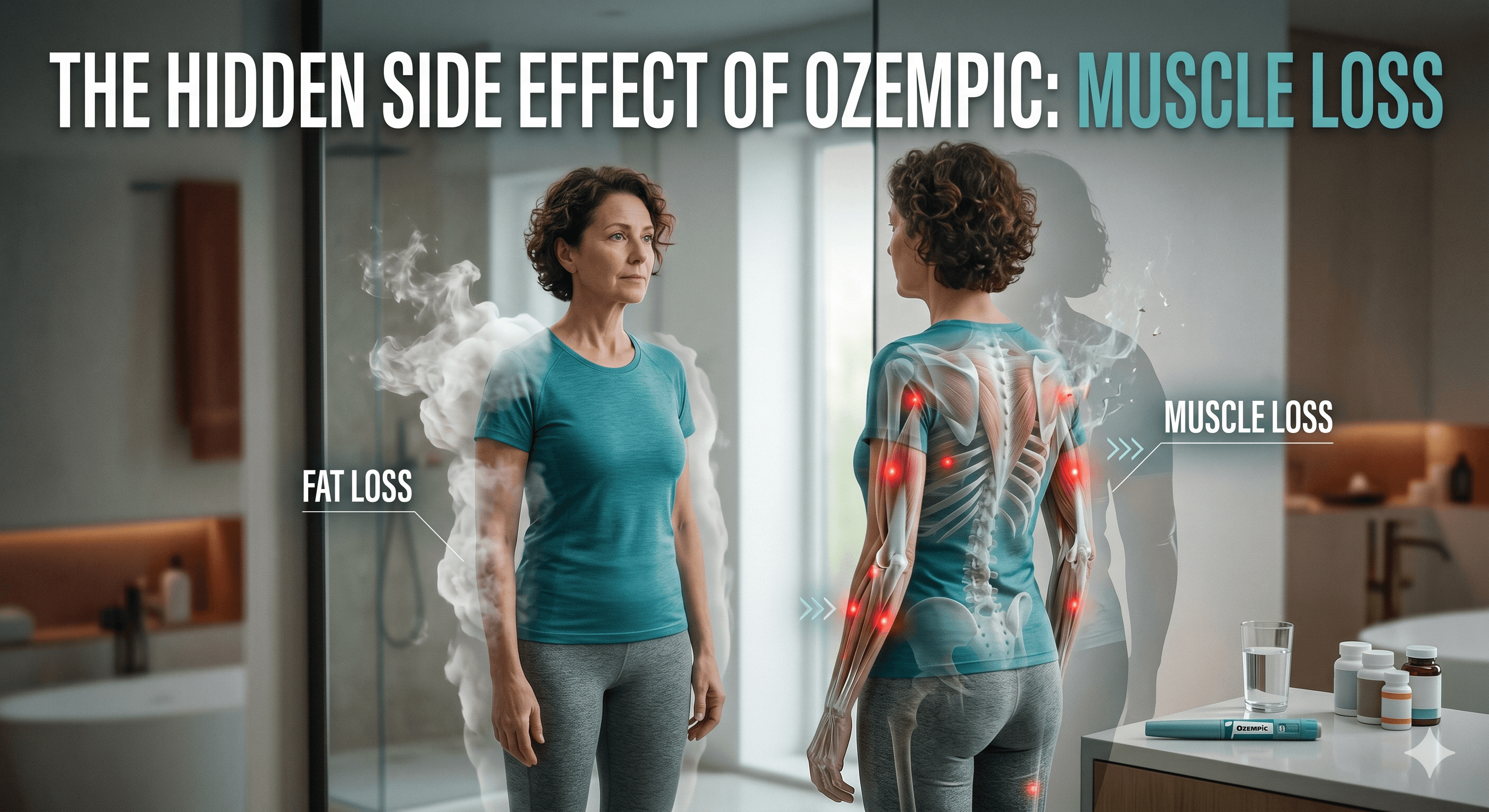
The Hidden Side Effect of Ozempic: Muscle Loss & How to Prevent It

Ozempic's Hidden Muscle Loss Problem
Medical Disclaimer: The content provided in this article is for educational and informational purposes only and does not constitute medical advice. Always consult your physician or a qualified healthcare provider before starting any new medication, diet, or exercise program, especially when managing complex metabolic conditions.
You're losing weight on Ozempic—but you may be losing the wrong kind.
The scale is moving. Your clothes are fitting differently. Your doctor is nodding approvingly at your chart. By every visible measure, the medication is working. But beneath that encouraging surface, a quieter and far more consequential process may be underway—one that most patients never hear about in the exam room, and one that the headlines celebrating GLP-1 medications rarely address.
A significant portion of the weight lost on semaglutide (the active ingredient in Ozempic and Wegovy) is not fat. It's muscle. And losing muscle while chasing fat loss isn't just a cosmetic concern. It is a metabolic time bomb that can make you worse off in the long run than when you started.
ACT 1: The Drug Doesn't Choose What You Lose
To understand the problem, you first need to understand how Ozempic works in the body.
The Mechanics of GLP-1s
Semaglutide is a GLP-1 receptor agonist—a medication that mimics a gut hormone your body naturally releases after eating. It slows gastric emptying, reduces appetite, and signals to your brain that you're full. The result is a significant and sustained reduction in calorie intake, often achieved without the white-knuckle willpower that conventional dieting requires.
This is genuinely remarkable. Clinical trials, including the landmark STEP trials, showed that patients on semaglutide lost an average of 15% of their body weight over 68 weeks—results that were previously only achievable through bariatric surgery. The drug deserves its reputation as a breakthrough.
The Reality of Rapid Weight Reduction
But here's the uncomfortable truth that tends to get buried in the enthusiasm: whenever the human body loses weight rapidly through caloric restriction alone—regardless of the mechanism causing that restriction—it does not selectively burn fat. It burns a combination of fat and lean mass, which includes your precious muscle tissue.
Clinical data bears this out starkly. Studies examining body composition changes in semaglutide users have found that roughly 25% to 40% of total weight lost can be lean mass, including skeletal muscle. A 2023 analysis published in Diabetes, Obesity and Metabolism noted that GLP-1 drugs produce lean mass losses comparable to, or in some cases exceeding, those seen with very-low-calorie diets—diets long criticized by physicians for exactly this reason.
Consider this scenario:
- The Loss: You lose 30 pounds on Ozempic.
- The Breakdown: 20 pounds of fat, but 10 pounds of muscle.
- The Reality: You haven't had the health transformation you think you've had. You've had a partial one—and you've potentially set yourself up for a harder road ahead.
The drug label won't warn you about this in bold print. Your prescribing physician may not have the time to bring it up. The social media transformation posts certainly won't mention it. But your physiology doesn't care about the narrative.
ACT 2: Why Losing Muscle Is a Metabolic Crisis in Slow Motion
To grasp why muscle loss matters so profoundly, you need to understand muscle's role in your metabolism—a role most people dramatically underestimate.
The BMR Trap
Skeletal muscle is highly metabolically expensive tissue. Just by existing, it burns calories. Your basal metabolic rate (BMR)—the number of calories your body burns at complete rest to keep you alive—is heavily determined by how much muscle mass you carry. The more muscle you have, the higher your BMR. The less muscle you have, the fewer calories your body burns doing absolutely nothing.
This creates a vicious and well-documented cycle:
The Drop: You lose weight on Ozempic, including a meaningful percentage of muscle mass.
The Slowdown: Your BMR drops because your body now has less metabolically active tissue to maintain.
The Stop: You stop taking Ozempic—whether by choice, due to cost, supply issues, or side effects.
The Rebound: Your appetite returns, often aggressively, because semaglutide's suppression of hunger is entirely drug-dependent.
The Surplus: You regain weight—but now you're doing so with a lower metabolic rate than before you started. Your body needs fewer calories to function. Even eating at what used to be your maintenance level now creates a surplus.
The Aftermath: The weight comes back faster and as fat, since the muscle you lost is not automatically rebuilt. Fat regain, however, is rapid.
This phenomenon—sometimes called "weight cycling" or colloquially "yo-yo dieting"—is not new. Researchers have documented it in the context of crash diets for decades. What is new is that millions of people are now entering this cycle via a pharmaceutical pathway, often without any guidance on how to prevent the muscle loss component.
A pivotal 2024 study following patients one year after discontinuing semaglutide found that most participants had regained two-thirds of their lost weight within 12 months—and the regained weight was disproportionately fat rather than lean mass. The muscle deficit persisted. The fat returned. The net body composition outcome for many patients was arguably worse than their pre-drug baseline.
Compounding Risks as We Age
Beyond weight regain, muscle loss carries additional long-term risks that compound with age:
- Accelerated Decline: Sarcopenia (age-related muscle loss) is already a significant health concern for adults over 40. Accelerating it through drug-induced dieting can advance functional decline by years.
- Worsened Insulin Resistance: This is paradoxically exacerbated by muscle loss, since skeletal muscle is the body's primary site for glucose disposal. Losing muscle makes blood sugar regulation harder—a cruel irony for a drug primarily prescribed to type 2 diabetics and prediabetics.
- Reduced Bone Density: Bone density is mechanically stimulated by muscle. Less muscle means less mechanical load on bones, which can contribute to reduced bone mineral density over time.
- Chronic Fatigue: Fatigue and physical weakness are commonly reported by long-term Ozempic users. While often attributed to reduced calorie intake, muscle atrophy is a significant and underacknowledged contributor.
None of this is an argument against GLP-1 medications. For many patients—particularly those with obesity-related cardiovascular disease, type 2 diabetes, or severe metabolic dysfunction—the benefits of significant weight loss clearly outweigh the risks of lean mass reduction. The problem isn't the drug. The problem is the absence of a protocol to protect muscle while using it.
ACT 3: The Non-Negotiable Safeguards — Protein and Iron
The good news is that the solution is well-understood, evidence-backed, and entirely within your control. Two interventions, used together, can dramatically reduce muscle loss during GLP-1 therapy: "pumping iron" (resistance training) and maintaining high protein intake. Neither is optional. Both are synergistic.
Pumping "Iron": The Muscle Preservation Signal
Resistance training—lifting weights, using resistance bands, or doing bodyweight exercises like push-ups and squats—sends a powerful anabolic signal to your muscles: adapt, grow, or at minimum, survive. When your body is in a caloric deficit (which Ozempic essentially enforces), it will preferentially preserve muscle tissue that is being actively used and challenged.
This is not a subtle effect. A 2022 meta-analysis in the British Journal of Sports Medicine found that resistance training during caloric restriction reduced lean mass loss by approximately 50% compared to diet alone. That is a dramatic intervention available to virtually everyone without a prescription.
Best Practices for GLP-1 Users:
- Frequency: Train at minimum 3 times per week, targeting all major muscle groups.
- Movement Choice: Prioritize compound movements: squats, deadlifts, rows, presses, lunges. These recruit the largest muscle groups and generate the strongest preservation signal.
- Progression: Progressive overload matters. Gradually increasing the weight or resistance over time keeps the adaptation signal strong.
- Accessibility: You do not need to be an athlete, nor do you need an expensive gym membership. But you do need to make resistance training a non-negotiable component of any GLP-1 treatment plan.
Cardiovascular exercise, while valuable for heart health, does relatively little to prevent muscle loss during a caloric deficit. It is not a substitute for resistance work. Walking more is better than nothing, but it will not save your muscle mass.
Protein Intake: The Structural Raw Material
Muscle is made of protein. Repairing, maintaining, and building muscle requires a continuous dietary supply of amino acids. During caloric restriction—including the restriction driven by Ozempic's appetite suppression—most people eat less of everything, including protein. This is particularly dangerous because the body's need for protein does not decrease when calories drop; it arguably increases.
Target Guidelines:
- Minimum Target: 1.2 grams of protein per kilogram of body weight per day. For a 180-pound (82 kg) person, that's approximately 98 grams of protein daily.
- Optimal Target: 1.6 to 2.2 g/kg/day for those actively resistance training—roughly 130 to 180 grams daily for the same individual.
Quick Swaps for High-Quality Protein:
- If you usually eat toast for breakfast → Try eggs or Greek yogurt.
- If you typically snack on crackers → Swap for cottage cheese or edamame.
- If your lunch is a standard salad → Add a generous portion of chicken breast, salmon, or tofu.
- If you struggle with appetite → Supplement with whey or plant-based protein shakes.
Given that Ozempic dramatically reduces appetite and food volume, protein should be the first macronutrient priority at every meal—not an afterthought. Many users, eating far less food than they used to, inadvertently become protein-deficient. They're consuming 1,200 to 1,500 calories daily but filling those calories with convenient, low-protein foods. The result is accelerated muscle catabolism occurring simultaneously with drug-driven weight loss.
The Combined Protocol
Used together, resistance training and adequate protein intake do not just reduce muscle loss—they can, in some patients, allow for muscle maintenance or even modest muscle gain during GLP-1 therapy. A 2023 clinical trial examining structured resistance training combined with high-protein intake in semaglutide users found that participants in the intervention group retained significantly more lean mass and showed superior body composition outcomes compared to semaglutide-only controls, despite similar total weight loss.
The takeaway is actionable and urgent: Ozempic is a tool for weight loss, not a complete metabolic strategy. Treating it as the latter ignores the body composition reality that will determine your long-term health outcomes far more than the number on the scale.
Maryland Trim Clinic (MTC) in Laurel, MD
Navigating the complexities of GLP-1 therapy requires more than just a prescription—it requires a comprehensive strategy. For those in the Baltimore-Washington metropolitan area, checking into the Maryland Trim Clinic (MTC) in Laurel, MD, offers a supportive environment to manage these metabolic shifts safely. As a specialized clinic, MTC focuses on holistic health rather than just tracking the scale.
Through their tailored medical weight loss program, patients receive guidance that prioritizes preserving lean mass while safely reducing body fat. A critical component of this process is monitoring your actual body composition. Facilities like MTC utilize advanced tools, such as 3D body scanning, to track your precise fat-to-muscle ratio, ensuring that your weight loss is coming from the right places. If you are exploring medication options or want to ensure your weight loss journey is metabolically sound, consulting a dedicated comprehensive wellness center can provide the exact guardrails necessary to protect your long-term vitality.
The Bottom Line
Ozempic and its GLP-1 cousins represent a genuine advance in treating obesity. The clinical results are real, and for millions of people, they offer a path to weight loss that was previously out of reach. None of that is in dispute.
What is in dispute—or rather, what is dangerously under-discussed—is the nature of that weight loss. Losing 15% of your body weight sounds like an unqualified victory. Losing 15% of your body weight while surrendering 30–40% of that loss from muscle tissue, and then regaining the weight as fat after stopping the drug, is a much more complicated story.
The scale will lie to you. It will show you a smaller number and your brain will register success. But your body composition—the ratio of fat to muscle, the metabolic engine running beneath the surface—tells a different story. One that doesn't show up on the scale, doesn't get posted on social media, and doesn't come up in the five-minute prescription conversation.
If you're on Ozempic, planning to start it, or advising someone who is: lift weights. Eat protein. Make these non-negotiable. Because the drug will handle your appetite. Only you can handle your muscle.
Frequently Asked Questions
Q: How much muscle mass do people typically lose on Ozempic?
A: Research suggests that approximately 25% to 40% of total weight lost on semaglutide can come from lean mass, including skeletal muscle. The exact percentage varies based on individual factors like age, baseline activity level, and protein intake. This is why body composition tracking—not just scale weight—is important for anyone on GLP-1 medications.
Q: Will I gain all the weight back when I stop taking Ozempic?
A: Clinical follow-up data shows that most patients regain a significant portion of lost weight—often two-thirds within 12 months—after stopping semaglutide. However, this outcome is not inevitable. Patients who preserve muscle mass through resistance training and adequate protein intake during treatment tend to have better metabolic outcomes after stopping, because their basal metabolic rate remains higher.
Q: How much protein should I eat while on Ozempic?
A: Most sports medicine and nutrition experts recommend a minimum of 1.2 grams of protein per kilogram of body weight per day while on GLP-1 medications, with an optimal target of 1.6 to 2.2 g/kg/day for those doing resistance training. Since Ozempic suppresses appetite significantly, protein should be prioritized as the first macronutrient at every meal to ensure targets are met despite reduced food volume.
Q: What type of exercise is best for preserving muscle on Ozempic?
A: Resistance training—including free weights, machines, resistance bands, and bodyweight exercises—is the most effective form of exercise for preserving muscle during caloric restriction. Aim for at least 3 sessions per week targeting all major muscle groups, focusing on compound movements like squats, deadlifts, rows, and presses. Cardio exercise is beneficial for cardiovascular health but does not meaningfully prevent muscle loss on its own.
Q: Is muscle loss on Ozempic permanent?
A: Muscle loss itself is not necessarily permanent, but it does not reverse automatically when you stop the drug or resume eating more. Rebuilding muscle requires consistent resistance training and adequate protein intake over months. Because fat tends to return faster than muscle is rebuilt after stopping GLP-1 medications, proactively preserving muscle during treatment is far more effective than trying to rebuild it afterward.
Q: Does Ozempic affect people over 40 differently in terms of muscle loss?
A: Yes, age is a significant factor. Adults over 40—and especially those over 50—are already susceptible to sarcopenia, the natural age-related decline in muscle mass. GLP-1-driven caloric restriction can accelerate this process substantially. Older adults on semaglutide face a compounded risk and should be especially diligent about resistance training and protein intake. Some physicians now recommend body composition assessments before and during GLP-1 therapy for patients in this age group.
Q: Can I build muscle and lose fat at the same time on Ozempic?
A: While simultaneously gaining muscle and losing fat—known as "body recomposition"—is challenging, it is most achievable in individuals who are newer to resistance training, have higher body fat percentages, or are consuming adequate protein. For many Ozempic users who begin structured resistance training during treatment, the realistic goal is to minimize lean mass loss rather than build new muscle, though some participants in clinical trials have shown modest muscle gains alongside fat loss when following optimized protocols.
Ready to Protect Your Metabolic Health?
Reach out to a healthcare professional or a specialized medical weight loss clinic to create a personalized plan that prioritizes your muscle preservation and long-term vitality.