Understanding Your METs Score: Cardiac Stress Test Guide

Imagine sitting in your cardiologist’s office. You’ve just finished a strenuous treadmill test, electrodes have been peeled off your chest, and your doctor walks in with your results. They give you a single number, your METs score, and explain that it will determine your treatment plan.
But if you are like most patients, you leave the office with no real understanding of what a "MET" actually is, or what it means for your heart health.
You aren't alone. The term is heavily used in cardiology, yet rarely explained in plain English. Your METs score isn't just a random medical metric; it is a direct reflection of your heart's functional capacity and an incredibly accurate predictor of your overall cardiovascular health. Understanding this number is the first step in taking control of your heart health.
ACT 1: HOW METs TESTING MEASURES YOUR HEART'S METABOLIC CAPACITY UNDER STRESS
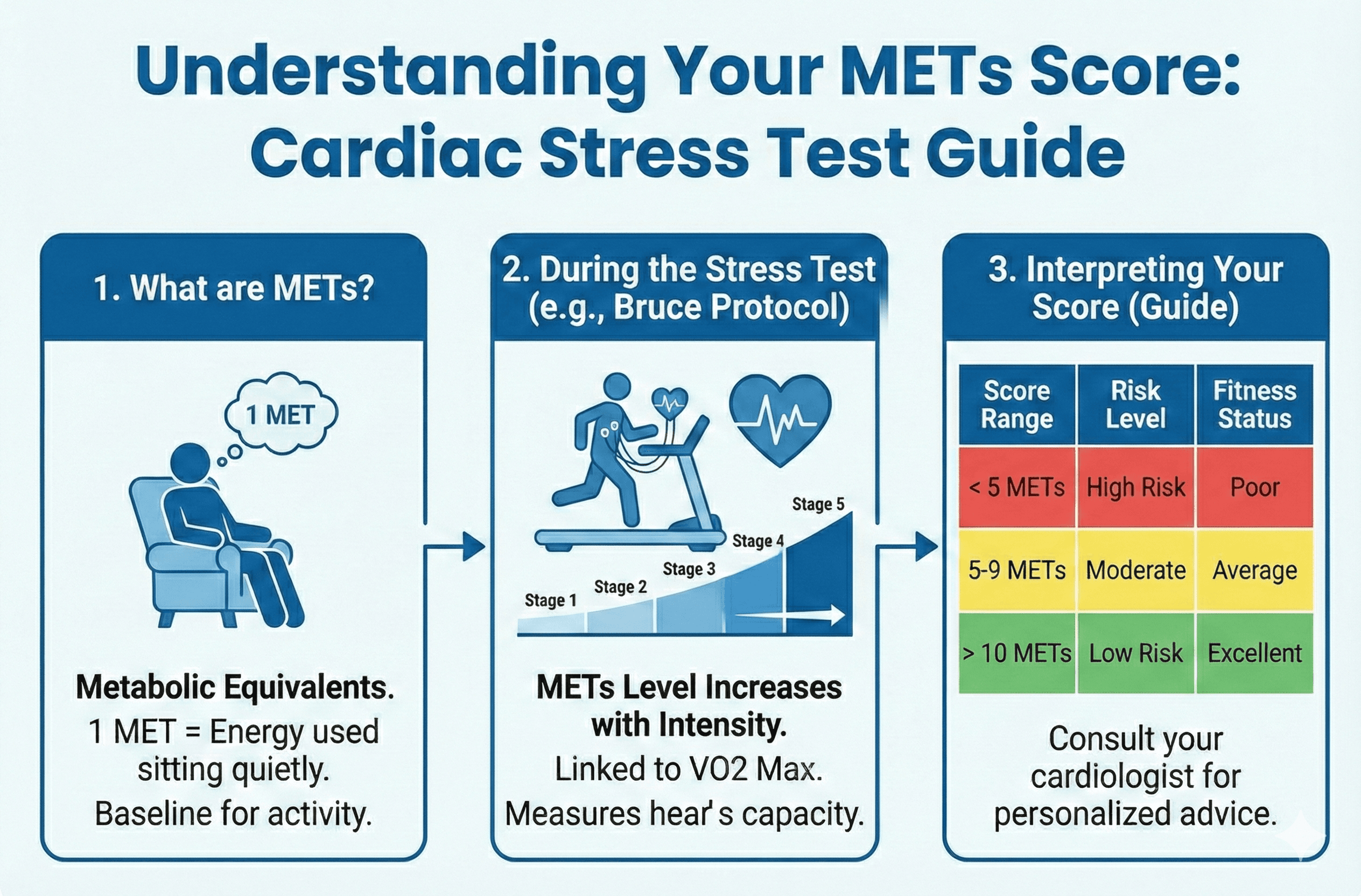
A Metabolic Equivalent of Task (MET) is a unit that measures how much oxygen your body uses during physical activity compared to when you are sitting perfectly still. According to the National Institutes of Health (NIH), one MET equals the amount of oxygen you consume at rest, roughly 3.5 milliliters of oxygen per kilogram of body weight per minute.
When your heart is healthy, it efficiently pumps oxygen-rich blood to your muscles during physical exertion. The more intense the activity, the more oxygen your body demands, and the more METs are required.
What Happens During the Test? During a cardiac stress test, your doctor is evaluating your "peak functional capacity." Here is what you can expect:
- The Setup: You will be connected to an EKG (electrocardiogram) monitor with electrodes to track your heart rhythm. You will also wear a blood pressure cuff, and occasionally a mask to measure your oxygen consumption directly.
- The Baseline: The test usually begins on a treadmill or stationary bike at a very easy pace, about 2 to 3 METs, which is equivalent to slow walking.
- The Progression: Every few minutes, the speed and incline increase. Your medical team carefully watches your heart rate, blood pressure, and EKG rhythm.
- The Peak: The test continues (typically lasting 8 to 12 minutes) until you reach a target heart rate, experience symptoms like chest pain or shortness of breath, or show concerning changes on your EKG monitor.
The highest intensity level you can safely achieve before stopping is your final METs score. This number provides a literal window into how well your heart performs when pushed to its limits.
ACT 2: WHAT DIFFERENT METs LEVELS MEAN FOR DAILY ACTIVITY TOLERANCE
A number on a medical chart is abstract, but your daily activity tolerance is very real. Here is what your METs score actually translates to in your everyday life.
The METs Scale Breakdown
- Less than 5 METs (Poor Functional Capacity): At this level, your cardiovascular system struggles with basic exertion. Activities like walking up a flight of stairs, carrying heavy groceries, or doing light housework may cause significant fatigue or shortness of breath. Patients in this range have a significantly higher cardiovascular risk and often qualify for supervised cardiac rehabilitation programs.
- 5 to 8 METs (Moderate Functional Capacity): You can comfortably handle most routine, daily activities. You can climb stairs, do moderate yard work, and keep up with grandchildren. However, vigorous exercises like jogging or playing competitive sports might be too challenging.
- Above 8 METs (Good to Excellent Capacity): You have a strong functional capacity. You can perform vigorous physical activities, such as running, swimming laps, or heavy physical labor, without significant cardiac limitation.
Daily Activities and Their MET Equivalents
To put this into perspective, the Centers for Disease Control and Prevention (CDC) uses METs to classify the intensity of physical activities. Here is a quick reference guide:
- 2 to 3 METs: Light housework, slow walking, stretching.
- 3.3 METs: Brisk walking (about 3 mph).
- 4 to 5 METs: Climbing a flight of stairs, scrubbing floors.
- 5.5 METs: Mowing the lawn (push mower).
- 8 METs: Jogging (about 5 mph).
- 10+ METs: Running (6 mph or faster), competitive sports.
Note for Veterans: Understanding functional capacity is incredibly important for disability claims. The VA often uses functional capacity (measured in METs) to determine disability ratings for cardiac conditions. A veteran with a documented exercise tolerance of 5 to 7 METs with symptoms may receive a specific rating, whereas an inability to reach 5 METs could result in a much higher disability rating.
ACT 3: HOW CARDIAC METABOLIC TESTING INFLUENCES TREATMENT DECISIONS
Your peak functional capacity does much more than tell a doctor how fit you are. It directly influences major medical decisions, determining whether you need invasive procedures, medication adjustments, or lifestyle interventions.
1. Risk Stratification Patients who achieve fewer than 5 METs generally face a higher risk for cardiac events. If you score well above that threshold, your prognosis is generally much stronger, even if you have underlying heart disease.
2. Surgical Interventions vs. Lifestyle Changes METs testing is crucial for evaluating blockages. If a patient experiences severe chest pain and EKG changes at just 3 METs, a cardiologist might aggressively pursue interventions like stents or bypass surgery. However, if a patient has a known blockage but reaches 7 or 8 METs with only mild symptoms, it suggests the blockage isn't severely limiting blood flow during activity. In these cases, doctors often start with medical therapy and lifestyle changes.
3. Surgical Clearance If you need a non-cardiac surgery (like a knee replacement or gallbladder removal), your METs score determines your surgical risk. If you cannot achieve at least 4 METs, you are considered at high risk for perioperative complications, and your doctor may require enhanced monitoring or cardiac optimization before clearing you for the operating room.
4. Cardiac Rehabilitation The most encouraging aspect of a METs score is that it is not permanent. With a structured cardiac rehabilitation program, medication optimization, and dedicated lifestyle changes, many patients improve their functional capacity. Studies show that improving your peak capacity by just 1 to 2 METs drastically reduces your risk of future cardiovascular events.
Maryland Trim Clinic (MTC) in Laurel, MD
If your METs score has highlighted a need to improve your cardiovascular fitness, reducing excess weight and addressing underlying metabolic health are often the most effective first steps. At the Maryland Trim Clinic (MTC) in Laurel, MD, patients receive individualized care designed to optimize how their bodies function.
Instead of guessing what your body needs to get stronger, the medical professionals at MTC use advanced metabolic testing and analysis to precisely measure how your body burns energy. Armed with this data, they can build a customized plan for you. Whether you need a comprehensive, doctor-supervised medical weight loss program to take stress off your heart, or guidance on improving your daily energy levels, MTC provides the evidence-based tools necessary to help you increase your functional capacity safely and effectively. You can learn more by visiting Maryland Trim Clinic (MTC).
KEY TAKEAWAYS
- METs measure oxygen consumption: They are a direct, objective indicator of your cardiac functional capacity.
- Under 5 METs is a warning sign: It indicates poor functional capacity and a higher risk for cardiovascular issues, usually requiring medical intervention.
- 5 to 8 METs is moderate: This level is sufficient for daily living and routine tasks, but limits vigorous exercise.
- METs guide major decisions: Cardiologists use this score to recommend medications, surgical procedures, and rehabilitation.
- Your score can improve: Through targeted exercise training, weight management, and lifestyle modifications, you can increase your METs score and protect your heart.
Medical Disclaimer: The information provided in this article is for educational purposes only and does not constitute medical advice. Always consult with a qualified healthcare professional or cardiologist regarding your specific heart health, stress test results, and treatment options.
Frequently Asked Questions
Q: What is a good METs score for my age? A: Normal functional capacity varies widely by age, fitness level, and gender. Generally, healthy adults in their 40s may achieve 12 to 14 METs. Those in their 60s might reach 10 to 12 METs, and adults 70 and older often achieve 8 to 10 METs. Keep in mind that less than 5 METs at any age indicates poor functional capacity and usually requires medical attention.
Q: How is METs testing different from a regular EKG? A: A resting EKG only records your heart's electrical activity while you are sitting still. METs testing (also known as an exercise stress test) monitors your heart while it is under physical stress. This helps doctors see how much actual work your cardiovascular system can perform and often reveals hidden blockages that do not appear on a resting EKG.
Q: Can I improve my METs score after being diagnosed with heart disease? A: Yes. Cardiac rehabilitation programs, structured exercise, weight loss, and medication optimization can significantly improve your score. Many patients increase their capacity by 1 to 3 METs with consistent effort, which dramatically improves their overall quality of life and longevity.
Q: What METs level qualifies for VA disability for heart conditions? A: The VA uses functional capacity to help determine disability ratings. Generally, a workload tolerance of 5 to 7 METs with symptoms may warrant a 30% rating. Reaching only 3 to 5 METs may result in a 60% rating, while a capacity of less than 3 METs often qualifies for 100%. Ratings depend on multiple medical factors, so you should always consult a VA benefits specialist for your specific case.
Q: Why did my doctor order a METs test instead of a cardiac catheterization? A: METs testing is entirely non-invasive and provides a functional assessment of your heart (how it actually performs). Cardiac catheterization is an invasive surgical procedure that looks at anatomic blockages. Doctors prefer to start with a non-invasive stress test to see if your heart is actually struggling to pump blood before subjecting you to the risks of an invasive procedure.
Ready to Improve Your Cardiovascular and Metabolic Health?
If you are ready to take control of your health, optimize your metabolism, and safely improve your functional capacity, the team at Maryland Trim Clinic is here to help. Reach out today to build a personalized, medically sound health strategy. Book Your Consultation at Maryland Trim Clinic Today