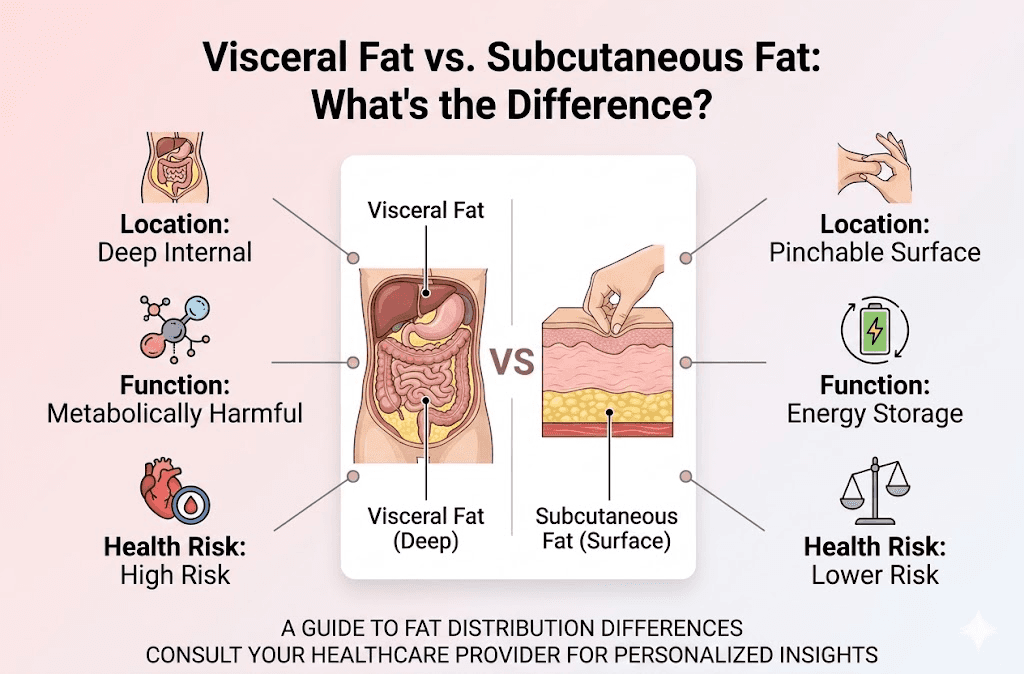
Visceral Fat vs. Subcutaneous Fat: What's the Difference?

Not all belly fat is equal, and treating them the same is exactly why you're stuck.
If you've been cutting calories, doing endless crunches, and watching your diet only to see your waistline refuse to budge, you may be targeting the wrong type of fat entirely. There are two fundamentally distinct categories of body fat that accumulate in the abdominal region. They behave so differently—biologically, hormonally, and metabolically—that the strategies used to address one can be almost completely ineffective against the other.
Understanding this distinction isn't just useful for aesthetics. It could, quite literally, save your life.
ACT 1: The Hidden Enemy — What Visceral Fat Really Is
Two Fats, Two Completely Different Stories
When most people think about belly fat, they're imagining subcutaneous fat—the soft, pinchable layer that sits just beneath the skin. This is the fat you can grab with your fingers. While it can be aesthetically frustrating, it is relatively benign from a medical standpoint.
Visceral fat, on the other hand, is a completely different beast. It sits deep inside the abdominal cavity, packed around your internal organs (specifically the liver, pancreas, intestines, and kidneys). You cannot see it, feel it from the outside, or measure it with a standard bathroom scale.
A person can appear relatively slim on the outside while carrying a dangerous amount of visceral fat internally. This phenomenon, known as TOFI (Thin Outside, Fat Inside), frequently goes undetected until serious health consequences emerge.
The Medical Consequences Go Far Beyond Appearance
The medical community has identified excess visceral fat as an independent risk factor for a staggering array of serious conditions. According to the Centers for Disease Control and Prevention (CDC), obesity and the accumulation of deep abdominal fat are primary drivers of metabolic syndrome.
- Type 2 diabetes: Visceral fat impairs insulin signaling, driving insulin resistance at the cellular level.
- Cardiovascular disease: It promotes arterial inflammation and elevates LDL ("bad") cholesterol.
- Non-alcoholic fatty liver disease (NAFLD): Visceral fat can embed directly into liver tissue.
- Hypertension: Fat deposits release compounds that raise blood pressure.
- Certain cancers & cognitive decline: Elevated visceral fat is associated with higher rates of colorectal cancer and increased Alzheimer's risk.
ACT 2: Why Your Diet Isn't Working — The Metabolic Secrets of Visceral Fat
Visceral Fat Is Not Passive Storage
Here is the critical insight most popular diet culture completely ignores: visceral fat is metabolically active. It does not simply sit there as inert stored energy waiting to be burned. It functions like a rogue organ, actively secreting inflammatory molecules and chemical signals that disrupt nearly every major system in your body.
Visceral fat cells produce elevated levels of:
- Cortisol-amplifying enzymes: These increase local stress hormone activity, promoting further fat storage in the belly.
- Interleukin-6 (IL-6) and TNF-alpha: Pro-inflammatory cytokines that promote systemic inflammation.
- Resistin: A hormone that directly impairs insulin sensitivity.
Subcutaneous fat, by contrast, is comparatively metabolically quiet. It stores energy and releases it relatively predictably in response to a caloric deficit.
Why Calorie Restriction Alone Falls Short
Standard calorie-cutting approaches create a generalized energy deficit. The frustrating biological truth is that the body often preferentially burns subcutaneous fat before it meaningfully reduces visceral stores.
This is why you can be dieting faithfully and losing weight on the scale, yet your waist measurement barely changes. You may be losing subcutaneous fat, water weight, and even muscle mass while the metabolically dangerous visceral layer remains stubbornly in place.
The Stress-Sleep-Visceral Fat Triangle
One of the most underappreciated drivers of visceral fat has nothing to do with food. Chronic stress and sleep deprivation are among the most potent promoters of visceral fat.
Elevated cortisol (the primary stress hormone) directly stimulates visceral fat deposition through receptors that are highly concentrated in deep abdominal fat. Meanwhile, sleep deprivation of even modest severity has been shown to significantly increase visceral fat accumulation within weeks, independent of caloric intake.
ACT 3: The Right Tools for the Right Fat — Evidence-Based Interventions
Because visceral fat operates through distinct biological mechanisms, it requires targeted strategies.
1. High-Intensity Interval Training (HIIT) and Aerobic Exercise
Of all lifestyle interventions studied, aerobic exercise—particularly at moderate-to-high intensity—is the single most effective non-pharmacological tool for visceral fat reduction. HIIT is particularly potent because it triggers a prolonged post-exercise metabolic elevation that preferentially draws from visceral stores. Combining this with muscle building and toning (resistance training) produces superior results by preserving your metabolic rate.
2. Dietary Composition Over Caloric Restriction
Rather than simply eating less, what you eat matters enormously for visceral fat:
- Reduce refined carbohydrates: These drive insulin spikes that directly stimulate visceral fat storage.
- Increase soluble fiber: Found in oats and legumes, fiber reduces visceral fat through mechanisms tied to gut microbiome health.
- Prioritize protein: Higher protein intake keeps insulin in a healthier range and promotes satiety.
3. Medical and Pharmacological Options
For individuals with clinically significant visceral adiposity, medical interventions are highly effective. Tools like metabolic testing and analysis can pinpoint the exact nature of your fat distribution.
- GLP-1 receptor agonists: Medications like semaglutide (Ozempic, Wegovy) and tirzepatide (Mounjaro, Zepbound) have demonstrated substantial visceral fat reduction in clinical trials by specifically addressing the hormonal environment that sustains these deposits.
- Hormone Optimization: Hormonal imbalances—such as low testosterone in men or estrogen dominance in women—can drive preferential visceral fat accumulation.
What Works for Subcutaneous Fat (But Not Visceral)
Subcutaneous fat responds more predictably to conventional approaches: sustained caloric deficit and moderate exercise. Cosmetic procedures like cryolipolysis (CoolSculpting) and liposuction can physically remove subcutaneous fat deposits.
However, if you are utilizing targeted targeted fat reduction therapies or non-invasive body contouring, understand that these address the layer you can pinch, not the visceral layer wrapped around your organs.
Maryland Trim Clinic (MTC) in Laurel, MD
Determining exactly what kind of fat you are fighting—and building a strategy to defeat it—requires precision medical insight, not guesswork. Located in Laurel, MD, the Maryland Trim Clinic (MTC) provides the advanced diagnostics and comprehensive therapies necessary to tackle both visceral and subcutaneous fat effectively.
At MTC, we understand that stubborn belly fat is often a symptom of deeper metabolic or hormonal issues. When you enroll in a customized medical weight loss program, our clinical team looks beyond the scale. We utilize tools like 3D body scanning to accurately assess your fat distribution. From there, we can deploy the right interventions—whether that involves prescribing targeted GLP-1 weight loss injections to address visceral fat, exploring hormone replacement therapy to correct imbalances, or providing nutritional counseling and coaching to lower systemic inflammation. MTC ensures you are fighting the right battle with the right tools.
The Bottom Line
Visceral fat and subcutaneous fat are not the same problem. They occupy different anatomical spaces, carry profoundly different health consequences, and respond to different interventions. Treating them identically is one of the primary reasons so many health-conscious adults see no meaningful change in their abdominal profile despite genuine effort.
Identify which type of fat is your primary challenge, then deploy the specific tools that address its unique biology. For visceral fat, that means strategic aerobic exercise, dietary composition changes, sleep optimization, and medically guided pharmacological support.
Your belly isn't failing to respond because you're not working hard enough. It's failing to respond because you may be working hard at the wrong problem.
Medical Disclaimer: The information provided in this article is for educational purposes only and is not intended as a substitute for professional medical advice, diagnosis, or treatment. Always seek the advice of your physician regarding a medical condition, treatment options, or before altering your prescribed health routine.
Frequently Asked Questions
Q: How can I tell if I have visceral fat versus subcutaneous fat? A: The simplest at-home indicator is waist circumference: above 35 inches for women or 40 inches for men suggests elevated visceral fat. A firm, protruding belly that doesn't 'give' when pressed is characteristic of visceral fat, whereas soft, pinchable fat is typically subcutaneous.
Q: Can I lose visceral fat without losing overall weight? A: Yes. Studies show that aerobic exercise reduces visceral fat even when the scale doesn't move significantly. Dietary changes that lower insulin levels can also specifically target visceral fat stores. Waist measurement is a far more meaningful indicator of visceral fat loss than scale weight.
Q: Why does stress make visceral fat worse specifically? A: Visceral fat cells have a much higher concentration of cortisol (stress hormone) receptors than subcutaneous fat cells. When cortisol levels are chronically elevated, these receptors actively signal the body to deposit and retain fat specifically in the deep abdominal region.
Q: Does liposuction or CoolSculpting remove visceral fat? A: No. These cosmetic procedures only target subcutaneous fat. They physically cannot reach or address visceral fat, which sits deep inside the abdominal cavity around the organs.
Q: Is visceral fat reversible? A: Yes, highly so. Because it is metabolically active, it mobilizes relatively quickly in response to consistent aerobic exercise, dietary changes targeting insulin, improved sleep, and stress reduction.
Q: Are medications like Ozempic effective specifically against visceral fat? A: Clinical evidence is increasingly compelling. According to the National Institutes of Health (NIH), GLP-1 receptor agonists like semaglutide (Ozempic, Wegovy) improve insulin sensitivity and hormonal signaling, showing specific efficacy in reducing visceral adiposity beyond general caloric reduction.
Ready to Finally Lose That Stubborn Belly Fat?
Stop guessing and start utilizing science to reshape your body. Visit the Maryland Trim Clinic homepage today to schedule a comprehensive body composition analysis and consultation. Our expert medical team in Laurel, MD, will help you identify exactly what's holding you back and build a customized plan to fix it.